AdPlexity Social vs. AdSpy: Which Ad Intelligence Tool Wins for Performance Marketers in 2026

Share:
AdSpy has name recognition. It was one of the first ad spy tools on the market. Performance marketers used it for years before alternatives existed.
But the way ads run on Meta has changed. The way performance marketers research, save, and act on ad intelligence has changed too. AdSpy has not kept up.
If you run paid social, manage client campaigns, or scale affiliate offers, here is what you actually need now. You need fresh data. Filters that match how Meta delivers ads in 2026. Visibility into what happens after the click. And a workflow that does not feel like using a 2017 SaaS dashboard.
This article compares AdPlexity Social and AdSpy on the eight dimensions that matter most for performance marketers.
TL;DR
Best overall for performance marketers: AdPlexity Social
Best for legacy users with existing AdSpy workflows: AdSpy
AdPlexity Social wins on data freshness, filter depth, landing page intelligence, multi-dimension search, and modern workflow. AdSpy is a recognizable name with a large historical archive but lags on every workflow and intelligence dimension that matters for active campaigns.
Tools at a Glance
Rank | Tool | Best For | Starting Price | Full-Funnel Coverage |
1 | AdPlexity Social | Performance marketers, media buyers, affiliates, agencies | $99/mo | Ads, domains, landing pages, redirect chains, Boards |
2 | AdSpy | Legacy users, basic Facebook ad search | $149/mo | Ads only |
Data Freshness and Index Volume
AdPlexity Social indexes 15M+ new Meta ads per month. The total database sits at 100M+ ads and grew to that size in under a year. That is the freshness curve performance marketers need when scouting active campaigns.
AdSpy claims a large historical archive but the rate of new ad ingestion is significantly slower. If you are searching for what is running this week, the gap shows up immediately. Ads from active competitors take longer to surface, and the system skews toward older campaigns that may already be paused.
For a performance marketer, fresh data is not a nice-to-have. It is the entire point. An ad that ran six months ago tells you what worked in a different market environment. An ad that has been running for the last 30 days tells you what is winning right now.
Filter Depth
This is where the gap between the two tools becomes the most obvious.
AdSpy offers a basic filter set: keywords, country, ad type, advertiser, and a few standard parameters. It is the same filter logic that shipped years ago.
AdPlexity Social offers filtering across every layer of the funnel.
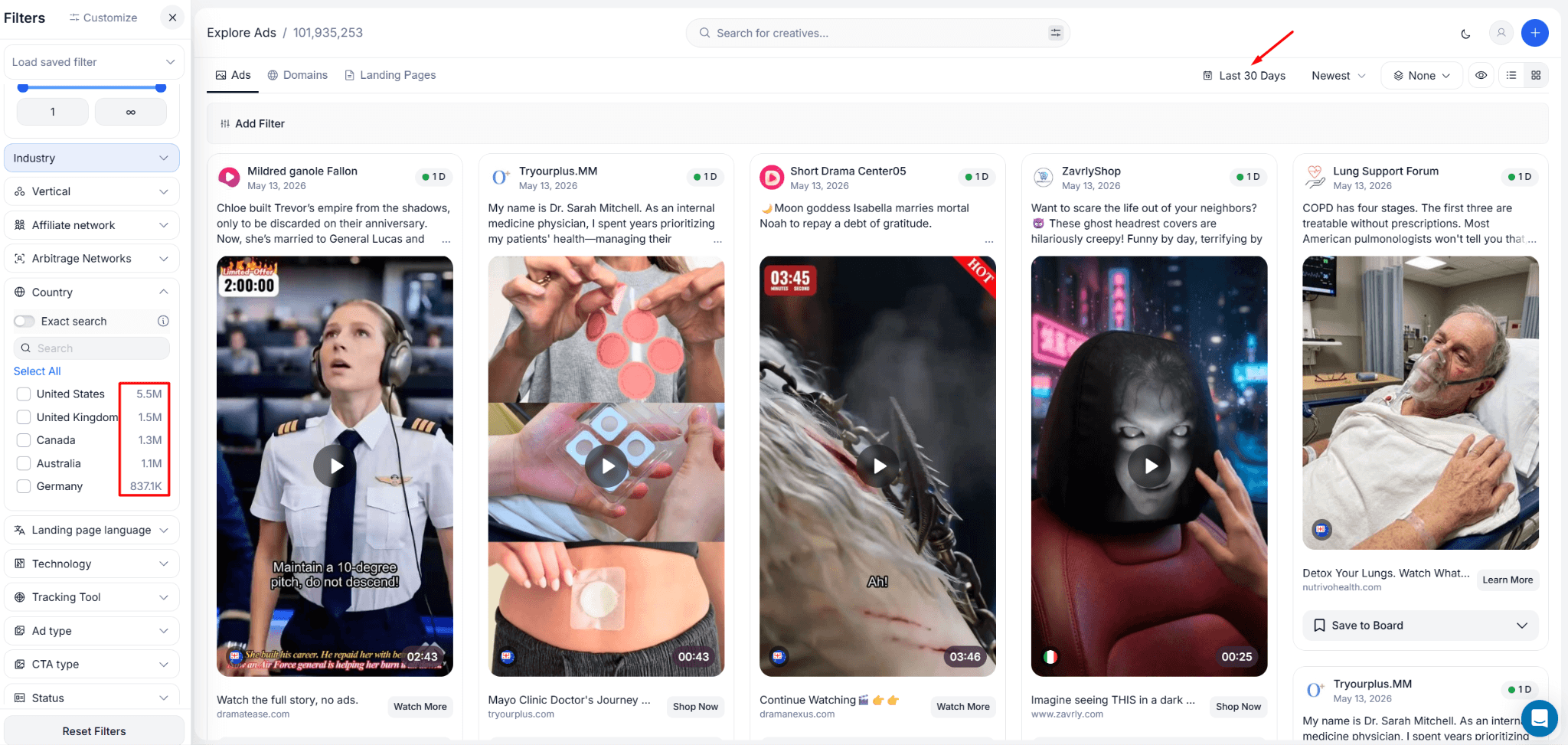
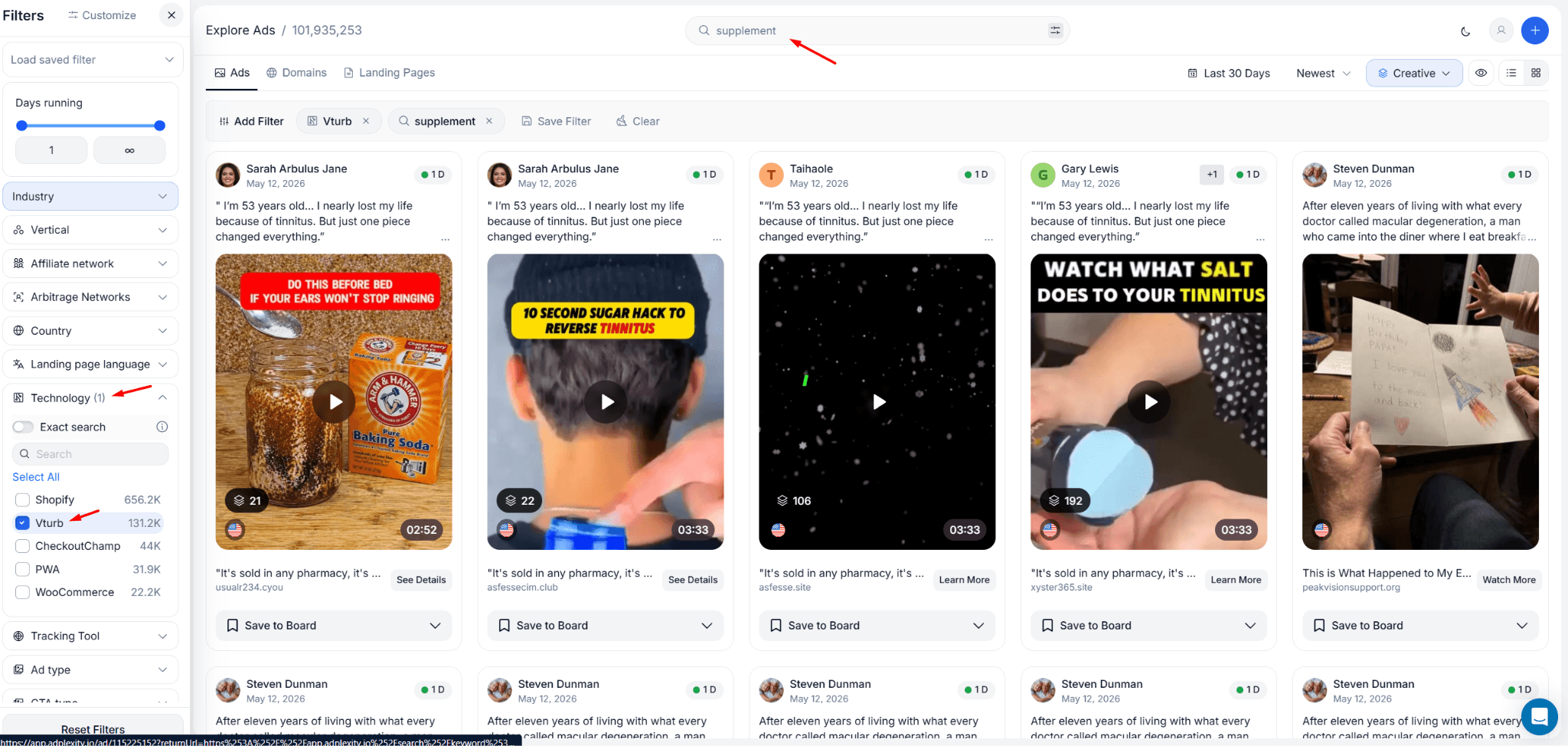
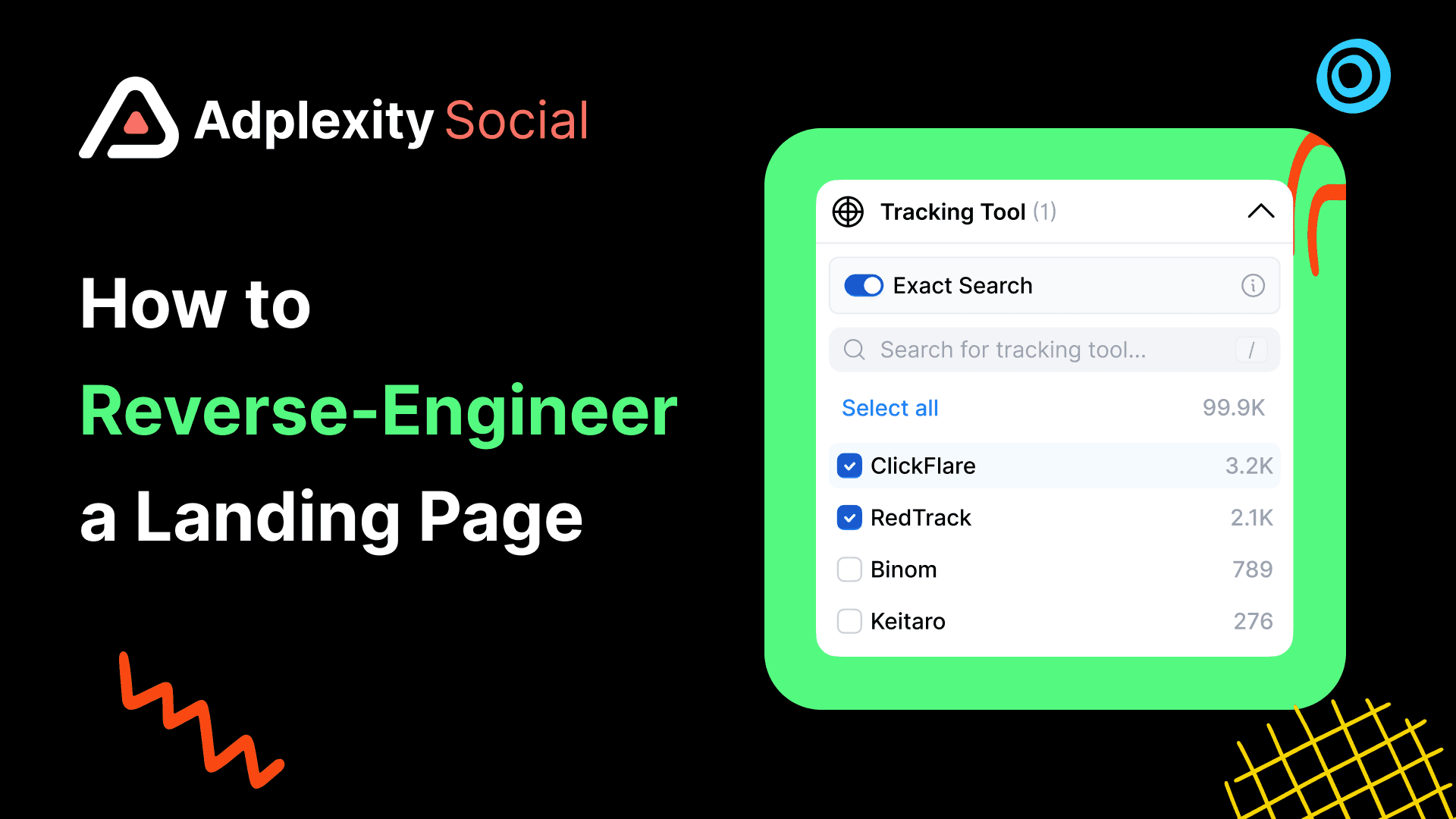
You can filter by technology stack: Shopify, ClickFunnels, TrustedForm, Ringba, VTurb, Lead Connector, Jornaya, and others. This is how you isolate a specific advertiser type. Want to find only ecom brands running Shopify? One filter. Want only VSL funnels running VTurb? One filter.
You can filter by affiliate network: ClickBank, BuyGoods, Digistore24, GiddyUp, and more. This is how you find affiliate offers other tools cannot detect because they only read the ad copy and not the redirect chain.
You can filter by vertical sub-niche: Weight Loss, Diabetes, ED, Dental, Skin, and dozens more.
You can filter by longevity: ads running 30, 60, 90+ days. This is how you separate tested winners from experiments.
And you can stack any of these filters on top of each other in a single search.
Practical example: Searching the keyword "supplement" while filtering by VTurb in the tech stack filter immediately surfaces the VSL funnels that are currently running in the supplement vertical. You are looking at a list of advertiser types most ad spy tools cannot identify at all, because identifying them requires crawling the destination page and detecting the video player technology.
That kind of search is structurally impossible in AdSpy.
Landing Page Indexing
AdSpy shows you the ad. That is where its visibility ends.
AdPlexity Social indexes the full landing page copy and crawls the entire redirect chain end to end. That includes outgoing URLs, tracking domains, parameters, and the final destination.
This matters in two ways.
First, you can search for keywords that appear on landing pages, not just on ads. An advertiser may not mention "GLP-1" in their ad copy but their pre-lander leads to it. AdPlexity Social finds them. AdSpy does not.
Second, the redirect chain reveals affiliate offers that are hidden behind pre-landers. If a media buyer is running an affiliate offer through a custom advertorial, the ad copy gives you nothing. The redirect chain gives you the offer, the network, and the tracking setup.
For affiliate marketers, this is the single most important capability in any ad intelligence tool.
Multi-Dimension Search
AdSpy is a single-dimension tool. You search ads. That is it.
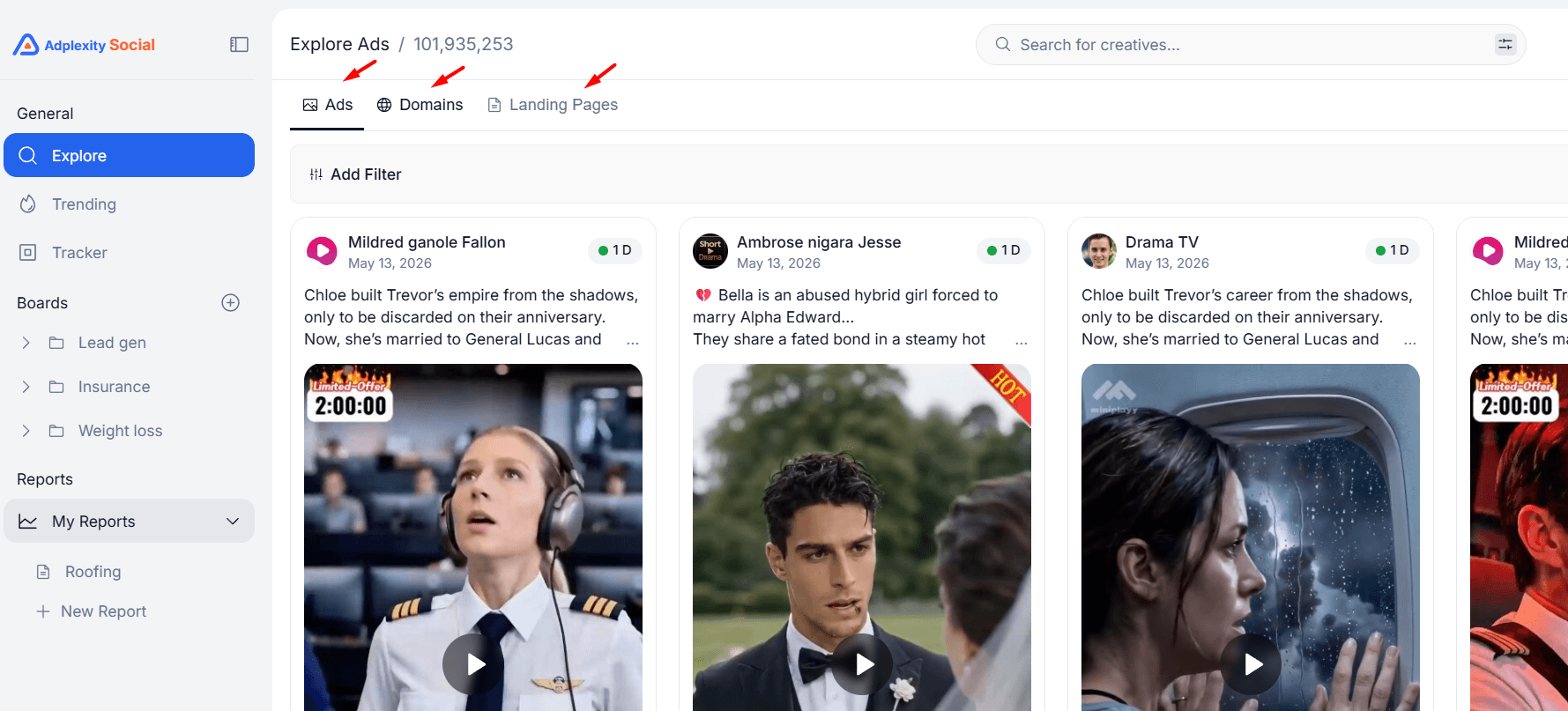
AdPlexity Social separates ad intelligence into three searchable dimensions: Ads, Domains, and Landing Pages.
Search by domain and you see every ad pointing to that domain regardless of which fan page or profile is running it. This is critical because performance marketers often run the same offer across multiple advertiser accounts. Single-dimension tools fragment that activity. AdPlexity Social aggregates it.
Search by landing page and you find creative angles by destination URL, which is how you reverse-engineer a competitor's funnel structure.
Boards: The Workflow Difference
Every ad spy tool lets you save ads. None of them save like Boards.
AdSpy lets you save ad creatives. That is the full extent of its saved-collection feature.
AdPlexity Social Boards lets you save three element types in the same folder structure: ads, domains, and Facebook pages or profiles. You can organize them by client, vertical, campaign concept, or any structure that fits your workflow. Boards can be shared via public URL with control over which element types are visible to viewers.
For agency teams, this is the difference between sending a screenshot deck to a client and sharing a live, organized intelligence Board.
For solo affiliates and media buyers, this is the difference between rebuilding your research every week and having a continuously evolving library that scales with you.
Interface and Workflow
AdSpy was built for a different era of ad research. The interface reflects that.
AdPlexity Social's new interface, shipped in April 2026, was rebuilt around how performance marketers actually work. Left sidebar navigation. Customizable filter bar where you choose which filters to display and save your defaults. Tabbed ad detail view with landing pages in a dedicated tab. Domain details modal with period-over-period analytics. Instant ad copy translation across 14 markets. Video hook extraction on demand.
These are not cosmetic upgrades. They cut the time between starting a search and acting on what you find.
Pricing
AdPlexity Social: $99/month, $950/year (20% off), $49/month per extra seat.
AdSpy: $149/month with no annual discount and no equivalent multi-seat structure.
For a more capable tool at a lower price, the math is straightforward.
Where AdSpy Still Has a Place
If you have an existing AdSpy workflow, an established team trained on the interface, and your research needs are limited to basic Facebook ad keyword search, AdSpy can still get the job done.
That is the legitimate use case.
But for any team running active campaigns, evaluating funnels, scouting affiliate offers, or building competitive intelligence systems, AdSpy is missing the capabilities that matter most.
Frequently Asked Questions
Is AdPlexity Social better than AdSpy for affiliate marketing?
For affiliate marketing specifically, AdPlexity Social is significantly more capable. The redirect chain crawling and dedicated affiliate network filters surface offers behind pre-landers, which AdSpy cannot detect because it only reads ad copy. Affiliate marketers running ClickBank, BuyGoods, Digistore24, or GiddyUp offers will find AdPlexity Social pulls campaigns AdSpy never sees.
How fresh is the data in AdPlexity Social compared to AdSpy?
AdPlexity Social indexes 15M+ new Meta ads per month. The total database reached 100M+ ads in under a year. AdSpy has a large historical archive but ingests new ads at a slower rate, which means active campaigns surface later and the dataset skews older.
Can AdSpy show landing page content like AdPlexity Social does?
No. AdSpy shows the ad creative and copy, but does not index landing pages or crawl redirect chains. AdPlexity Social indexes full landing page copy and crawls the entire URL chain end to end, including tracking domains, redirects, and outgoing URLs.
Does AdSpy have a feature equivalent to AdPlexity Social Boards?
No. AdSpy lets you save ad creatives but does not support saving domains or Facebook pages alongside them. AdPlexity Social Boards lets you save ads, domains, and pages in the same folder, organize them across clients or campaigns, and share Boards via public URL with element-type visibility controls.
Which tool has more advanced filtering for performance marketers?
AdPlexity Social. The filter set covers technology stack, affiliate network, vertical sub-niche, longevity, impression tier, and country, all stackable in a single search. AdSpy's filters are limited to basic keyword, country, ad type, and advertiser parameters. The depth gap is the single biggest functional difference between the two tools.
How much does AdPlexity Social cost compared to AdSpy?
AdPlexity Social is $99 per month or $950 per year, with extra seats at $49 per month. AdSpy is $149 per month with no annual discount. AdPlexity Social is roughly 33% less expensive with significantly broader capabilities.
Is AdSpy still a good choice in 2026?
AdSpy can still serve teams with established workflows and basic Facebook ad search needs. But for performance marketers researching active campaigns, evaluating funnels, or building competitive intelligence systems, the missing capabilities (landing page indexing, redirect chain crawling, multi-dimension search, modern workflow) make it a weaker choice than purpose-built alternatives.
Bottom Line
AdSpy is a recognizable name with a place in basic ad research workflows.
For everything performance marketers actually need in 2026, AdPlexity Social is the stronger choice.
Fresh data at 15M ads per month. Filters across tech stack, affiliate networks, verticals, longevity. Landing page indexing and redirect chain crawling. Multi-dimension search across ads, domains, and pages. Boards that actually fit how teams work.
At $99 per month, the gap between price and capability has never been clearer. Sign up at adplexity.io to see active campaigns AdSpy will not show you.
AdSpy has name recognition. It was one of the first ad spy tools on the market. Performance marketers used it for years before alternatives existed.
But the way ads run on Meta has changed. The way performance marketers research, save, and act on ad intelligence has changed too. AdSpy has not kept up.
If you run paid social, manage client campaigns, or scale affiliate offers, here is what you actually need now. You need fresh data. Filters that match how Meta delivers ads in 2026. Visibility into what happens after the click. And a workflow that does not feel like using a 2017 SaaS dashboard.
This article compares AdPlexity Social and AdSpy on the eight dimensions that matter most for performance marketers.
TL;DR
Best overall for performance marketers: AdPlexity Social
Best for legacy users with existing AdSpy workflows: AdSpy
AdPlexity Social wins on data freshness, filter depth, landing page intelligence, multi-dimension search, and modern workflow. AdSpy is a recognizable name with a large historical archive but lags on every workflow and intelligence dimension that matters for active campaigns.
Tools at a Glance
Rank | Tool | Best For | Starting Price | Full-Funnel Coverage |
1 | AdPlexity Social | Performance marketers, media buyers, affiliates, agencies | $99/mo | Ads, domains, landing pages, redirect chains, Boards |
2 | AdSpy | Legacy users, basic Facebook ad search | $149/mo | Ads only |
Data Freshness and Index Volume
AdPlexity Social indexes 15M+ new Meta ads per month. The total database sits at 100M+ ads and grew to that size in under a year. That is the freshness curve performance marketers need when scouting active campaigns.
AdSpy claims a large historical archive but the rate of new ad ingestion is significantly slower. If you are searching for what is running this week, the gap shows up immediately. Ads from active competitors take longer to surface, and the system skews toward older campaigns that may already be paused.
For a performance marketer, fresh data is not a nice-to-have. It is the entire point. An ad that ran six months ago tells you what worked in a different market environment. An ad that has been running for the last 30 days tells you what is winning right now.
Filter Depth
This is where the gap between the two tools becomes the most obvious.
AdSpy offers a basic filter set: keywords, country, ad type, advertiser, and a few standard parameters. It is the same filter logic that shipped years ago.
AdPlexity Social offers filtering across every layer of the funnel.
You can filter by technology stack: Shopify, ClickFunnels, TrustedForm, Ringba, VTurb, Lead Connector, Jornaya, and others. This is how you isolate a specific advertiser type. Want to find only ecom brands running Shopify? One filter. Want only VSL funnels running VTurb? One filter.
You can filter by affiliate network: ClickBank, BuyGoods, Digistore24, GiddyUp, and more. This is how you find affiliate offers other tools cannot detect because they only read the ad copy and not the redirect chain.
You can filter by vertical sub-niche: Weight Loss, Diabetes, ED, Dental, Skin, and dozens more.
You can filter by longevity: ads running 30, 60, 90+ days. This is how you separate tested winners from experiments.
And you can stack any of these filters on top of each other in a single search.
Practical example: Searching the keyword "supplement" while filtering by VTurb in the tech stack filter immediately surfaces the VSL funnels that are currently running in the supplement vertical. You are looking at a list of advertiser types most ad spy tools cannot identify at all, because identifying them requires crawling the destination page and detecting the video player technology.
That kind of search is structurally impossible in AdSpy.
Landing Page Indexing
AdSpy shows you the ad. That is where its visibility ends.
AdPlexity Social indexes the full landing page copy and crawls the entire redirect chain end to end. That includes outgoing URLs, tracking domains, parameters, and the final destination.
This matters in two ways.
First, you can search for keywords that appear on landing pages, not just on ads. An advertiser may not mention "GLP-1" in their ad copy but their pre-lander leads to it. AdPlexity Social finds them. AdSpy does not.
Second, the redirect chain reveals affiliate offers that are hidden behind pre-landers. If a media buyer is running an affiliate offer through a custom advertorial, the ad copy gives you nothing. The redirect chain gives you the offer, the network, and the tracking setup.
For affiliate marketers, this is the single most important capability in any ad intelligence tool.
Multi-Dimension Search
AdSpy is a single-dimension tool. You search ads. That is it.
AdPlexity Social separates ad intelligence into three searchable dimensions: Ads, Domains, and Landing Pages.
Search by domain and you see every ad pointing to that domain regardless of which fan page or profile is running it. This is critical because performance marketers often run the same offer across multiple advertiser accounts. Single-dimension tools fragment that activity. AdPlexity Social aggregates it.
Search by landing page and you find creative angles by destination URL, which is how you reverse-engineer a competitor's funnel structure.
Boards: The Workflow Difference
Every ad spy tool lets you save ads. None of them save like Boards.
AdSpy lets you save ad creatives. That is the full extent of its saved-collection feature.
AdPlexity Social Boards lets you save three element types in the same folder structure: ads, domains, and Facebook pages or profiles. You can organize them by client, vertical, campaign concept, or any structure that fits your workflow. Boards can be shared via public URL with control over which element types are visible to viewers.
For agency teams, this is the difference between sending a screenshot deck to a client and sharing a live, organized intelligence Board.
For solo affiliates and media buyers, this is the difference between rebuilding your research every week and having a continuously evolving library that scales with you.
Interface and Workflow
AdSpy was built for a different era of ad research. The interface reflects that.
AdPlexity Social's new interface, shipped in April 2026, was rebuilt around how performance marketers actually work. Left sidebar navigation. Customizable filter bar where you choose which filters to display and save your defaults. Tabbed ad detail view with landing pages in a dedicated tab. Domain details modal with period-over-period analytics. Instant ad copy translation across 14 markets. Video hook extraction on demand.
These are not cosmetic upgrades. They cut the time between starting a search and acting on what you find.
Pricing
AdPlexity Social: $99/month, $950/year (20% off), $49/month per extra seat.
AdSpy: $149/month with no annual discount and no equivalent multi-seat structure.
For a more capable tool at a lower price, the math is straightforward.
Where AdSpy Still Has a Place
If you have an existing AdSpy workflow, an established team trained on the interface, and your research needs are limited to basic Facebook ad keyword search, AdSpy can still get the job done.
That is the legitimate use case.
But for any team running active campaigns, evaluating funnels, scouting affiliate offers, or building competitive intelligence systems, AdSpy is missing the capabilities that matter most.
Frequently Asked Questions
Is AdPlexity Social better than AdSpy for affiliate marketing?
For affiliate marketing specifically, AdPlexity Social is significantly more capable. The redirect chain crawling and dedicated affiliate network filters surface offers behind pre-landers, which AdSpy cannot detect because it only reads ad copy. Affiliate marketers running ClickBank, BuyGoods, Digistore24, or GiddyUp offers will find AdPlexity Social pulls campaigns AdSpy never sees.
How fresh is the data in AdPlexity Social compared to AdSpy?
AdPlexity Social indexes 15M+ new Meta ads per month. The total database reached 100M+ ads in under a year. AdSpy has a large historical archive but ingests new ads at a slower rate, which means active campaigns surface later and the dataset skews older.
Can AdSpy show landing page content like AdPlexity Social does?
No. AdSpy shows the ad creative and copy, but does not index landing pages or crawl redirect chains. AdPlexity Social indexes full landing page copy and crawls the entire URL chain end to end, including tracking domains, redirects, and outgoing URLs.
Does AdSpy have a feature equivalent to AdPlexity Social Boards?
No. AdSpy lets you save ad creatives but does not support saving domains or Facebook pages alongside them. AdPlexity Social Boards lets you save ads, domains, and pages in the same folder, organize them across clients or campaigns, and share Boards via public URL with element-type visibility controls.
Which tool has more advanced filtering for performance marketers?
AdPlexity Social. The filter set covers technology stack, affiliate network, vertical sub-niche, longevity, impression tier, and country, all stackable in a single search. AdSpy's filters are limited to basic keyword, country, ad type, and advertiser parameters. The depth gap is the single biggest functional difference between the two tools.
How much does AdPlexity Social cost compared to AdSpy?
AdPlexity Social is $99 per month or $950 per year, with extra seats at $49 per month. AdSpy is $149 per month with no annual discount. AdPlexity Social is roughly 33% less expensive with significantly broader capabilities.
Is AdSpy still a good choice in 2026?
AdSpy can still serve teams with established workflows and basic Facebook ad search needs. But for performance marketers researching active campaigns, evaluating funnels, or building competitive intelligence systems, the missing capabilities (landing page indexing, redirect chain crawling, multi-dimension search, modern workflow) make it a weaker choice than purpose-built alternatives.
Bottom Line
AdSpy is a recognizable name with a place in basic ad research workflows.
For everything performance marketers actually need in 2026, AdPlexity Social is the stronger choice.
Fresh data at 15M ads per month. Filters across tech stack, affiliate networks, verticals, longevity. Landing page indexing and redirect chain crawling. Multi-dimension search across ads, domains, and pages. Boards that actually fit how teams work.
At $99 per month, the gap between price and capability has never been clearer. Sign up at adplexity.io to see active campaigns AdSpy will not show you.
Table of Contents
Quickly navigate through the key sections of this article.
Discover Winning Meta Ads
Similar Blogs
Check related blogs
Check related blogs
Check related blogs







Ready to See What’s Really Working on Meta?
Adplexity
Social
© Copyright 2026 All Rights Reserved
Ready to See What’s Really Working on Meta?
Adplexity
Social
© Copyright 2026 All Rights Reserved
Ready to See What’s Really Working on Meta?
Adplexity
Social
© Copyright 2026 All Rights Reserved