AdPlexity Social vs. Foreplay: Which Meta Ad Intelligence Tool Actually Wins in 2026?

Share:
Foreplay built the best swipe file on the market.
That is not a throwaway compliment.
If your job is collecting creative inspiration, organizing it by theme, and sharing boards with a team, Foreplay does that job as well as anything in the category.
But saving ads and understanding ads are different things.
And performance marketers need the second one.
If you run paid social for a brand, scale offers as an affiliate, or buy media for lead gen clients, inspiration is the easy part.
The hard part is working out which campaigns are actually profitable, how the funnel is built, which tech stack sits behind it, and whether the creative you are looking at is a one-off test or a winner being deployed at scale.
Foreplay was not built for that question.
AdPlexity Social was.
This comparison walks through how the two tools differ, which features matter for which job, and which one fits the way you actually work.
If you want to see how it stacks up against other options, here is a full breakdown of the best Foreplay alternatives
TL;DR
Best for creative teams and content production workflows: Foreplay
Best for performance marketers, affiliates, and lead gen operators: AdPlexity Social
Foreplay is a creative library with team collaboration features. AdPlexity Social is a competitive intelligence platform built to show you what happens before and after the click.
If your work stops at the creative, Foreplay covers it. If your work starts with the creative, you need AdPlexity Social.
AdPlexity Social vs. Foreplay at a Glance
Capability | AdPlexity Social | Foreplay |
Starting price | $99/month | $59/month (Basic) |
Meta ad database | 100M+ indexed, 15M+ added per month | 186M indexed from the beginning |
Landing page copy indexing | Yes | No |
Tech stack filters | Yes (Shopify, ClickFunnels, TrustedForm, Ringba, VTurb, and more) | No |
Affiliate network filters | Yes (ClickBank, BuyGoods, Digistore24, Giddyup) | No |
Redirect chain crawling | Yes, full path including outgoing URLs | No |
Market-wide creative grouping | Yes, matched across every url in the database | Per fan page only |
Domain-level analytics | Yes, with period-over-period comparison | No |
Vertical sub-niches | Yes (Weight Loss, Diabetes, ED, Dental, Skin, and more) | No |
Longevity filter | Yes, set to any threshold | Limited |
GEO coverage | 14 countries with full breakdown | Multi-country |
Boards | Ads, domains, and Facebook pages/profiles in folders, shareable via public URL | Ads only |
Deleted and inactive ads | Yes | Partial |
Team collaboration features | Basic | Strong |
AI hook extraction | Yes | Partial |
Best for | Performance marketers, affiliates, lead gen, ecom, agencies | Creative strategists, in-house brand teams, content production |
What Foreplay Does Well
Foreplay knows exactly what it is.
It is a creative library with strong collaboration features, built for teams that produce ads rather than teams that buy media.
The swipe file functionality is polished. You can save ads with one click, organize them into boards, tag them by theme or hook or format, and share collections with teammates or clients. The interface is clean and the save workflow is faster than almost anything else in the category.
For a creative strategist building a hook library for the quarter, or an agency compiling reference creative for a new client brief, this is a real workflow advantage.
The team features are genuinely good. Multiple seats, comment threads on saved ads, shared folders, and a tagging system that scales with team size. If your team is passing creative references back and forth all day, Foreplay makes that process smooth.
Pricing starts at $59/month for the Basic plan. Workflow is $175/month, and Agency is $459/month. For a creative team that primarily needs organization and collaboration, the Basic plan covers the core job.
Where Foreplay is the right call:
In-house creative teams building content pipelines
Agencies producing creative briefs and reference decks
Individual creative strategists curating inspiration libraries
Teams whose main bottleneck is coordinating around creative, not researching it
If that describes your workflow, Foreplay is the right tool. The rest of this article will not change that.
Where Foreplay Falls Short for Performance Marketers
Here is where the positioning gets clearer.
Foreplay is built for the person who makes ads. Most people searching for ad intelligence tools are the person who buys ads.
Those are different jobs, and they need different information.
A creative strategist needs hooks, formats, and emotional patterns. That is Foreplay.
A media buyer needs to know which of those ads are actually scaling, which tech stack they use, which affiliate offer sits behind the click, whether the landing page is a VSL or an advertorial or a quiz funnel, and whether the campaign has been running long enough to be profitable.
Foreplay does not surface any of that.
No landing page indexing. You cannot search the actual copy on the destination page, which means you cannot find campaigns based on what they claim or how they pitch. You are stuck searching ad copy only.
No tech stack filters. You cannot isolate advertisers using ClickFunnels, Shopify, Ringba, VTurb, TrustedForm, or any of the tools that signal a structured, revenue-focused funnel. If you want to find every VSL running on Meta right now, Foreplay cannot help you.
No domain-level view. Foreplay organizes around fan pages. But experienced media buyers run the same offer from multiple fan pages to the same domain. If you look at a Foreplay collection organized by advertiser, you see a slice of the operation, not the full picture.
No market-wide creative grouping. Foreplay shows you how many ads a single advertiser is running with a specific creative.
It does not show you how many other advertisers are running the same creative across completely different fan pages and domains.
That distinction matters because when a creative wins, it gets deployed at scale across the market, not just inside one account.
No affiliate network detection. If your work involves finding which affiliate offers are being promoted on Meta, Foreplay has no direct way to do that. You can see the ad, but you cannot filter by ClickBank, BuyGoods, Digistore24, or Giddyup.
No redirect chain crawling. When an ad links to a tracking domain that redirects to an advertorial that redirects to a ClickBank offer, Foreplay shows you the first link and stops. You have to open a browser, click through manually, and trace the path yourself for every single ad you want to understand.
The result is that Foreplay tells you what ads look like. It does not tell you which ones are working, how they are structured, or how to find the ones that matter in your vertical.
For a creative team, that is fine. Inspiration does not need a profit signal attached.
For a performance marketer, that gap is the entire job.
What AdPlexity Social Does Differently
AdPlexity Social was built around a different starting question.
Not "what do the ads look like," but "what is actually working, and how do I find it fast."
The database and the search architecture are both designed around that question.
Three-layer search
Most ad intelligence tools, including Foreplay, search ad copy or brand (Fan Page). AdPlexity Social can search on four places: ad copy, full landing page text, fan page, and the complete URL chain including tracking domains, affiliate parameters, and outgoing URLs.
The landing page layer alone changes what you can find. If you want to see every advertiser promoting a specific offer, you search the offer language on landing pages, not the ad hook. Ad hooks change constantly.
Landing page claims are more stable and more specific.
The URL chain layer is where affiliate and lead gen research gets easier. If you want to know which affiliate network sits behind a campaign, you do not have to manually trace redirects. The tool has already done it.
Market-wide creative grouping
When a creative wins on Meta, it gets deployed across multiple fan pages and multiple domains simultaneously. That is how experienced media buyers scale.
Foreplay shows you how many ads one advertiser is running with a given creative. AdPlexity Social matches that same creative against every other advertiser in the database, regardless of which fan page or domain is running it.
That is the difference between seeing one account's activity and seeing the full market-wide footprint of a winning ad.
Domain-level intelligence
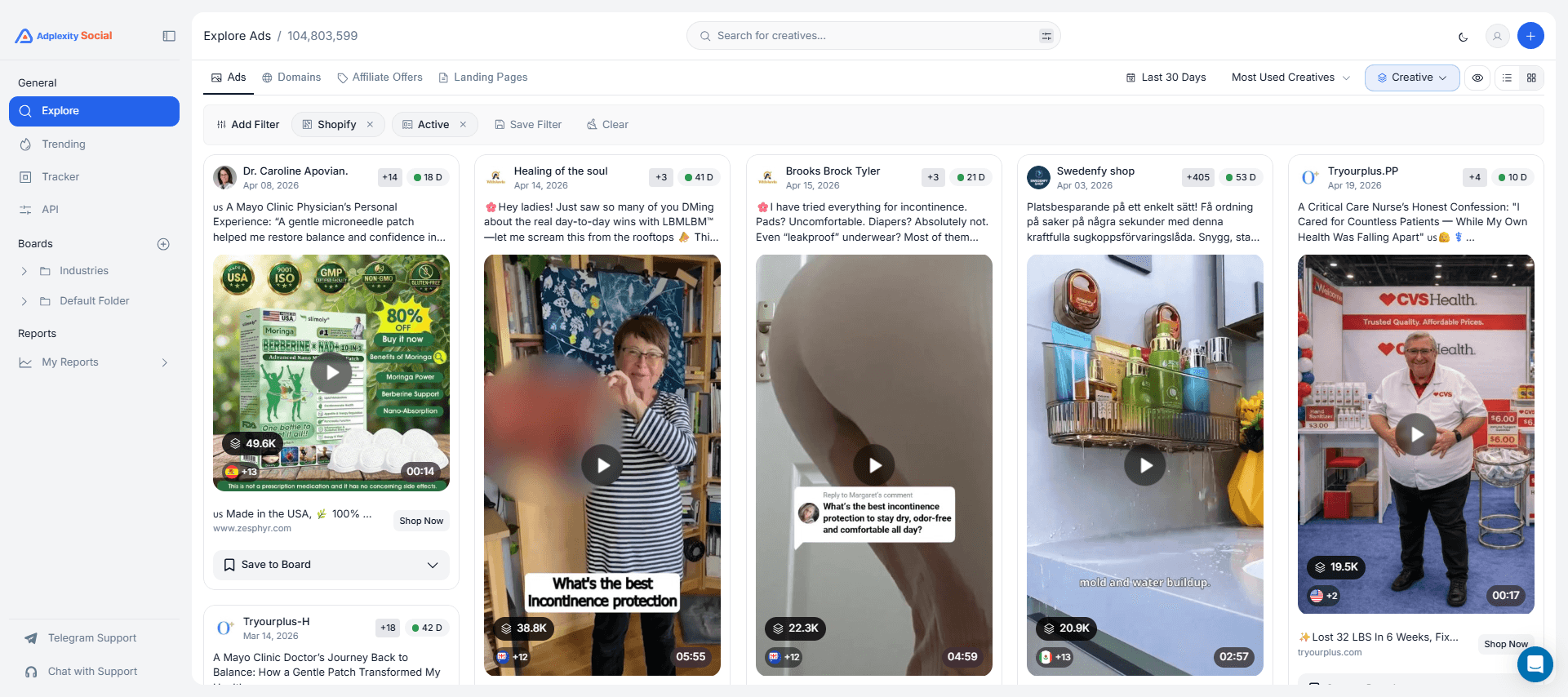
Foreplay indexes fan pages. AdPlexity Social indexes domains.
Pull up any domain in the database, and you see every ad pointing to it, across every fan page and advertiser account running it.
For offers where the same product is being promoted from multiple angles through multiple accounts, this view shows the full operation rather than a fragment.
Domain analytics include period-over-period comparison, so you can track whether a competitor is scaling up, scaling down, or shifting tactics over time.
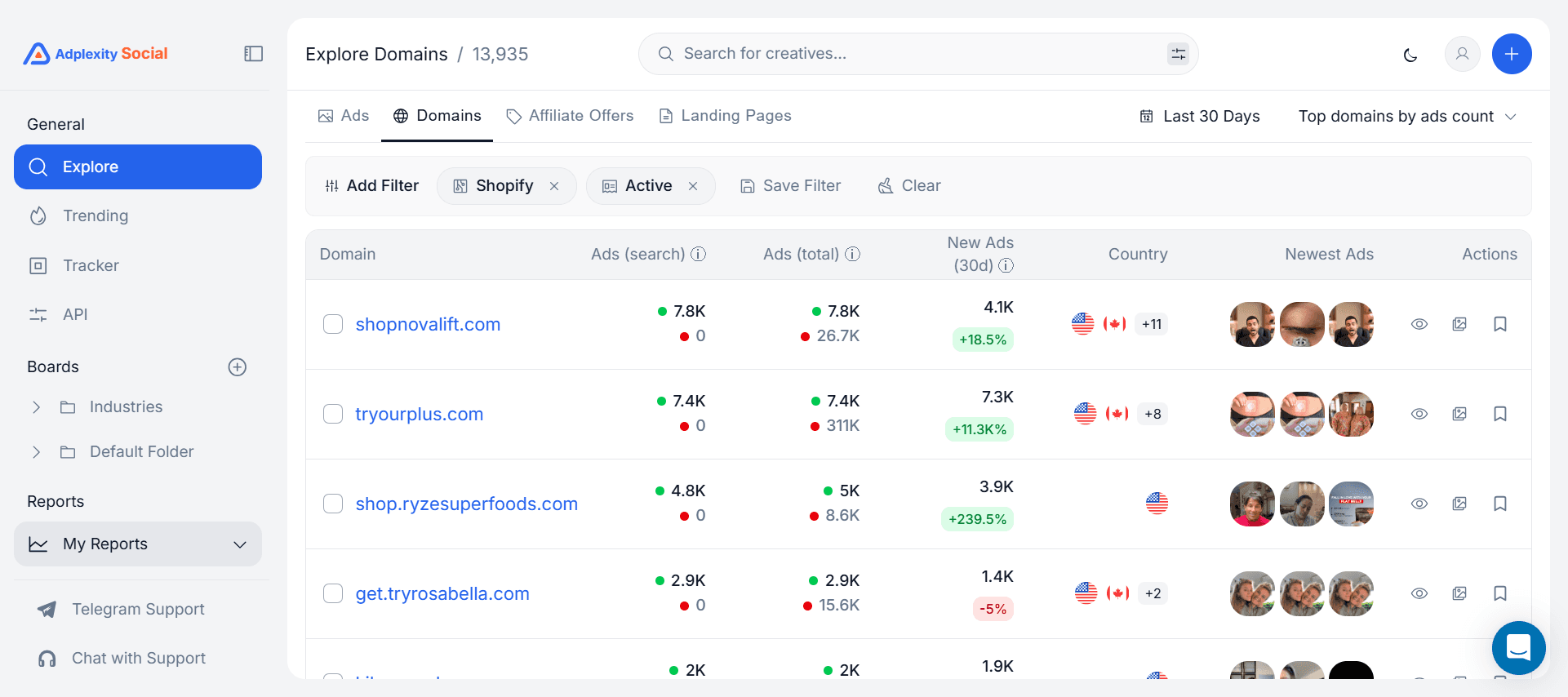
The filter stack
This is where the gap becomes structural rather than incremental.
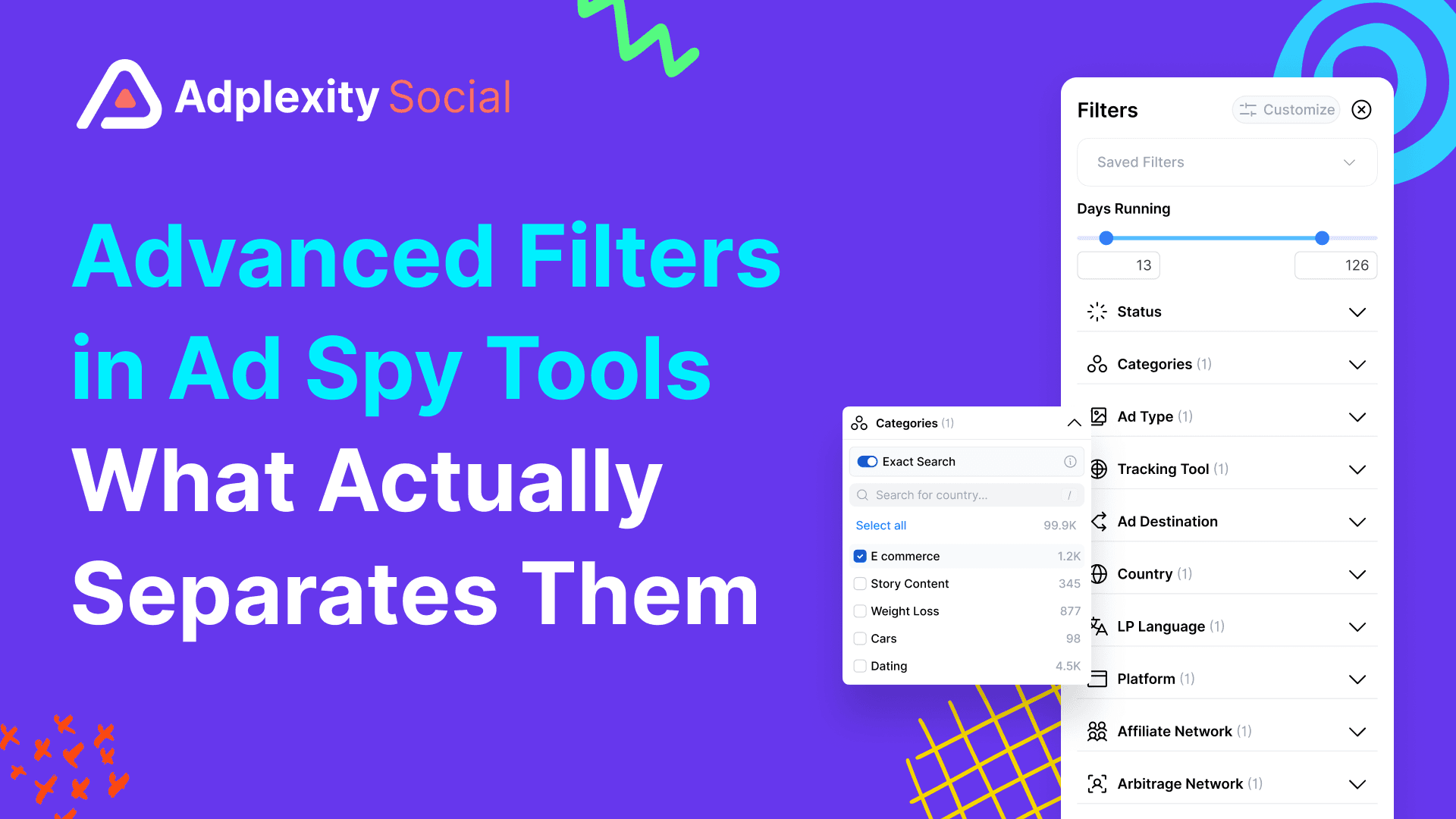
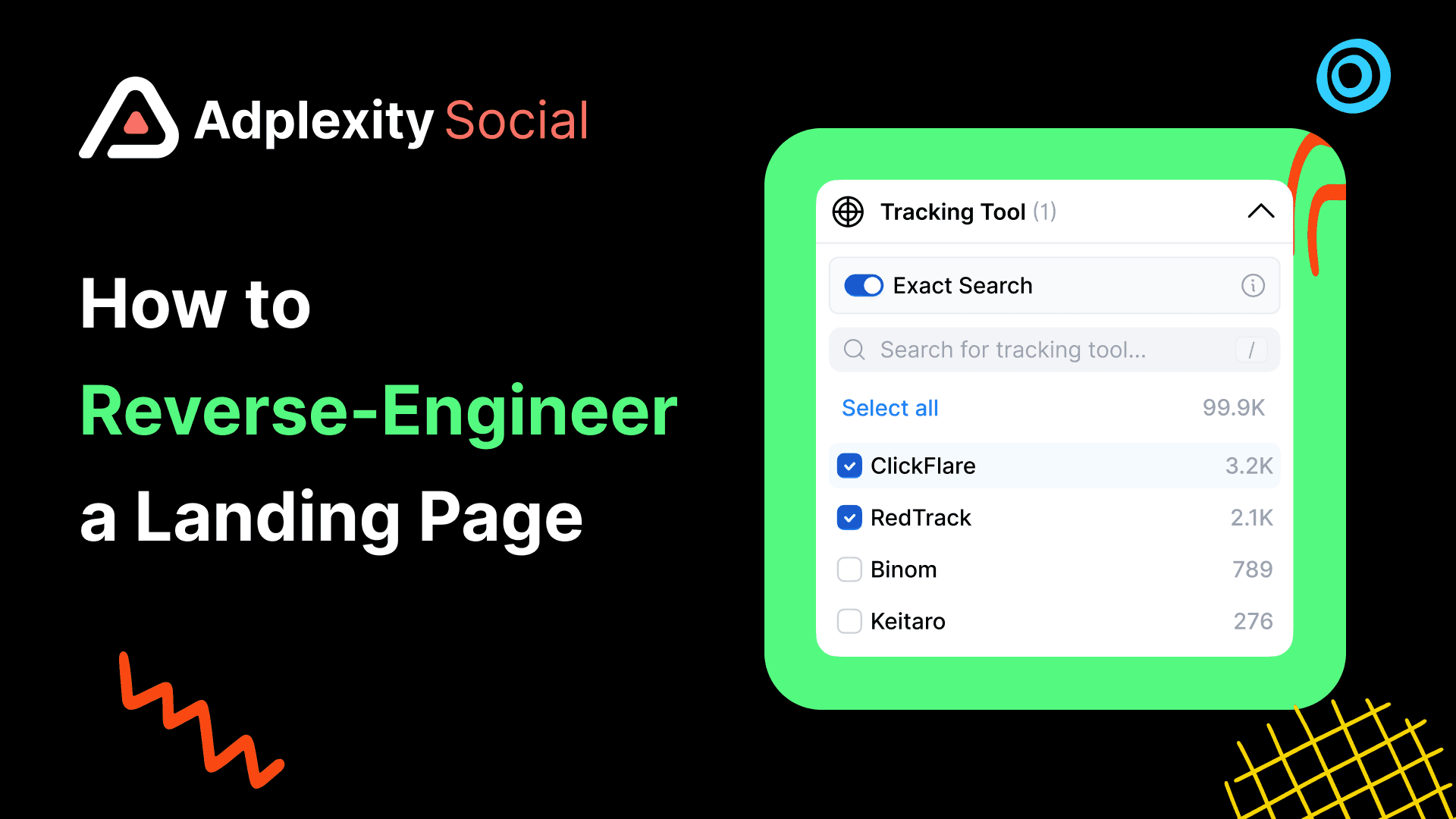
Tech stack filters let you isolate advertisers by the tools detected on their landing page: Shopify, ClickFunnels, TrustedForm, Ringba, VTurb, Jornaya, Lead Connector, and more. None of that exists in Foreplay.
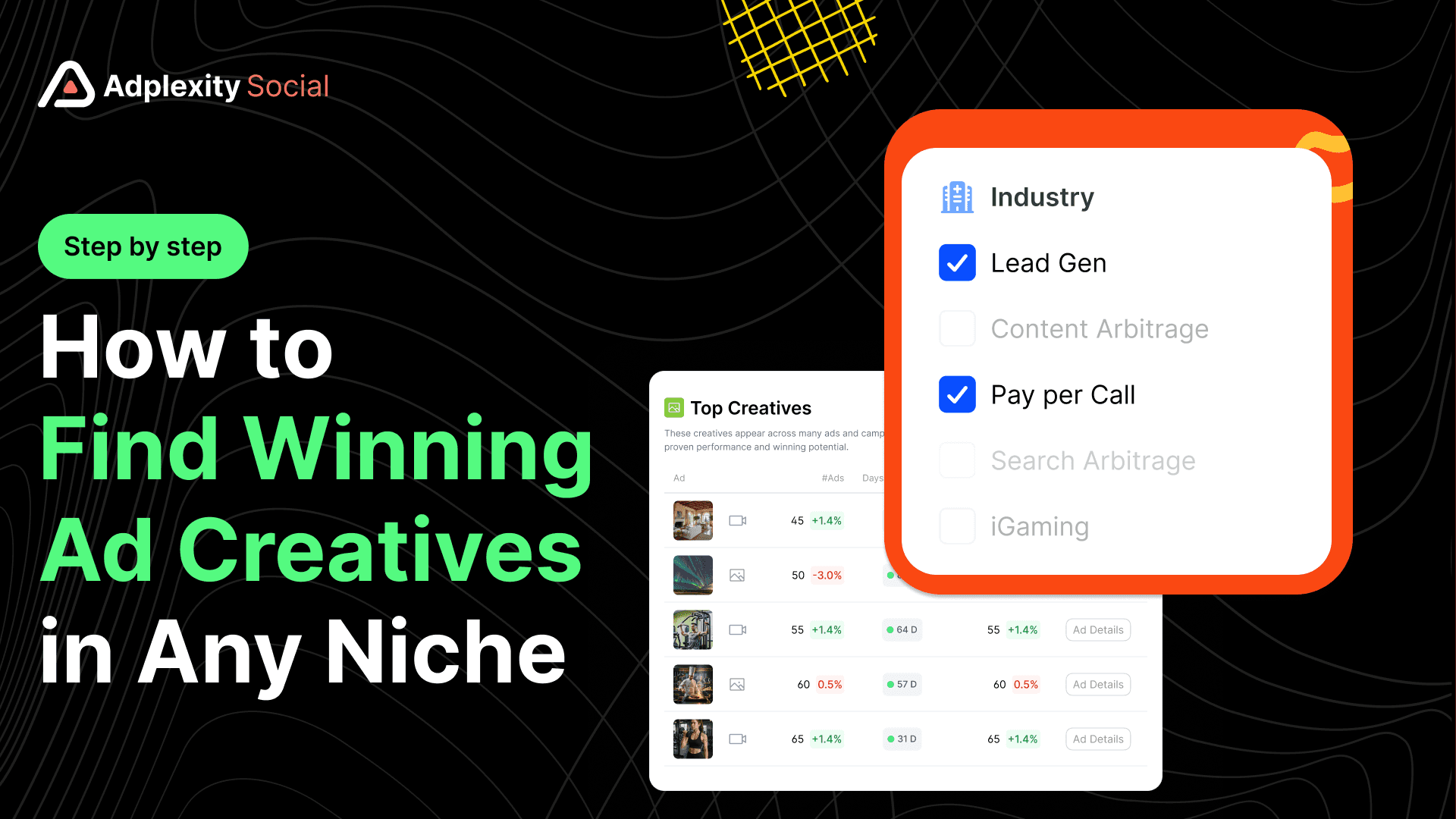
Vertical sub-niches cover Weight Loss, Diabetes, ED, Dental, Skin, and more, so you can narrow a search to the sub-vertical you actually operate in rather than a broad category.
Longevity filter lets you set any day-running threshold, which is the cleanest proxy for "this ad is profitable." The reasoning is simple: advertisers do not run losing ads for 30 days.
Affiliate network filter covers ClickBank, BuyGoods, Digistore24,Giddyup, and many others directly.
Other filters include language, 14 GEOs with full country breakdown, ad destination, platform, video duration, and more.
Boards
Foreplay's core value is to save creative collections.
AdPlexity Social's Boards save three element types: ads, domains, and Facebook pages/profiles, organized in folders. Share any Board via a public URL and control which element types are visible to the viewer.
For an agency producing a competitive intelligence report for a client, this is the difference between delivering a creative mood board and delivering a full operational breakdown.
Real Research Workflows That Only Work in AdPlexity Social
Instead of listing features in the abstract, here are four concrete research tasks that are either impossible or significantly harder in Foreplay.
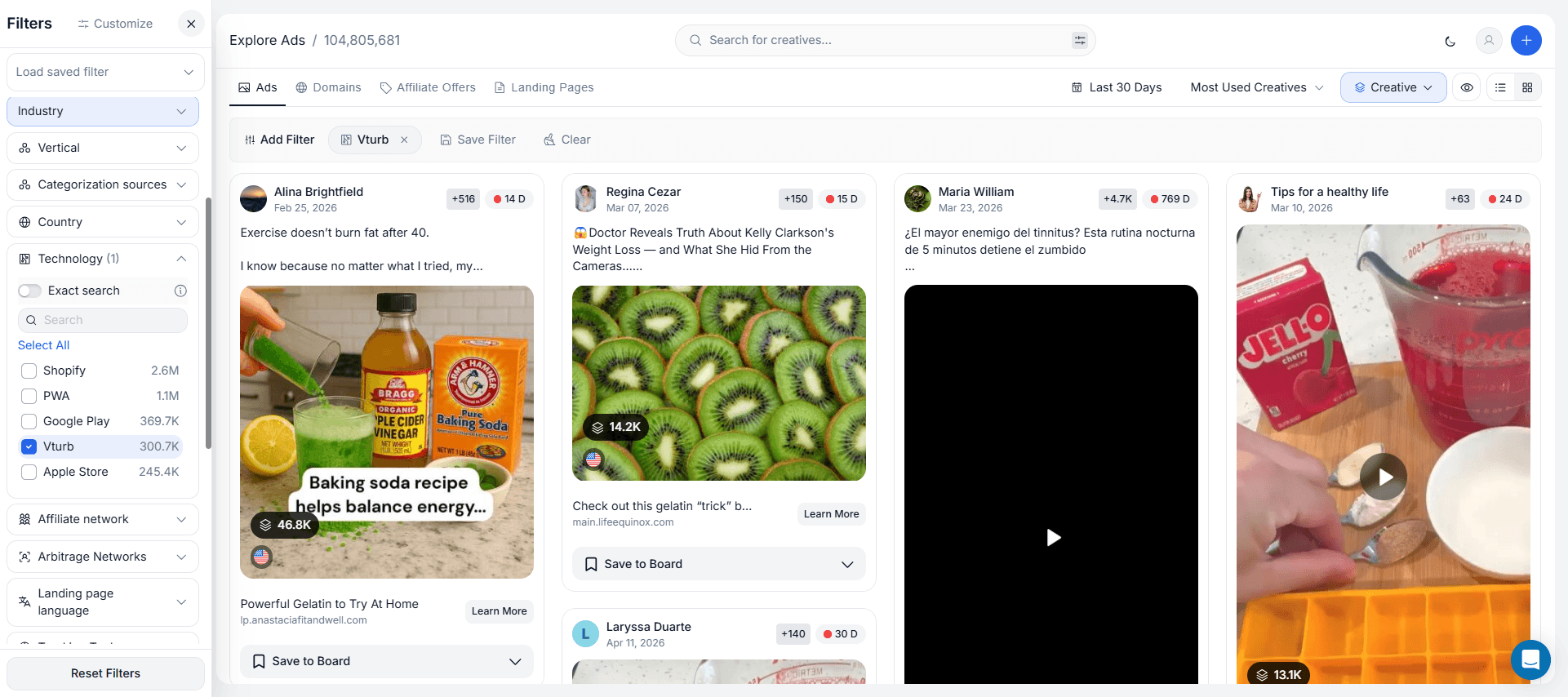
Finding winning weight loss VSL funnels
Weight loss is one of the largest affiliate verticals on Meta. Most winners run on VSL landing pages using VTurb or similar video funnel tools.
In AdPlexity Social, the search is simple: filter by the Weight Loss vertical, add the VTurb tech stack filter, and set longevity to 15+ days.
Within seconds, you have a list of VSL funnels that have been running long enough to be profitable in one of the most competitive verticals on the platform.
In Foreplay, this workflow has no starting point. You cannot filter by tech stack, so the VSL funnels are invisible in the noise.
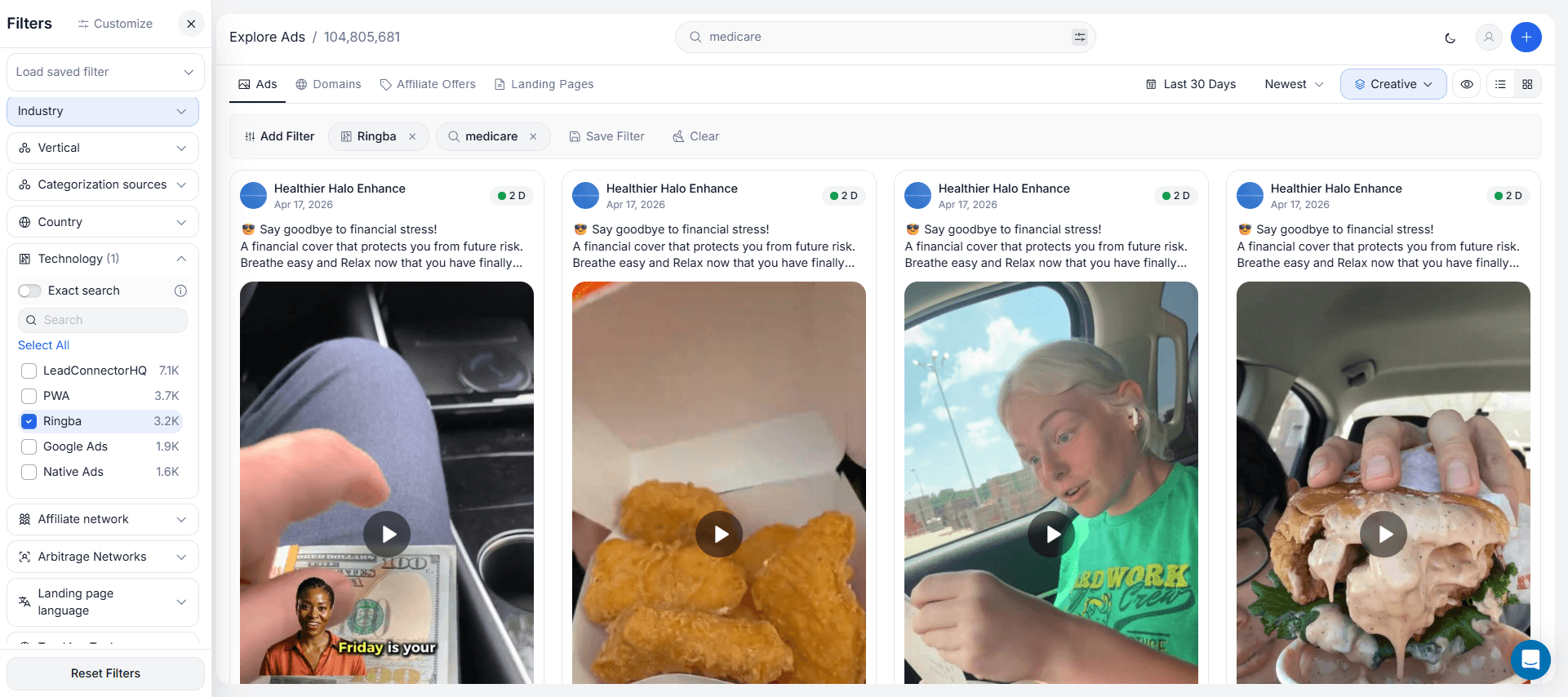
Finding Medicare Benefits pay-per-call campaigns
Pay per call in Medicare is a specific business. It runs on Ringba or similar call tracking platforms, it uses compliance tools like TrustedForm or Jornaya, and the landing pages are structured around a phone number rather than a form.
In AdPlexity Social, the search is: "Medicare" as a keyword, filtered by Ringba tech stack. The result is a tight list of active pay-per-call operators in exactly the vertical you want, with the actual landing pages and funnel structure visible.
In Foreplay, the Ringba filter does not exist. The best you can do is search "Medicare" and manually sort through the results to guess which advertisers are running call campaigns versus lead forms. That workflow breaks at scale.
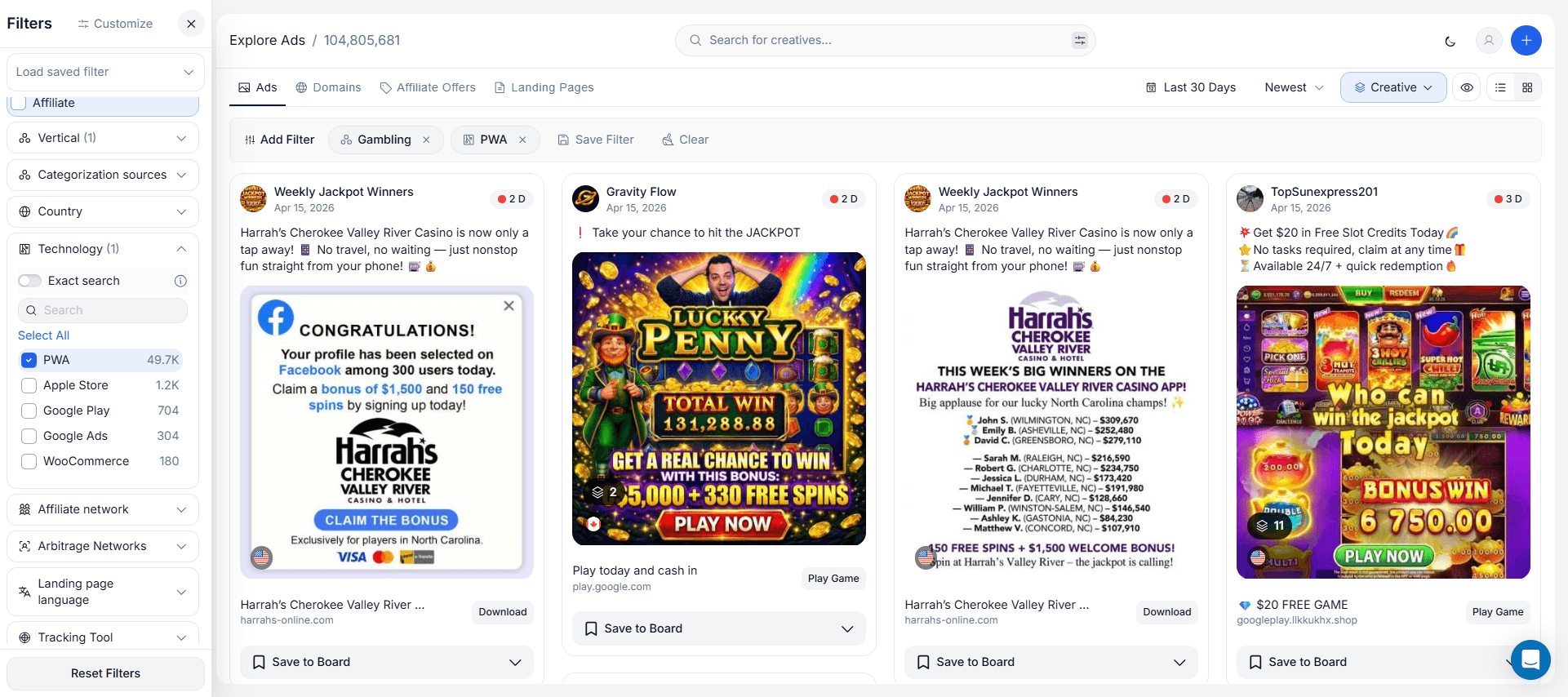
Finding iGaming campaigns running on PWA
iGaming affiliates often use Progressive Web Apps rather than standard landing pages because PWAs handle the Meta compliance game differently and allow for faster deployment.
In AdPlexity Social, you can search iGaming keywords while filtering by the tech stack signals that indicate PWA delivery. Y
ou surface the exact operators running this strategy right now, across any of the 14 supported countries.
Foreplay has no way to filter by landing page technology at all, which means the entire PWA segment of the iGaming market is indistinguishable from standard campaigns.
Exposing the weight loss patch pattern across multiple Shopify stores
This one shows why market-wide creative grouping matters.
Imagine you spot a weight loss patch ad on Meta. It looks like a small brand. The fan page has a few hundred followers.
In Foreplay, that is all you see: one advertiser, one creative, small footprint.
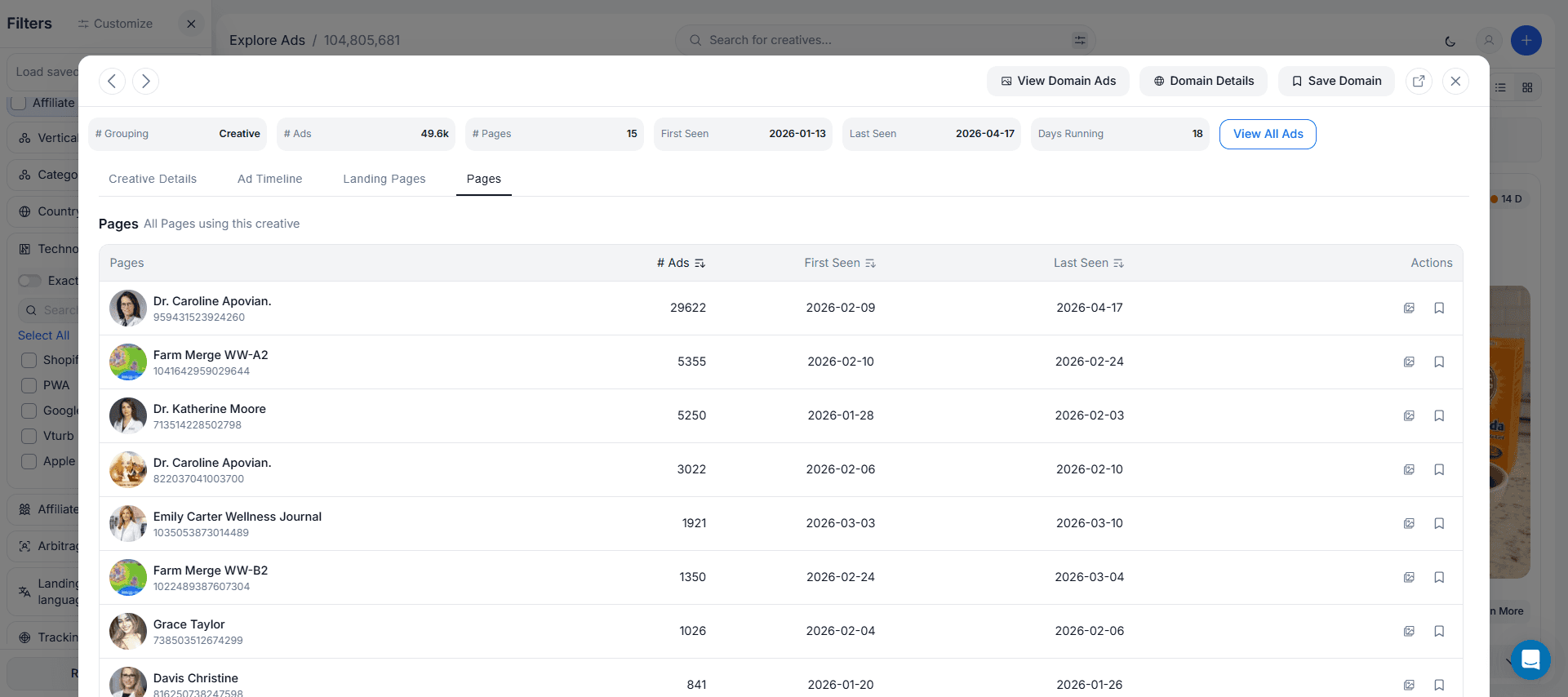
In AdPlexity Social, you can take that same creative and run a market-wide grouping to see every other advertiser running it.
What often surfaces is a pattern: the same creative is running from six or seven different Shopify stores, each with different branding, each with a different fan page, all pointing to what is functionally the same product offer.
That is not a small brand test. That is a coordinated affiliate operation running the same winner through multiple accounts to avoid platform risk and maximize volume.
The moment you see that pattern, your whole reading of the market changes. You are no longer looking at isolated advertisers. You are looking at who the actual operators are.
None of these workflows are possible in Foreplay. Not because Foreplay is a bad tool, but because it was not built for this job.
Pricing Compared
Plan | AdPlexity Social | Foreplay |
Entry | $99/month (full access) | $59/month (Basic) |
Mid | Same features, annual at $950 (~20% off) | $175/month (Workflow) |
Top | Additional seats at $49/month | $459/month (Agency) |
AdPlexity Social runs on a single tier. Every feature on the platform is available on every plan. The only variable is how many seats you need.
Foreplay runs on a traditional SaaS tier structure, where more advanced features and higher usage limits sit behind higher plans.
The comparison at face value is $99 vs. $59 at the entry point. But the feature sets are not equivalent at any tier. Foreplay's Agency plan at $459/month still does not include landing page indexing, tech stack filters, redirect chain crawling, or any of the intelligence features that define AdPlexity Social.
For a creative team that only needs a swipe file, Foreplay Basic is cheaper and appropriate. For anyone doing performance marketing research, the price comparison is not really a comparison. The tools are doing different jobs.
Who Should Use Which
Use Foreplay if: You are a creative strategist, in-house brand marketer, or agency producing ads.
Your bottleneck is organizing inspiration, building hook libraries, and collaborating with a team on creative production. You are not primarily responsible for campaign profitability or media buying decisions.
Use AdPlexity Social if: You buy media, run affiliate campaigns, build lead gen funnels, scale ecommerce brands, or operate performance marketing for clients.
You need to know what is actually working in your vertical, how funnels are structured, which tech stacks and affiliate networks sit behind winning campaigns, and how widely specific creatives are being deployed. Your decisions have money attached.
Use both if: Your team includes both creative and media buying functions. Foreplay for the creative workflow, AdPlexity Social for the intelligence layer. They solve different problems, so they coexist rather than compete.
Frequently Asked Questions
Is AdPlexity Social a direct replacement for Foreplay?
For performance marketers, affiliates, and media buyers: yes.. AdPlexity Social covers the creative research job Foreplay handles, then adds the landing page, tech stack, and domain-level intelligence Foreplay does not offer. For creative teams focused primarily on collaboration and swipe file organization, Foreplay's team features are more developed and may justify keeping it in the stack.
Which tool has more ads in its database?
AdPlexity Social has indexed over 100 million ads and adds more than 15 million per month across Facebook, Instagram, Messenger, and Audience Network. Foreplay has over 180M ads collected across a much longer timeframe. For most research, the gap that matters is not raw count but what the tool can do with the ads, specifically whether it indexes landing pages and detects tech stacks. AdPlexity Social does both. Foreplay does neither.
Can I find affiliate offers in Foreplay?
Not directly. Foreplay does not have affiliate network filters or redirect chain crawling, so identifying the offer behind an affiliate ad requires manual work: clicking through the ad, following redirects, and looking at the final URL yourself. AdPlexity Social has direct filters for ClickBank, BuyGoods, Digistore24, Giddyup and more, and the platform crawls the full redirect chain automatically.
Is Foreplay cheaper than AdPlexity Social?
At the entry level, yes. Foreplay Basic is $59/month vs. AdPlexity Social at $99/month. But the entry tiers are not feature-equivalent. AdPlexity Social gives you full access to every feature at $99. Foreplay's Basic plan is a limited version of the product. To access Foreplay's higher usage limits and advanced features, pricing moves to $175/month (Workflow) or $459/month (Agency), neither of which matches AdPlexity Social on intelligence features.
Does AdPlexity Social cover Instagram ads?
Yes. AdPlexity Social indexes ads across all Meta placements: Facebook, Instagram, Messenger, and Audience Network. Instagram advertiser accounts are searchable as profiles within the platform.
Can I share research with my team or clients in both tools?
Both tools support sharing. Foreplay's team features are built around creative collaboration, with comments, tags, and shared folders. AdPlexity Social's Boards let you share collections of ads, domains, and Facebook pages/profiles via public URL, with control over exactly which element types the viewer can see. For client-facing competitive intelligence reports, Boards give you more flexibility.
Can I try AdPlexity Social before committing?
Pricing is $99/month with no long-term contract, so you can sign up at adplexity.io, use the platform for the month, and cancel if it is not a fit.
The Bottom Line
Foreplay is a good tool for the job it was built for.
That job is not performance marketing research.
If your work ends at the creative, Foreplay covers it.
If your work starts at the creative, you need something else.
Landing page intelligence. Tech stack filters. Redirect chain visibility. Market-wide creative grouping. Domain-level analytics.
AdPlexity Social gives you all of that at $99/month. Sign up at adplexity.io.
Discover Winning Meta Ads
Similar Blogs