Best Spy Tools for Creative Intelligence on Facebook in 2026

Share:
Most ad spy tools answer the wrong question.
They tell you what ads exist.
They do not tell you which creatives are actually winning right now.
The Facebook Ad Library holds tens of millions of active ads at any given moment. Free tools and most paid ones dump them in front of you with light filters. You scroll. You guess. You burn hours on ads that ran for three days before being killed.
That is not creative intelligence. That is creative archaeology.
If you run paid social and want to find creatives that are actually moving the needle for your competitors in the last 30 days, you need a tool that does three things well: tracks how many advertisers are running the same creative, filters by tech stack so you can isolate the type of advertiser you care about, and surfaces longevity so you can separate proven creatives from test creatives.
This article compares six tools on those criteria.
TL;DR
Best overall for creative intelligence: AdPlexity Social
Best for fast creative inspiration and team collaboration: Foreplay
Best for AI-driven creative scoring: Atria
Best for ecommerce product discovery: Minea
Best for raw volume of indexed ads: BigSpy
Best for legacy archives and historical creative research: AdSpy
Tools at a Glance
Rank | Tool | Best For | Starting Price | Creative Duplicate Visibility |
1 | AdPlexity Social | Performance marketers and affiliates running on Meta | $99/mo | Full: every duplicate of a creative is grouped across all advertisers and pages |
2 | Foreplay | Creative teams and agencies | $59/mo | Limited: single ad view, no advertiser-level duplicate aggregation |
3 | Atria | AI-assisted creative ideation | $129/mo | Limited: surfaces variants but does not group all copies of the same creative |
4 | Minea | Ecommerce ad discovery | $49/mo | Partial: duplicate detection within product feeds, not across all advertisers |
5 | BigSpy | Large database access at a low price | $9/mo entry tier | None: ads shown in isolation |
6 | AdSpy | Historical Facebook ad archives | $149/mo | None: search-based, no duplicate grouping |
Why creative duplicate visibility is the right benchmark
When a Shopify store finds a winning video, they do not run one ad with that video. They run it as 200 ads, or 2,000, or 41,000.
That replication pattern is the single clearest performance signal you can get without access to the advertiser's ad account. If a creative is running as 41,000 ads across 136 days, the advertiser is not testing. They have found something that works and they are scaling it.
Most spy tools treat every ad as a unique row in a database. You see the same video twenty times in your feed and think you are looking at twenty different ads. You are looking at one winning creative that the spy tool failed to deduplicate.
The tool you choose should make this difference obvious in the first three seconds of looking at a result.
1. AdPlexity Social
Best for performance marketers, media buyers, and affiliates running on Meta.
AdPlexity Social was built on a different premise from most ad spy tools. Instead of indexing ads as standalone units, it groups identical creatives across every advertiser and page in the database, then layers tech stack, vertical, and longevity filters on top.
The result is a workflow that takes minutes instead of hours.
The platform indexes 15M+ new Meta ads per month and has built a database of over 100M ads in under one year. It collects ads from all Meta placements, not just the brand fan pages most tools focus on. That means small Shopify advertisers, affiliate funnels, and lead gen operators all get indexed alongside the big brands.
A real search example using Shopify tech stack and last 30 days:
Open the dashboard. Switch to the Ads dimension under Explore. Apply two filters: Shopify (under tech stack) and last 30 days (under time period). The platform returns roughly 2.8 million ads. Sort ads by most used creatives.
Within one minute you surface a single video creative being run as 41,000 ads by a Shopify advertiser called LuxeFinds, on the domain loveginsly.store, selling an electrostatic pet hair remover glove. The video opens with a "5 seconds challenge" hook. The creative has been running for 136 days.
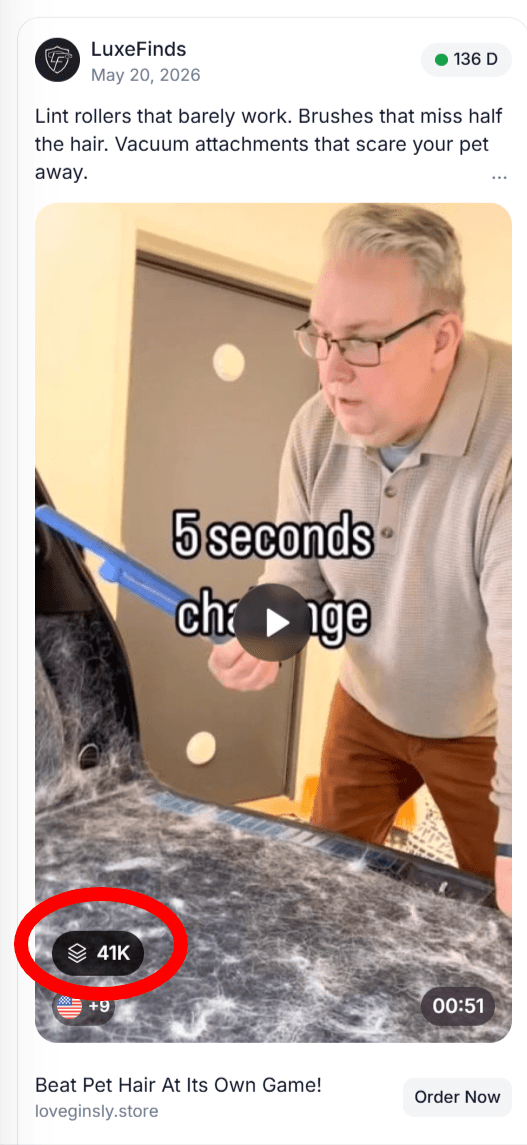
That is what a winning creative looks like in 2026. It is one piece of video content, replicated tens of thousands of times by one advertiser who clearly knows what they are doing.
From there the workflow continues. Click into the domain to see every other ad LuxeFinds is running. Open the Landing Pages tab to see the full destination page, the redirect chain, and any affiliate networks involved. Save the entire creative cluster to a Board so you can come back to it next week and see whether the advertiser is still scaling or whether they have killed it.
Where AdPlexity Social wins on creative intelligence specifically:
Creative grouping is the foundation of the entire product. Every duplicate of a creative is aggregated in one place with a running count.
Tech stack filtering works at the Shopify, ClickFunnels, TrustedForm, Ringba, VTurb level. You can isolate the type of advertiser you actually want to study before you ever look at a creative.
The Longevity filter lets you set a minimum number of days a creative has been running. 30+ days usually means profitable. 90+ days usually means a category killer.
Domain analytics give you period-over-period comparison so you can see whether an advertiser is scaling, plateauing, or declining without leaving the platform.
Boards lets you save ads, domains, and Facebook pages in folders, and share entire research collections via public URL. No other tool on this list supports saving anything beyond ad creatives.
Where it falls short: AdPlexity Social does not include AI-generated creative scoring, AI rewrites of ad copy, or built-in design tools. If you want a tool that ideates new creatives for you, this is not it. If you want a tool that finds creatives that are proven to work and shows you how they were built, this is the tool.
Pricing: $99/month. Extra seats are $49/month. Annual billing saves 20%.
Best for: Performance marketers, affiliates, lead gen operators, ecommerce brands, and agencies who need to identify winning creatives quickly and reverse-engineer the funnels behind them.
2. Foreplay
Foreplay is the most popular alternative for creative teams that need a clean library and fast collaboration. Its Discovery feed is well-organized. Its tagging system is genuinely useful for agencies juggling multiple clients. If you are looking primarily for creative inspiration rather than performance signals, Foreplay is a reasonable choice.
The gap shows up the moment you try to assess whether a creative is actually winning. Foreplay shows ads as standalone units. You can see a creative once and have no way of knowing whether the advertiser is running it as 50 copies or 50,000. There is no creative duplicate aggregation across the broader database. Only on a fan page level.
Tech stack filtering is also absent. You cannot isolate Shopify advertisers, ClickFunnels users, or TrustedForm-based lead gen operators. You are working with ad copy and visual content alone.
For agencies that have already done the work of identifying which advertisers to watch and just need a place to organize creative references, Foreplay works. For performance marketers trying to find the next 41,000-ad winner before competitors do, it does not.
Pricing: $59/mo Basic, $175/mo Workflow, $459/mo Agency.
Best for: Creative directors, designers, and agency strategists who need an inspiration library more than a performance intelligence layer.
3. Atria
Atria has built a strong reputation around AI-driven creative analysis. It scores ads, identifies patterns across creative styles, and offers generative tools to riff on what it surfaces. For teams who want a copilot for creative ideation, the AI layer is the headline feature.
Where Atria slips on creative intelligence is in raw data depth. The database is meaningfully smaller than AdPlexity Social's. Duplicate aggregation exists at a basic level but does not extend across all advertisers and pages. You will see a creative and a few related variants, but not the full count of how many times that exact creative has been replicated across the ecosystem.
Tech stack filtering is also absent. Atria treats every ad as a creative artifact to be analyzed by AI, not as a signal about advertiser behavior. That distinction matters when you are trying to decide whether to copy a creative or copy a strategy.
Pricing: $129/mo entry, up to $479/mo for the top tier.
Best for: In-house creative teams using AI to accelerate ad concepting and copywriting.
4. Minea
Minea has carved out a specific niche in ecommerce product discovery. It is one of the few tools that meaningfully covers TikTok and Pinterest alongside Meta, and its product-feed structure is built around helping dropshippers find trending physical products.
For creative intelligence on Facebook specifically, Minea is a partial fit. It surfaces winning ecommerce ads and groups some duplicates within its product feed. The challenge is that the duplicate detection is product-centric rather than creative-centric. If two different Shopify advertisers run the same video for the same product, Minea may surface both. If one advertiser runs the same video as 40,000 ads, Minea does not give you a single grouped view of that scale.
Lead gen, pay per call, affiliate offers outside dropshipping, and most non-product verticals are weakly covered.
Pricing: $49/mo Starter, $99/mo Premium, $399/mo Business.
Best for: Dropshippers and ecommerce media buyers focused on product discovery rather than full-funnel intelligence.
5. BigSpy
BigSpy competes almost entirely on database size and entry price. It claims one of the largest ad indexes in the category and offers a low-cost entry tier that attracts price-sensitive buyers and people just starting out in paid social.
The trade-off is depth. Ads in BigSpy are shown in isolation. There is no creative duplicate aggregation. There is no tech stack filtering. Landing page coverage is shallow, and redirect chain analysis is not part of the product.
If your goal is to scroll through a lot of ads cheaply, BigSpy delivers. If your goal is to identify which creatives are actually winning and reverse-engineer what makes them work, the database size becomes a liability rather than a strength. You spend more time scrolling and less time deciding.
Pricing: $9/mo entry, $99/mo Pro, $249/mo Group.
Best for: Beginners who want exposure to a high volume of ads at a low entry cost.
6. AdSpy
AdSpy was one of the earliest Facebook ad spy tools and is still in use today, primarily for its historical archive. If you need to research what was being run two or three years ago, AdSpy has depth that newer tools cannot match.
For current creative intelligence in 2026, the gap is large. The interface and filtering model reflect the product's age. There is no creative duplicate grouping across advertisers, no tech stack filtering, and no domain-level analytics. Landing page indexing is limited.
The platform still has value for researchers and consultants who need historical context. For active media buyers trying to identify what is winning right now, more modern tools have moved past it.
Pricing: $149/mo flat.
Best for: Researchers, consultants, and operators who need access to historical Facebook ad archives.
How to choose between them
If you run paid Meta campaigns and need to know which creatives are actually winning in the last 30 days, the right tool needs three things. It needs to group duplicates so you can see the scale at which a creative is being replicated. It needs tech stack filters so you can isolate the type of advertiser you care about. And it needs longevity data so you can separate creatives that are proven from creatives that are still being tested.
AdPlexity Social does all three. It is the only tool on this list that does.
The other tools each win on something narrower. Foreplay wins on team collaboration. Atria wins on AI creative scoring. Minea wins on dropshipping product discovery. BigSpy wins on entry price. AdSpy wins on historical archives.
If your job is to find winners fast and copy what works, the choice is straightforward.
Frequently Asked Questions
What is creative intelligence in the context of Facebook ads?
Creative intelligence is the practice of analyzing which ad creatives are performing well for your competitors and understanding what makes them work. It goes beyond looking at individual ads. It involves tracking how many advertisers are running the same creative, how long each creative has been running, what funnel sits behind it, and what tech stack the advertiser is using to support it. The goal is to identify creatives that are proven before you invest in producing your own.
How do I tell if a Facebook ad is actually winning?
The two clearest public signals are replication scale and longevity. If a creative is being run as thousands of ads by the same advertiser, they have stopped testing and started scaling. If a creative has been running for 30 or more days, it is almost certainly profitable. Most Meta advertisers will kill a losing creative within a week. The combination of both signals, high replication count and 30+ days of activity, is the strongest indicator you can get without access to the advertiser's ad account.
Why does creative duplicate detection matter more than database size?
A database of 100 million ads is only useful if you can find the few hundred that matter. Without duplicate detection, you scroll through the same winning creative twenty times thinking you are seeing twenty different ads. Duplicate detection collapses that noise into one clear signal that tells you a creative is being scaled. A smaller database with proper grouping will produce better intelligence than a larger database without it.
Can I do creative intelligence research with the free Facebook Ad Library?
You can do basic research, but the Ad Library is missing most of the features that make creative intelligence efficient. It does not group duplicate creatives. It does not filter by tech stack. It does not crawl landing pages or redirect chains. It does not show you longevity data clearly. For occasional one-off checks the Ad Library is fine. For a daily or weekly research workflow, the time cost of doing it manually quickly outweighs the price of a dedicated tool.
Do I need a tool that covers TikTok and other platforms as well as Facebook?
Only if you are actually advertising on those platforms. Spreading a database across multiple ad networks usually reduces the depth of coverage on each one. Tools that specialize in Meta tend to have better creative grouping, deeper landing page indexing, and more accurate tech stack detection than tools that try to cover everything. If Meta is where you spend, a Meta-specialized tool will produce better intelligence than a multi-platform tool with similar pricing.
How long does it take to find a winning creative once you know what to look for?
With the right filter setup, less than five minutes. Apply a tech stack filter to isolate the type of advertiser you care about, set the time window to the last 30 days, sort by creative duplicate count, and the top results are creatives that are being actively scaled right now. The slow part of creative research is not finding ads. It is filtering out the noise so you only see the ads that matter.
Are deleted and banned Facebook ads still useful for research?
Yes, in two ways. Banned ads often reveal which angles and claims push the boundaries of what Meta allows, which is useful intelligence for any operator running in sensitive verticals. Archives of historical creatives also help you spot patterns that have been profitable across multiple cycles. A tool that preserves deleted and banned ads gives you research material that disappears from the live Ad Library within hours.
The bottom line
Foreplay, Atria, Minea, BigSpy, and AdSpy each have a use case.
But if your job is to find winning Facebook creatives before competitors do, the question is simpler.
You need duplicate detection.
You need tech stack filters.
You need longevity data.
You need the funnel behind the ad.
AdPlexity Social gives you all four for $99 a month, with no usage caps on creative duplicate counts. Sign up at adplexity.io and run the Shopify Last 30 Days search yourself. The 41,000-ad creative is sitting there waiting for you to find it.
Most ad spy tools answer the wrong question.
They tell you what ads exist.
They do not tell you which creatives are actually winning right now.
The Facebook Ad Library holds tens of millions of active ads at any given moment. Free tools and most paid ones dump them in front of you with light filters. You scroll. You guess. You burn hours on ads that ran for three days before being killed.
That is not creative intelligence. That is creative archaeology.
If you run paid social and want to find creatives that are actually moving the needle for your competitors in the last 30 days, you need a tool that does three things well: tracks how many advertisers are running the same creative, filters by tech stack so you can isolate the type of advertiser you care about, and surfaces longevity so you can separate proven creatives from test creatives.
This article compares six tools on those criteria.
TL;DR
Best overall for creative intelligence: AdPlexity Social
Best for fast creative inspiration and team collaboration: Foreplay
Best for AI-driven creative scoring: Atria
Best for ecommerce product discovery: Minea
Best for raw volume of indexed ads: BigSpy
Best for legacy archives and historical creative research: AdSpy
Tools at a Glance
Rank | Tool | Best For | Starting Price | Creative Duplicate Visibility |
1 | AdPlexity Social | Performance marketers and affiliates running on Meta | $99/mo | Full: every duplicate of a creative is grouped across all advertisers and pages |
2 | Foreplay | Creative teams and agencies | $59/mo | Limited: single ad view, no advertiser-level duplicate aggregation |
3 | Atria | AI-assisted creative ideation | $129/mo | Limited: surfaces variants but does not group all copies of the same creative |
4 | Minea | Ecommerce ad discovery | $49/mo | Partial: duplicate detection within product feeds, not across all advertisers |
5 | BigSpy | Large database access at a low price | $9/mo entry tier | None: ads shown in isolation |
6 | AdSpy | Historical Facebook ad archives | $149/mo | None: search-based, no duplicate grouping |
Why creative duplicate visibility is the right benchmark
When a Shopify store finds a winning video, they do not run one ad with that video. They run it as 200 ads, or 2,000, or 41,000.
That replication pattern is the single clearest performance signal you can get without access to the advertiser's ad account. If a creative is running as 41,000 ads across 136 days, the advertiser is not testing. They have found something that works and they are scaling it.
Most spy tools treat every ad as a unique row in a database. You see the same video twenty times in your feed and think you are looking at twenty different ads. You are looking at one winning creative that the spy tool failed to deduplicate.
The tool you choose should make this difference obvious in the first three seconds of looking at a result.
1. AdPlexity Social
Best for performance marketers, media buyers, and affiliates running on Meta.
AdPlexity Social was built on a different premise from most ad spy tools. Instead of indexing ads as standalone units, it groups identical creatives across every advertiser and page in the database, then layers tech stack, vertical, and longevity filters on top.
The result is a workflow that takes minutes instead of hours.
The platform indexes 15M+ new Meta ads per month and has built a database of over 100M ads in under one year. It collects ads from all Meta placements, not just the brand fan pages most tools focus on. That means small Shopify advertisers, affiliate funnels, and lead gen operators all get indexed alongside the big brands.
A real search example using Shopify tech stack and last 30 days:
Open the dashboard. Switch to the Ads dimension under Explore. Apply two filters: Shopify (under tech stack) and last 30 days (under time period). The platform returns roughly 2.8 million ads. Sort ads by most used creatives.
Within one minute you surface a single video creative being run as 41,000 ads by a Shopify advertiser called LuxeFinds, on the domain loveginsly.store, selling an electrostatic pet hair remover glove. The video opens with a "5 seconds challenge" hook. The creative has been running for 136 days.
That is what a winning creative looks like in 2026. It is one piece of video content, replicated tens of thousands of times by one advertiser who clearly knows what they are doing.
From there the workflow continues. Click into the domain to see every other ad LuxeFinds is running. Open the Landing Pages tab to see the full destination page, the redirect chain, and any affiliate networks involved. Save the entire creative cluster to a Board so you can come back to it next week and see whether the advertiser is still scaling or whether they have killed it.
Where AdPlexity Social wins on creative intelligence specifically:
Creative grouping is the foundation of the entire product. Every duplicate of a creative is aggregated in one place with a running count.
Tech stack filtering works at the Shopify, ClickFunnels, TrustedForm, Ringba, VTurb level. You can isolate the type of advertiser you actually want to study before you ever look at a creative.
The Longevity filter lets you set a minimum number of days a creative has been running. 30+ days usually means profitable. 90+ days usually means a category killer.
Domain analytics give you period-over-period comparison so you can see whether an advertiser is scaling, plateauing, or declining without leaving the platform.
Boards lets you save ads, domains, and Facebook pages in folders, and share entire research collections via public URL. No other tool on this list supports saving anything beyond ad creatives.
Where it falls short: AdPlexity Social does not include AI-generated creative scoring, AI rewrites of ad copy, or built-in design tools. If you want a tool that ideates new creatives for you, this is not it. If you want a tool that finds creatives that are proven to work and shows you how they were built, this is the tool.
Pricing: $99/month. Extra seats are $49/month. Annual billing saves 20%.
Best for: Performance marketers, affiliates, lead gen operators, ecommerce brands, and agencies who need to identify winning creatives quickly and reverse-engineer the funnels behind them.
2. Foreplay
Foreplay is the most popular alternative for creative teams that need a clean library and fast collaboration. Its Discovery feed is well-organized. Its tagging system is genuinely useful for agencies juggling multiple clients. If you are looking primarily for creative inspiration rather than performance signals, Foreplay is a reasonable choice.
The gap shows up the moment you try to assess whether a creative is actually winning. Foreplay shows ads as standalone units. You can see a creative once and have no way of knowing whether the advertiser is running it as 50 copies or 50,000. There is no creative duplicate aggregation across the broader database. Only on a fan page level.
Tech stack filtering is also absent. You cannot isolate Shopify advertisers, ClickFunnels users, or TrustedForm-based lead gen operators. You are working with ad copy and visual content alone.
For agencies that have already done the work of identifying which advertisers to watch and just need a place to organize creative references, Foreplay works. For performance marketers trying to find the next 41,000-ad winner before competitors do, it does not.
Pricing: $59/mo Basic, $175/mo Workflow, $459/mo Agency.
Best for: Creative directors, designers, and agency strategists who need an inspiration library more than a performance intelligence layer.
3. Atria
Atria has built a strong reputation around AI-driven creative analysis. It scores ads, identifies patterns across creative styles, and offers generative tools to riff on what it surfaces. For teams who want a copilot for creative ideation, the AI layer is the headline feature.
Where Atria slips on creative intelligence is in raw data depth. The database is meaningfully smaller than AdPlexity Social's. Duplicate aggregation exists at a basic level but does not extend across all advertisers and pages. You will see a creative and a few related variants, but not the full count of how many times that exact creative has been replicated across the ecosystem.
Tech stack filtering is also absent. Atria treats every ad as a creative artifact to be analyzed by AI, not as a signal about advertiser behavior. That distinction matters when you are trying to decide whether to copy a creative or copy a strategy.
Pricing: $129/mo entry, up to $479/mo for the top tier.
Best for: In-house creative teams using AI to accelerate ad concepting and copywriting.
4. Minea
Minea has carved out a specific niche in ecommerce product discovery. It is one of the few tools that meaningfully covers TikTok and Pinterest alongside Meta, and its product-feed structure is built around helping dropshippers find trending physical products.
For creative intelligence on Facebook specifically, Minea is a partial fit. It surfaces winning ecommerce ads and groups some duplicates within its product feed. The challenge is that the duplicate detection is product-centric rather than creative-centric. If two different Shopify advertisers run the same video for the same product, Minea may surface both. If one advertiser runs the same video as 40,000 ads, Minea does not give you a single grouped view of that scale.
Lead gen, pay per call, affiliate offers outside dropshipping, and most non-product verticals are weakly covered.
Pricing: $49/mo Starter, $99/mo Premium, $399/mo Business.
Best for: Dropshippers and ecommerce media buyers focused on product discovery rather than full-funnel intelligence.
5. BigSpy
BigSpy competes almost entirely on database size and entry price. It claims one of the largest ad indexes in the category and offers a low-cost entry tier that attracts price-sensitive buyers and people just starting out in paid social.
The trade-off is depth. Ads in BigSpy are shown in isolation. There is no creative duplicate aggregation. There is no tech stack filtering. Landing page coverage is shallow, and redirect chain analysis is not part of the product.
If your goal is to scroll through a lot of ads cheaply, BigSpy delivers. If your goal is to identify which creatives are actually winning and reverse-engineer what makes them work, the database size becomes a liability rather than a strength. You spend more time scrolling and less time deciding.
Pricing: $9/mo entry, $99/mo Pro, $249/mo Group.
Best for: Beginners who want exposure to a high volume of ads at a low entry cost.
6. AdSpy
AdSpy was one of the earliest Facebook ad spy tools and is still in use today, primarily for its historical archive. If you need to research what was being run two or three years ago, AdSpy has depth that newer tools cannot match.
For current creative intelligence in 2026, the gap is large. The interface and filtering model reflect the product's age. There is no creative duplicate grouping across advertisers, no tech stack filtering, and no domain-level analytics. Landing page indexing is limited.
The platform still has value for researchers and consultants who need historical context. For active media buyers trying to identify what is winning right now, more modern tools have moved past it.
Pricing: $149/mo flat.
Best for: Researchers, consultants, and operators who need access to historical Facebook ad archives.
How to choose between them
If you run paid Meta campaigns and need to know which creatives are actually winning in the last 30 days, the right tool needs three things. It needs to group duplicates so you can see the scale at which a creative is being replicated. It needs tech stack filters so you can isolate the type of advertiser you care about. And it needs longevity data so you can separate creatives that are proven from creatives that are still being tested.
AdPlexity Social does all three. It is the only tool on this list that does.
The other tools each win on something narrower. Foreplay wins on team collaboration. Atria wins on AI creative scoring. Minea wins on dropshipping product discovery. BigSpy wins on entry price. AdSpy wins on historical archives.
If your job is to find winners fast and copy what works, the choice is straightforward.
Frequently Asked Questions
What is creative intelligence in the context of Facebook ads?
Creative intelligence is the practice of analyzing which ad creatives are performing well for your competitors and understanding what makes them work. It goes beyond looking at individual ads. It involves tracking how many advertisers are running the same creative, how long each creative has been running, what funnel sits behind it, and what tech stack the advertiser is using to support it. The goal is to identify creatives that are proven before you invest in producing your own.
How do I tell if a Facebook ad is actually winning?
The two clearest public signals are replication scale and longevity. If a creative is being run as thousands of ads by the same advertiser, they have stopped testing and started scaling. If a creative has been running for 30 or more days, it is almost certainly profitable. Most Meta advertisers will kill a losing creative within a week. The combination of both signals, high replication count and 30+ days of activity, is the strongest indicator you can get without access to the advertiser's ad account.
Why does creative duplicate detection matter more than database size?
A database of 100 million ads is only useful if you can find the few hundred that matter. Without duplicate detection, you scroll through the same winning creative twenty times thinking you are seeing twenty different ads. Duplicate detection collapses that noise into one clear signal that tells you a creative is being scaled. A smaller database with proper grouping will produce better intelligence than a larger database without it.
Can I do creative intelligence research with the free Facebook Ad Library?
You can do basic research, but the Ad Library is missing most of the features that make creative intelligence efficient. It does not group duplicate creatives. It does not filter by tech stack. It does not crawl landing pages or redirect chains. It does not show you longevity data clearly. For occasional one-off checks the Ad Library is fine. For a daily or weekly research workflow, the time cost of doing it manually quickly outweighs the price of a dedicated tool.
Do I need a tool that covers TikTok and other platforms as well as Facebook?
Only if you are actually advertising on those platforms. Spreading a database across multiple ad networks usually reduces the depth of coverage on each one. Tools that specialize in Meta tend to have better creative grouping, deeper landing page indexing, and more accurate tech stack detection than tools that try to cover everything. If Meta is where you spend, a Meta-specialized tool will produce better intelligence than a multi-platform tool with similar pricing.
How long does it take to find a winning creative once you know what to look for?
With the right filter setup, less than five minutes. Apply a tech stack filter to isolate the type of advertiser you care about, set the time window to the last 30 days, sort by creative duplicate count, and the top results are creatives that are being actively scaled right now. The slow part of creative research is not finding ads. It is filtering out the noise so you only see the ads that matter.
Are deleted and banned Facebook ads still useful for research?
Yes, in two ways. Banned ads often reveal which angles and claims push the boundaries of what Meta allows, which is useful intelligence for any operator running in sensitive verticals. Archives of historical creatives also help you spot patterns that have been profitable across multiple cycles. A tool that preserves deleted and banned ads gives you research material that disappears from the live Ad Library within hours.
The bottom line
Foreplay, Atria, Minea, BigSpy, and AdSpy each have a use case.
But if your job is to find winning Facebook creatives before competitors do, the question is simpler.
You need duplicate detection.
You need tech stack filters.
You need longevity data.
You need the funnel behind the ad.
AdPlexity Social gives you all four for $99 a month, with no usage caps on creative duplicate counts. Sign up at adplexity.io and run the Shopify Last 30 Days search yourself. The 41,000-ad creative is sitting there waiting for you to find it.
Table of Contents
Quickly navigate through the key sections of this article.
Discover Winning Meta Ads
Similar Blogs
Check related blogs
Check related blogs
Check related blogs











Ready to See What’s Really Working on Meta?
Adplexity
Social
© Copyright 2026 All Rights Reserved
Ready to See What’s Really Working on Meta?
Adplexity
Social
© Copyright 2026 All Rights Reserved
Ready to See What’s Really Working on Meta?
Adplexity
Social
© Copyright 2026 All Rights Reserved