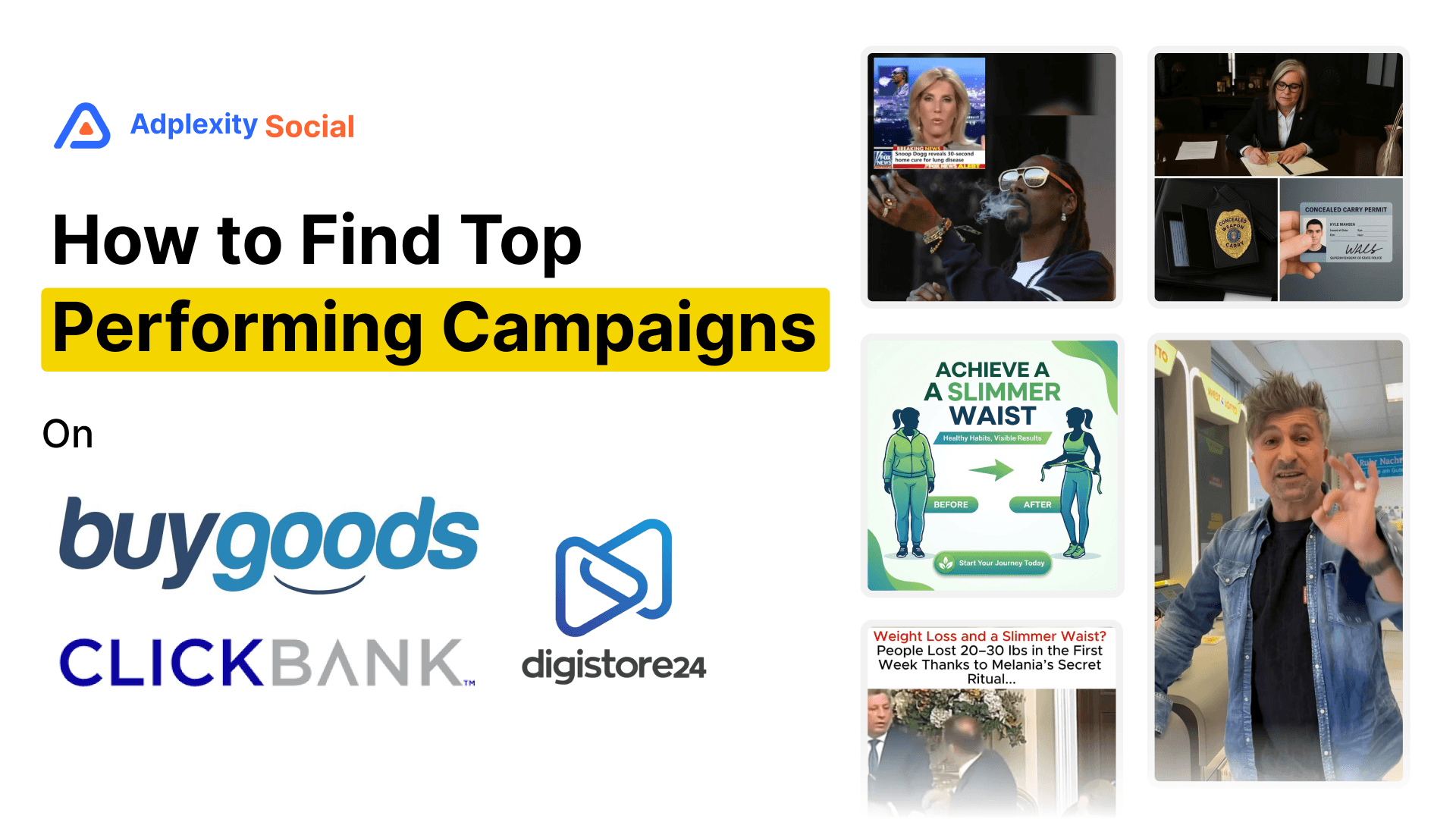
We dug into 611,000 weight loss ads running on Meta to find the winning creatives, dominant domains, and which affiliate networks are getting the most traction right now.
We dug into 611,000 weight loss ads running on Meta to find the winning creatives, dominant domains, and which affiliate networks are getting the most traction right now.
Key Takeaways: Weight loss is one of the most crowded verticals on Meta right now, with over 611,000 ads tagged in the last 30 days. Weight loss patches are the dominant product format across virtually every domain and network we analyzed. BuyGoods is outpacing both ClickBank and Digistore in affiliate volume by a wide margin, and a handful of specific domains control most of the activity on each network.
Watch the full tutorial on YouTube:
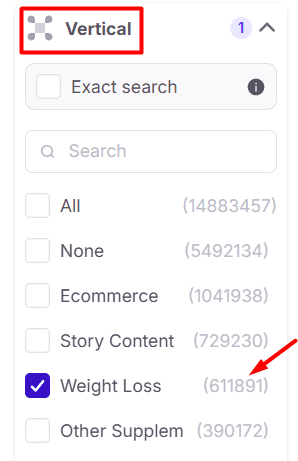
Weight loss is not just competitive on Meta. It is borderline absurd. When we pulled the data in AdPlexity Social, the vertical filter returned 611,000 ads in the last 30 days alone. That makes it one of the top categorized verticals on the platform, ahead of skincare, finance, and things we track.
But raw volume does not tell you much on its own. What actually matters is where the money is going, which creatives are winning, and which offers are getting the most traction. So we dug in.
The Creative Grouping Trick That Cuts Through the Noise
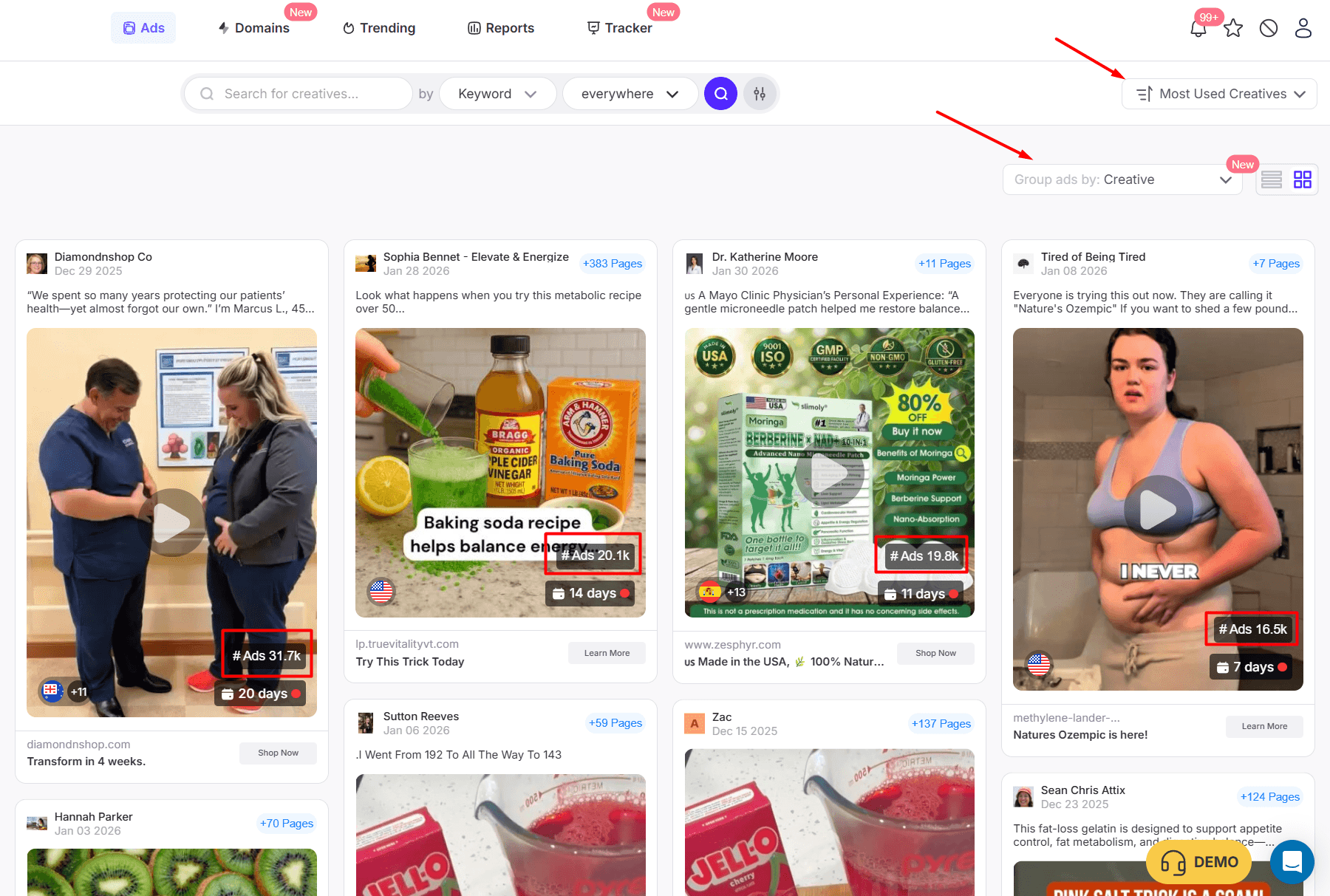
When you are staring at 611K ads, scrolling through them one by one is a waste of time. The move here is creative grouping: sorting ads by the most-used creative rather than by recency or days active.
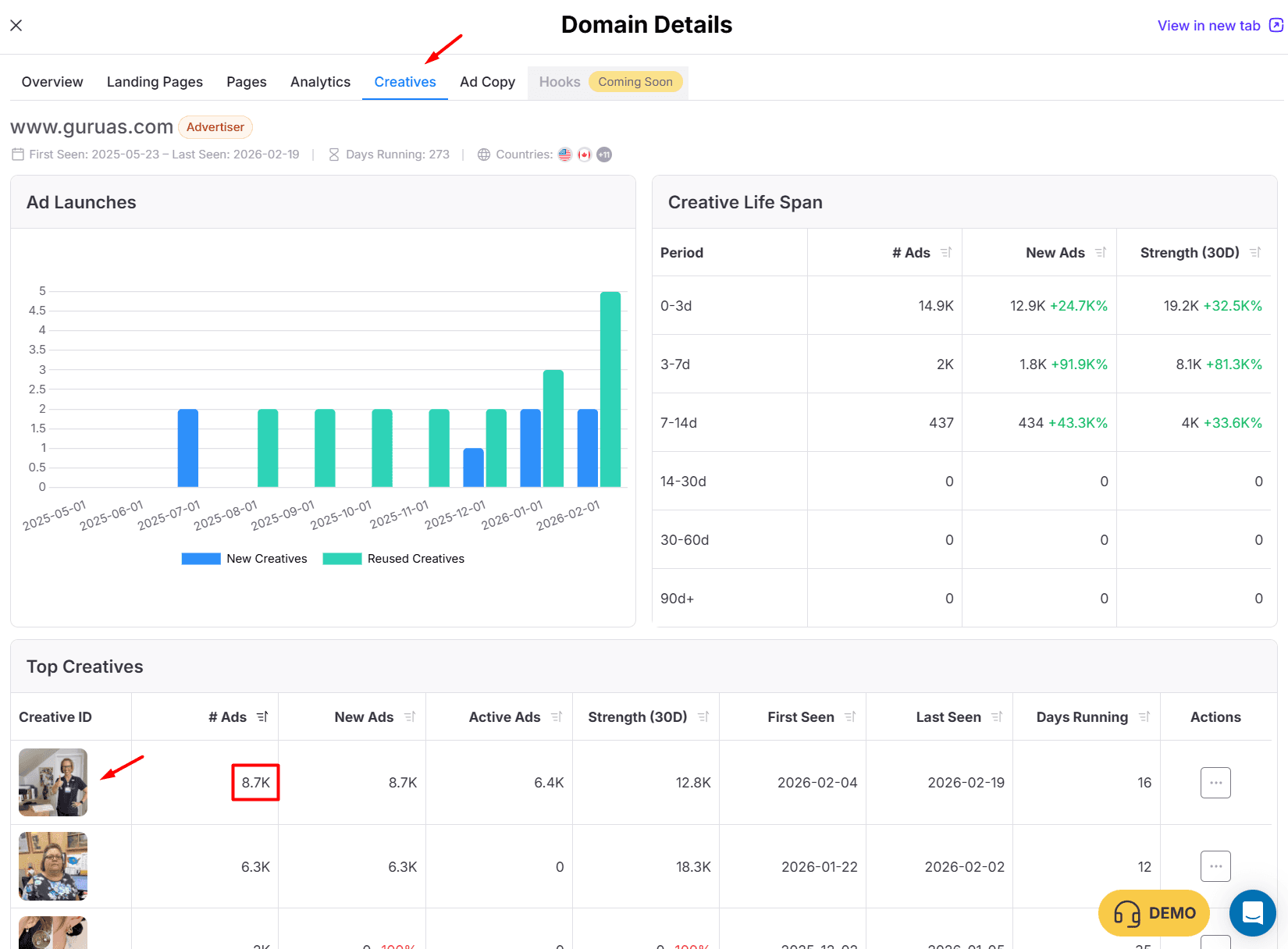
This immediately surfaces the winners. The top creative in the weight loss vertical had been used across 31,000 ads. The second: 19,400. The third: 18,300. These are not small-time tests. When a single creative is deployed across tens of thousands of ads, somebody is scaling hard because it is working.
Most of the top creatives we found were tied to weight loss patches, which, as we will get into, are absolutely everywhere right now. But scrolling past the obvious leaders into the 1,000–3,000 range is where things get more interesting, because that is where you start finding creatives that have not been burned yet.
Weight Loss Patches Are Dominating Everything
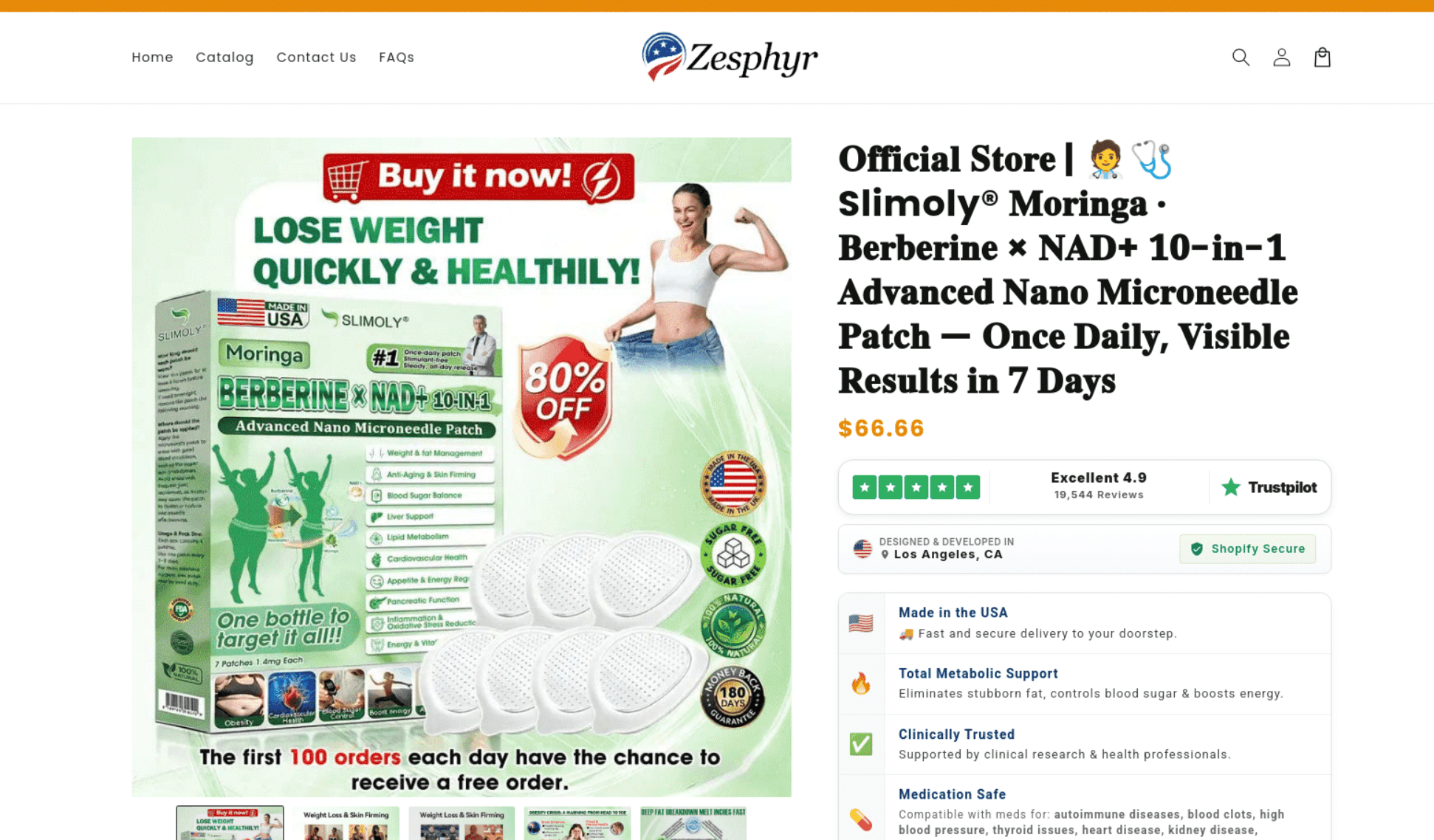
This is not an exaggeration. Every angle we explored (creative grouping, domain analysis, etc) kept surfacing weight loss patches. Different brands, different domains, different fan pages, but the same core product format.
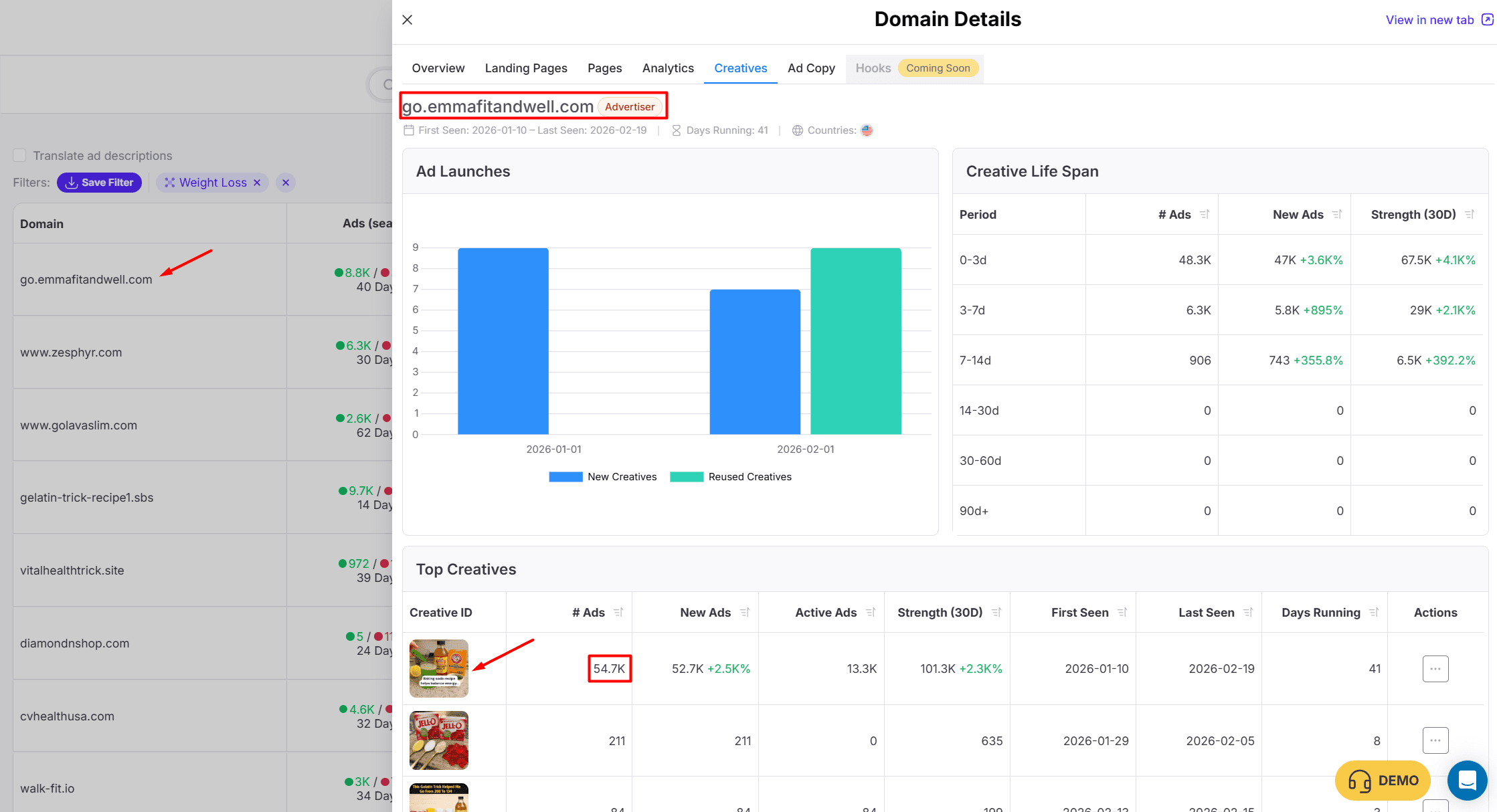
One domain alone had a single image creative running across over 50,000 ads. That creative was being pushed through dozens of Facebook pages, all targeting the US. You do not see that kind of volume on a non-performing offer. The economics simply would not support it.
The patches are showing up under multiple brand names, and it is unclear whether some of these are the same parent company spinning up new storefronts or genuinely independent sellers. But the pattern is unmistakable: if you are in the weight loss space on Meta right now, patches are the product format getting the most spend.
A Smart GLP-1-Adjacent Play: Zentheca’s Balance Wellness Beads
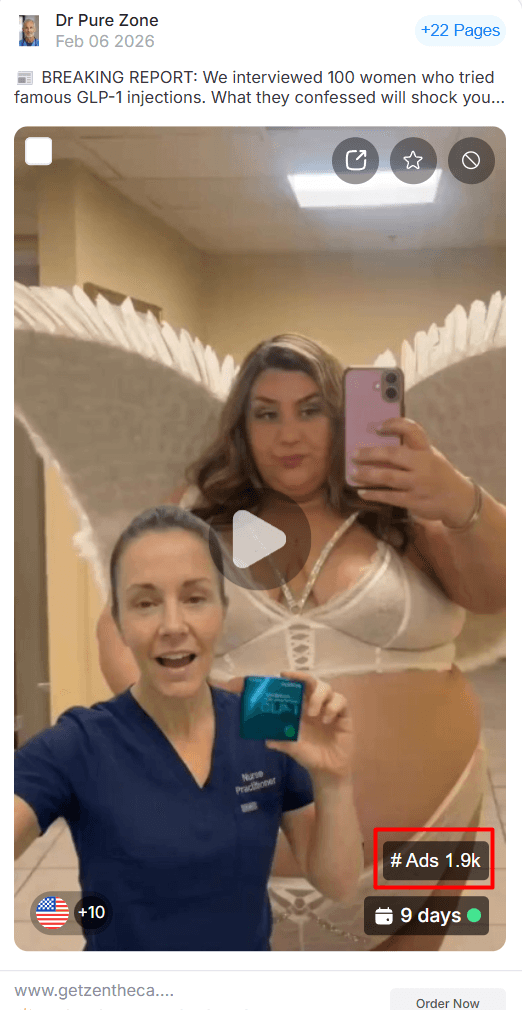
Here is where it gets interesting from a compliance angle. We spotted a creative with around 1,700 ads that initially looked like it might be a GLP-1 ad: the video referenced GLP-1 on the packaging. But it is not actually a GLP-1 product.
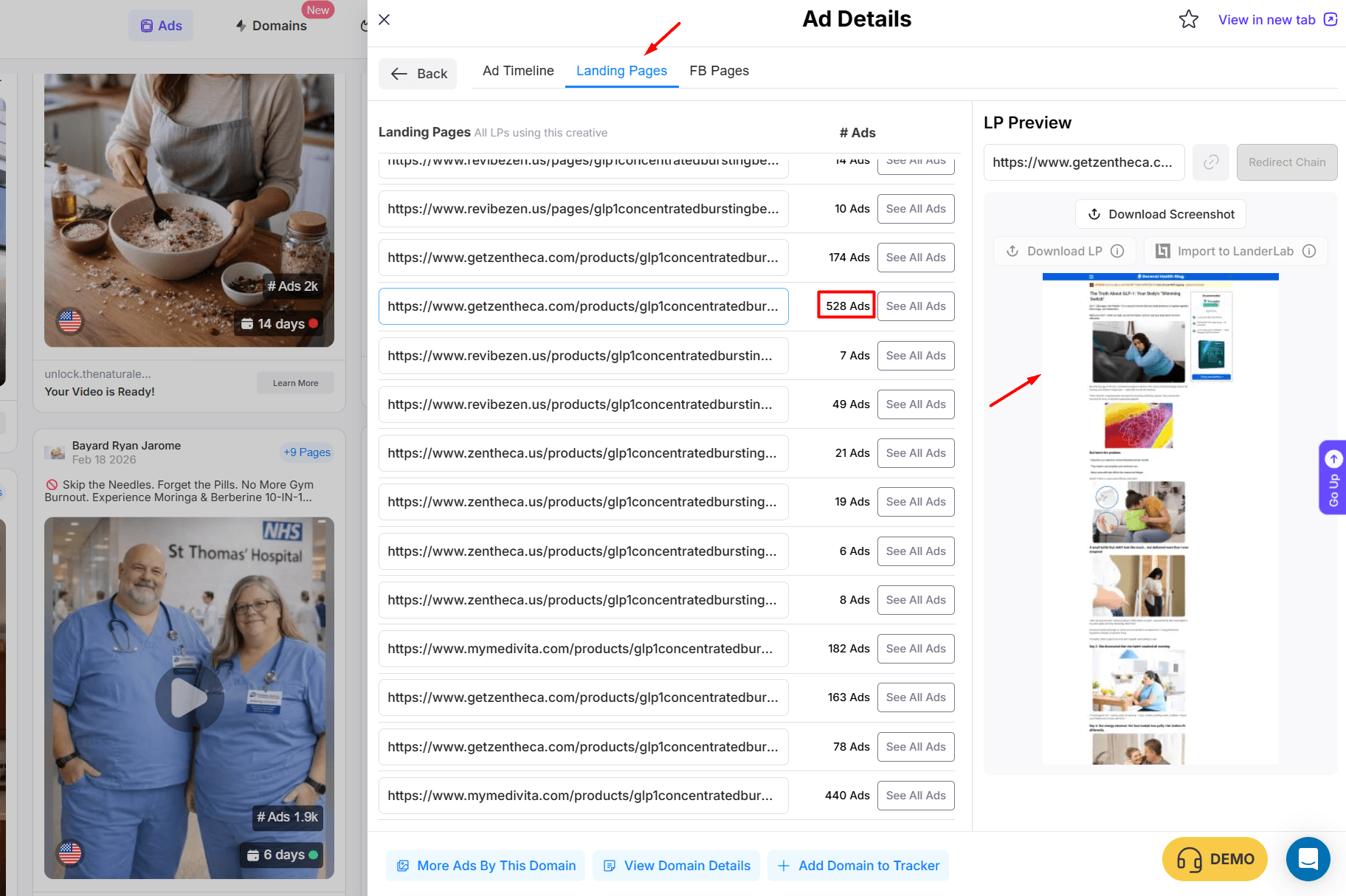
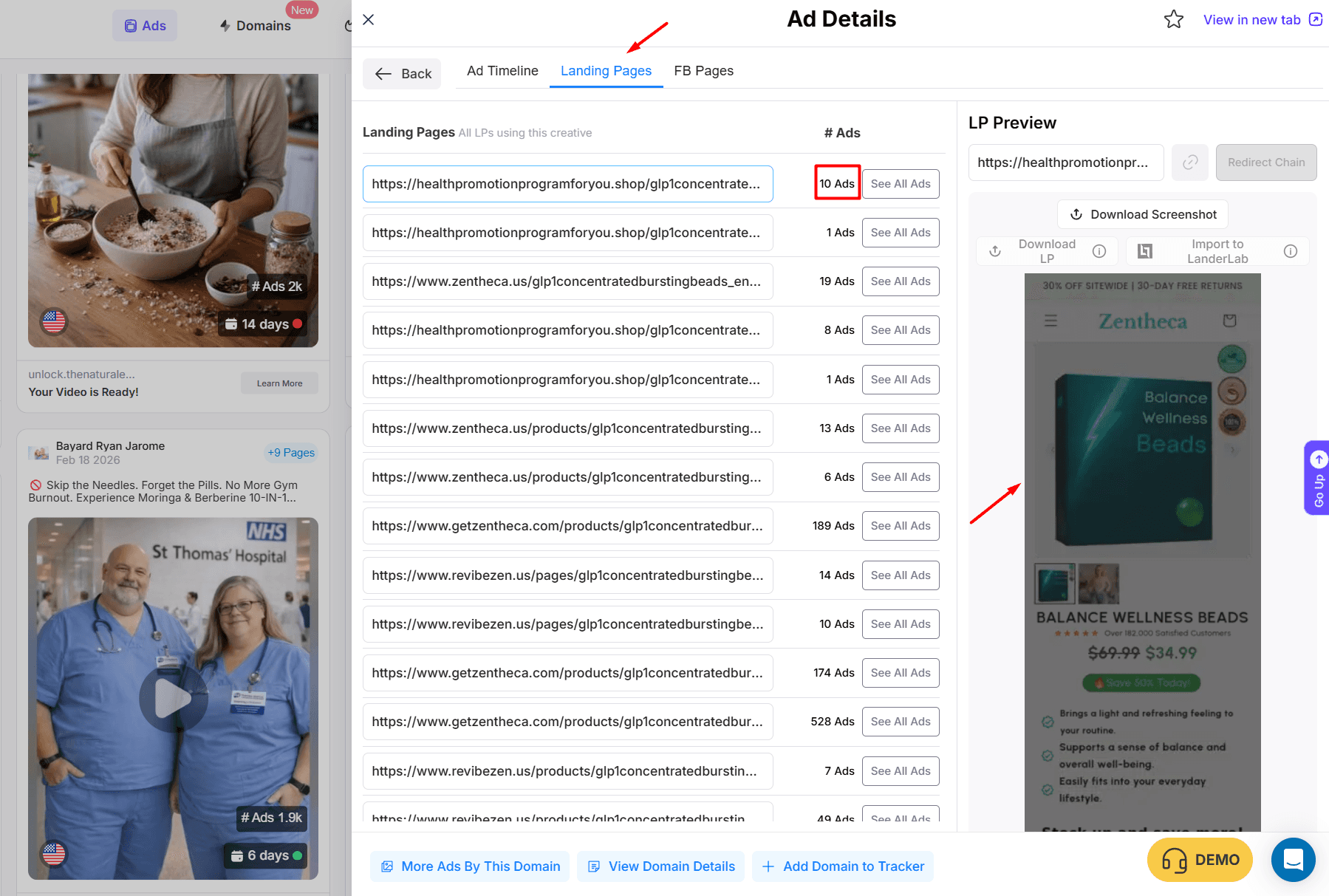
The brand is Zentheca, and they are selling something called Balance Wellness Beads. The positioning is clever: they are riding the massive GLP-1 wave without actually being a prescription drug. The product is framed as something that supports GLP-1, which means it is significantly easier to run in a compliant way on Meta.
The ad itself is clearly AI-generated (something we are seeing more and more across weight loss), and the advertiser is testing multiple landing page approaches (advertorials, product pages, different angles) all through various Facebook pages styled with a medical or wellness branding approach rather than the typical “before and after” consumer look.
This is a pattern worth watching. As GLP-1 drugs continue to dominate the weight loss conversation, expect more non-prescription products to position themselves adjacent to the trend. It is a smart way to capture search intent and cultural momentum without the regulatory headaches of promoting actual prescription medication.
(We will be covering GLP-1 and telehealth ads in a dedicated analysis soon. Stay tuned for that.)
Domain Analysis: Who Is Actually Winning by Volume
One of the most powerful ways to analyze a vertical is through domain-level data, looking at which destination domains are attracting the most ad activity, rather than just browsing individual ads.
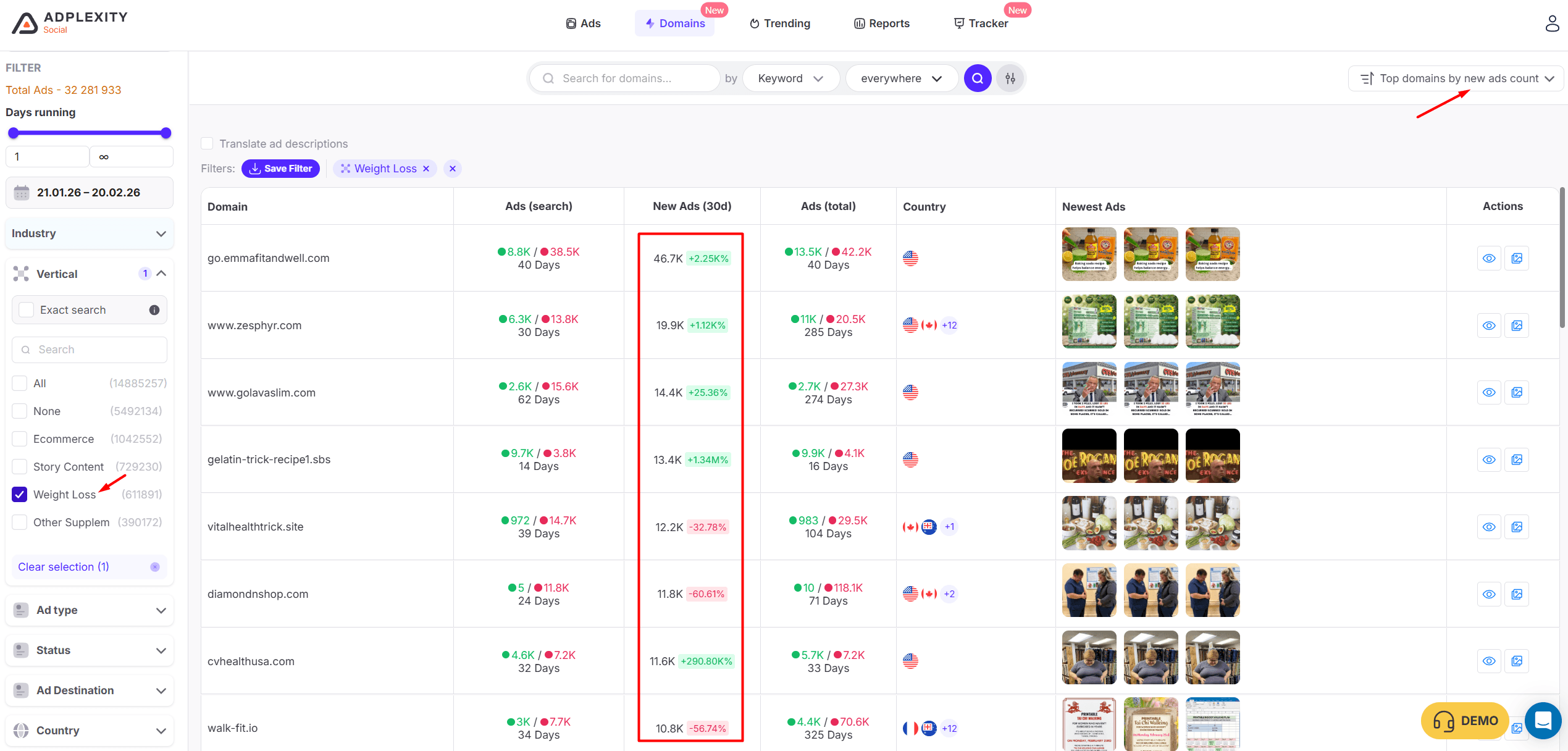
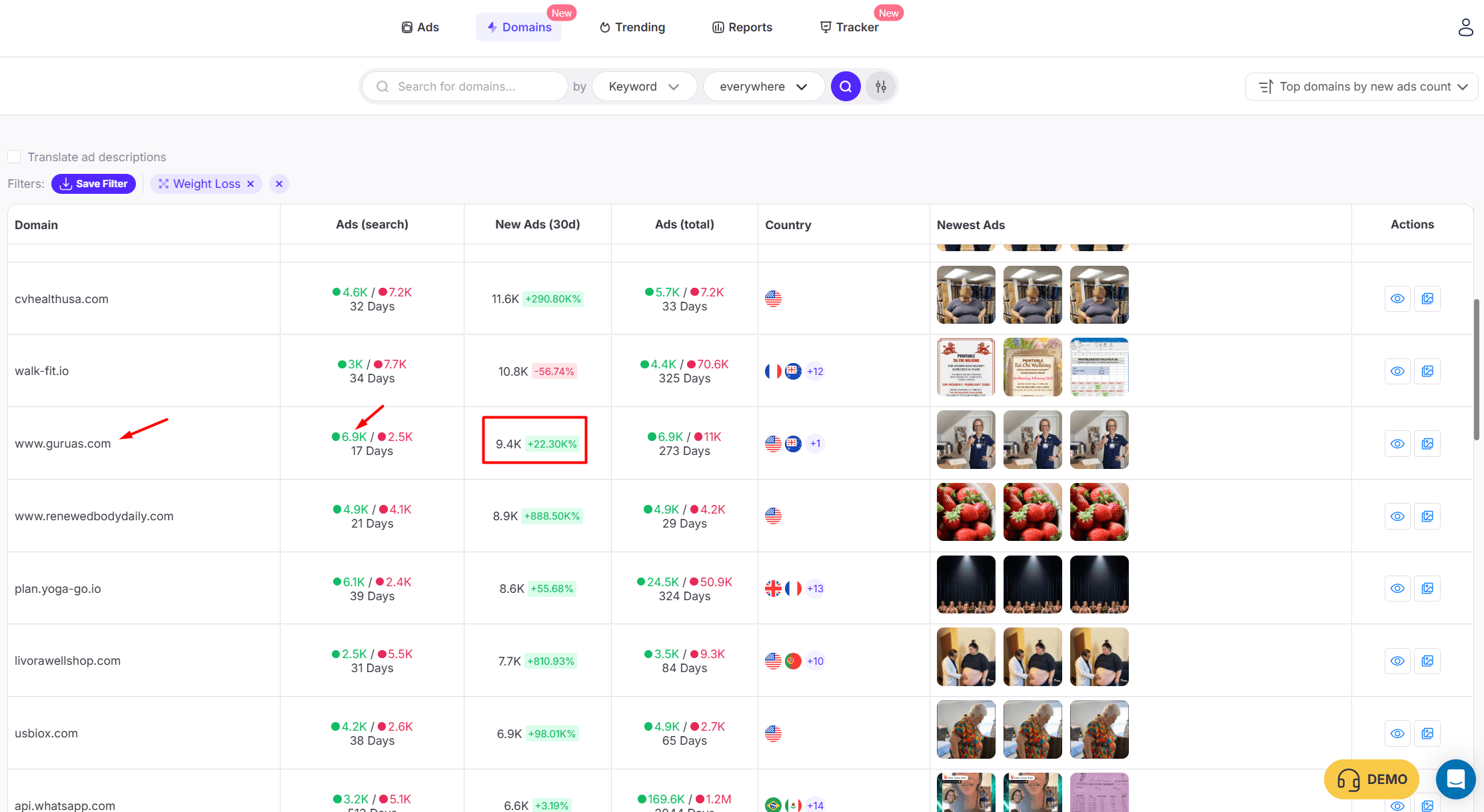
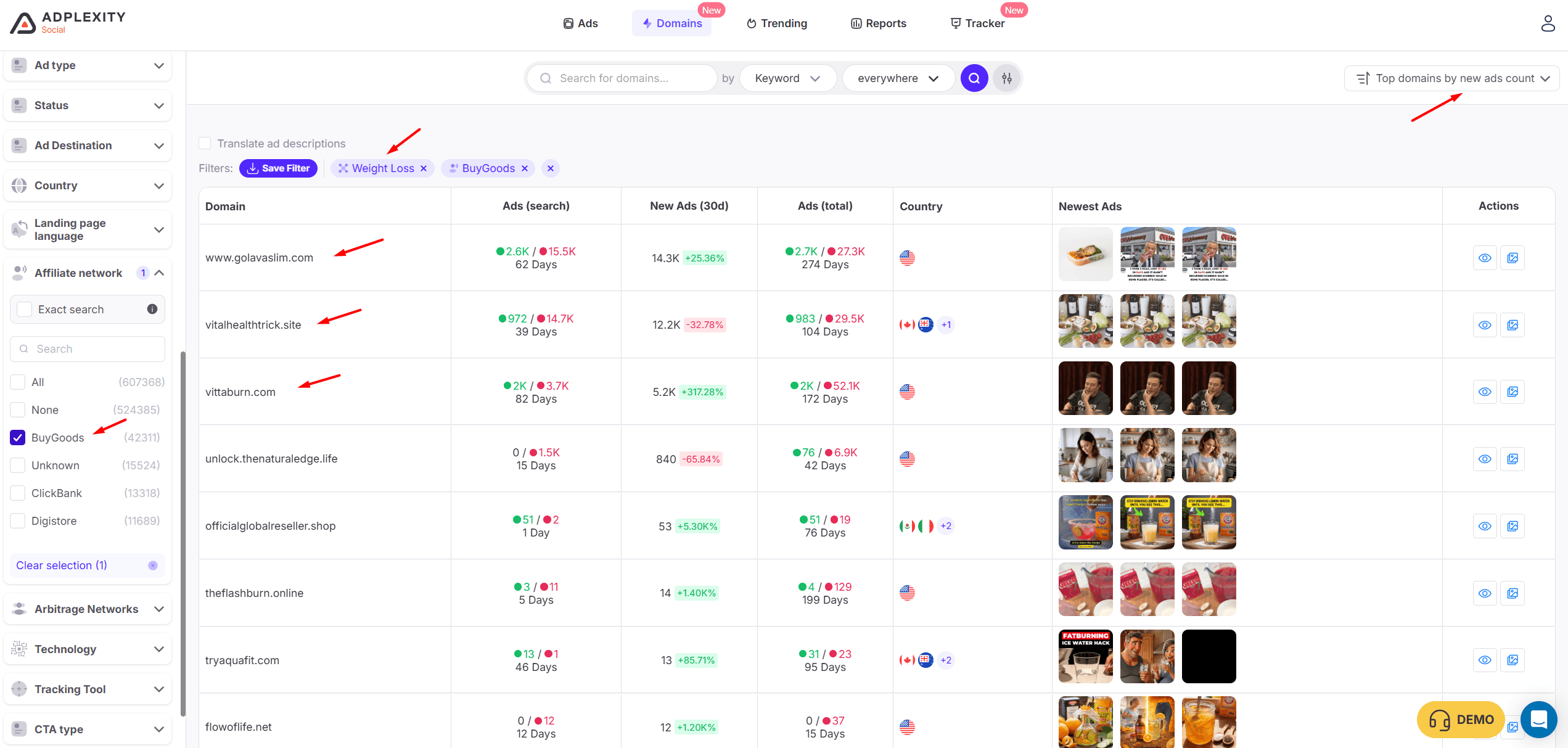
When we sorted weight loss domains by new ad count (the ones launching the most ads right now), the usual suspects appeared at the top: VSL funnels, weight loss patches, and supplement brands. But the real value is in identifying which specific domains are growing fastest.
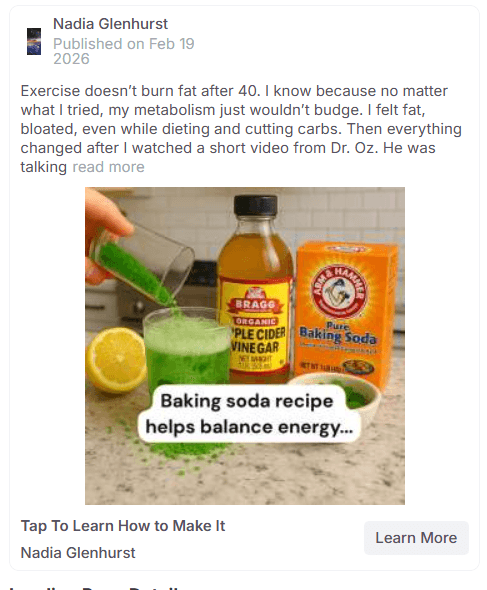
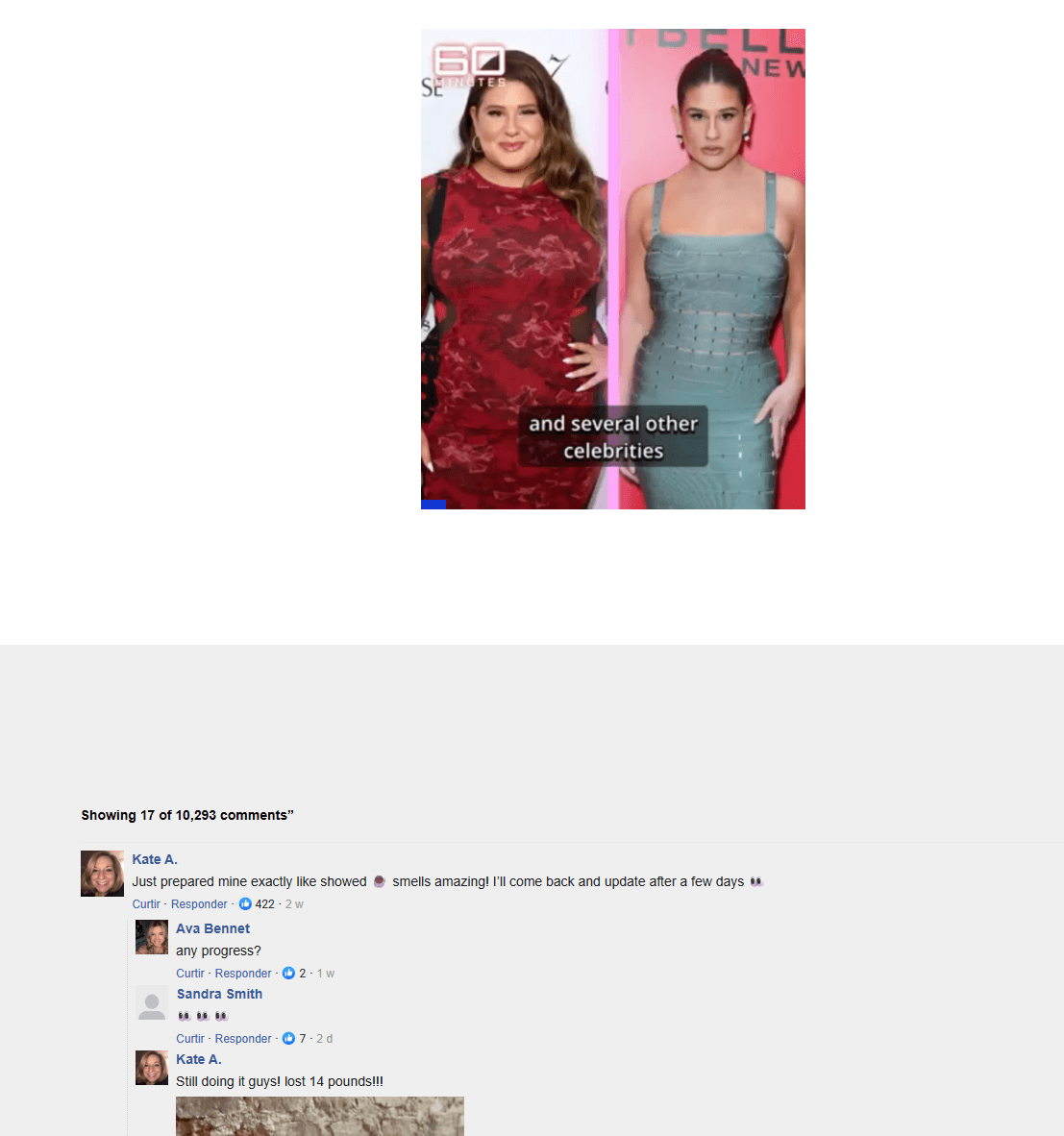
Go.EmmaFitandwell.com is a monster in this space. This VSL funnel drives traffic to a long-form video sales letter (we are talking 10–15 minutes, unskippable) that ultimately sells a supplement. Their top image creative alone had been used in over 50,000 ads, and they are running through a huge number of Facebook pages, all targeting the US. When you see creative volume like that combined with that many active fan pages, you are looking at serious media buying infrastructure.
Creative
Landing page
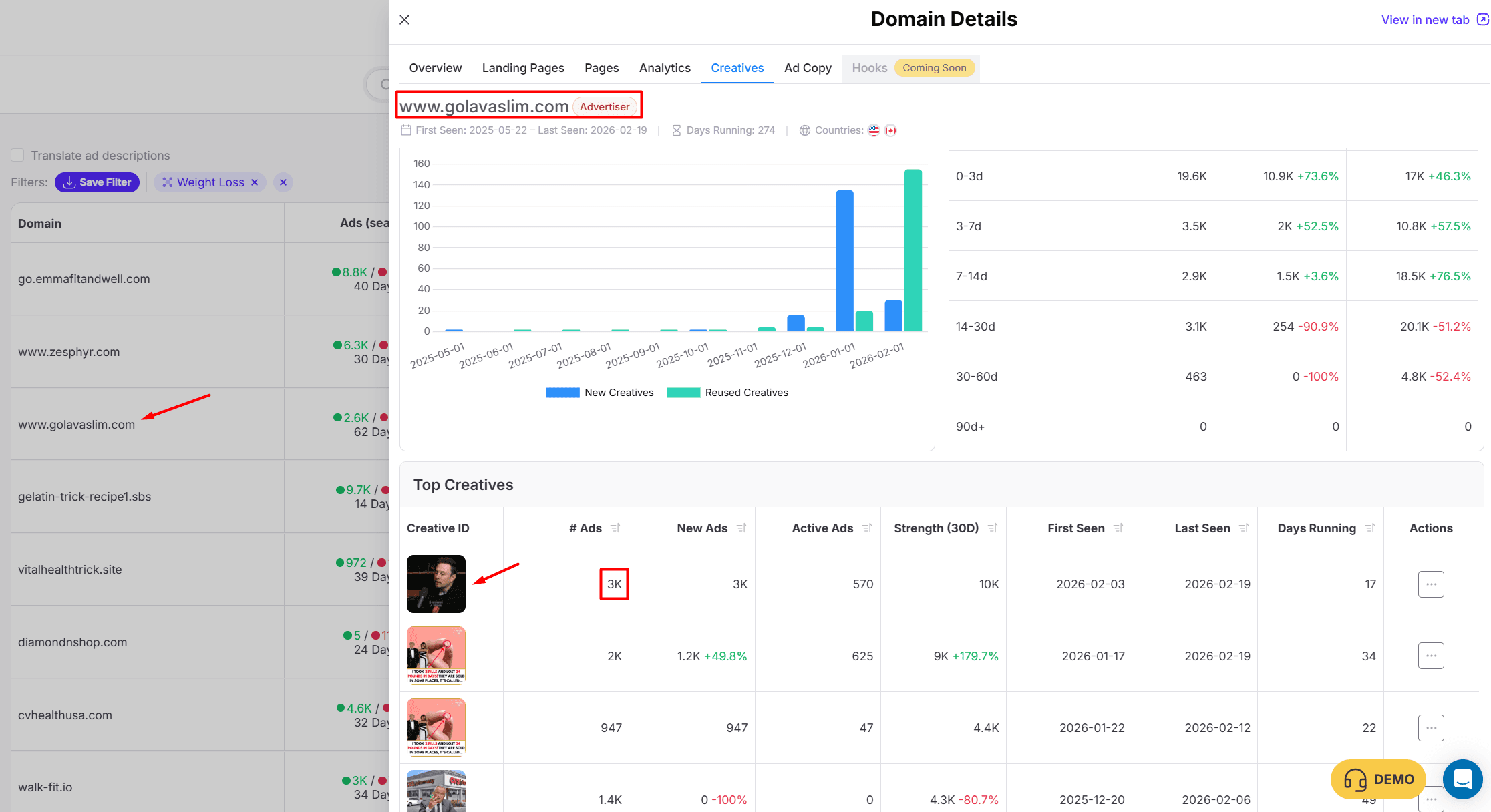
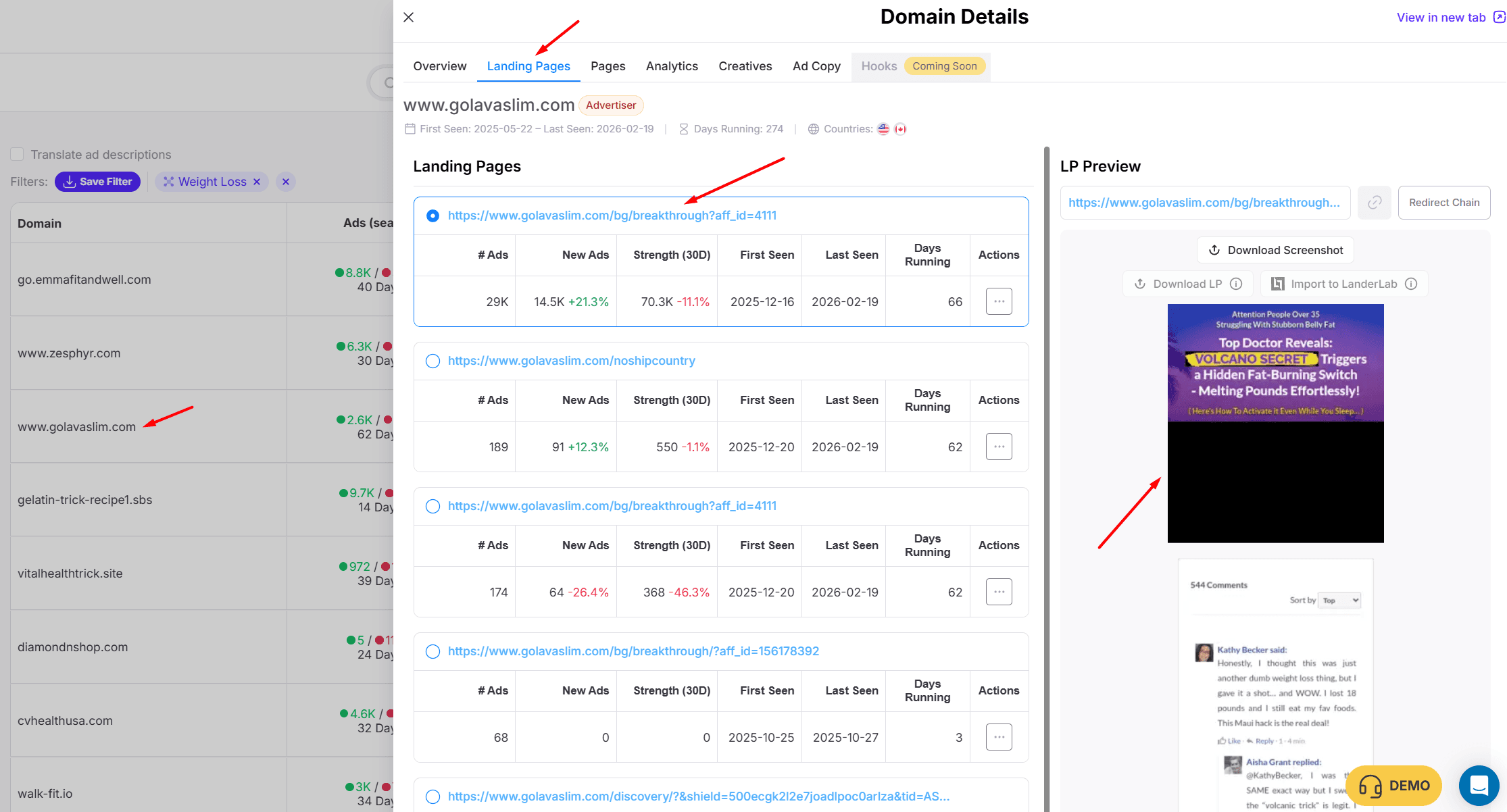
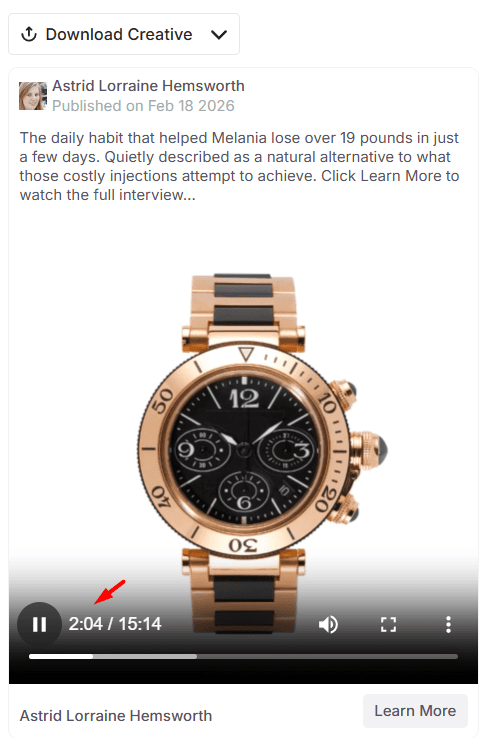
GoLavaSlim.com is another interesting case. They launched 14,000 ads in the last 30 days, with about 2,000 active at any given time, running 82% image ads and 18% video. Their creative strategy is more balanced than Go.EmmaFit’s, with several creatives in the low thousands rather than one dominant winner. When we dug into the landing page data, we could see it is primarily one affiliate (affiliate_ID 4111) pushing most of the volume on a BuyGoods offer. Their top VSL is around 15 minutes long, and here is a weird detail: after the actual video content ends, the video continues with just a clock running. If anyone knows the logic behind that tactic, we would genuinely love to hear it.
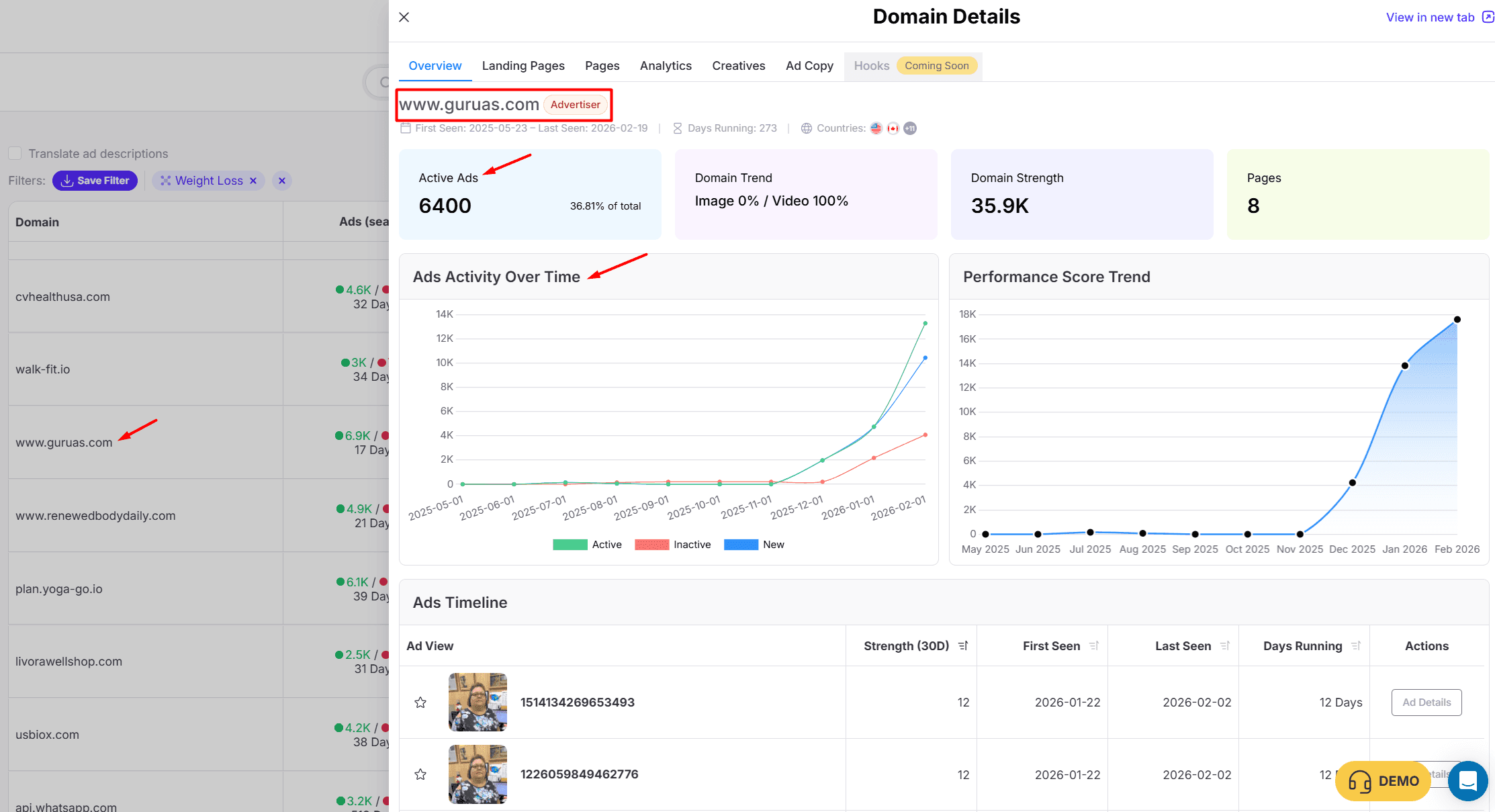
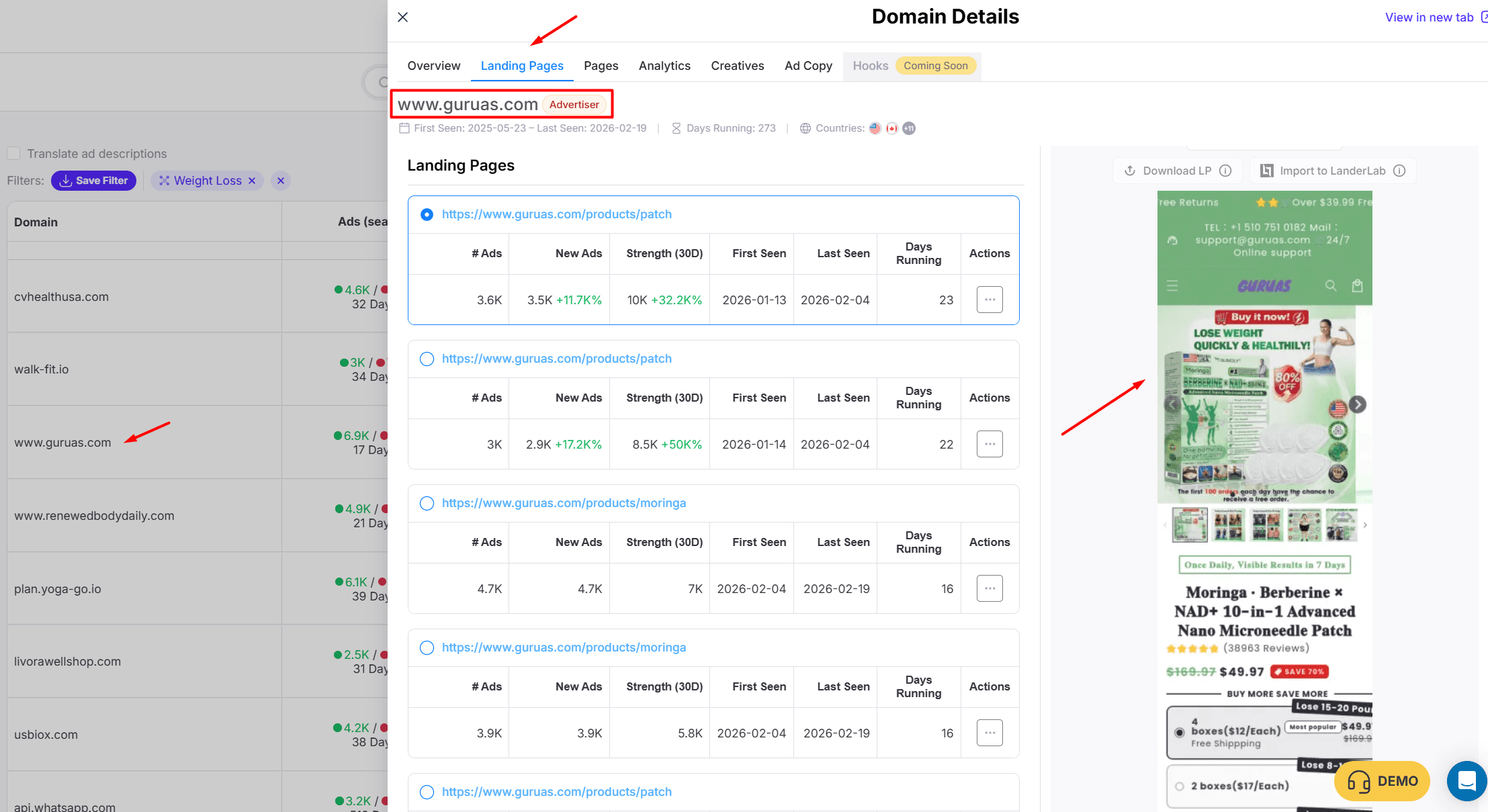
guruas.com was another domain that jumped out with almost 6,000 live ads, and once again, when we looked at the landing pages, we found weight loss patches.
Aggressive Tactics We Are Seeing (But Not Recommending)
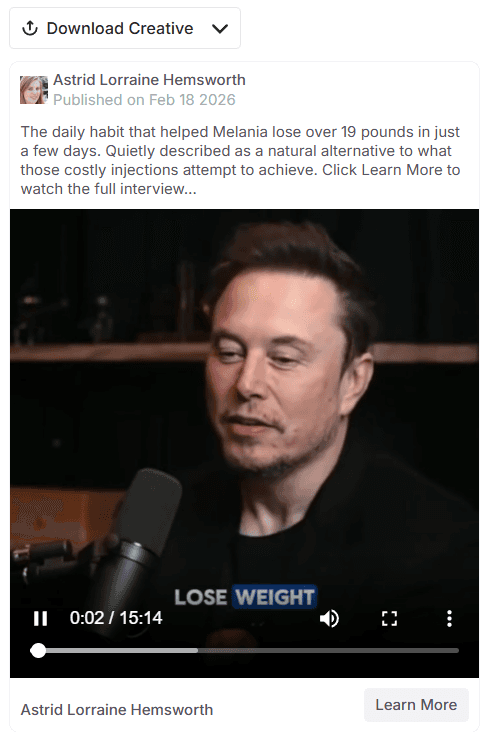
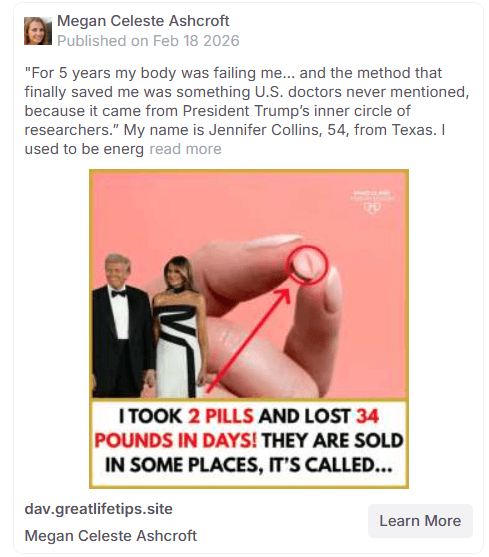
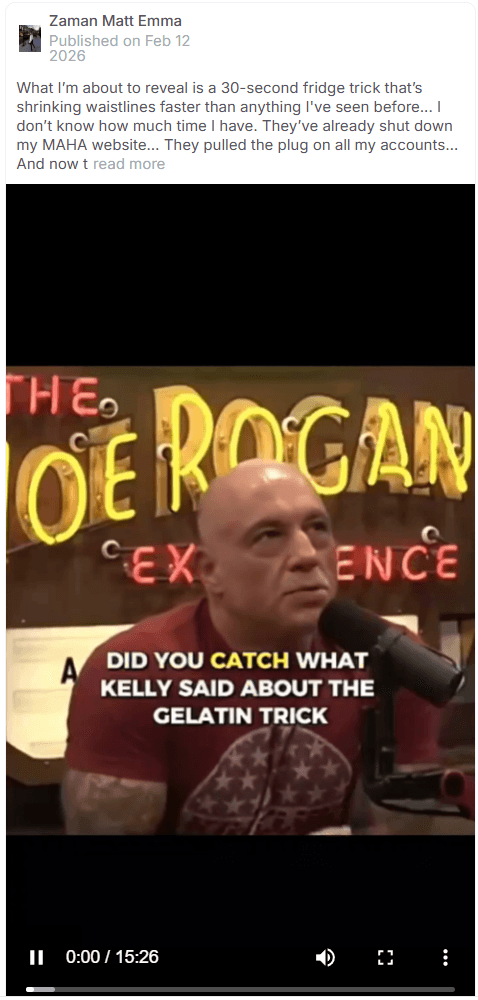
Part of competitive intelligence is documenting what is happening in the market, even the stuff that is pushing boundaries. We spotted several advertisers using AI-generated videos featuring public figures, including imagery of political figures, in their weight loss ads. Some thumbnails were deliberately deceptive, showing one thing while the actual video content was completely different (one showed what appeared to be a podcast clip that turned out to be a VSL).
This is about as aggressive as it gets on Meta. We are not recommending anyone follow this approach. The compliance risks are obvious. But if you are analyzing the competition, it is worth knowing that some affiliates are willing to go this far to grab attention, and they are apparently getting enough runway on the platform to scale.
The Affiliate Network Breakdown: BuyGoods, ClickBank, and Digistore
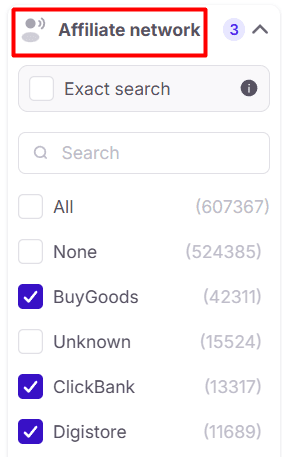
This is where things get really actionable for affiliates. By filtering the weight loss vertical by affiliate network, you can see exactly which offers and domains are getting traction on each platform.
BuyGoods is the clear leader right now with 42,000 weight loss ads in the last 30 days. Three domains are dominating the BuyGoods weight loss space: Vitahealthtrick.site (an affiliate pre-lander), golavaslim.com, and vitaburn.com. After those top three, the volume drops off dramatically: the next tier is launching around 1,400 ads, and everything below that has minimal activity. So if you are an affiliate looking at BuyGoods weight loss offers, the data is telling you exactly where the money is flowing.
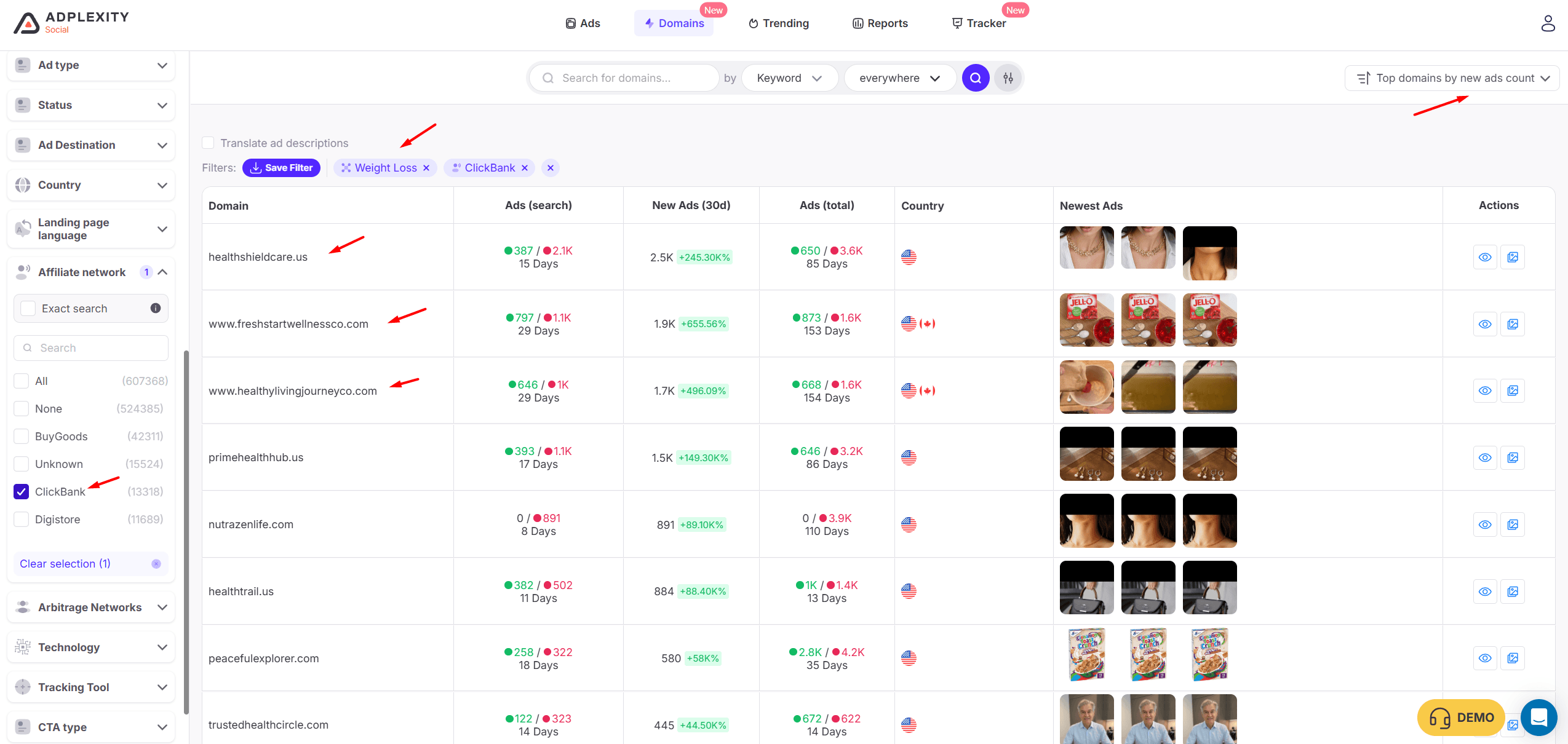
ClickBank has noticeably less volume than BuyGoods in this vertical right now. The top ClickBank weight loss domains are healthshieldcareus.com (an affiliate pre-lander), freshstartwellnessco.com (also a pre-lander), and healthylivingjourneyco.com (another pre-lander). The pattern here is interesting: it is mostly pre-landers rather than direct product pages, which suggests affiliates are doing the heavy lifting on the their side rather than the Clickbank offer themselves. A lot of what we saw on ClickBank was VSL-driven with advertorial-style landing pages, and the creatives were often using deceptive thumbnails to drive clicks.
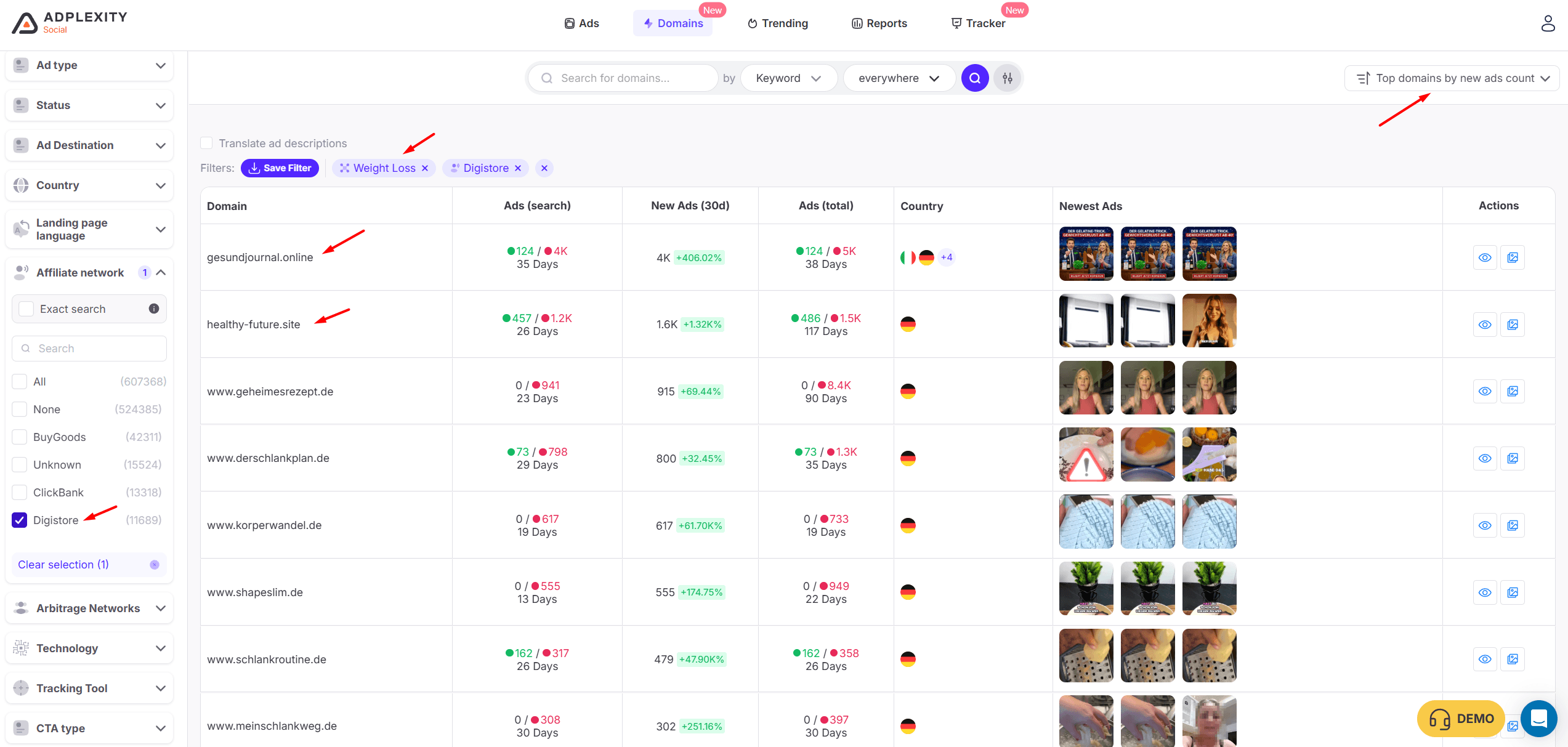
Digistore has the smallest footprint of the three, with gesundjournal.online and healthy-future.site as the notable domains. The German-language domain hints at a European focus, which makes sense given Digistore’s stronger presence in German-speaking markets.
Using Keyword Refinement to Find Niche Angles
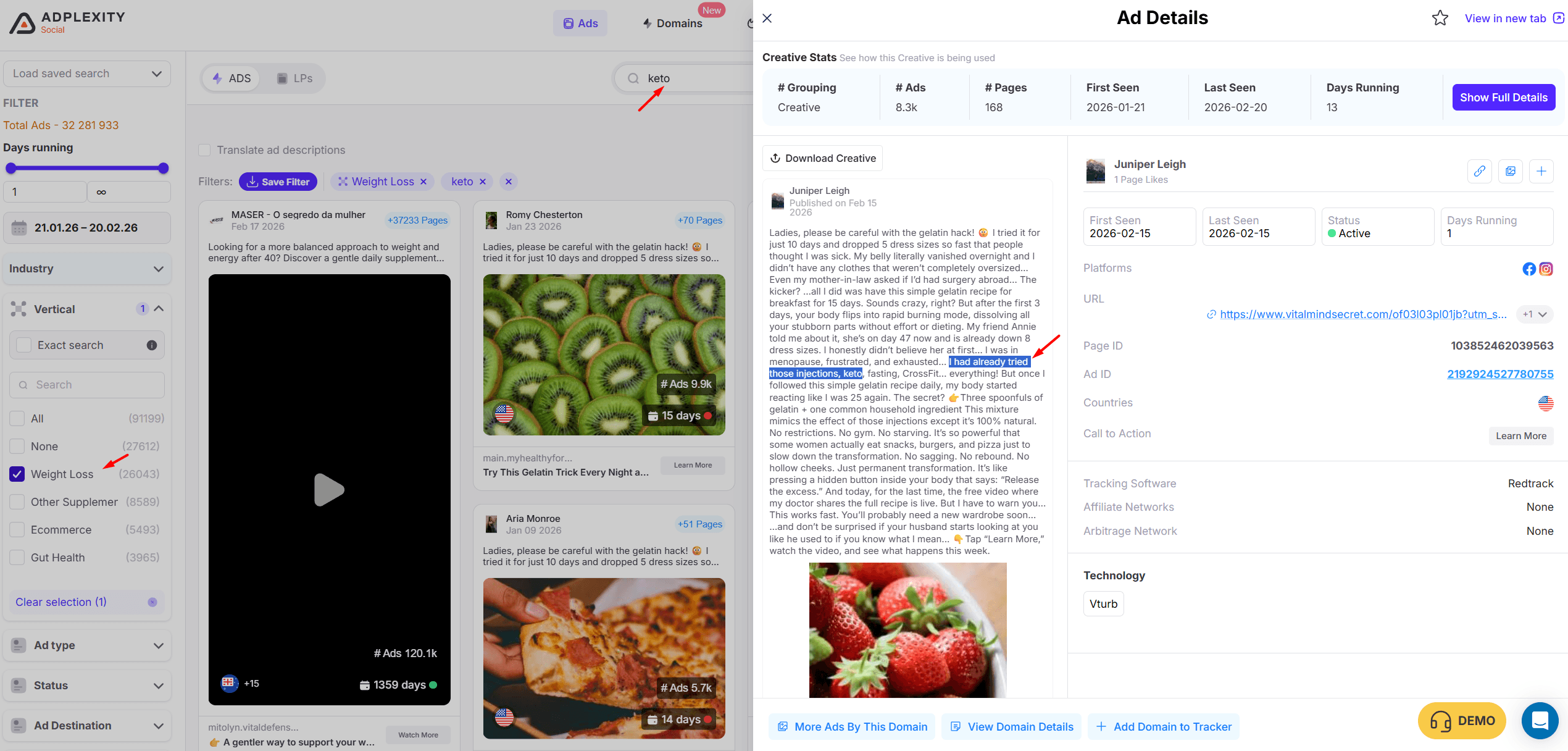
The vertical filter gives you the big picture, but keyword search is how you drill into specific sub-niches. We tested this by searching for “keto” within the weight loss vertical.
What showed up was mostly contrarian: ads that reference keto in order to position their product as a better alternative. Think copy like “I had already tried keto” followed by a pitch for a different supplement or approach. The “gelatin trick” was another angle that kept appearing across multiple ads and domains.
This is a useful research pattern: search for the trending keyword in your space, and instead of looking for ads that promote it directly, look for ads that use it as a hook to sell something else. That is often where the more creative (and compliant) angles live.
VSLs Are Everywhere, And Getting Their Own Deep Dive
If there is one thing this analysis made obvious, it is that VSLs (video sales letters) completely dominate the weight loss affiliate space. Almost every domain we clicked into, whether it was a BuyGoods offer, a ClickBank product, or an independent brand, was running some form of long-form VSL funnel.
The format is consistent: a pre-lander or advertorial that drives to a 10–15 minute unskippable video, which then reveals the product and pushes to a checkout page. The VSL format clearly works in this vertical, and it is being deployed at a scale that suggests it is not going anywhere soon.
We are preparing a dedicated deep dive into VSLs across all verticals: which ones are performing, how they are structured, and what the redirect chains look like. That is coming soon.
One Outlier: Weight Loss Apps Are Losing Steam
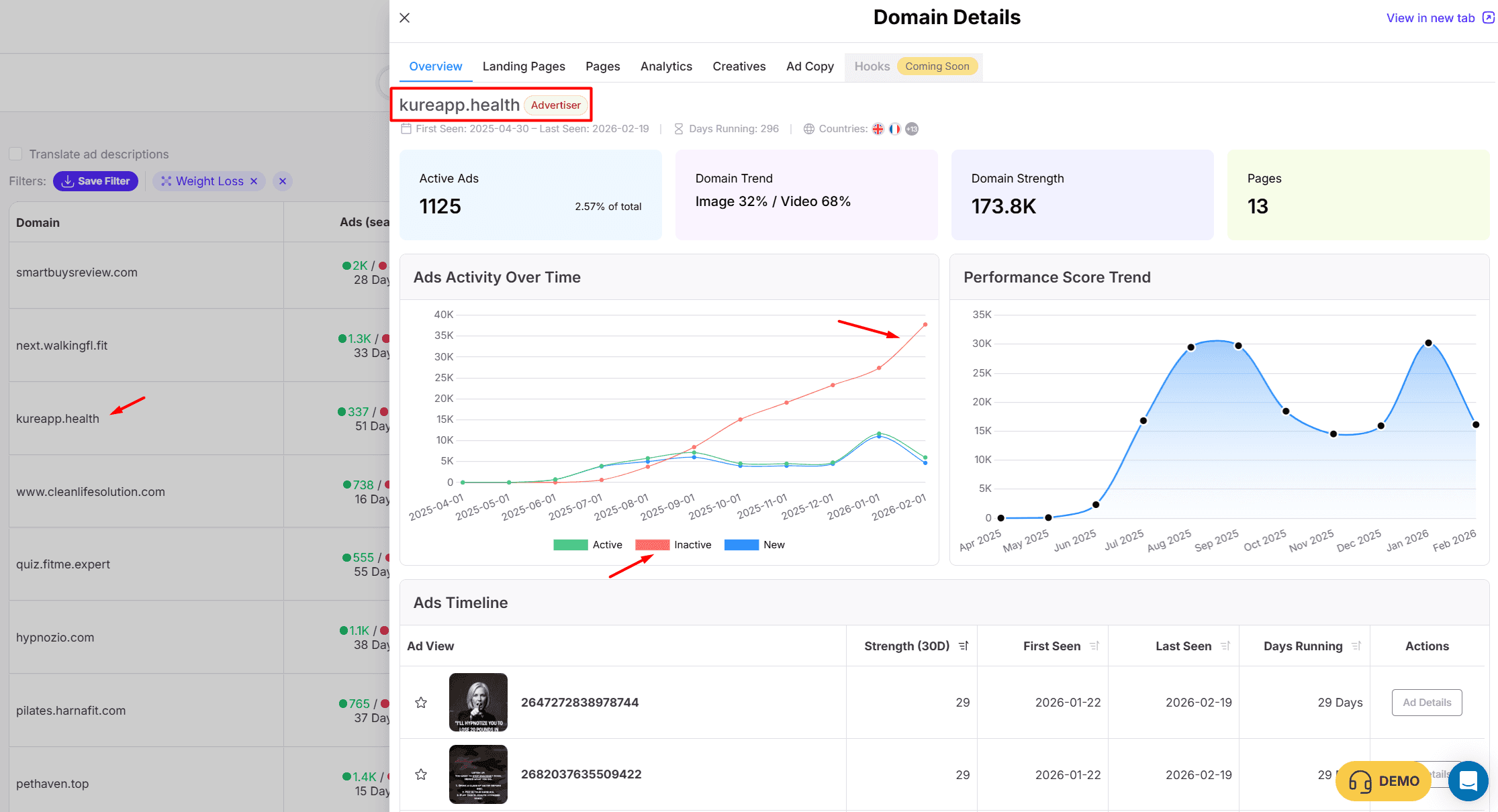
Not everything in the weight loss space is scaling up. We found a weight loss app (Kureapp.health) running about 900 ads, but the trend line was heading the wrong direction: more ads going inactive than new ones launching. They were targeting the US, Canada, UK, and Australia with heavy fan page usage, but the declining graph suggests the unit economics may not be holding up.
This is exactly the kind of signal that saves you time. If you were considering building or promoting a weight loss app, the data is showing you that even established players are pulling back. Supplements, patches, and VSL-driven offers are where the spend is going.
What This Means If You Are In the Weight Loss Space
The weight loss vertical on Meta is massive, competitive, and consolidating around a few dominant formats. Here is how to think about it depending on where you sit:
If you are an affiliate, the data points toward BuyGoods as the network with the most active weight loss volume right now. The top three domains on each network give you a clear starting point for offer selection. Pay attention to creative volume: when you see one creative running across thousands of ads, that is a strong signal worth investigating further.
If you are running an ecom brand, weight loss patches are the format with the most momentum. Whether that is a long-term trend or a bubble is debatable, but right now the spend is undeniable. The GLP-1-adjacent positioning (like Zentheca’s approach) is a smart angle that may have legs as the cultural conversation around weight loss drugs continues.
If you are doing creative research, the shift toward AI-generated content in this vertical is accelerating. Many of the newer creatives we analyzed were clearly AI-produced, which lowers the production barrier but also means the space is getting noisier faster.
The weight loss vertical is not going to get less competitive. But with the right intel, knowing which domains are scaling, which networks are hot, and which creative formats are actually winning, you can at least make sure you are competing with real data instead of guessing.
If you are serious about: uncovering the strongest campaigns, tracking real, revenue-driving funnels, and dissecting the exact angles top marketers are using right now… Then AdPlexity Social is hands-down the #1 tool you should be using
Key Takeaways: Weight loss is one of the most crowded verticals on Meta right now, with over 611,000 ads tagged in the last 30 days. Weight loss patches are the dominant product format across virtually every domain and network we analyzed. BuyGoods is outpacing both ClickBank and Digistore in affiliate volume by a wide margin, and a handful of specific domains control most of the activity on each network.
Watch the full tutorial on YouTube:
Weight loss is not just competitive on Meta. It is borderline absurd. When we pulled the data in AdPlexity Social, the vertical filter returned 611,000 ads in the last 30 days alone. That makes it one of the top categorized verticals on the platform, ahead of skincare, finance, and things we track.
But raw volume does not tell you much on its own. What actually matters is where the money is going, which creatives are winning, and which offers are getting the most traction. So we dug in.
The Creative Grouping Trick That Cuts Through the Noise
When you are staring at 611K ads, scrolling through them one by one is a waste of time. The move here is creative grouping: sorting ads by the most-used creative rather than by recency or days active.
This immediately surfaces the winners. The top creative in the weight loss vertical had been used across 31,000 ads. The second: 19,400. The third: 18,300. These are not small-time tests. When a single creative is deployed across tens of thousands of ads, somebody is scaling hard because it is working.
Most of the top creatives we found were tied to weight loss patches, which, as we will get into, are absolutely everywhere right now. But scrolling past the obvious leaders into the 1,000–3,000 range is where things get more interesting, because that is where you start finding creatives that have not been burned yet.
Weight Loss Patches Are Dominating Everything
This is not an exaggeration. Every angle we explored (creative grouping, domain analysis, etc) kept surfacing weight loss patches. Different brands, different domains, different fan pages, but the same core product format.
One domain alone had a single image creative running across over 50,000 ads. That creative was being pushed through dozens of Facebook pages, all targeting the US. You do not see that kind of volume on a non-performing offer. The economics simply would not support it.
The patches are showing up under multiple brand names, and it is unclear whether some of these are the same parent company spinning up new storefronts or genuinely independent sellers. But the pattern is unmistakable: if you are in the weight loss space on Meta right now, patches are the product format getting the most spend.
A Smart GLP-1-Adjacent Play: Zentheca’s Balance Wellness Beads
Here is where it gets interesting from a compliance angle. We spotted a creative with around 1,700 ads that initially looked like it might be a GLP-1 ad: the video referenced GLP-1 on the packaging. But it is not actually a GLP-1 product.
The brand is Zentheca, and they are selling something called Balance Wellness Beads. The positioning is clever: they are riding the massive GLP-1 wave without actually being a prescription drug. The product is framed as something that supports GLP-1, which means it is significantly easier to run in a compliant way on Meta.
The ad itself is clearly AI-generated (something we are seeing more and more across weight loss), and the advertiser is testing multiple landing page approaches (advertorials, product pages, different angles) all through various Facebook pages styled with a medical or wellness branding approach rather than the typical “before and after” consumer look.
This is a pattern worth watching. As GLP-1 drugs continue to dominate the weight loss conversation, expect more non-prescription products to position themselves adjacent to the trend. It is a smart way to capture search intent and cultural momentum without the regulatory headaches of promoting actual prescription medication.
(We will be covering GLP-1 and telehealth ads in a dedicated analysis soon. Stay tuned for that.)
Domain Analysis: Who Is Actually Winning by Volume
One of the most powerful ways to analyze a vertical is through domain-level data, looking at which destination domains are attracting the most ad activity, rather than just browsing individual ads.
When we sorted weight loss domains by new ad count (the ones launching the most ads right now), the usual suspects appeared at the top: VSL funnels, weight loss patches, and supplement brands. But the real value is in identifying which specific domains are growing fastest.
Go.EmmaFitandwell.com is a monster in this space. This VSL funnel drives traffic to a long-form video sales letter (we are talking 10–15 minutes, unskippable) that ultimately sells a supplement. Their top image creative alone had been used in over 50,000 ads, and they are running through a huge number of Facebook pages, all targeting the US. When you see creative volume like that combined with that many active fan pages, you are looking at serious media buying infrastructure.
Creative
Landing page
GoLavaSlim.com is another interesting case. They launched 14,000 ads in the last 30 days, with about 2,000 active at any given time, running 82% image ads and 18% video. Their creative strategy is more balanced than Go.EmmaFit’s, with several creatives in the low thousands rather than one dominant winner. When we dug into the landing page data, we could see it is primarily one affiliate (affiliate_ID 4111) pushing most of the volume on a BuyGoods offer. Their top VSL is around 15 minutes long, and here is a weird detail: after the actual video content ends, the video continues with just a clock running. If anyone knows the logic behind that tactic, we would genuinely love to hear it.
guruas.com was another domain that jumped out with almost 6,000 live ads, and once again, when we looked at the landing pages, we found weight loss patches.
Aggressive Tactics We Are Seeing (But Not Recommending)
Part of competitive intelligence is documenting what is happening in the market, even the stuff that is pushing boundaries. We spotted several advertisers using AI-generated videos featuring public figures, including imagery of political figures, in their weight loss ads. Some thumbnails were deliberately deceptive, showing one thing while the actual video content was completely different (one showed what appeared to be a podcast clip that turned out to be a VSL).
This is about as aggressive as it gets on Meta. We are not recommending anyone follow this approach. The compliance risks are obvious. But if you are analyzing the competition, it is worth knowing that some affiliates are willing to go this far to grab attention, and they are apparently getting enough runway on the platform to scale.
The Affiliate Network Breakdown: BuyGoods, ClickBank, and Digistore
This is where things get really actionable for affiliates. By filtering the weight loss vertical by affiliate network, you can see exactly which offers and domains are getting traction on each platform.
BuyGoods is the clear leader right now with 42,000 weight loss ads in the last 30 days. Three domains are dominating the BuyGoods weight loss space: Vitahealthtrick.site (an affiliate pre-lander), golavaslim.com, and vitaburn.com. After those top three, the volume drops off dramatically: the next tier is launching around 1,400 ads, and everything below that has minimal activity. So if you are an affiliate looking at BuyGoods weight loss offers, the data is telling you exactly where the money is flowing.
ClickBank has noticeably less volume than BuyGoods in this vertical right now. The top ClickBank weight loss domains are healthshieldcareus.com (an affiliate pre-lander), freshstartwellnessco.com (also a pre-lander), and healthylivingjourneyco.com (another pre-lander). The pattern here is interesting: it is mostly pre-landers rather than direct product pages, which suggests affiliates are doing the heavy lifting on the their side rather than the Clickbank offer themselves. A lot of what we saw on ClickBank was VSL-driven with advertorial-style landing pages, and the creatives were often using deceptive thumbnails to drive clicks.
Digistore has the smallest footprint of the three, with gesundjournal.online and healthy-future.site as the notable domains. The German-language domain hints at a European focus, which makes sense given Digistore’s stronger presence in German-speaking markets.
Using Keyword Refinement to Find Niche Angles
The vertical filter gives you the big picture, but keyword search is how you drill into specific sub-niches. We tested this by searching for “keto” within the weight loss vertical.
What showed up was mostly contrarian: ads that reference keto in order to position their product as a better alternative. Think copy like “I had already tried keto” followed by a pitch for a different supplement or approach. The “gelatin trick” was another angle that kept appearing across multiple ads and domains.
This is a useful research pattern: search for the trending keyword in your space, and instead of looking for ads that promote it directly, look for ads that use it as a hook to sell something else. That is often where the more creative (and compliant) angles live.
VSLs Are Everywhere, And Getting Their Own Deep Dive
If there is one thing this analysis made obvious, it is that VSLs (video sales letters) completely dominate the weight loss affiliate space. Almost every domain we clicked into, whether it was a BuyGoods offer, a ClickBank product, or an independent brand, was running some form of long-form VSL funnel.
The format is consistent: a pre-lander or advertorial that drives to a 10–15 minute unskippable video, which then reveals the product and pushes to a checkout page. The VSL format clearly works in this vertical, and it is being deployed at a scale that suggests it is not going anywhere soon.
We are preparing a dedicated deep dive into VSLs across all verticals: which ones are performing, how they are structured, and what the redirect chains look like. That is coming soon.
One Outlier: Weight Loss Apps Are Losing Steam
Not everything in the weight loss space is scaling up. We found a weight loss app (Kureapp.health) running about 900 ads, but the trend line was heading the wrong direction: more ads going inactive than new ones launching. They were targeting the US, Canada, UK, and Australia with heavy fan page usage, but the declining graph suggests the unit economics may not be holding up.
This is exactly the kind of signal that saves you time. If you were considering building or promoting a weight loss app, the data is showing you that even established players are pulling back. Supplements, patches, and VSL-driven offers are where the spend is going.
What This Means If You Are In the Weight Loss Space
The weight loss vertical on Meta is massive, competitive, and consolidating around a few dominant formats. Here is how to think about it depending on where you sit:
If you are an affiliate, the data points toward BuyGoods as the network with the most active weight loss volume right now. The top three domains on each network give you a clear starting point for offer selection. Pay attention to creative volume: when you see one creative running across thousands of ads, that is a strong signal worth investigating further.
If you are running an ecom brand, weight loss patches are the format with the most momentum. Whether that is a long-term trend or a bubble is debatable, but right now the spend is undeniable. The GLP-1-adjacent positioning (like Zentheca’s approach) is a smart angle that may have legs as the cultural conversation around weight loss drugs continues.
If you are doing creative research, the shift toward AI-generated content in this vertical is accelerating. Many of the newer creatives we analyzed were clearly AI-produced, which lowers the production barrier but also means the space is getting noisier faster.
The weight loss vertical is not going to get less competitive. But with the right intel, knowing which domains are scaling, which networks are hot, and which creative formats are actually winning, you can at least make sure you are competing with real data instead of guessing.
If you are serious about: uncovering the strongest campaigns, tracking real, revenue-driving funnels, and dissecting the exact angles top marketers are using right now… Then AdPlexity Social is hands-down the #1 tool you should be using
Table of Contents
Quickly navigate through the key sections of this article.