
What Is Working in Telehealth Ads Right Now: Inside the Brands Scaling Hardest on Meta
Share:
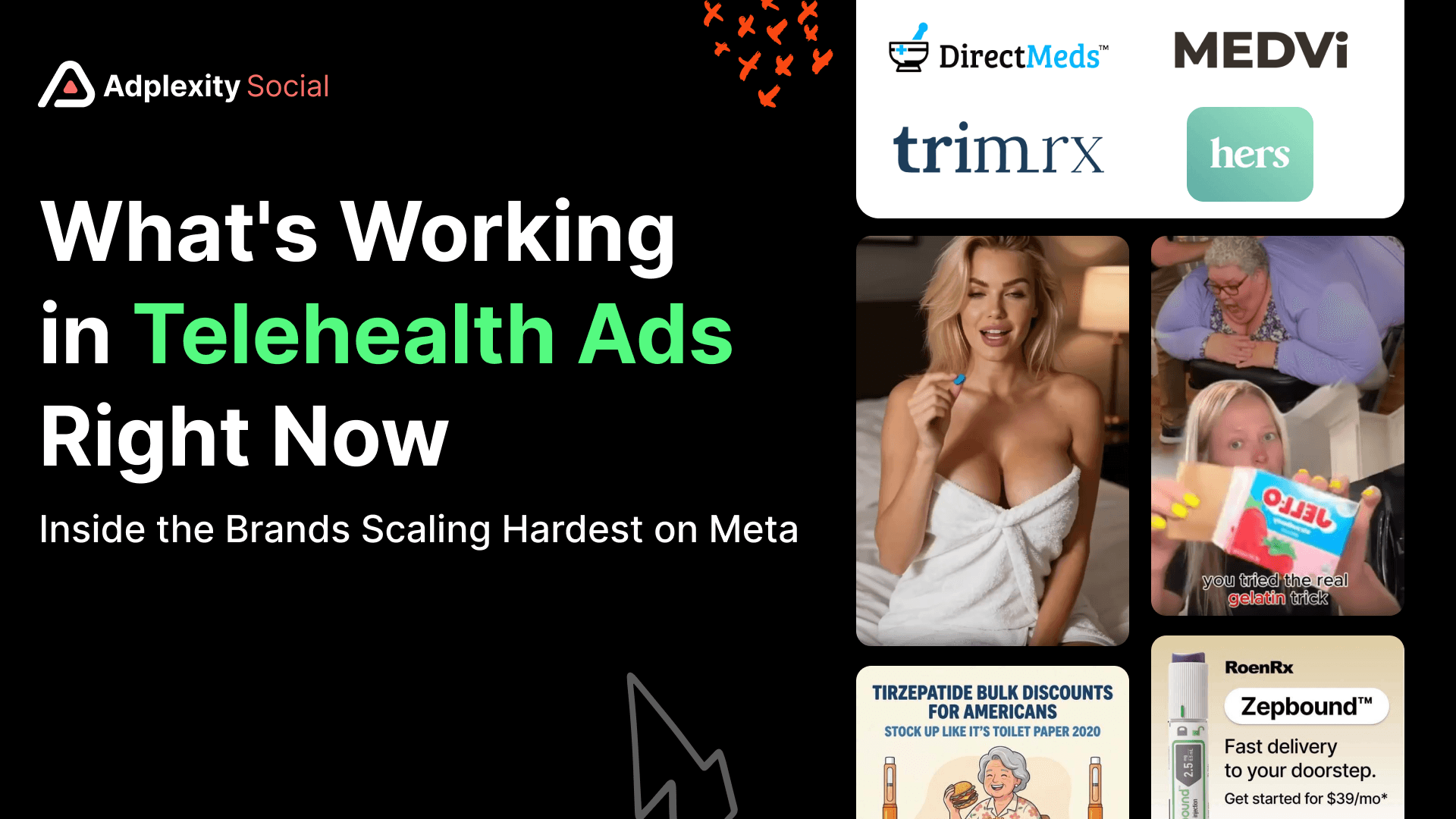
Telehealth on Meta is not a trend anymore. It is the dominant paid acquisition channel for a category that includes weight loss, ED, hair loss, anti-aging, testosterone, and general health supplements. The brands buying the most traffic in this space are scaling fast, burning through creatives in weeks, and rotating through hundreds of Facebook fan pages to keep CPMs down.
If you run paid social for a telehealth brand, or you are an affiliate pushing one of these offers, you already know the surface level of this. What is harder to see is who is actually scaling versus who is just present, which sub-verticals are growing fastest, and what creative angles are doing the heavy lifting.
AdPlexity Social indexes telehealth ads on Meta at scale and monitors them every day to see which ones stay live. Here is what the data shows in 2026, and how every campaign in this space gets surfaced regardless of how it is structured.
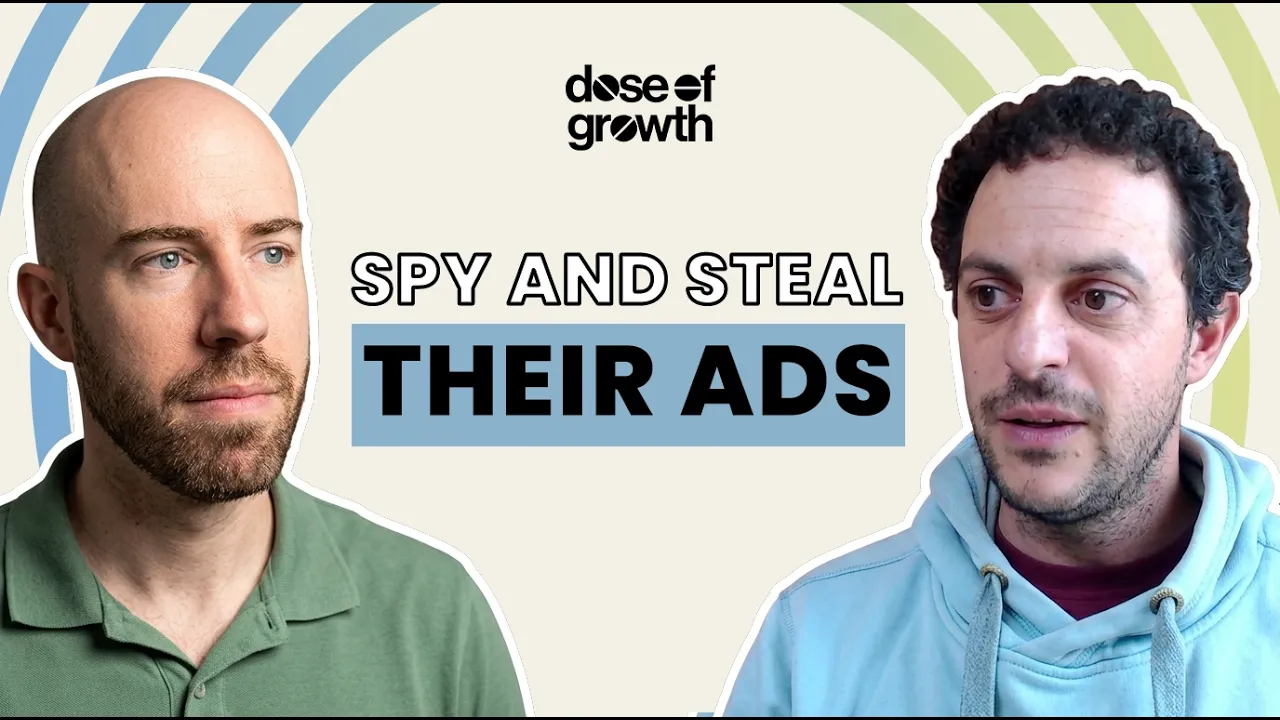
This breakdown is based on a conversation I had with Mike Walton on the Dose of Growth podcast, where we went deep on the telehealth space, how the biggest brands are buying traffic on Meta, and what the data tells us about which sub-verticals are scaling fastest. Mike works inside one of the largest telehealth operators in the market, so the questions were sharp, and the discussion got specific. The full episode is below.
Key takeaways
The telehealth space on Meta breaks down into seven sub-verticals, with weight loss far and away the largest. Brands like DirectMeds, Trimrx, Medvi, Noom, ForHers, and Hims dominate the share of voice, but a huge percentage of telehealth traffic flows through affiliates running advertorials and pre-landers that hide the destination brand until the final redirect. AI UGC is the breakout creative format. Creative lifespan in telehealth is short. The brands winning are the ones rotating creatives the fastest.
How telehealth ads get identified at scale
Most ad spy tools cannot reliably isolate telehealth campaigns. They can search keywords or fan pages, but neither approach works for a category where the same product is sold under different brand names and through hundreds of disposable fan pages and domains.
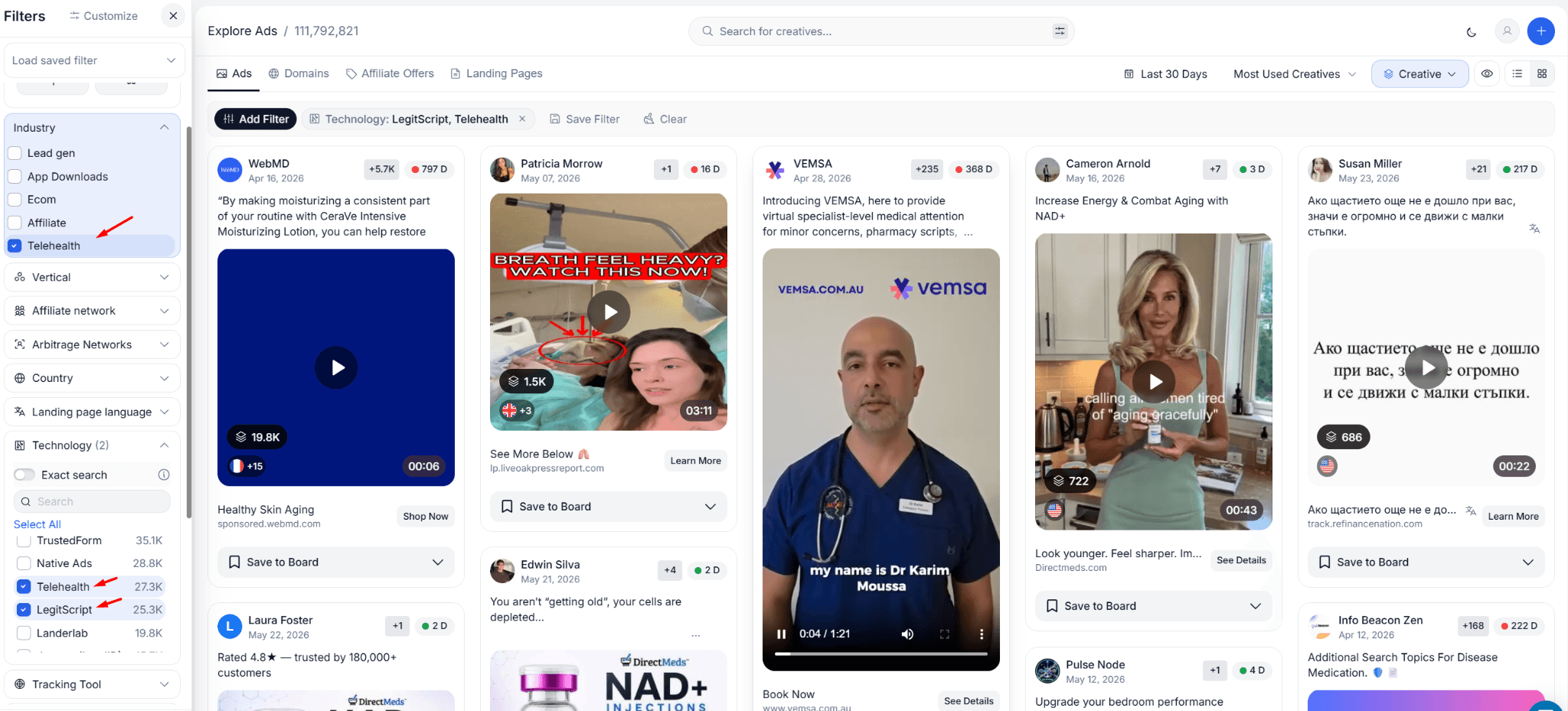
The way we approach it is by treating Telehealth as a vertical and combining several signals to capture every ad that belongs in that bucket.
The first signal is LegitScript. This is a compliance certification that telehealth brands have to display on their landing pages to run paid traffic legally on Meta. It is a regulatory requirement, not a marketing choice. We crawl every landing page in our index, and when LegitScript appears, the ad gets tagged automatically.
The second signal is known telehealth brands in the redirect chain. We maintain a list of the major telehealth players: DirecMeds, Medvi, TrimRx, ForHers, Hims, Noom, and others. When an ad eventually lands on one of those domains, even after going through a pre-lander or advertorial first, we tag it as telehealth. This is how we catch the affiliate traffic that would otherwise look like generic supplement ads on the surface.
We combined both signals and simplified by adding the Telehealth industry tag itself.
Stacked together, these signals give us over 50K Telehealth ads indexed in the last 30 days. Filter by any combination, sort by any metric, and the dataset is consistent.
See the live telehealth board
To go with this post, I put together a board inside AdPlexity Social with a selection of the top telehealth advertisers, their creatives, and the domains running active campaigns in the space. It is a snapshot to give you a starting point for exploring the category.
Boards are how I organize ongoing competitive research in the platform. Instead of running the same filters every week, I save the advertisers, ads, and domains I want to monitor in one place. The board is mine to curate, so I add and remove elements as the market shifts.
You can view the board here: https://app.adplexity.io/boards/shared/BpWdOn8GBdTZ2pfNcri0
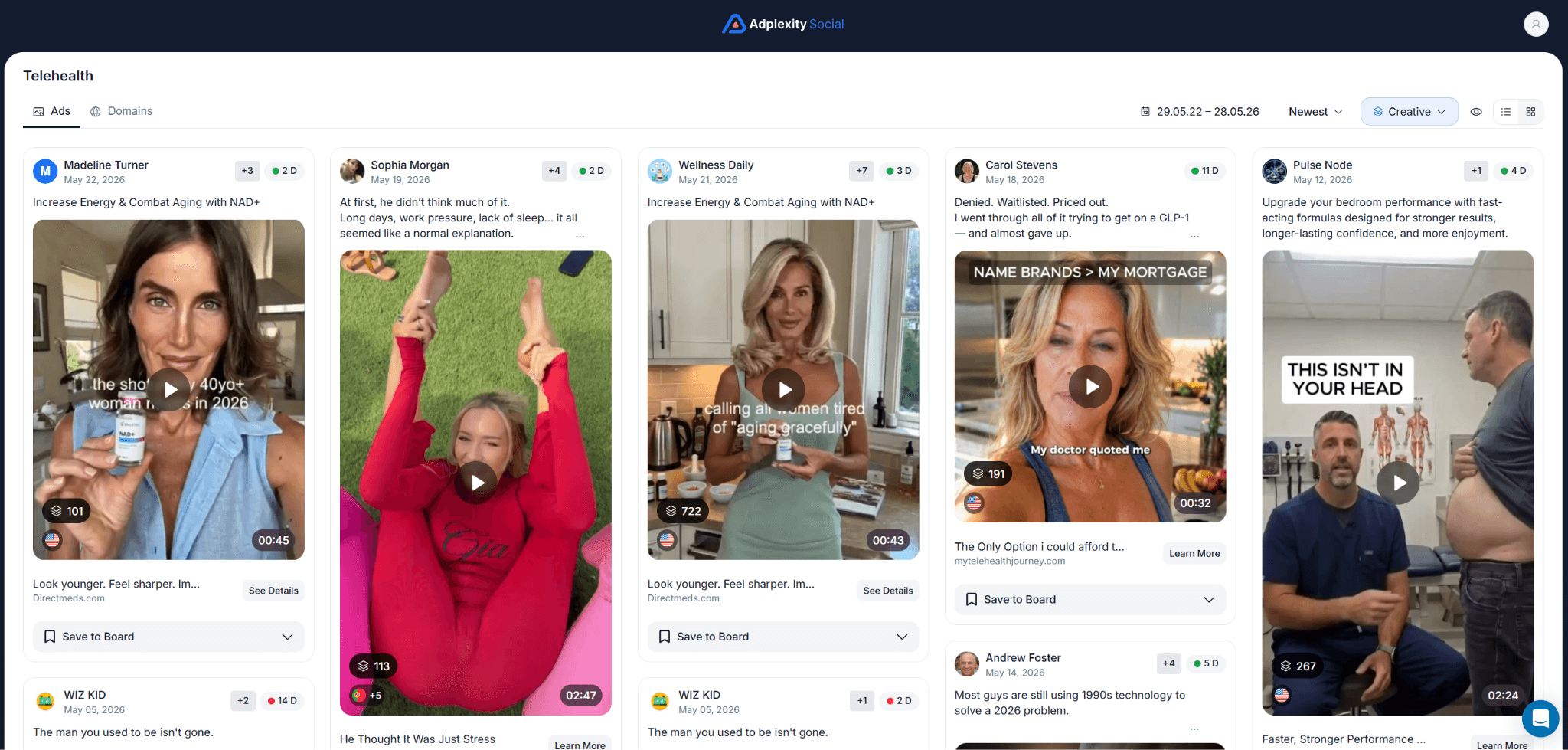
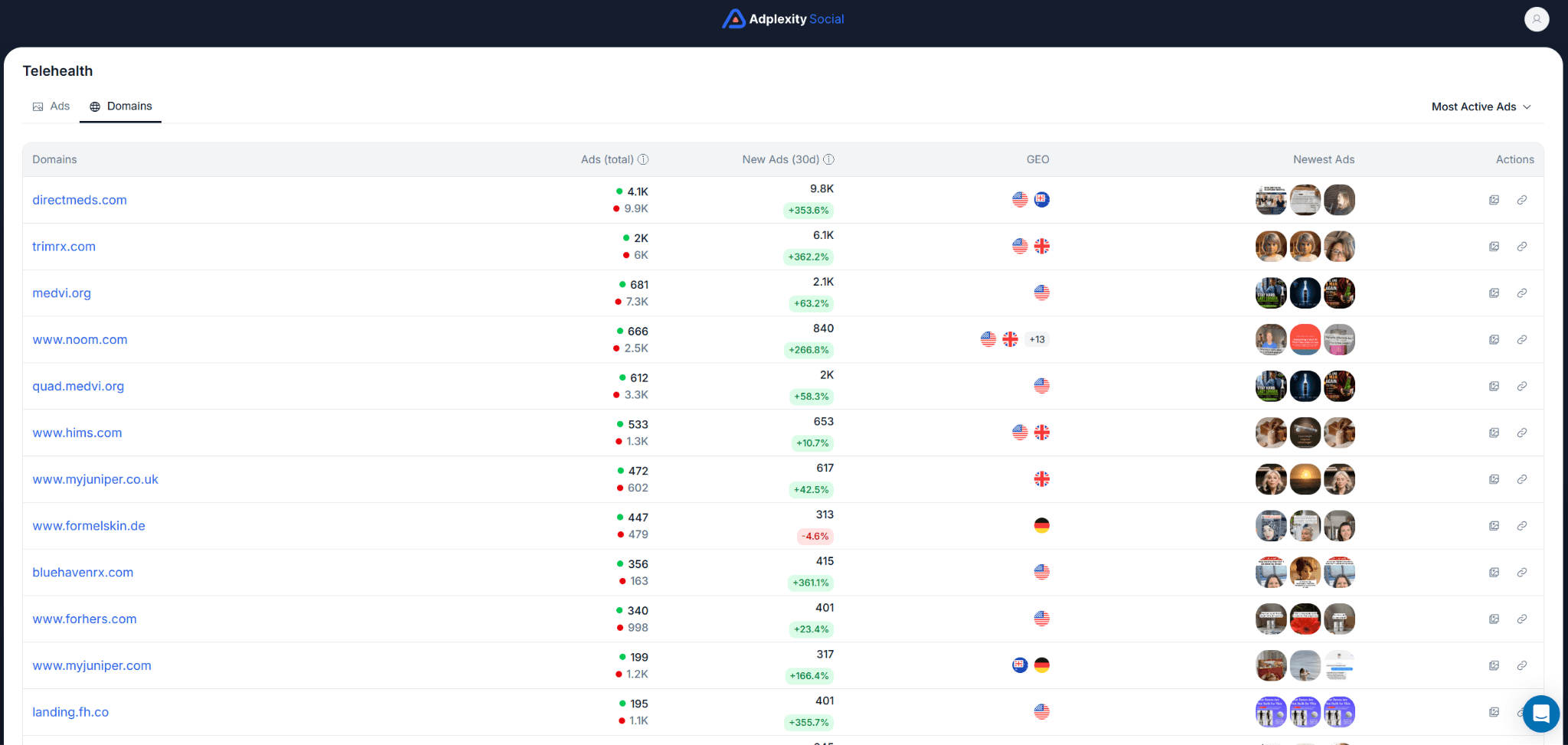
If you have an AdPlexity Social account, you can use this board as a reference and build your own from scratch to track the brands and offers most relevant to you.
The brands scaling hardest right now
If you sort telehealth advertisers by share of new ads in the last 30 days, a clear ranking emerges. DirectMeds, TrimRx, Medvi, ForHers, Noom, and Hims are the seven names that consistently appear at the top.
DirectMeds is the standout. In the previous 30-day period, we collected around 2,200 ads from them. In the most recent 30 days, that number is 9,800. Roughly 4,300 are still active right now, which is about 40 percent of everything we have ever indexed from the brand. They are not just present in the space. They are scaling aggressively.
What is interesting about DirectMeds compared to most of their competitors is the branding. Their creatives are noticeably more brand-led, which is unusual in a vertical that traditionally runs on disposable fan pages and advertorial-style pre-landers. They are betting on a different play.
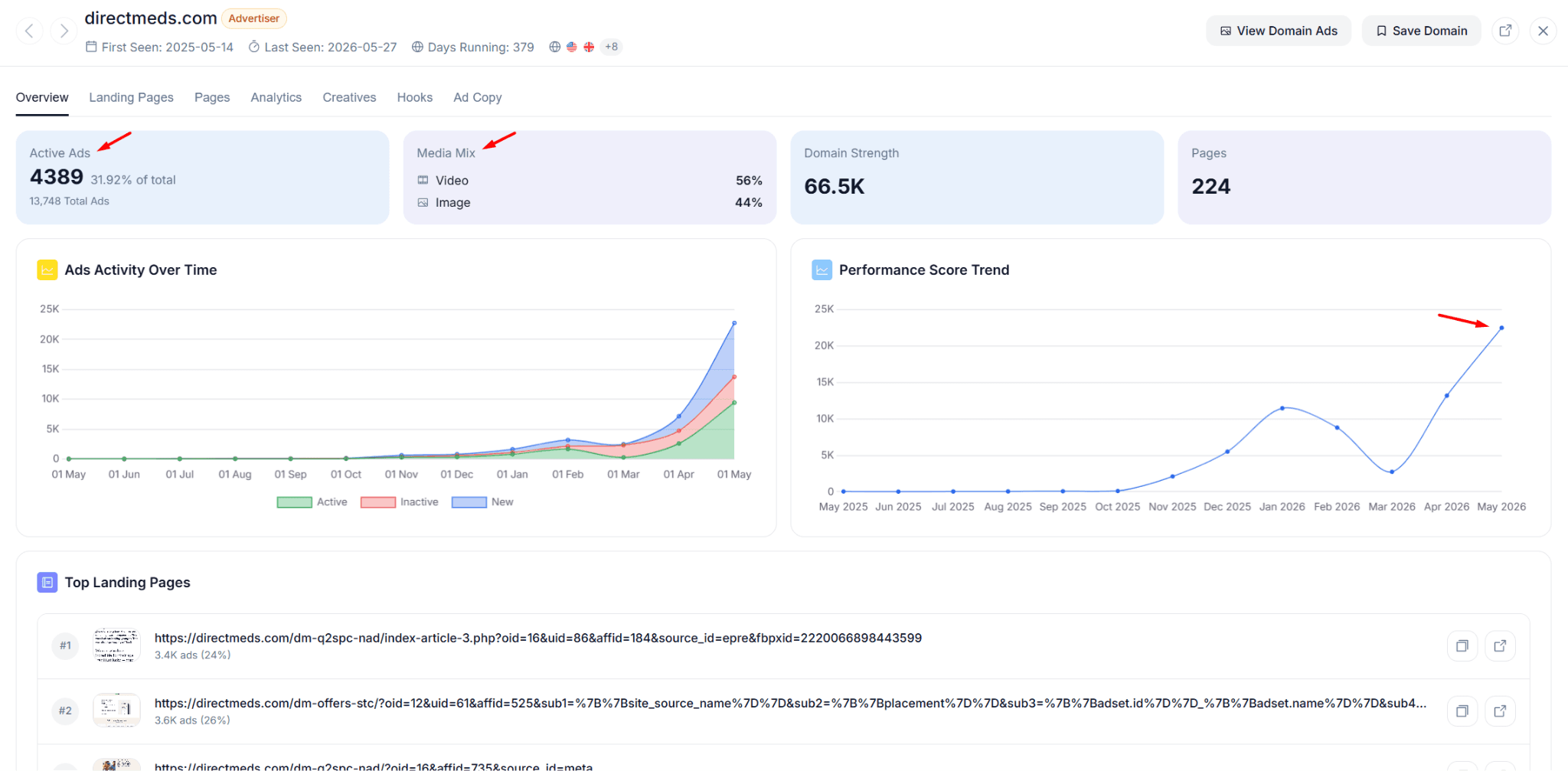
The growth percentages tell the bigger story. We compare each 30-day window against the previous one. When you see a brand collecting four to seven times more ads than the prior period, that is the signal you want to pay attention to. That is a brand actively scaling, not just maintaining.
Weight loss is the biggest sub-vertical. By a lot.
Inside the telehealth filter, we tag every ad by sub-vertical where we can identify one. The breakdown is consistent across the largest advertisers.
Weight loss is the dominant category. Erectile dysfunction sits second. Hair growth, anti-aging, testosterone, general health, and other supplements fill out the rest. For a brand like DirecMeds, you can pull up only their weight loss ads in one filter click and see exactly what creatives they are running against that sub-segment.
This is where the data gets useful for media buyers. You do not have to guess what the leaders are doing. You can see, for each major brand, which sub-vertical they are putting the most creative behind, how their creative mix has shifted month over month, and which sub-verticals are getting cannibalized by the others.
Weight loss is so saturated that CPAs are rising fast. The brands that have already noticed this are pivoting. You can see it in the data. The same names that were heavy in weight loss six months ago are now adding hair loss and ED creatives. The shift is happening in real time.
The creative trends that matter
One format is dominating telehealth ads on Meta right now.
AI-generated UGC is everywhere. Not just in telehealth, but the volume in this category is striking. These are creatives where AI-generated faces deliver testimonial-style scripts, often with deliberately weird visual mashups designed to stop the scroll. The "gelatin trick" angle, the overweight presenter discovering a hack, the controversial-opening style that leads with something inflammatory. These are not edge cases. They are the dominant format.
The branded creatives like the DirectMeds approach are the exception. Most of the volume is running through disposable fan pages with AI UGC, where the brand is not even visible until the user reaches the landing page.
Creative lifespan in telehealth is short. Across the major brands, individual creatives rarely run for more than a few weeks before they get cycled out. Health is not a category where you can repeat the same hook for months. The frequency ramps up fast, the audience starts ignoring it, and you have to bring new angles in constantly.
This is why brands like DirectMeds are running thousands of ads built on a smaller library of base creatives. They take one winning video and deploy it across hundreds of ad variations and dozens of fan pages. The creative is the same. Everything around it changes.
The 1,500-ad pre-lander funnel
Here is a real example of what affiliate-driven telehealth traffic looks like in practice.
We found one video creative being used in roughly 1,500 active ads. The fan page running it has nothing to do with telehealth on the surface. Two different fan pages are pushing the same exact creative across 1,500 ad variations.
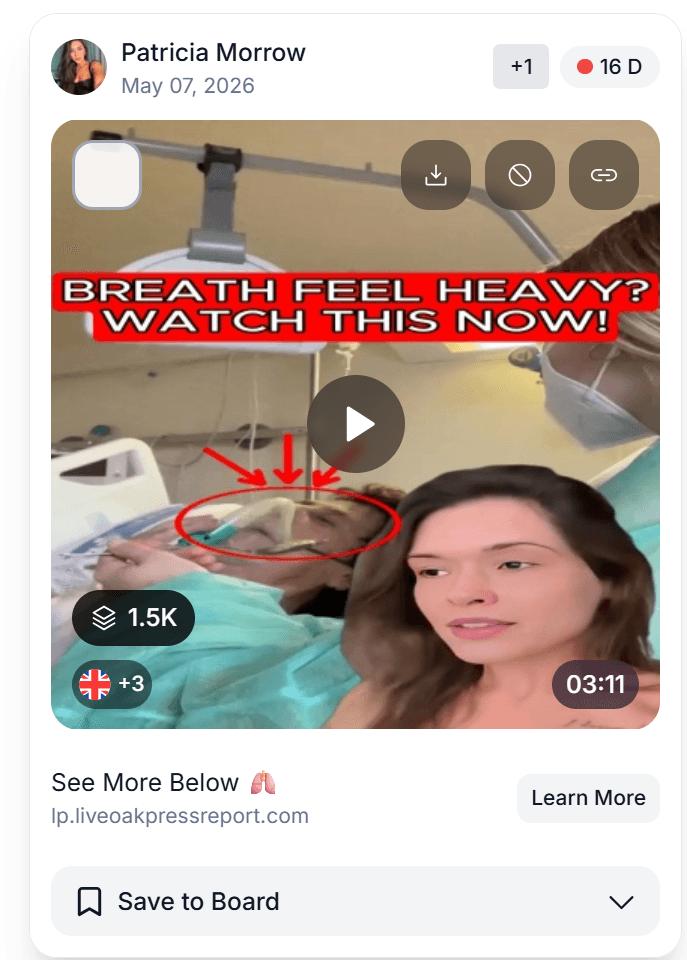
The video links to a domain called evrydayly.com. That is the first landing page the user sees. But the redirect chain does not end there. The traffic flows through everydaily.com into a page on AltRx.com, which connects to a telehealth brand on the final step.
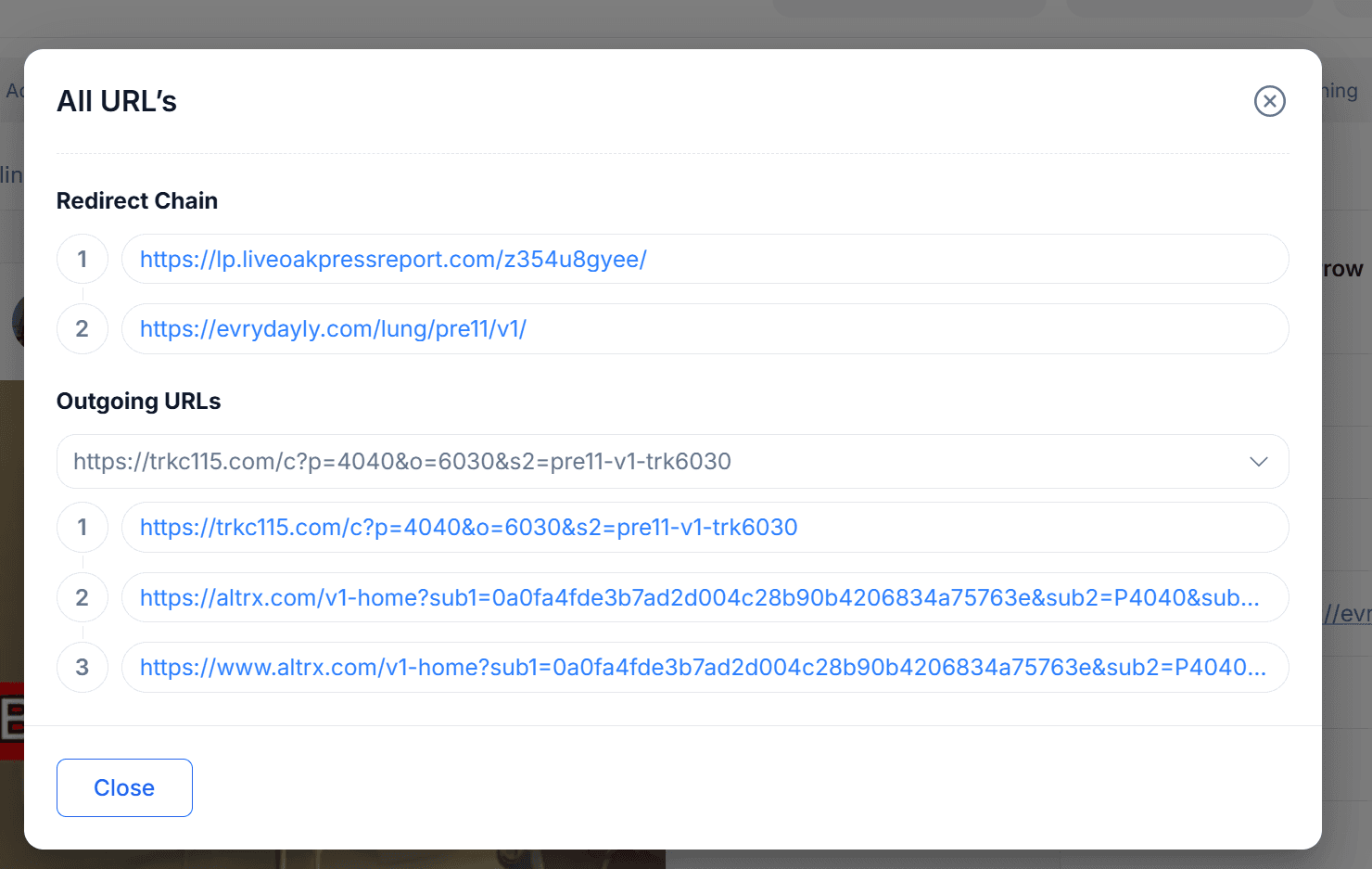
This is the part most spy tools miss. They show you the ad. They might show you the first landing page. They do not crawl the full redirect chain to surface the actual destination. Which means an affiliate running this exact setup looks like a generic supplement campaign on the surface. It is only when you map the full URL chain that you see what they are actually selling.
For a media buyer at a brand, this matters because your competition is not just the other brands. It is the army of affiliates running pre-lander funnels into those brands. If you are at DirecMeds or Hims, the question is not "who else is buying telehealth keywords." The question is "who else is sending traffic to my offer through advertorials I don't control."
Why fan page data is misleading in this space
Most ad spy tools let you search by fan page. In telehealth, that is close to useless.
When you run telehealth ads at scale, you do not use one fan page. You use hundreds. Some are owned by the brand directly to spread risk and avoid getting flagged. Others are run by affiliates with names like "David Miller" or "Chez Idelon" or other made-up personas designed to look like real people.
We have indexed brands in this space running over 200 distinct fan pages, some active, some banned, some dormant. If you searched any single one of those fan pages, you would get a tiny fragment of the picture. You would miss 99 percent of activity flowing through the other 199.
This is why we aggregate creative data across all fan pages and all domains. If the same video is running in 1,500 ads spread across two fan pages, we group it as one creative with 1,500 instances. The fan page becomes a piece of metadata, not the unit of analysis.
What media buyers should actually do with this data
There are three plays worth running if you are buying paid social in telehealth or thinking about entering the category.
The first is angle research before launch. Pull the top creatives from the biggest brands in your sub-vertical. Do not copy them directly. Read the ad copy, watch the videos, and identify the structural patterns. Then feed those patterns into your creative team or into an LLM with your own value proposition, and generate variations specific to your offer. The point is to learn what is winning at the structural level, not to clone the surface.
The second is monitoring the leaders for pivots. The brands at the top of this space are running constant tests. When DirecMeds shifts from weight loss to hair loss, that is a signal. When Medvi added testosterone creatives at scale, that is a signal. You can track this week over week and adjust your own roadmap based on where the smart money is going.
The third is understanding the affiliate layer. Affiliates push enormous volume into telehealth offers. If you are a brand, you want to know which affiliates are sending you traffic and what their funnels look like. If you are an affiliate, you want to see what other affiliates are doing and which offers they are pushing hardest. The redirect chain data makes both possible.
Where the platform is heading
The roadmap on our side has telehealth getting more granular over the next year. More sub-vertical filters. Deeper landing page indexing. Hook extraction across more video formats. Better grouping signals to surface which creatives are early in their growth curve versus which ones are about to burn.
The bigger direction is moving from intel to action. The longer-term goal is to let users move from spotting a winning creative to generating variations of it for their own brand to launching those variations into their ad accounts, all from inside one workflow. That is two to three years out, but the direction is set.
For now, the value is in the data. Telehealth on Meta is a category where the brands willing to invest in real competitive intelligence are pulling away from the ones who are not. The Ads Library is a starting point. It is not enough on its own.
Frequently Asked Questions
How do I find telehealth ads on Facebook and Instagram?
The Meta Ad Library lets you search by advertiser name and keyword, which works if you already know which brands you want to monitor. To find every telehealth ad running on Meta, including the ones hidden behind pre-landers and disposable fan pages, you need a tool that classifies ads by industry and crawls the full redirect chain. AdPlexity Social does this through the Telehealth industry filter, which combines LegitScript detection on landing pages, known telehealth brand domains, and industry-level tagging.
Which telehealth brands spend the most on Meta ads in 2026?
Based on the share of new ads in the last 30 days, the brands consistently at the top are DirectMeds, TrimRx, Medvi, ForHers, Noom, and Hims. DirecMeds is currently scaling the fastest, with a 4 to 7x increase in indexed ads compared to the previous 30-day window. Roughly 1,400 of their ads are active at any given time.
What is the biggest sub-vertical inside telehealth advertising?
Weight loss is by far the largest sub-vertical, followed by erectile dysfunction. Hair growth, anti-aging, testosterone, general health, and other supplements account for the remaining share. Weight loss is also the most saturated, which is pushing brands to expand into adjacent sub-verticals as CPAs rise.
Why do telehealth brands use so many different Facebook fan pages?
Brands and affiliates use multiple fan pages to mitigate risk, avoid platform-level flags, and recover quickly when individual pages get banned or accumulate negative sentiment. A single major telehealth brand can have 200 or more fan pages indexed in our database. Negative comments on a page hurt CPMs, so rotating pages keeps acquisition costs lower.
How long do telehealth ad creatives typically run before they burn out?
Creative lifespan in telehealth is short compared to other verticals. Most individual creatives run for a few weeks at most before being cycled out. This is because health categories require strong persuasion, audience pools fatigue quickly, and frequency ramps up fast. The brands that win in this space are the ones rotating creatives constantly and testing new angles every week.
What creative formats are working best in telehealth right now?
AI-generated UGC is the dominant format. These are videos featuring AI-generated faces delivering testimonial-style scripts with deliberately attention-grabbing visual elements. Branded creatives, like those from DirectMeds, are the exception rather than the rule. Most volume runs through disposable fan pages and advertorial-style pre-landers.
Do I need a paid tool to spy on telehealth ads?
The Meta Ad Library is free and useful if you already know which brands to look at. It does not classify ads by industry, does not crawl landing pages, does not follow redirect chains, and does not group creatives across fan pages. For systematic research on a category like telehealth, where most of the traffic flows through hidden funnels, a paid tool is the difference between seeing 1 percent of the market and seeing most of it.
How does AdPlexity Social identify a telehealth ad if the brand is hidden behind a pre-lander?
We crawl the full redirect chain on every ad we index. When the final destination resolves to one of the major telehealth brand domains, the ad gets tagged as telehealth regardless of what the initial landing page looks like. This catches affiliate funnels where the user sees an advertorial first and only reaches the actual brand on the second or third redirect.
See the data yourself
Telehealth is one of the fastest-moving categories on Meta right now, and the gap between brands using real competitive intelligence and brands working off the Ads Library is widening every month. If you are running paid social in this space, or thinking about entering it, the data is what tells you where to spend, what to test, and which brand to study.
Thanks again to Mike Walton and the Dose of Growth team for the conversation. If you work in telehealth and want more context on what was covered in the episode, the full breakdown is in the video above. The board I put together to go with this post is here.
AdPlexity Social indexes telehealth ads continuously and monitors them daily for activity, with full landing page crawling, redirect chain analysis, and creative grouping across all fan pages and domains. Sign up at adplexity.io to see the full telehealth dataset and start pulling intel on the brands you compete with.
Telehealth on Meta is not a trend anymore. It is the dominant paid acquisition channel for a category that includes weight loss, ED, hair loss, anti-aging, testosterone, and general health supplements. The brands buying the most traffic in this space are scaling fast, burning through creatives in weeks, and rotating through hundreds of Facebook fan pages to keep CPMs down.
If you run paid social for a telehealth brand, or you are an affiliate pushing one of these offers, you already know the surface level of this. What is harder to see is who is actually scaling versus who is just present, which sub-verticals are growing fastest, and what creative angles are doing the heavy lifting.
AdPlexity Social indexes telehealth ads on Meta at scale and monitors them every day to see which ones stay live. Here is what the data shows in 2026, and how every campaign in this space gets surfaced regardless of how it is structured.
This breakdown is based on a conversation I had with Mike Walton on the Dose of Growth podcast, where we went deep on the telehealth space, how the biggest brands are buying traffic on Meta, and what the data tells us about which sub-verticals are scaling fastest. Mike works inside one of the largest telehealth operators in the market, so the questions were sharp, and the discussion got specific. The full episode is below.
Key takeaways
The telehealth space on Meta breaks down into seven sub-verticals, with weight loss far and away the largest. Brands like DirectMeds, Trimrx, Medvi, Noom, ForHers, and Hims dominate the share of voice, but a huge percentage of telehealth traffic flows through affiliates running advertorials and pre-landers that hide the destination brand until the final redirect. AI UGC is the breakout creative format. Creative lifespan in telehealth is short. The brands winning are the ones rotating creatives the fastest.
How telehealth ads get identified at scale
Most ad spy tools cannot reliably isolate telehealth campaigns. They can search keywords or fan pages, but neither approach works for a category where the same product is sold under different brand names and through hundreds of disposable fan pages and domains.
The way we approach it is by treating Telehealth as a vertical and combining several signals to capture every ad that belongs in that bucket.
The first signal is LegitScript. This is a compliance certification that telehealth brands have to display on their landing pages to run paid traffic legally on Meta. It is a regulatory requirement, not a marketing choice. We crawl every landing page in our index, and when LegitScript appears, the ad gets tagged automatically.
The second signal is known telehealth brands in the redirect chain. We maintain a list of the major telehealth players: DirecMeds, Medvi, TrimRx, ForHers, Hims, Noom, and others. When an ad eventually lands on one of those domains, even after going through a pre-lander or advertorial first, we tag it as telehealth. This is how we catch the affiliate traffic that would otherwise look like generic supplement ads on the surface.
We combined both signals and simplified by adding the Telehealth industry tag itself.
Stacked together, these signals give us over 50K Telehealth ads indexed in the last 30 days. Filter by any combination, sort by any metric, and the dataset is consistent.
See the live telehealth board
To go with this post, I put together a board inside AdPlexity Social with a selection of the top telehealth advertisers, their creatives, and the domains running active campaigns in the space. It is a snapshot to give you a starting point for exploring the category.
Boards are how I organize ongoing competitive research in the platform. Instead of running the same filters every week, I save the advertisers, ads, and domains I want to monitor in one place. The board is mine to curate, so I add and remove elements as the market shifts.
You can view the board here: https://app.adplexity.io/boards/shared/BpWdOn8GBdTZ2pfNcri0
If you have an AdPlexity Social account, you can use this board as a reference and build your own from scratch to track the brands and offers most relevant to you.
The brands scaling hardest right now
If you sort telehealth advertisers by share of new ads in the last 30 days, a clear ranking emerges. DirectMeds, TrimRx, Medvi, ForHers, Noom, and Hims are the seven names that consistently appear at the top.
DirectMeds is the standout. In the previous 30-day period, we collected around 2,200 ads from them. In the most recent 30 days, that number is 9,800. Roughly 4,300 are still active right now, which is about 40 percent of everything we have ever indexed from the brand. They are not just present in the space. They are scaling aggressively.
What is interesting about DirectMeds compared to most of their competitors is the branding. Their creatives are noticeably more brand-led, which is unusual in a vertical that traditionally runs on disposable fan pages and advertorial-style pre-landers. They are betting on a different play.
The growth percentages tell the bigger story. We compare each 30-day window against the previous one. When you see a brand collecting four to seven times more ads than the prior period, that is the signal you want to pay attention to. That is a brand actively scaling, not just maintaining.
Weight loss is the biggest sub-vertical. By a lot.
Inside the telehealth filter, we tag every ad by sub-vertical where we can identify one. The breakdown is consistent across the largest advertisers.
Weight loss is the dominant category. Erectile dysfunction sits second. Hair growth, anti-aging, testosterone, general health, and other supplements fill out the rest. For a brand like DirecMeds, you can pull up only their weight loss ads in one filter click and see exactly what creatives they are running against that sub-segment.
This is where the data gets useful for media buyers. You do not have to guess what the leaders are doing. You can see, for each major brand, which sub-vertical they are putting the most creative behind, how their creative mix has shifted month over month, and which sub-verticals are getting cannibalized by the others.
Weight loss is so saturated that CPAs are rising fast. The brands that have already noticed this are pivoting. You can see it in the data. The same names that were heavy in weight loss six months ago are now adding hair loss and ED creatives. The shift is happening in real time.
The creative trends that matter
One format is dominating telehealth ads on Meta right now.
AI-generated UGC is everywhere. Not just in telehealth, but the volume in this category is striking. These are creatives where AI-generated faces deliver testimonial-style scripts, often with deliberately weird visual mashups designed to stop the scroll. The "gelatin trick" angle, the overweight presenter discovering a hack, the controversial-opening style that leads with something inflammatory. These are not edge cases. They are the dominant format.
The branded creatives like the DirectMeds approach are the exception. Most of the volume is running through disposable fan pages with AI UGC, where the brand is not even visible until the user reaches the landing page.
Creative lifespan in telehealth is short. Across the major brands, individual creatives rarely run for more than a few weeks before they get cycled out. Health is not a category where you can repeat the same hook for months. The frequency ramps up fast, the audience starts ignoring it, and you have to bring new angles in constantly.
This is why brands like DirectMeds are running thousands of ads built on a smaller library of base creatives. They take one winning video and deploy it across hundreds of ad variations and dozens of fan pages. The creative is the same. Everything around it changes.
The 1,500-ad pre-lander funnel
Here is a real example of what affiliate-driven telehealth traffic looks like in practice.
We found one video creative being used in roughly 1,500 active ads. The fan page running it has nothing to do with telehealth on the surface. Two different fan pages are pushing the same exact creative across 1,500 ad variations.
The video links to a domain called evrydayly.com. That is the first landing page the user sees. But the redirect chain does not end there. The traffic flows through everydaily.com into a page on AltRx.com, which connects to a telehealth brand on the final step.
This is the part most spy tools miss. They show you the ad. They might show you the first landing page. They do not crawl the full redirect chain to surface the actual destination. Which means an affiliate running this exact setup looks like a generic supplement campaign on the surface. It is only when you map the full URL chain that you see what they are actually selling.
For a media buyer at a brand, this matters because your competition is not just the other brands. It is the army of affiliates running pre-lander funnels into those brands. If you are at DirecMeds or Hims, the question is not "who else is buying telehealth keywords." The question is "who else is sending traffic to my offer through advertorials I don't control."
Why fan page data is misleading in this space
Most ad spy tools let you search by fan page. In telehealth, that is close to useless.
When you run telehealth ads at scale, you do not use one fan page. You use hundreds. Some are owned by the brand directly to spread risk and avoid getting flagged. Others are run by affiliates with names like "David Miller" or "Chez Idelon" or other made-up personas designed to look like real people.
We have indexed brands in this space running over 200 distinct fan pages, some active, some banned, some dormant. If you searched any single one of those fan pages, you would get a tiny fragment of the picture. You would miss 99 percent of activity flowing through the other 199.
This is why we aggregate creative data across all fan pages and all domains. If the same video is running in 1,500 ads spread across two fan pages, we group it as one creative with 1,500 instances. The fan page becomes a piece of metadata, not the unit of analysis.
What media buyers should actually do with this data
There are three plays worth running if you are buying paid social in telehealth or thinking about entering the category.
The first is angle research before launch. Pull the top creatives from the biggest brands in your sub-vertical. Do not copy them directly. Read the ad copy, watch the videos, and identify the structural patterns. Then feed those patterns into your creative team or into an LLM with your own value proposition, and generate variations specific to your offer. The point is to learn what is winning at the structural level, not to clone the surface.
The second is monitoring the leaders for pivots. The brands at the top of this space are running constant tests. When DirecMeds shifts from weight loss to hair loss, that is a signal. When Medvi added testosterone creatives at scale, that is a signal. You can track this week over week and adjust your own roadmap based on where the smart money is going.
The third is understanding the affiliate layer. Affiliates push enormous volume into telehealth offers. If you are a brand, you want to know which affiliates are sending you traffic and what their funnels look like. If you are an affiliate, you want to see what other affiliates are doing and which offers they are pushing hardest. The redirect chain data makes both possible.
Where the platform is heading
The roadmap on our side has telehealth getting more granular over the next year. More sub-vertical filters. Deeper landing page indexing. Hook extraction across more video formats. Better grouping signals to surface which creatives are early in their growth curve versus which ones are about to burn.
The bigger direction is moving from intel to action. The longer-term goal is to let users move from spotting a winning creative to generating variations of it for their own brand to launching those variations into their ad accounts, all from inside one workflow. That is two to three years out, but the direction is set.
For now, the value is in the data. Telehealth on Meta is a category where the brands willing to invest in real competitive intelligence are pulling away from the ones who are not. The Ads Library is a starting point. It is not enough on its own.
Frequently Asked Questions
How do I find telehealth ads on Facebook and Instagram?
The Meta Ad Library lets you search by advertiser name and keyword, which works if you already know which brands you want to monitor. To find every telehealth ad running on Meta, including the ones hidden behind pre-landers and disposable fan pages, you need a tool that classifies ads by industry and crawls the full redirect chain. AdPlexity Social does this through the Telehealth industry filter, which combines LegitScript detection on landing pages, known telehealth brand domains, and industry-level tagging.
Which telehealth brands spend the most on Meta ads in 2026?
Based on the share of new ads in the last 30 days, the brands consistently at the top are DirectMeds, TrimRx, Medvi, ForHers, Noom, and Hims. DirecMeds is currently scaling the fastest, with a 4 to 7x increase in indexed ads compared to the previous 30-day window. Roughly 1,400 of their ads are active at any given time.
What is the biggest sub-vertical inside telehealth advertising?
Weight loss is by far the largest sub-vertical, followed by erectile dysfunction. Hair growth, anti-aging, testosterone, general health, and other supplements account for the remaining share. Weight loss is also the most saturated, which is pushing brands to expand into adjacent sub-verticals as CPAs rise.
Why do telehealth brands use so many different Facebook fan pages?
Brands and affiliates use multiple fan pages to mitigate risk, avoid platform-level flags, and recover quickly when individual pages get banned or accumulate negative sentiment. A single major telehealth brand can have 200 or more fan pages indexed in our database. Negative comments on a page hurt CPMs, so rotating pages keeps acquisition costs lower.
How long do telehealth ad creatives typically run before they burn out?
Creative lifespan in telehealth is short compared to other verticals. Most individual creatives run for a few weeks at most before being cycled out. This is because health categories require strong persuasion, audience pools fatigue quickly, and frequency ramps up fast. The brands that win in this space are the ones rotating creatives constantly and testing new angles every week.
What creative formats are working best in telehealth right now?
AI-generated UGC is the dominant format. These are videos featuring AI-generated faces delivering testimonial-style scripts with deliberately attention-grabbing visual elements. Branded creatives, like those from DirectMeds, are the exception rather than the rule. Most volume runs through disposable fan pages and advertorial-style pre-landers.
Do I need a paid tool to spy on telehealth ads?
The Meta Ad Library is free and useful if you already know which brands to look at. It does not classify ads by industry, does not crawl landing pages, does not follow redirect chains, and does not group creatives across fan pages. For systematic research on a category like telehealth, where most of the traffic flows through hidden funnels, a paid tool is the difference between seeing 1 percent of the market and seeing most of it.
How does AdPlexity Social identify a telehealth ad if the brand is hidden behind a pre-lander?
We crawl the full redirect chain on every ad we index. When the final destination resolves to one of the major telehealth brand domains, the ad gets tagged as telehealth regardless of what the initial landing page looks like. This catches affiliate funnels where the user sees an advertorial first and only reaches the actual brand on the second or third redirect.
See the data yourself
Telehealth is one of the fastest-moving categories on Meta right now, and the gap between brands using real competitive intelligence and brands working off the Ads Library is widening every month. If you are running paid social in this space, or thinking about entering it, the data is what tells you where to spend, what to test, and which brand to study.
Thanks again to Mike Walton and the Dose of Growth team for the conversation. If you work in telehealth and want more context on what was covered in the episode, the full breakdown is in the video above. The board I put together to go with this post is here.
AdPlexity Social indexes telehealth ads continuously and monitors them daily for activity, with full landing page crawling, redirect chain analysis, and creative grouping across all fan pages and domains. Sign up at adplexity.io to see the full telehealth dataset and start pulling intel on the brands you compete with.
Table of Contents
Quickly navigate through the key sections of this article.
Discover Winning Meta Ads
Similar Blogs
Check related blogs
Check related blogs
Check related blogs














Ready to See What’s Really Working on Meta?
Adplexity
Social
© Copyright 2026 All Rights Reserved
Ready to See What’s Really Working on Meta?
Adplexity
Social
© Copyright 2026 All Rights Reserved
Ready to See What’s Really Working on Meta?
Adplexity
Social
© Copyright 2026 All Rights Reserved