Minea has a real following. Over 200,000 dropshippers, by the company's own count, use it to pull ads from Facebook, TikTok, and Pinterest into one dashboard.
For quick product research, that is a genuinely useful setup.
But an ad is just the surface of a campaign.
The part that actually decides whether a funnel makes money happens after the click: the landing page, the redirect chain, the offer sitting behind it, the tech stack running underneath. Minea never goes there.
If you buy Meta traffic for a living, that is the exact intelligence you need most, and it is the one thing Minea cannot give you.
Here is where each tool wins, what each one costs, and which one actually fits how you work.
TL;DR: Minea is best for dropshippers who want fast product ideas pulled from ad activity across Facebook, TikTok, and Pinterest. AdPlexity Social is best for performance marketers, media buyers, ecommerce brands, and agencies who need to see the full funnel behind every Meta ad: landing pages, redirect chains, affiliate offers, and tech stacks.
Dropshipping product research across Facebook, TikTok, Pinterest
$49 - $99/month
None: ad creative and engagement stats only
What each tool is actually built for
Minea is a product research tool that happens to spy on ads. Everything about it points in one direction: help a dropshipper find the next product to test. The dashboard opens with a daily top ten of winning products. There are daily niche lists, a shop tracker, an image-based Magic Search, and even a bundled option to spin up a Shopify store from a product you find there. If your business is testing dropshipping products, that whole package makes sense.
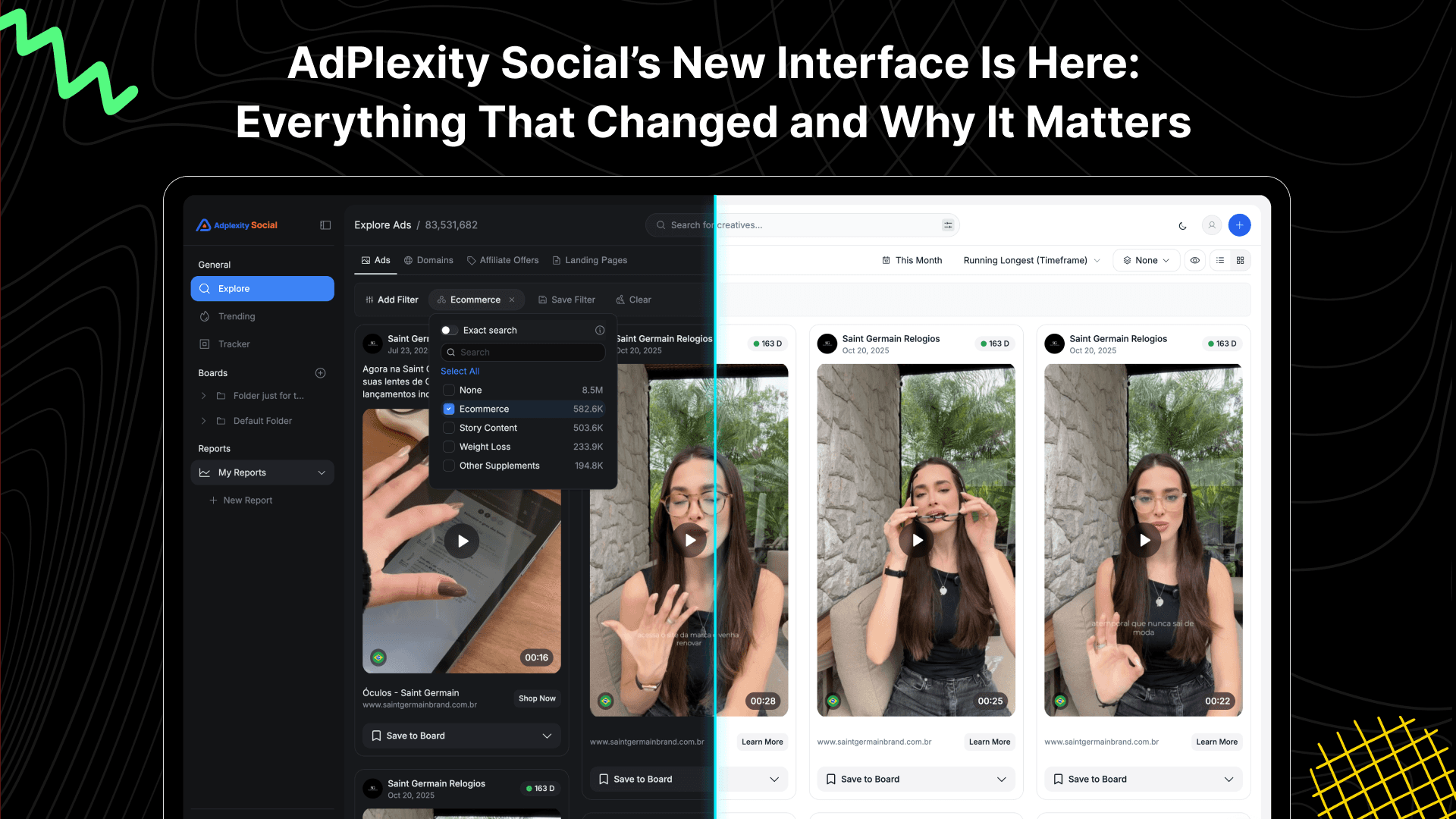
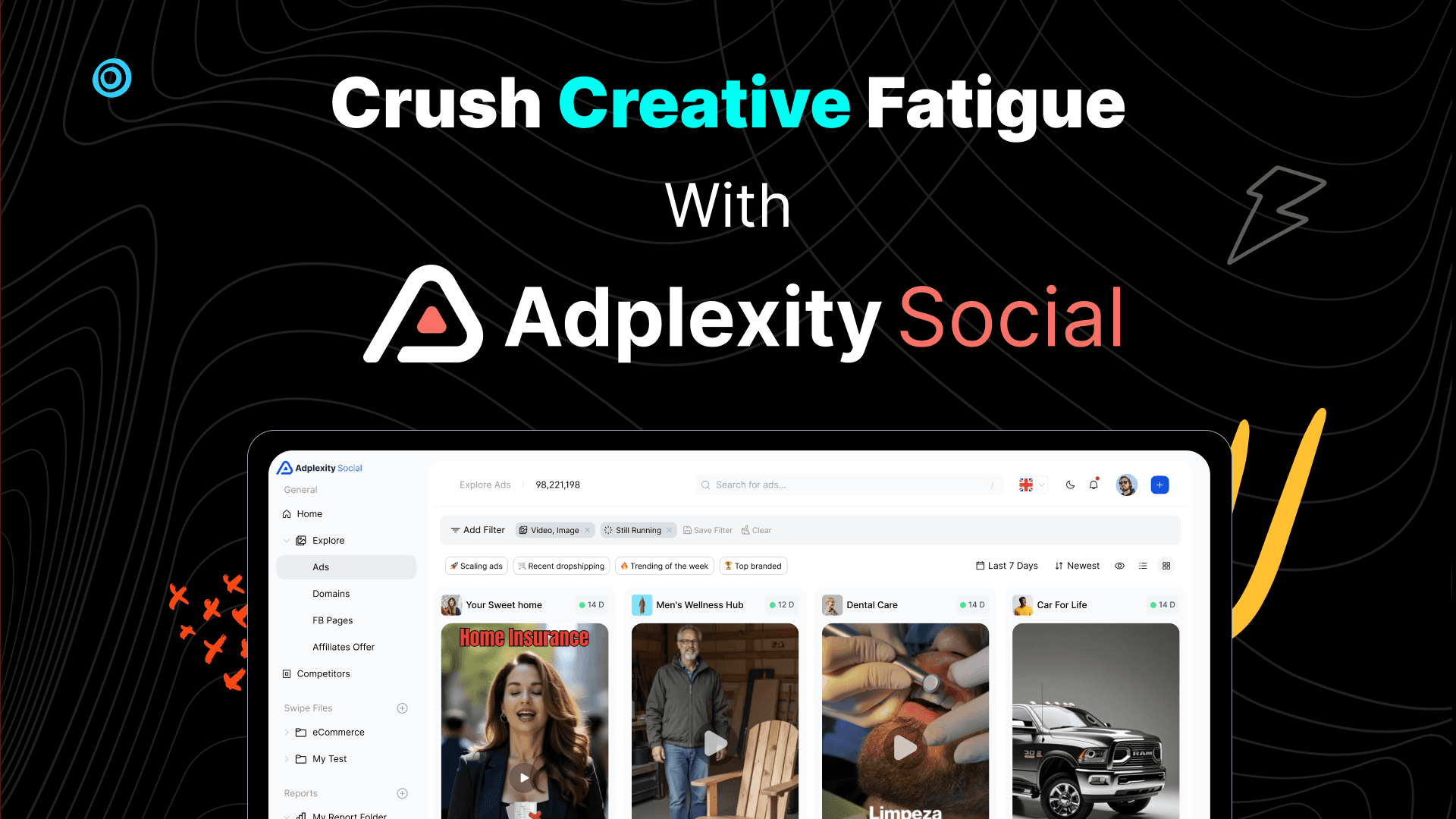
AdPlexity Social is built for people who treat Meta as a real performance channel, not a place to browse for ideas. It indexes over 100 million Meta ads, adds more than 15 million new ones every month, and covers all Meta placements, not just the Facebook and Instagram feeds. Then it does what Minea never attempts: it visits the destination. Every landing page gets indexed, every redirect chain gets crawled, and the technology running on each page becomes a filter you can search by.
That single difference in intent shapes almost everything that follows.
Where Minea genuinely earns credit
Minea covers TikTok and Pinterest alongside Facebook, and for a dropshipper testing one product across three networks, having it all in one interface is a real convenience. The product-first workflow also lowers the barrier for someone just starting out: open the dashboard, and it hands you ideas without requiring you to already know what to search for.
That is the honest case for Minea. Now the rest of the story.
The database question
Minea's homepage claims 80 million or more active ads across its supported networks. Spread across Facebook, TikTok, and Pinterest, that number gets thin fast once you divide it by network.
AdPlexity Social holds over 100 million ads from Meta alone, growing by more than 15 million a month, including an archive of deleted and banned ads. When an aggressive advertiser gets a campaign pulled, the ad vanishes from Meta and from any tool that only mirrors what is currently live. It stays fully visible in AdPlexity Social. For anyone studying what actually works in competitive verticals, that archive is often where the most useful material lives.
Depth beats breadth here. A tool spread thin across three networks tells you less about your actual Meta competition than a tool that goes all the way down on one.
Post-click intelligence: where the two tools stop being comparable
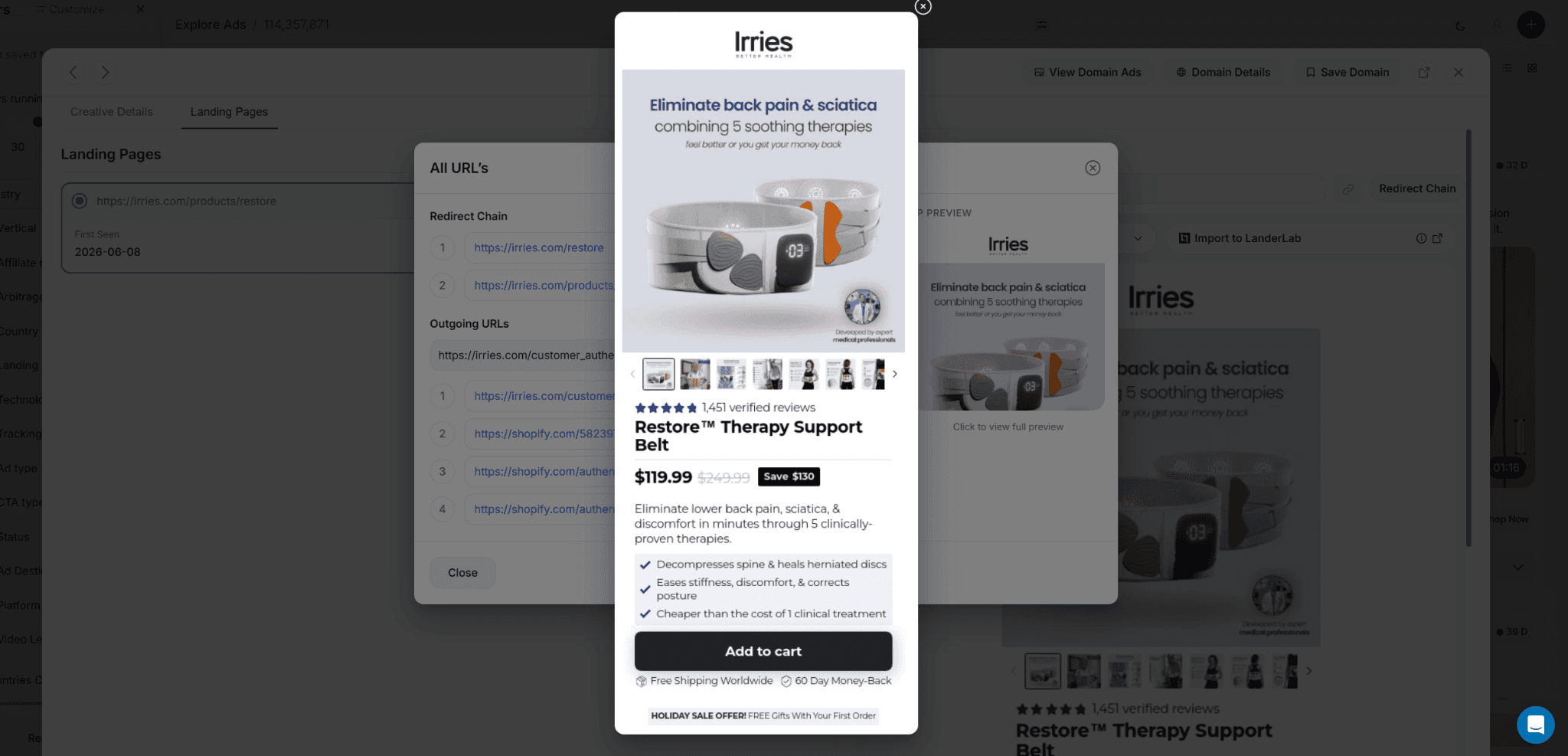
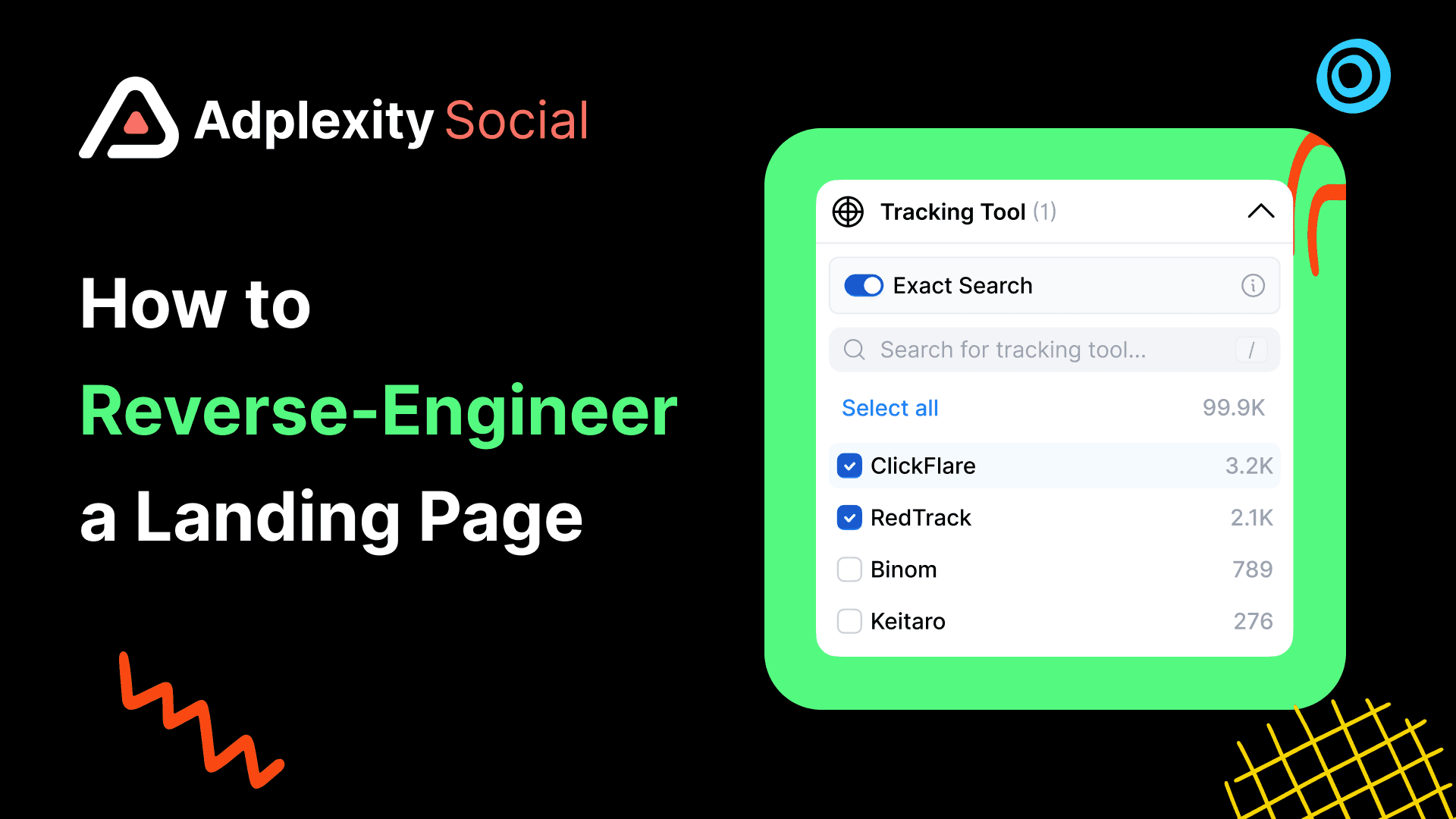
Minea shows you the ad creative, the copy, and engagement stats on the ad itself. That is where its visibility ends. What page did the click land on? What is written on it? Does the traffic pass through a pre-lander before the real offer? Which affiliate network sits behind it? Is the store running Shopify? Is there a tracker like Redtrack or ClickFlare in the stack? Minea has no answer to any of that.
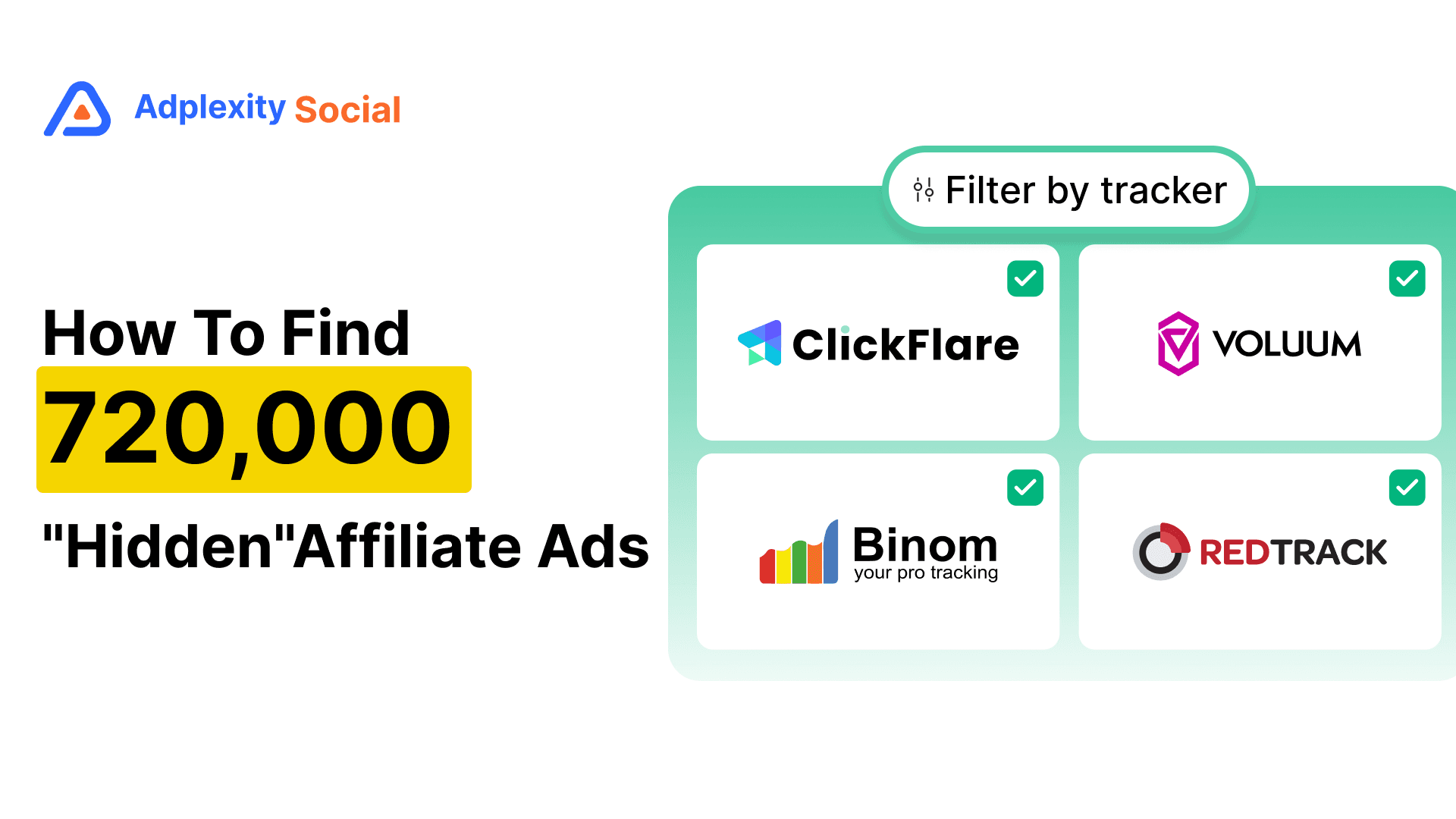
AdPlexity Social answers all of it. Landing pages are fully indexed, so you can search for keywords that appear on the destination page, not just in the ad copy. Redirect chains are crawled end to end, including outgoing URLs, which exposes the affiliate offers hiding behind pre-landers. Tech stack filters cover Shopify, ClickFunnels, VTurb, Ringba, TrustedForm, and more. A dedicated affiliate offer dimension aggregates activity from networks like ClickBank, BuyGoods, and Digistore24 at the offer level.
Here is what that looks like in practice. Search “posture corrector” in AdPlexity Social, filter by Shopify stores, and set the Longevity filter to ads running 30 days or more. You immediately surface the health and wellness advertisers whose creatives have survived a full month of continuous spend, along with the exact Shopify product pages behind each one. One search gets you the angle, the page structure, and hard proof that someone has been paying to keep this campaign alive for over a month. Minea can show you a similar-looking ad. It cannot show you anything past the click.
If you build funnels instead of just picking products, this is not a nice-to-have. It is the job itself. (And once you find a winning page worth rebuilding fast, a landing page builder like LanderLab pairs naturally with that kind of research.)
Finding proven ads: what actually signals a winner
Minea's model of a winning product leans on engagement: likes, comments, shares on the ad. Engagement tells you people reacted to a creative. It does not tell you the campaign made money, and it only ever describes one single ad, not the wider push behind it. Viral and profitable are not the same thing, and plenty of high-engagement campaigns quietly bleed cash on the backend.
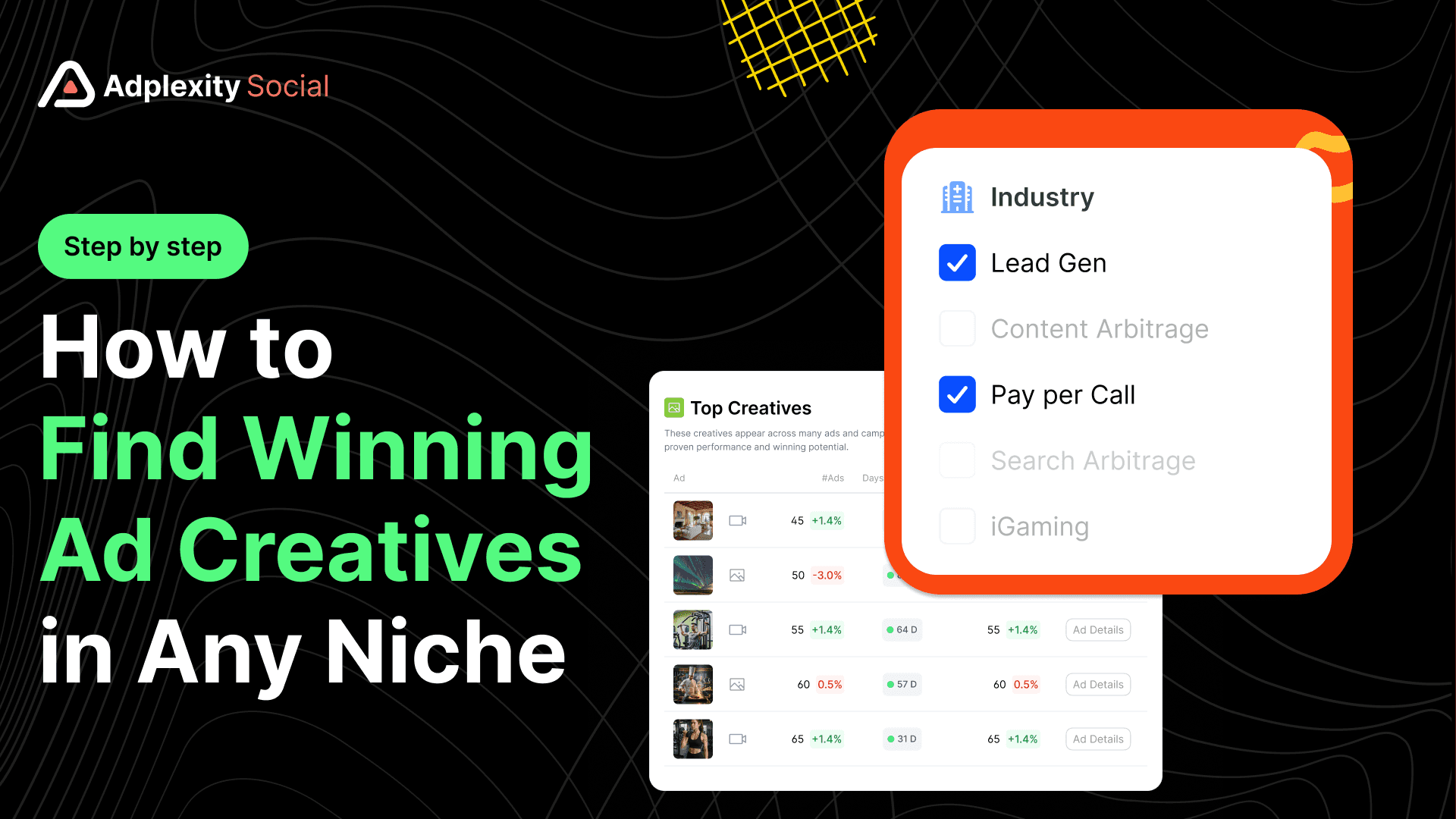
AdPlexity Social looks at the creative itself, not just one ad. Every ad running the exact same creative gets grouped and counted, no matter which advertiser profile or fan page is posting it. That distinction matters more than it sounds. An advertiser spinning the same winning video across five different profiles shows up in AdPlexity Social as one creative with a real duplicate count. Tools that group duplicates by fan page instead miss that entirely and report five separate, unremarkable-looking ads. Plus, you can also see how long a creative has been running, which is a great indicator of performance through longevity.
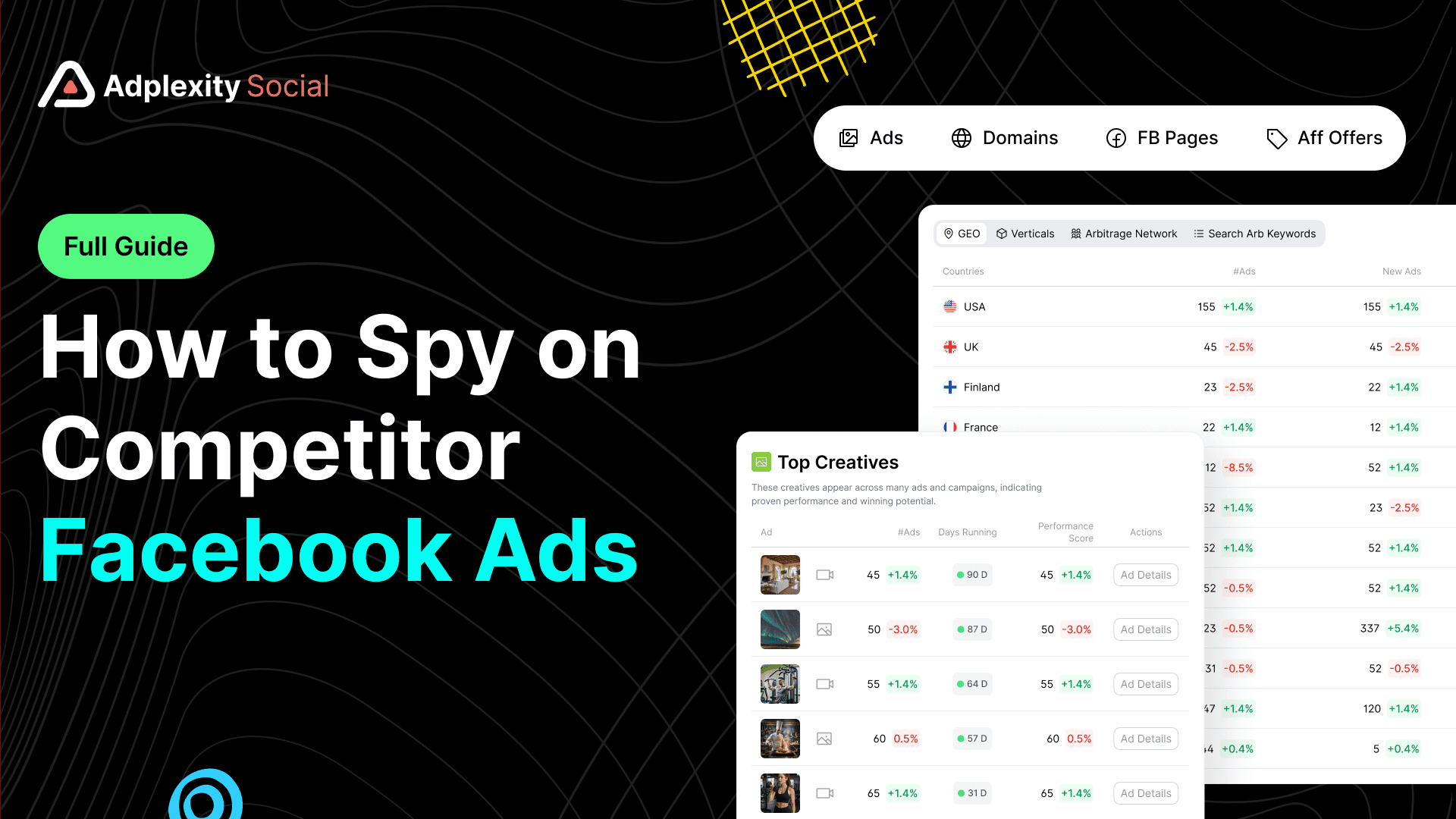
On top of that duplicate count, the team is currently working on 3 extra very powerful metrics for every creative - New Ads and Active Ads, each compared against the previous 30 days and Creative Score. New Ads tells you whether an advertiser is still actively spinning up variations of a winning idea. Active Ads tells you how many of those duplicates are actually live right now, not just how many ever existed. Creative Score will be a calculated score taking into account all the metrics. Put together, those numbers separate a creative that is quietly scaling across an advertiser's whole page network from one that got posted once and went nowhere, in a way a single engagement count on one ad never could.
The same breakdown already exists at the domain level. The Domain Details view includes a Creatives tab listing every creative a domain has run with the same metrics, so you can see at a glance which creatives a competitor is currently pushing hardest.
Organizing research: Boards vs. collections
Minea lets you save ad creatives into collections, which covers the basic swipe-file use case fine.
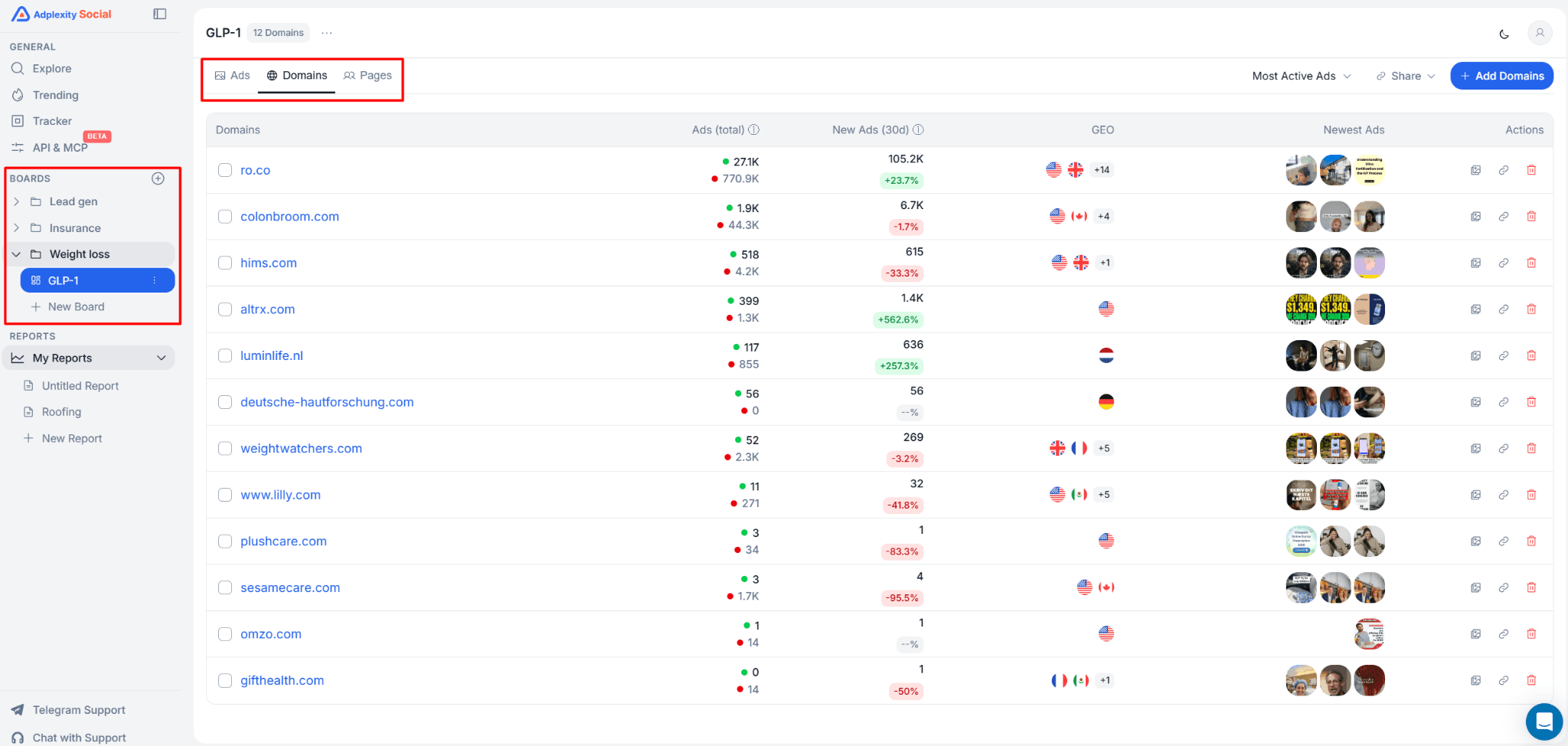
AdPlexity Social's Boards go further. A Board holds three element types: ads, domains, and pages or profiles. That means you can track a competitor as an entity, not just a pile of screenshots: their domain, their advertiser pages, their ads, all organized into folders and shareable through a public URL. For agencies and teams, handing a client a live board of competitor activity beats exporting a slide deck of images.
Pricing compared
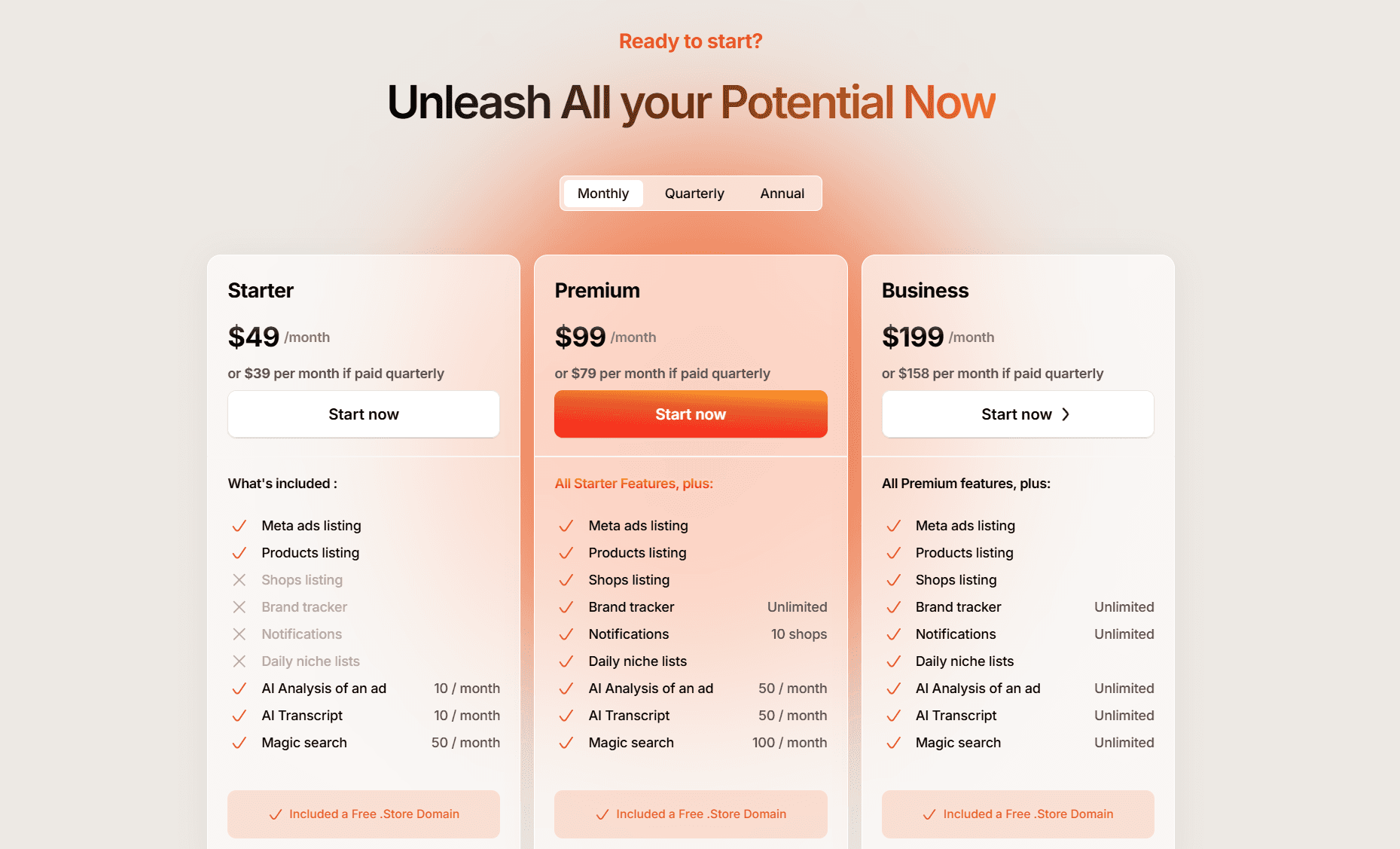
Minea runs three tiers: Starter at $49 per month, Premium at $99, with a discount for quarterly billing. Every tier is credit-metered, and the AI features are capped monthly on the lower plans. The $49 entry price looks attractive until your research volume grows and the credit meter starts deciding how much spying you get to do.
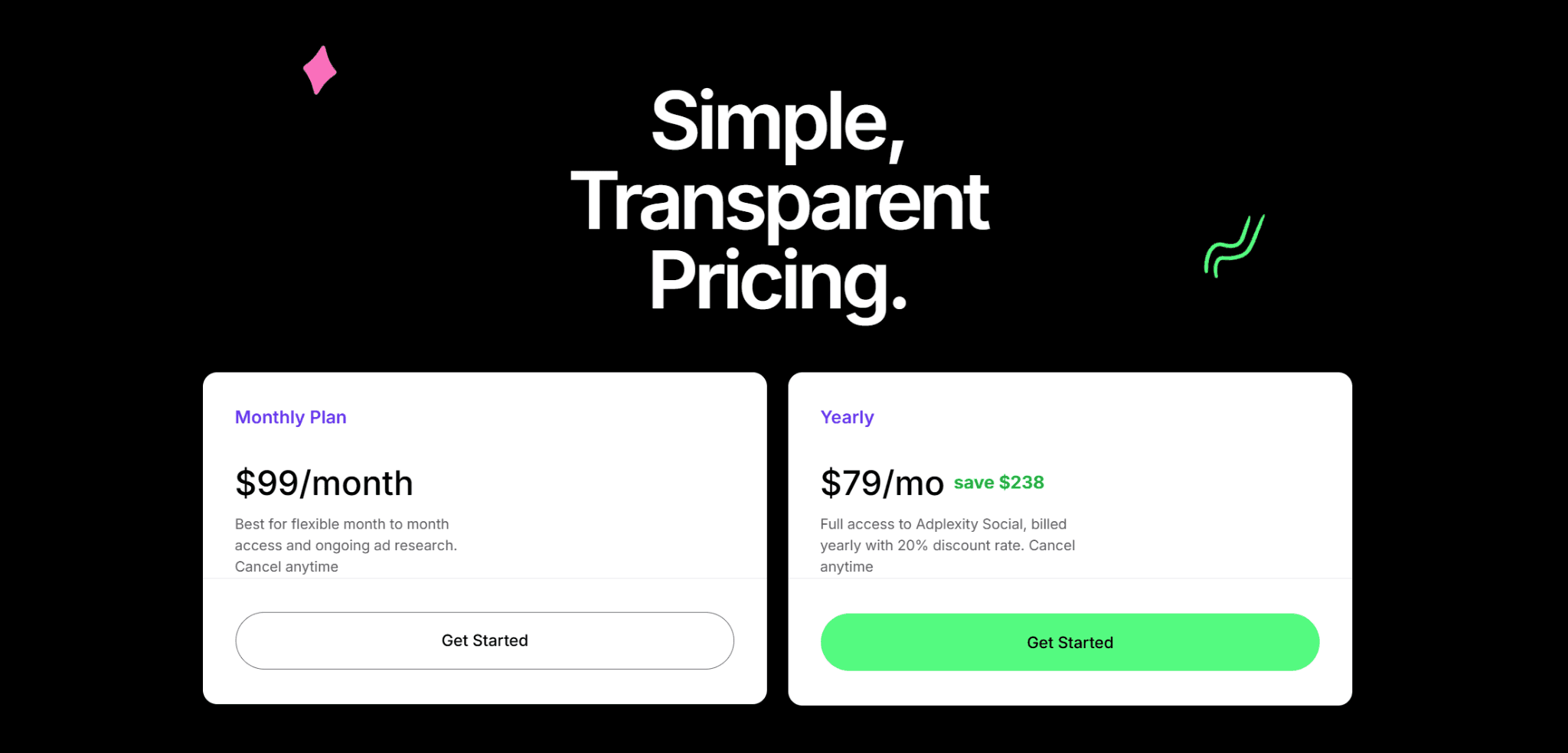
AdPlexity Social is $99 per month, or $950 per year with the annual discount, with extra seats at $49 per month. No credits, no metering. At the same $99 price point as Minea's Premium plan, you get the entire post-click layer on Meta instead: indexed landing pages, crawled redirect chains, tech stack filters, the affiliate offer dimension, domain analytics, and the deleted ads archive.
Which one should you actually pick?
Pick Minea if you are a beginner dropshipper who wants product ideas served daily across Facebook, TikTok, and Pinterest, and you do not need to see anything past the ad itself.
Pick AdPlexity Social if Meta is your money channel. Performance marketers, media buyers, affiliate marketers, lead gen operators, and ecommerce brands doing real volume need to know what happens after the click, because that is where campaigns actually get won or lost. One insight pulled from a competitor's redirect chain, or one proven 60-day-old funnel, pays for the subscription many times over.
Frequently Asked Questions
What is the main difference between AdPlexity Social and Minea?
Minea is a product research tool for dropshippers that shows ad creatives and engagement stats across Facebook, TikTok, and Pinterest. AdPlexity Social is a Meta ad intelligence platform with post-click intelligence: it indexes landing pages, crawls redirect chains, detects affiliate networks, and filters by tech stack, none of which Minea offers.
Is Minea good for spying on Facebook ads?
Minea works for surface-level Facebook ad research, especially finding dropshipping product ideas. It shows the creative and engagement stats but stops at the click, so you cannot see landing pages, funnels, or the technology behind a campaign.
Does AdPlexity Social cover TikTok or Pinterest ads?
No. AdPlexity Social focuses entirely on Meta and covers all Meta placements, not just Facebook and Instagram feeds. That focus is deliberate: it trades network breadth for depth, indexing over 100 million Meta ads along with the landing pages and redirect chains behind them.
Which tool is better for dropshipping?
Beginners who want daily product ideas will find Minea's dashboard easier to start with. Dropshippers running serious Meta spend get more from AdPlexity Social, because filtering by Shopify stores and checking a creative's duplicate count, active ads, and days running reveals which products are actually sustaining paid traffic across an advertiser's whole page network, not just collecting likes on one ad.
How much does Minea cost compared to AdPlexity Social?
Minea starts at $49 per month, with Premium at $99, all credit-metered. AdPlexity Social is $99 per month or $950 per year with no usage credits or metering.
Can any ad spy tool show me a competitor's landing page?
Most cannot. AdPlexity Social indexes the full landing page behind every ad, crawls redirect chains including outgoing URLs, and lets you search keywords that appear on destination pages. That reveals pre-landers, affiliate offers, and funnel structures that ad-only tools miss.
Do I need a paid tool, or is the Facebook Ads Library enough?
The Facebook Ads Library is fine for occasionally looking up a known advertiser. It has no keyword search across landing pages, no longevity data, no tech stack filters, and no archive of deleted ads, so any systematic competitive research quickly outgrows it.
Bottom Line
Minea earns its place as a product idea machine for dropshippers who want quick, creative inspiration across three networks.
But performance marketing runs on what happens after the click.
Landing pages, indexed and searchable.
Redirect chains, crawled to the final offer.
Tech stacks, filterable down to the tracker.
Winning creatives, tracked by duplicate count, active ads, and days running, not likes.
That is the difference between watching ads and understanding campaigns. Head to adplexity.io and see the full funnel behind any Meta ad.
Minea has a real following. Over 200,000 dropshippers, by the company's own count, use it to pull ads from Facebook, TikTok, and Pinterest into one dashboard.
For quick product research, that is a genuinely useful setup.
But an ad is just the surface of a campaign.
The part that actually decides whether a funnel makes money happens after the click: the landing page, the redirect chain, the offer sitting behind it, the tech stack running underneath. Minea never goes there.
If you buy Meta traffic for a living, that is the exact intelligence you need most, and it is the one thing Minea cannot give you.
Here is where each tool wins, what each one costs, and which one actually fits how you work.
TL;DR: Minea is best for dropshippers who want fast product ideas pulled from ad activity across Facebook, TikTok, and Pinterest. AdPlexity Social is best for performance marketers, media buyers, ecommerce brands, and agencies who need to see the full funnel behind every Meta ad: landing pages, redirect chains, affiliate offers, and tech stacks.
Dropshipping product research across Facebook, TikTok, Pinterest
$49 - $99/month
None: ad creative and engagement stats only
What each tool is actually built for
Minea is a product research tool that happens to spy on ads. Everything about it points in one direction: help a dropshipper find the next product to test. The dashboard opens with a daily top ten of winning products. There are daily niche lists, a shop tracker, an image-based Magic Search, and even a bundled option to spin up a Shopify store from a product you find there. If your business is testing dropshipping products, that whole package makes sense.
AdPlexity Social is built for people who treat Meta as a real performance channel, not a place to browse for ideas. It indexes over 100 million Meta ads, adds more than 15 million new ones every month, and covers all Meta placements, not just the Facebook and Instagram feeds. Then it does what Minea never attempts: it visits the destination. Every landing page gets indexed, every redirect chain gets crawled, and the technology running on each page becomes a filter you can search by.
That single difference in intent shapes almost everything that follows.
Where Minea genuinely earns credit
Minea covers TikTok and Pinterest alongside Facebook, and for a dropshipper testing one product across three networks, having it all in one interface is a real convenience. The product-first workflow also lowers the barrier for someone just starting out: open the dashboard, and it hands you ideas without requiring you to already know what to search for.
That is the honest case for Minea. Now the rest of the story.
The database question
Minea's homepage claims 80 million or more active ads across its supported networks. Spread across Facebook, TikTok, and Pinterest, that number gets thin fast once you divide it by network.
AdPlexity Social holds over 100 million ads from Meta alone, growing by more than 15 million a month, including an archive of deleted and banned ads. When an aggressive advertiser gets a campaign pulled, the ad vanishes from Meta and from any tool that only mirrors what is currently live. It stays fully visible in AdPlexity Social. For anyone studying what actually works in competitive verticals, that archive is often where the most useful material lives.
Depth beats breadth here. A tool spread thin across three networks tells you less about your actual Meta competition than a tool that goes all the way down on one.
Post-click intelligence: where the two tools stop being comparable
Minea shows you the ad creative, the copy, and engagement stats on the ad itself. That is where its visibility ends. What page did the click land on? What is written on it? Does the traffic pass through a pre-lander before the real offer? Which affiliate network sits behind it? Is the store running Shopify? Is there a tracker like Redtrack or ClickFlare in the stack? Minea has no answer to any of that.
AdPlexity Social answers all of it. Landing pages are fully indexed, so you can search for keywords that appear on the destination page, not just in the ad copy. Redirect chains are crawled end to end, including outgoing URLs, which exposes the affiliate offers hiding behind pre-landers. Tech stack filters cover Shopify, ClickFunnels, VTurb, Ringba, TrustedForm, and more. A dedicated affiliate offer dimension aggregates activity from networks like ClickBank, BuyGoods, and Digistore24 at the offer level.
Here is what that looks like in practice. Search “posture corrector” in AdPlexity Social, filter by Shopify stores, and set the Longevity filter to ads running 30 days or more. You immediately surface the health and wellness advertisers whose creatives have survived a full month of continuous spend, along with the exact Shopify product pages behind each one. One search gets you the angle, the page structure, and hard proof that someone has been paying to keep this campaign alive for over a month. Minea can show you a similar-looking ad. It cannot show you anything past the click.
If you build funnels instead of just picking products, this is not a nice-to-have. It is the job itself. (And once you find a winning page worth rebuilding fast, a landing page builder like LanderLab pairs naturally with that kind of research.)
Finding proven ads: what actually signals a winner
Minea's model of a winning product leans on engagement: likes, comments, shares on the ad. Engagement tells you people reacted to a creative. It does not tell you the campaign made money, and it only ever describes one single ad, not the wider push behind it. Viral and profitable are not the same thing, and plenty of high-engagement campaigns quietly bleed cash on the backend.
AdPlexity Social looks at the creative itself, not just one ad. Every ad running the exact same creative gets grouped and counted, no matter which advertiser profile or fan page is posting it. That distinction matters more than it sounds. An advertiser spinning the same winning video across five different profiles shows up in AdPlexity Social as one creative with a real duplicate count. Tools that group duplicates by fan page instead miss that entirely and report five separate, unremarkable-looking ads. Plus, you can also see how long a creative has been running, which is a great indicator of performance through longevity.
On top of that duplicate count, the team is currently working on 3 extra very powerful metrics for every creative - New Ads and Active Ads, each compared against the previous 30 days and Creative Score. New Ads tells you whether an advertiser is still actively spinning up variations of a winning idea. Active Ads tells you how many of those duplicates are actually live right now, not just how many ever existed. Creative Score will be a calculated score taking into account all the metrics. Put together, those numbers separate a creative that is quietly scaling across an advertiser's whole page network from one that got posted once and went nowhere, in a way a single engagement count on one ad never could.
The same breakdown already exists at the domain level. The Domain Details view includes a Creatives tab listing every creative a domain has run with the same metrics, so you can see at a glance which creatives a competitor is currently pushing hardest.
Organizing research: Boards vs. collections
Minea lets you save ad creatives into collections, which covers the basic swipe-file use case fine.
AdPlexity Social's Boards go further. A Board holds three element types: ads, domains, and pages or profiles. That means you can track a competitor as an entity, not just a pile of screenshots: their domain, their advertiser pages, their ads, all organized into folders and shareable through a public URL. For agencies and teams, handing a client a live board of competitor activity beats exporting a slide deck of images.
Pricing compared
Minea runs three tiers: Starter at $49 per month, Premium at $99, with a discount for quarterly billing. Every tier is credit-metered, and the AI features are capped monthly on the lower plans. The $49 entry price looks attractive until your research volume grows and the credit meter starts deciding how much spying you get to do.
AdPlexity Social is $99 per month, or $950 per year with the annual discount, with extra seats at $49 per month. No credits, no metering. At the same $99 price point as Minea's Premium plan, you get the entire post-click layer on Meta instead: indexed landing pages, crawled redirect chains, tech stack filters, the affiliate offer dimension, domain analytics, and the deleted ads archive.
Which one should you actually pick?
Pick Minea if you are a beginner dropshipper who wants product ideas served daily across Facebook, TikTok, and Pinterest, and you do not need to see anything past the ad itself.
Pick AdPlexity Social if Meta is your money channel. Performance marketers, media buyers, affiliate marketers, lead gen operators, and ecommerce brands doing real volume need to know what happens after the click, because that is where campaigns actually get won or lost. One insight pulled from a competitor's redirect chain, or one proven 60-day-old funnel, pays for the subscription many times over.
Frequently Asked Questions
What is the main difference between AdPlexity Social and Minea?
Minea is a product research tool for dropshippers that shows ad creatives and engagement stats across Facebook, TikTok, and Pinterest. AdPlexity Social is a Meta ad intelligence platform with post-click intelligence: it indexes landing pages, crawls redirect chains, detects affiliate networks, and filters by tech stack, none of which Minea offers.
Is Minea good for spying on Facebook ads?
Minea works for surface-level Facebook ad research, especially finding dropshipping product ideas. It shows the creative and engagement stats but stops at the click, so you cannot see landing pages, funnels, or the technology behind a campaign.
Does AdPlexity Social cover TikTok or Pinterest ads?
No. AdPlexity Social focuses entirely on Meta and covers all Meta placements, not just Facebook and Instagram feeds. That focus is deliberate: it trades network breadth for depth, indexing over 100 million Meta ads along with the landing pages and redirect chains behind them.
Which tool is better for dropshipping?
Beginners who want daily product ideas will find Minea's dashboard easier to start with. Dropshippers running serious Meta spend get more from AdPlexity Social, because filtering by Shopify stores and checking a creative's duplicate count, active ads, and days running reveals which products are actually sustaining paid traffic across an advertiser's whole page network, not just collecting likes on one ad.
How much does Minea cost compared to AdPlexity Social?
Minea starts at $49 per month, with Premium at $99, all credit-metered. AdPlexity Social is $99 per month or $950 per year with no usage credits or metering.
Can any ad spy tool show me a competitor's landing page?
Most cannot. AdPlexity Social indexes the full landing page behind every ad, crawls redirect chains including outgoing URLs, and lets you search keywords that appear on destination pages. That reveals pre-landers, affiliate offers, and funnel structures that ad-only tools miss.
Do I need a paid tool, or is the Facebook Ads Library enough?
The Facebook Ads Library is fine for occasionally looking up a known advertiser. It has no keyword search across landing pages, no longevity data, no tech stack filters, and no archive of deleted ads, so any systematic competitive research quickly outgrows it.
Bottom Line
Minea earns its place as a product idea machine for dropshippers who want quick, creative inspiration across three networks.
But performance marketing runs on what happens after the click.
Landing pages, indexed and searchable.
Redirect chains, crawled to the final offer.
Tech stacks, filterable down to the tracker.
Winning creatives, tracked by duplicate count, active ads, and days running, not likes.
That is the difference between watching ads and understanding campaigns. Head to adplexity.io and see the full funnel behind any Meta ad.
Table of Contents
Quickly navigate through the key sections of this article.