5 Best Ad Spy Tools for Affiliate Marketing (2026 Guide to Finding Profitable Campaigns)

Share:
Every few months, a new “best ad spy tools” list shows up.
They all look the same.
A few screenshots, a feature table, maybe some star ratings, and a ranking that somehow favors whoever pays the highest affiliate commission.
That is not how real affiliate marketers choose tools.
If you are actually running paid traffic, the question is not how many countries a tool covers or how many CTA buttons you can filter by. The question is simple:
Can this tool help you find campaigns that are already making money, and understand how they work?
Because finding an ad is easy.
Understanding what happens after the click is where the money is made.
You need to know:
where the traffic actually goes
what the landing page says
how the funnel is structured
which affiliate network or offer is behind it
Most tools stop at the ad creative.
The ones that actually drive results go much deeper.
This guide ranks the best ad spy tools for affiliate marketing based on one thing:
How much real campaign intelligence they provide, not just surface-level data.
TL;DR: Best Ad Spy Tools for Affiliate Marketing (2026)
AdPlexity Social – Best overall for affiliate campaign intelligence and funnel visibility
AdSpy – Best for the largest historical ad database
AdHeart – Best for Meta-focused research in CIS markets
BigSpy – Best budget option with multi-platform coverage
PowerAdSpy – Best for moderate multi-platform analysis
If you are serious about affiliate marketing, focus on tools that show what happens after the click, not just the ad creative.
Below, we break down how each tool performs in practice.
What Separates a Research Tool from a Revenue Tool
Before we get into the rankings, it is worth establishing what actually matters for affiliate workflows on Meta. Not all features are created equal, and many of the things spy tools promote the most are the least useful in practice.
Landing Page Intelligence
Landing page intelligence is one of the most underrated features in ad spy tools. The ad creative gets your attention, but the landing page reveals what is really going on.
When a tool indexes the actual text on destination pages, you can search by keywords that appear on the landing page, not just in the ad copy.
This allows you to find campaigns promoting specific ingredients, claims, or offer structures, even when the ad itself is vague.
Redirect Chain Analysis
Redirect chain analysis is what separates tools built for affiliates from those built for brand marketers.
In affiliate marketing, the URL shown in the ad is almost never the final destination. Traffic often passes through tracking domains, cloakers, and intermediate pages before reaching the actual offer.
A tool that shows the full chain gives you visibility into the entire funnel, including which affiliate network is being used and where the monetization actually happens.
Technology Stack Detection
The technology behind a landing page often tells you more about a campaign than the ad itself.
For example:
TrustedForm usually indicates lead generation
Shopify suggests ecommerce
VSL tools like Vturb point to long-form video funnels
Platforms like ClickFunnels or GoHighLevel signal specific funnel types
Being able to filter campaigns by tech stack helps you quickly identify patterns across profitable campaigns.
Creative Grouping
Creative grouping solves a common issue: the same ad running across dozens of different fan pages.
Without grouping, you might see the same campaign repeated multiple times. With it, you can identify when a single creative is being scaled aggressively, which is a strong signal that it is working.
Domain-Level Analysis
Domain-level analysis flips the research process.
Instead of starting from an ad, you start from a domain and see everything connected to it, including ads, fan pages, and creatives.
This makes it much easier to map entire operations rather than analyzing isolated campaigns.
Why This Actually Matters
Most comparison tables focus on surface-level features like country count or filtering options. Those are useful, but they do not directly impact profitability.
The features above are what turn a spy tool from a browsing tool into a decision-making tool.
They allow you to understand not just what ads are running, but how the entire campaign is structured and monetized.
Here is how each tool compares on the features that actually impact affiliate profitability:
Tool | Landing Page Data | Redirect Tracking | Tech Detection | Affiliate Insights | Best For | Price |
|---|---|---|---|---|---|---|
AdPlexity Social | Full indexed copy | Full chain | Advanced | Network-level | Affiliate campaign intelligence | $99/mo |
AdSpy | Partial | Limited | Basic | No | Historical data & comment search | $149/mo |
AdHeart | No | No | No | No | Creative research (Meta) | ~$53/mo |
BigSpy | No | No | No | No | Budget multi-platform browsing | Free–$99/mo |
PowerAdSpy | No | No | Limited | No | Multi-platform analysis | $69–$399/mo |
1. AdPlexity Social: Best Overall for Affiliate Campaign Intelligence
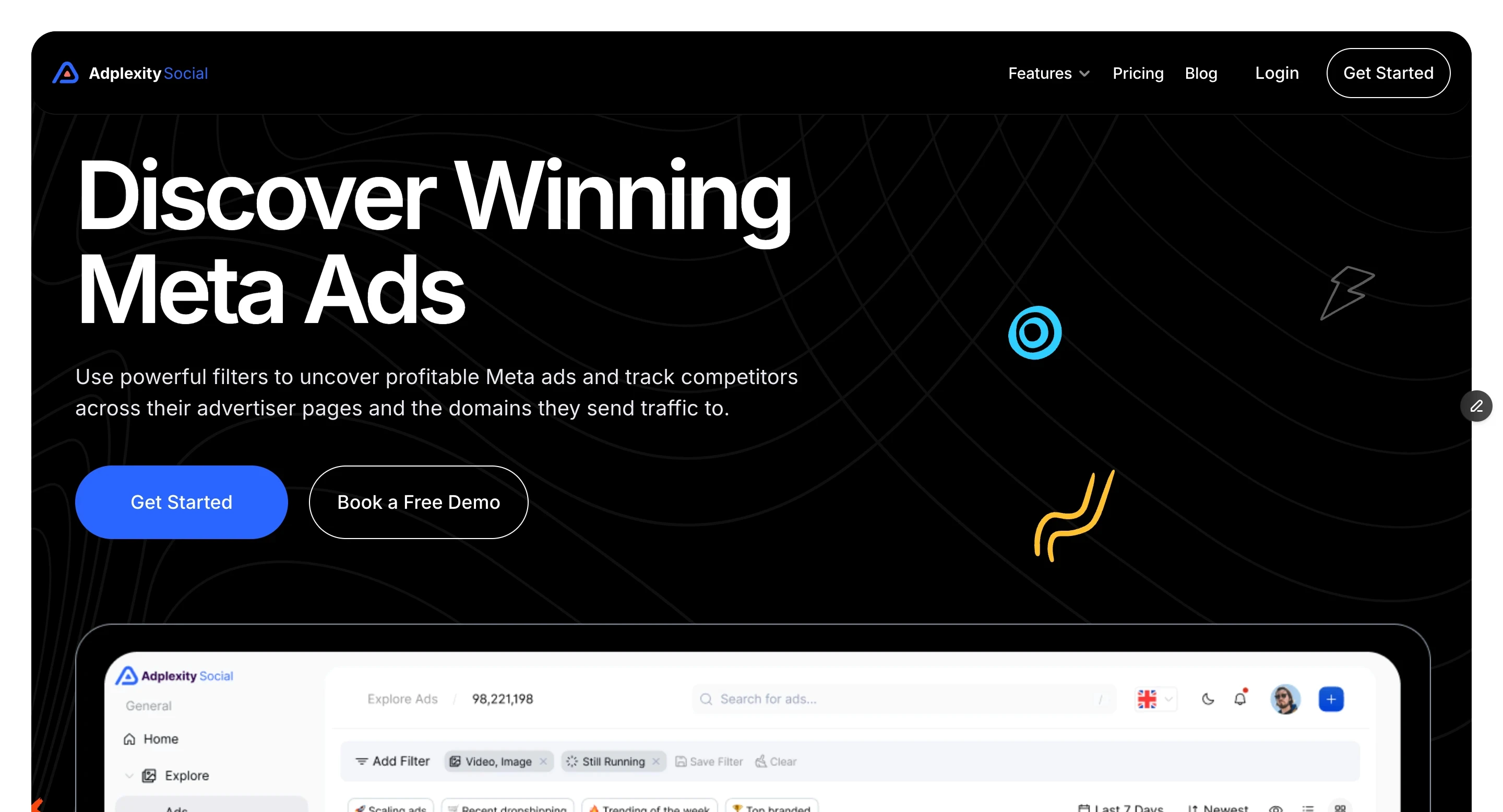
Pricing: $99/month | $950/year (save ~20%) | Additional seats $49/month
AdPlexity Social is built specifically for Meta ad intelligence, but what sets it apart is how deeply it analyzes what happens after the click.
Instead of stopping at ad creatives, it focuses on the full campaign structure.
According to the platform, it indexes millions of ads per month and includes detailed data for each entry, including landing page content, redirect chains, and detected technologies.
This makes it possible to move from “this ad looks interesting” to “this is how the entire campaign works.”
One of the biggest advantages is landing page indexing. You can search campaigns based on the actual content of the destination page, not just the ad copy.
This is especially useful for affiliate campaigns where the ad often hides the real offer behind curiosity hooks.
Another key feature is redirect chain tracking.
Instead of guessing where traffic goes, you can see the full path from click to final destination. This reveals affiliate networks, tracking setups, and how the funnel is structured.
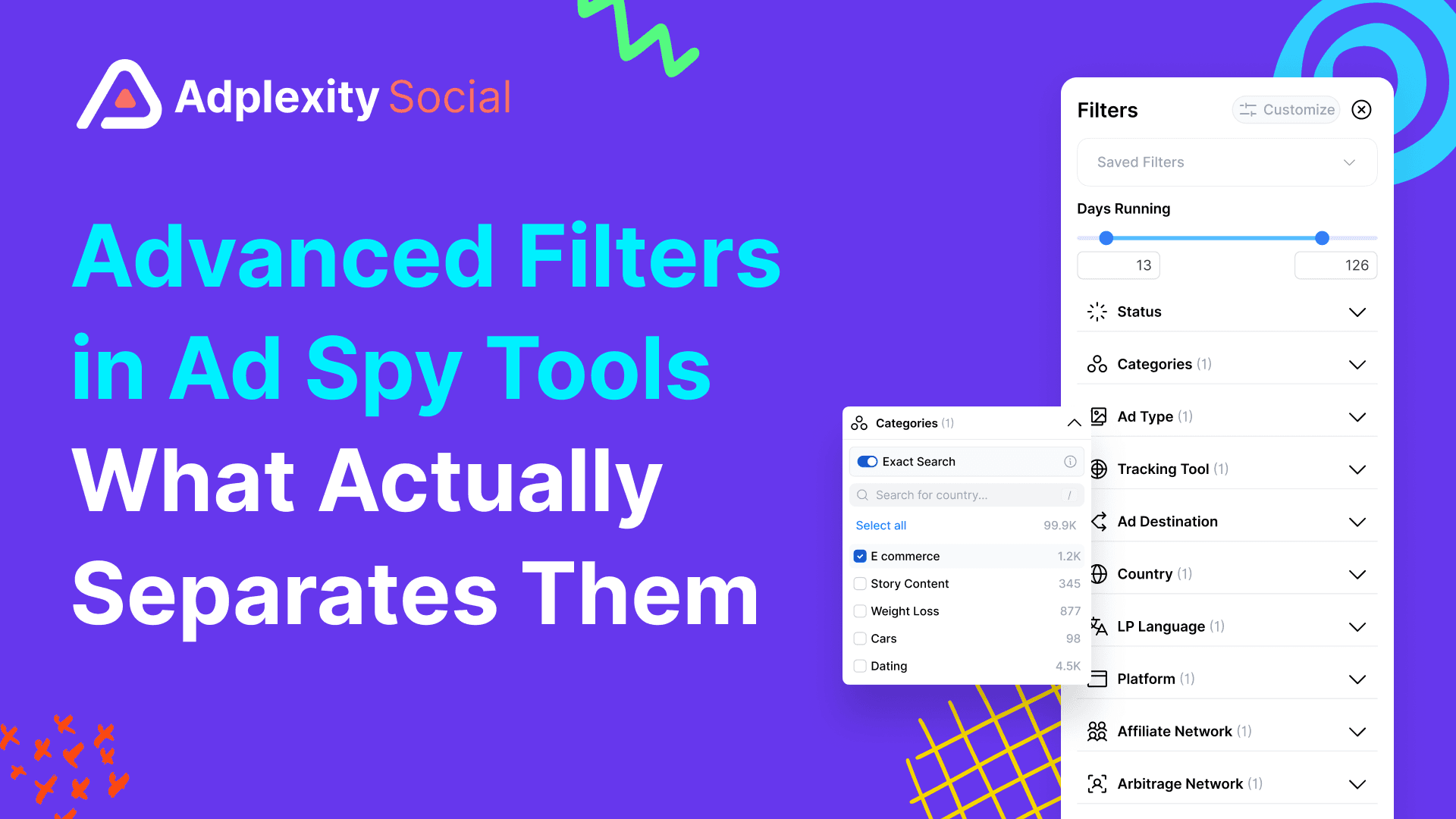
The platform also includes technology detection, allowing you to filter campaigns by tools like Shopify, ClickFunnels, TrustedForm, Vturb, and more.
This helps identify patterns across profitable campaigns and understand the infrastructure behind them.
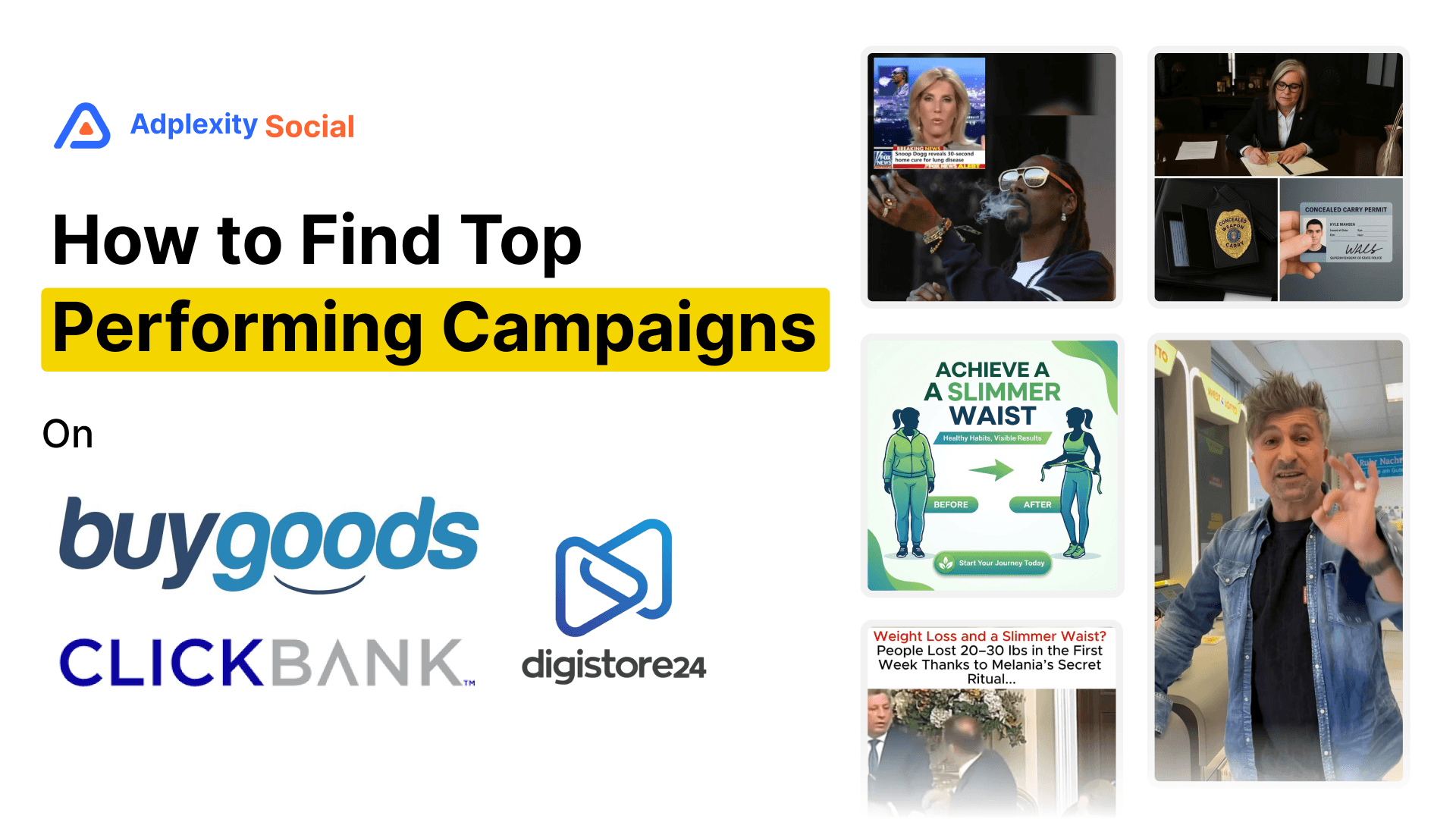
A standout feature for affiliates is the affiliate network view, which groups campaigns by networks like ClickBank, Buygoods, Digistore, and others. This makes it much easier to discover active offers and see how they are being promoted.
The domain view flips the research process by showing all ads pointing to a specific domain.
Combined with creative grouping, you can quickly identify when campaigns are being scaled across multiple fan pages.
Finally, the Boards feature allows you to organize research in a way that matches how real campaign analysis works.
Instead of saving just ads, you can track ads, domains, and fan pages together, giving you a complete view of a competitor’s operation.
Best for:
Performance marketers and affiliates who need full campaign visibility, not just ad creatives.
Key advantage:
Deep funnel intelligence, including landing pages, redirect chains, and affiliate network tracking.
Main limitation:
No free tier and a learning curve if you are used to simpler creative browsing tools.
2. AdSpy: Largest Historical Database, Premium Price
Pricing: $149/month (no free tier)
AdSpy is one of the longest-running ad spy tools in the space and is primarily known for its large historical database.
With hundreds of millions of ads across many countries and languages, it is built more for broad research than for understanding how current campaigns actually work.
Its main strength is database depth. If you want to analyze long-term trends, revisit older campaigns, or search for specific ad text patterns, it can be useful.
One of its more unique features is comment search. You can filter ads based on what users are saying in the comments, which can surface buying-intent signals like “does this work?” or “where can I buy this?”
However, most of its capabilities stay at the surface level.
While it allows basic filtering by landing page URLs or detected technologies, it does not provide full visibility into what happens after the click.
There is no redirect chain tracking, no affiliate network detection, and limited insight into the actual funnel structure.
As a result, AdSpy is better suited for discovering ads than for breaking down how profitable campaigns are built.
Best for:
Teams that prioritize historical ad data and long-term trend analysis.
Key advantage:
Large database and the ability to search through ad comments.
Main limitation:
Expensive and lacks deep funnel or affiliate-level intelligence.
3. AdHeart: Strong CIS-Market Focus, Competitive on Meta Depth
Pricing: Starts at ~$53/month (discounts available)
AdHeart is a Meta-focused ad spy tool that covers Facebook, Instagram, Messenger, and Audience Network.
It is especially popular among media buyers in CIS markets, where it has built a strong reputation.
The platform offers solid filtering options, including keywords, GEO, language, placement, and campaign duration.
It also includes features like IP-based filtering and app campaign analysis, which can be useful depending on your niche.
AdHeart is designed primarily for creative research and monitoring. It provides a clean interface for browsing ads and tracking competitors across Meta platforms without a steep learning curve.
However, it lacks deeper campaign analysis features.
There is no landing page copy indexing, no redirect chain tracking, and no affiliate network visibility.
This means you can see where an ad links to, but not fully understand what happens after the click.
As a result, it works well as a research tool, but requires manual work if you want to break down full funnels.
Best for:
Media buyers focused on Meta ads, especially in CIS markets.
Key advantage:
Strong filtering and frequent data refresh for Facebook and Instagram creatives.
Main limitation:
No post-click intelligence or funnel-level insights.
4. BigSpy: Widest Platform Coverage on a Budget
Pricing: Free tier available | Basic from $9/month | Pro at $99/month
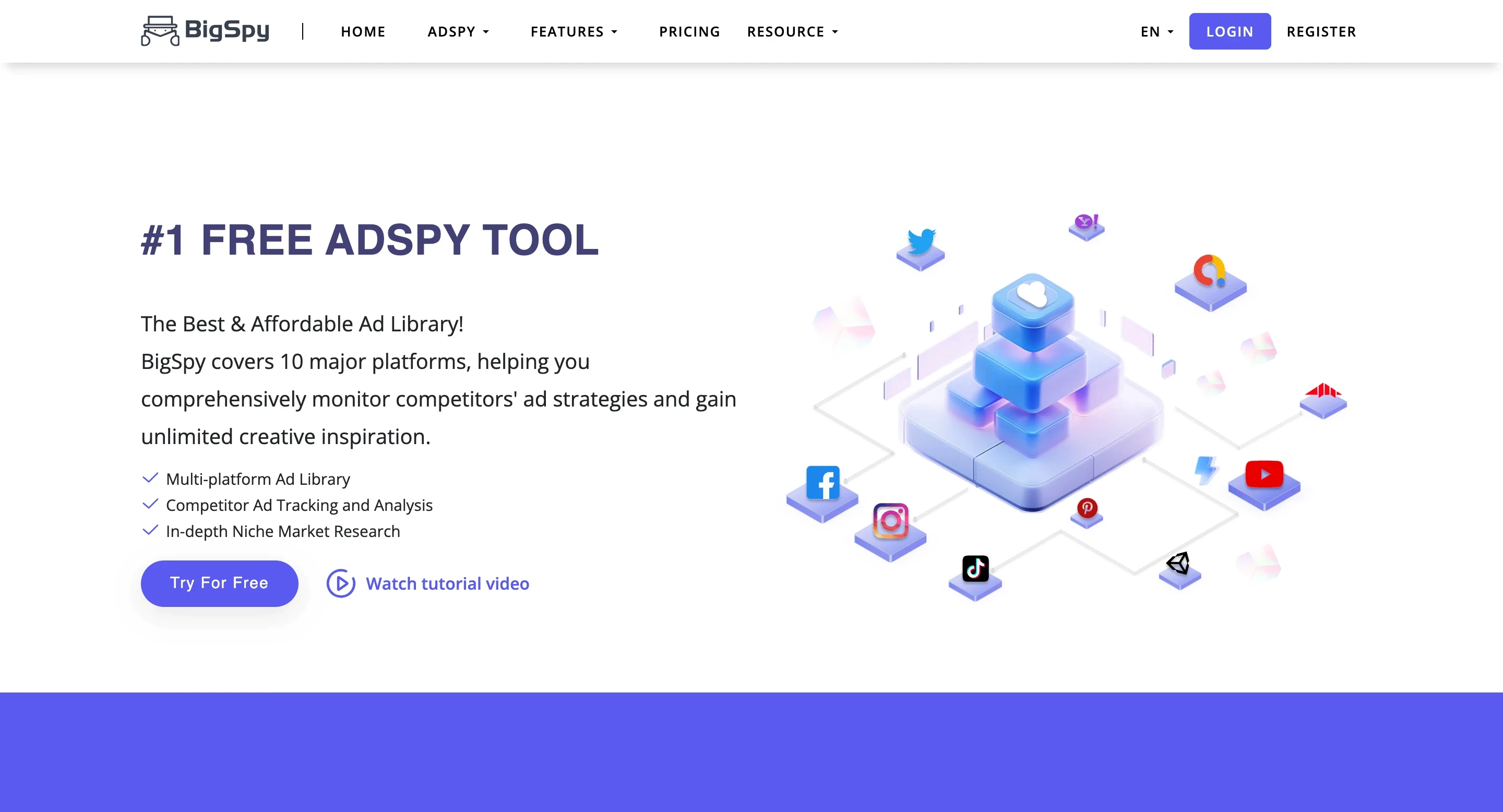
BigSpy stands out for its multi-platform coverage. It supports Facebook, Instagram, TikTok, YouTube, Google, Pinterest, and more, making it one of the broadest tools available.
The biggest appeal is accessibility. The free tier lets you explore the platform and run basic searches, while the low-cost plans make it one of the most affordable entry points into ad intelligence.
For beginners, this makes BigSpy a good starting point for understanding how ads look across different platforms.
The trade-off is depth. While it covers many platforms, its Meta-specific capabilities are limited. It lacks features like landing page indexing, redirect tracking, affiliate detection, and detailed funnel analysis.
Data freshness can also vary, especially on lower-tier plans, making it harder to distinguish what is currently working from what worked in the past.
Best for:
Beginners who want a low-cost way to explore ads across multiple platforms.
Key advantage:
Wide platform coverage and a usable free plan.
Main limitation:
Limited depth and inconsistent data freshness.
5. PowerAdSpy: Multi-Platform with a Complex Pricing Structure
Pricing: $69/month to $399/month, depending on features
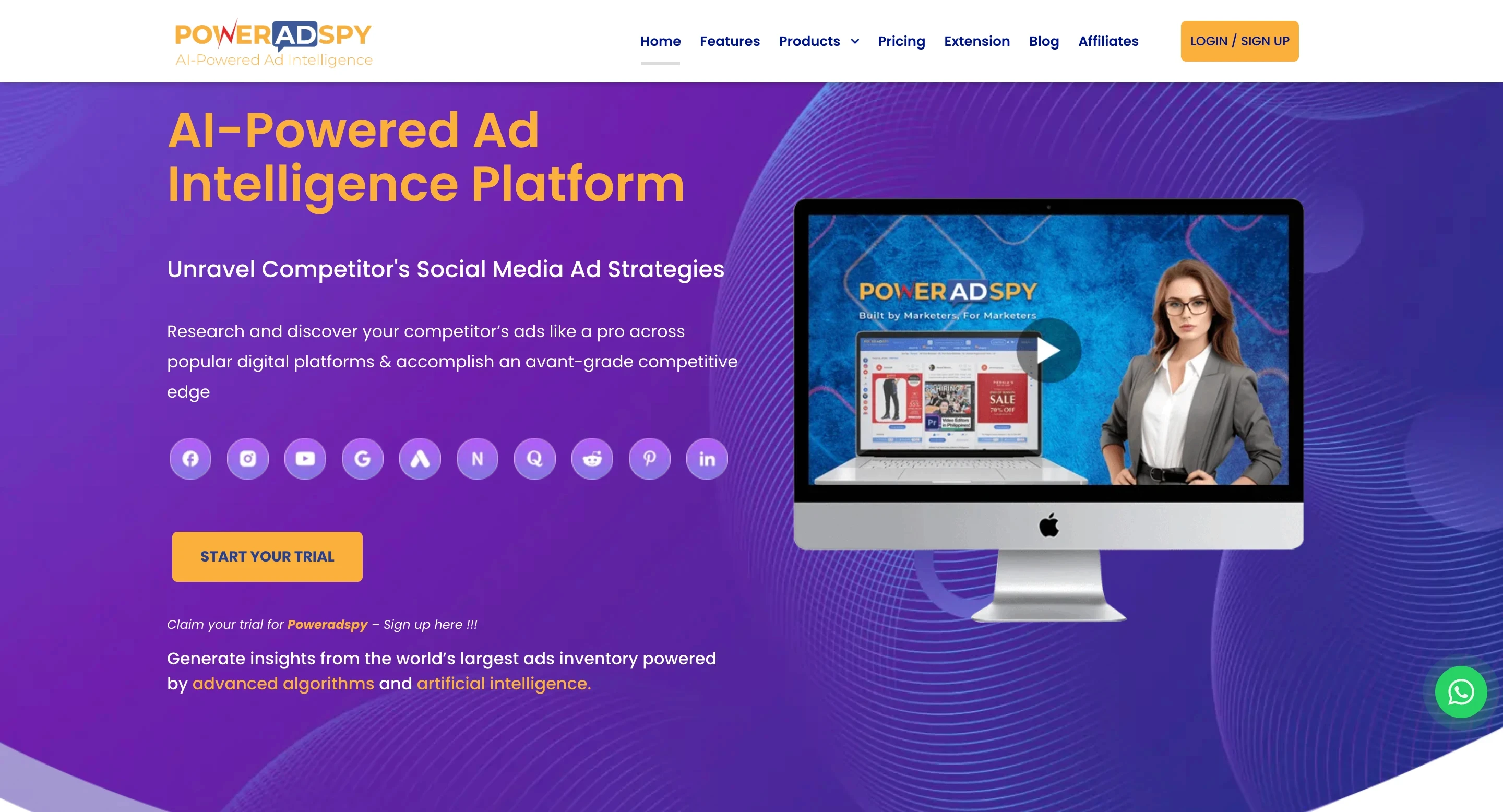
PowerAdSpy is another multi-platform tool that covers Facebook, Instagram, Google, YouTube, and several native and social channels.
Its main value lies in giving users access to multiple ad ecosystems within a single platform.
The tool includes standard filtering options, such as keywords, domain search, country targeting, and engagement-based sorting.
It also offers a browser extension for saving ads while browsing, which can be convenient for quick research.
A notable feature is its trial access, allowing users to test the platform before committing to a full subscription.
However, the biggest drawback is its pricing structure. Key features are split across multiple tiers, which can quickly become expensive if you need access to multiple platforms.
On the Meta side specifically, it lacks deeper insights.
There is no landing page indexing, no redirect chain tracking, and no affiliate-level analysis, which makes it less useful for affiliates who need full-funnel visibility.
Best for:
Marketers who want a single tool covering multiple ad platforms.
Key advantage:
Broad platform coverage with standard filtering features.
Main limitation:
Complex pricing and limited depth for Meta-specific analysis.
The Feature That No Comparison Table Shows You
If you have read other spy tool comparison articles, you have probably seen tables comparing country counts, CTA button types, platform coverage, and pricing.
Those tables are useful for surface-level comparison, but they miss the feature category that matters most for affiliate profitability: post-click intelligence.
Here is a quick breakdown of where each tool stands on the capabilities that actually drive affiliate campaign decisions:
This is not about which tool is “best” overall. It is about which one fits your workflow.
They are built for different use cases.
If you just need creative inspiration and trend monitoring, several of the cheaper options on this list do that job well.
But if you are running real affiliate campaigns and you need to understand the full picture, from ad to funnel to offer, there is a clear gap between what most tools provide and what AdPlexity Social delivers.
How to Actually Use a Spy Tool (Without Wasting Hours)
Owning a spy tool is not the same as getting value from one. Most affiliates sign up, search a few keywords, scroll through some ads, and either feel overwhelmed or underwhelmed.
Here is a workflow that actually produces results:
Start with the offer, not the ad. If you already know which offer or vertical you want to promote, search for it directly.
Use the offer name, the product name, or a core keyword from the landing page. Filter by ads running 14+ days to eliminate test campaigns.
What is left is almost certainly profitable, because no one runs a losing campaign for two weeks on Meta.
Work backward from the destination. Once you find an ad worth studying, the creative is only the starting point. Look at where the ad sends traffic.
Is it going directly to a product page? Through a pre-lander? To an advertorial? The funnel structure tells you more about the campaign strategy than the ad copy does.
If a tool lets you see the full URL chain and landing page content, use that data. If it does not, you will need to click through manually, which is slower and does not scale.
Track infrastructure, not just creatives. When you notice that multiple successful campaigns in a niche are all using the same tracking tool, the same checkout platform, or the same video hosting service, that is a signal.
It means there is a proven tech stack for that vertical. Replicate the infrastructure approach, not the creative.
Build Boards around operations, not just ads. When you find a competitor worth tracking, do not just save their best ads. Save the domains they are sending traffic to and the fan pages they are running ads from.
A Board with all three element types gives you a living snapshot of their entire operation that you can check back on weekly. This is how you move from one-off research sessions to ongoing competitive monitoring.
Do not copy. Adapt. This should go without saying, but copying someone's content is a fast track to getting your ad account flagged or banned.
Use spy data to understand angles, hooks, funnel structures, and offer positioning. Then build your own version from that understanding.
The Bottom Line
If you are spending money on Meta ads, guessing is expensive.
Most spy tools show you what looks interesting. Very few show you what is actually making money.
That difference is where most affiliates either waste budget or scale profitably.
If you want to see the full picture, from ad creative to landing page to offer and infrastructure, you need a tool built for that level of analysis.
AdPlexity Social gives you that visibility.
Try AdPlexity Social and start analyzing real campaigns instead of guessing.
Frequently Asked Questions
Q: What is the best ad spy tool for affiliate marketing?
A: The best tool depends on your needs, but for affiliate marketers, tools that provide landing page data, redirect tracking, and funnel insights like AdPlexity Social offer the most value.
Q: Are ad spy tools worth it?
A: Yes, if you are running paid traffic. A good spy tool can save thousands in testing by showing proven campaigns, winning funnels, and validated offer structures.
Q: Can you spy on Facebook ads legally?
A: Yes. Ad spy tools collect publicly available advertising data and organize it for analysis. They do not access private accounts or restricted information.
Q: What should I look for in an ad spy tool?
A: Focus on tools that go beyond ad creatives. Landing page visibility, redirect tracking, and technology detection are key features for affiliate marketers.
Q: What is the difference between a spy tool and an ad library?
Ad libraries like Meta Ads Library show basic ad data. Spy tools go further by analyzing landing pages, tracking funnels, and uncovering the full campaign structure.
Discover Winning Meta Ads
Similar Blogs