How to Reverse-Engineer a Competitor's Landing Page Funnel From Their Facebook Ads

Share:
Most marketers stop at the ad creative and miss 90 percent of what is actually worth studying.
The ad is the invitation. The real intelligence lives on the other side of the click: the landing page structure, the offer angle, the pricing mechanics, the post-click experience, the affiliate network behind the pre-lander.
When you know how to read those signals, you stop copying ads and start copying what actually makes money.
If you are running paid campaigns on Meta and want to understand why certain competitors are scaling hard in your vertical, this guide walks you through the full process from finding the right ads to dissecting the complete funnel they sit in front of.
By the end, you will know how to trace any Facebook ad back through its redirect chain, identify the landing page structure and tech stack, spot the monetization mechanic, and reconstruct the funnel logic so you can apply it to your own campaigns.
This is the research process senior media buyers do before they write a single brief. Most guides skip it entirely.
What you will be able to do by the end of this post:
Pull ads that are worth studying, not just ads that look good. Trace the full click path from the ad to the landing page to the offer.
Identify the tech stack and traffic signals that reveal whether a campaign is actually performing. Reconstruct the funnel structure and understand the offer mechanics.
Do all of this in about 15 minutes per competitor.
Why Most Competitive Research Stops Too Early
Open the Meta Ads Library, search your competitor's brand name, and you will see their ads. That is useful for about 10 minutes.
What you will not see: where those ads actually send traffic. What the landing page says. Whether the offer is a direct product or an affiliate pre-lander.
What tracking tools are loaded in the background? How long has the campaign been running?
How many variations of that creative have they tested? Whether the domain behind the ad has 200 other advertisers pointing to it.
The Ads Library shows you the surface. The funnel is everything underneath it.
This matters more than it used to because the creative arms race on Meta has made the ad itself a commodity. Hooks get copied in days.
But a well-built funnel with a tested offer angle, a tight pre-lander, and a conversion flow optimized over six months?
That takes time to build and time to decode. The marketers doing this research have a compounding advantage over those who are just scrolling through creatives.
Step 1: Find the Ads Worth Studying
Not every competitor ad is worth pulling apart. You want ads that have been running for a while, because longevity in paid media almost always means the funnel is working. Nobody keeps a losing ad live for 90 days.
Start by building a shortlist of target advertisers. These might be direct competitors, adjacent brands in your vertical, or successful campaigns in a market you are trying to enter.
If you already have a swipe file, pull from that.
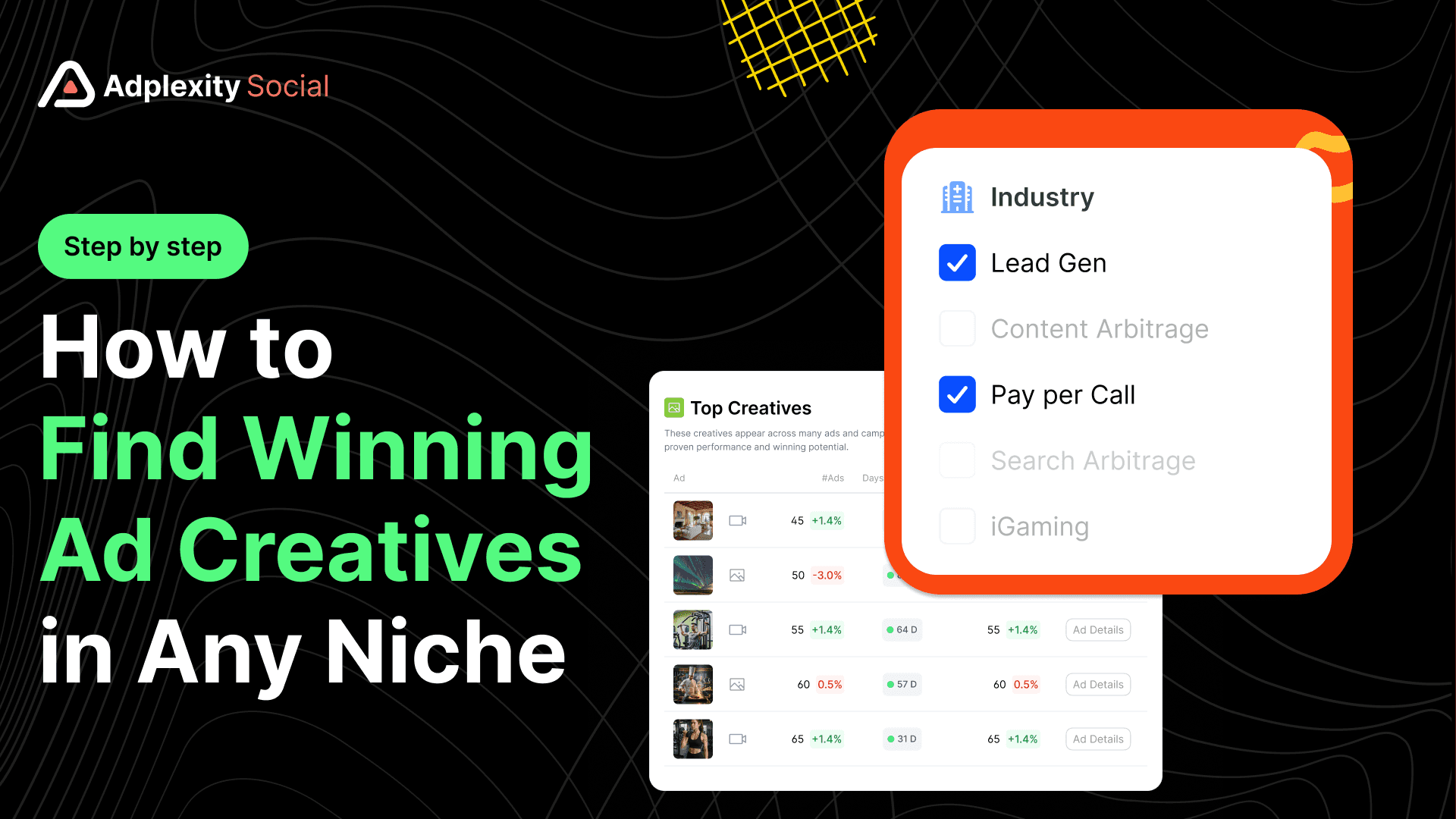
If you need to build one from scratch, the " How to Find Winning Ad Creatives in Any Niche guide on this blog walks through the research process in detail.
For each advertiser on your list, you are looking for ads that have been running for at least 30 days, which suggests the funnel is profitable enough to scale spend.
Ads with a consistent creative direction, rather than wild variation, usually signal that the advertiser has found a working angle and is milking it.
At this stage, the Meta Ads Library will show you a brand's active ads if you search by page name. That is a starting point, but it has real limits: no longevity data, no way to see how many advertisers are running the same offer.
You can use it to identify which funnel category a competitor is running (product page, lead form, advertorial, VSL) and to grab a URL to investigate further.
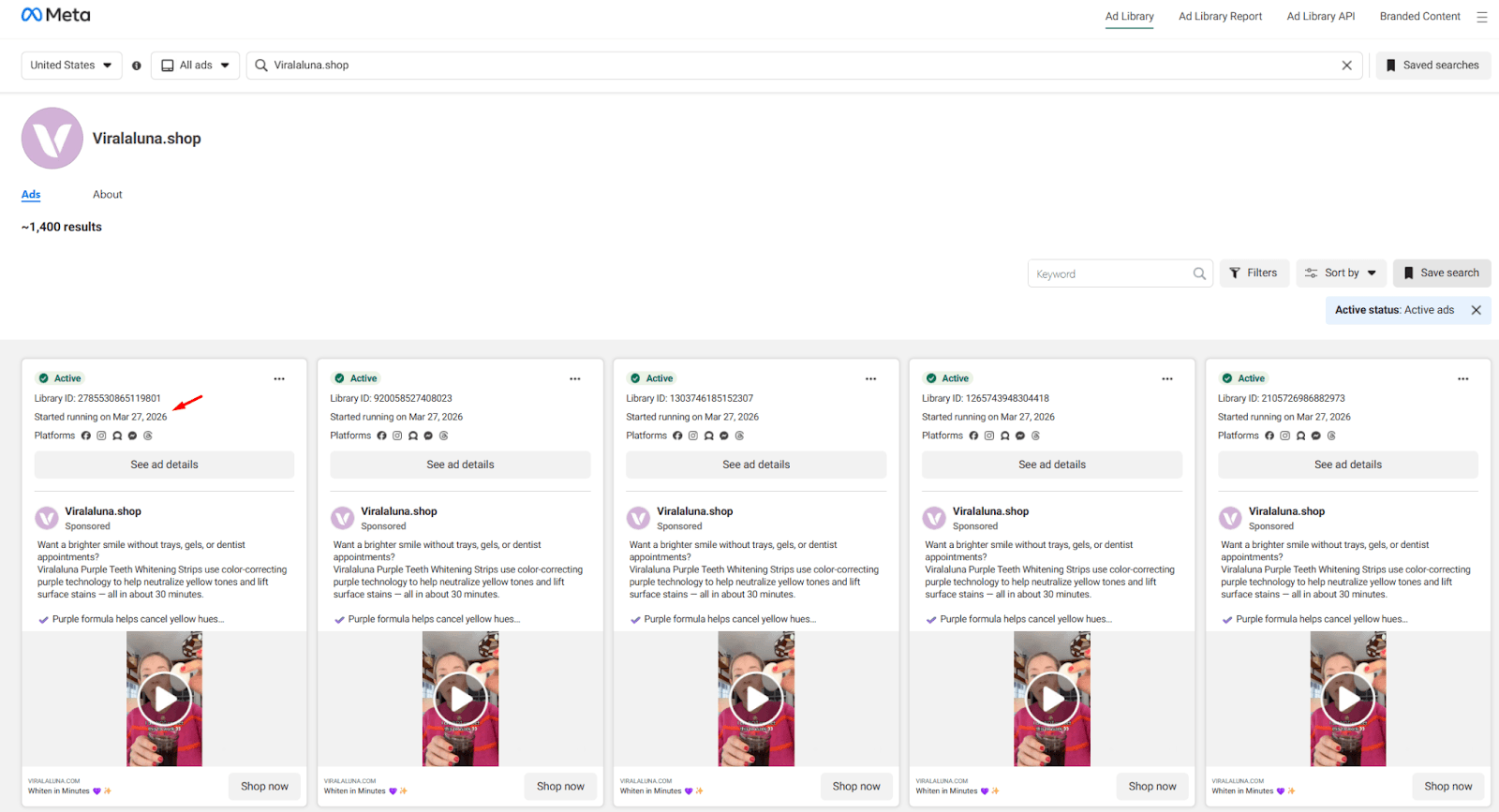
Quality check: Before you go deeper on any ad, confirm it has been running at least 2 to 4 weeks by checking the "started running on" date in the Ads Library.
If an ad launched three days ago, you are studying a test, not a winner.
Step 2: Read the Landing Page as a Funnel Document
Every ad in the ads library lets you click to go to the landing page.
Now read the page as a funnel document, not as a consumer. You are trying to answer six questions.
What is the hook at the top of the page? The above-the-fold copy is usually a close relative of the ad hook.
If the ad said "doctors are furious," and the landing page opens with a credentialing angle, that tells you the funnel is leaning on authority positioning.
If the ad hook and the page hook are completely disconnected, the campaign usually does not perform well.
What is the primary call to action? Is it a purchase, a lead form, a quiz, a free trial, or a phone number? The CTA structure tells you the monetization model.
A short-form lead form with just name and email usually feeds a call center.
A multi-step quiz is almost always a pre-lander for a supplement or insurance offer. A single buy button on a product page is an ecommerce feature.
A VSL (video sales letter) with a buy button below the fold that appears after several minutes of the video is a direct-response affiliate.
How long is the page? Scroll depth matters. A 400-word page with one CTA is built for impulse conversions on warm traffic.
A 3,000-word page with proof elements, objection handling, and a guarantee section is built to convert cold traffic and has probably been tested hard. If it is long, read the whole thing.
The objection-handling sections tell you exactly what the competitor thinks their biggest conversion barriers are.
What proof elements are present? Testimonials, before and afters, media logos, doctor endorsements, clinical study citations. These are not just trust signals.
They are a map of the competitive positioning. If a competitor is leaning heavily on clinical language in a supplement vertical, they are trying to differentiate from the "miracle cure" ads and earn a longer buying window.
What happens after the primary CTA? If you can, go through the funnel. Hit the button. Fill out the form. Does a second page load with an upsell?
Does it go to a thank-you page with a video? Does it redirect to a different domain?
The post-click sequence is often where most revenue is generated, and almost no one in competitive research looks at it.
Is there an exit pop or retargeting trigger? Scroll to the bottom and trigger an exit intent if one exists.
Many well-built funnels have a secondary offer in the exit pop that is softer than the main CTA, and this secondary offer often reveals the true economics of the offer.
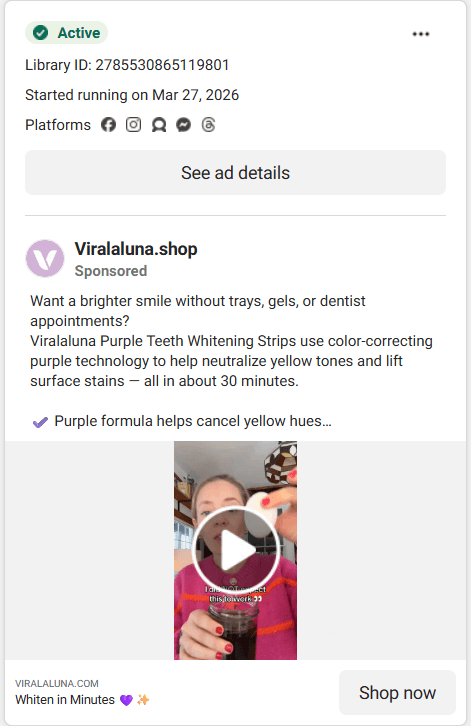
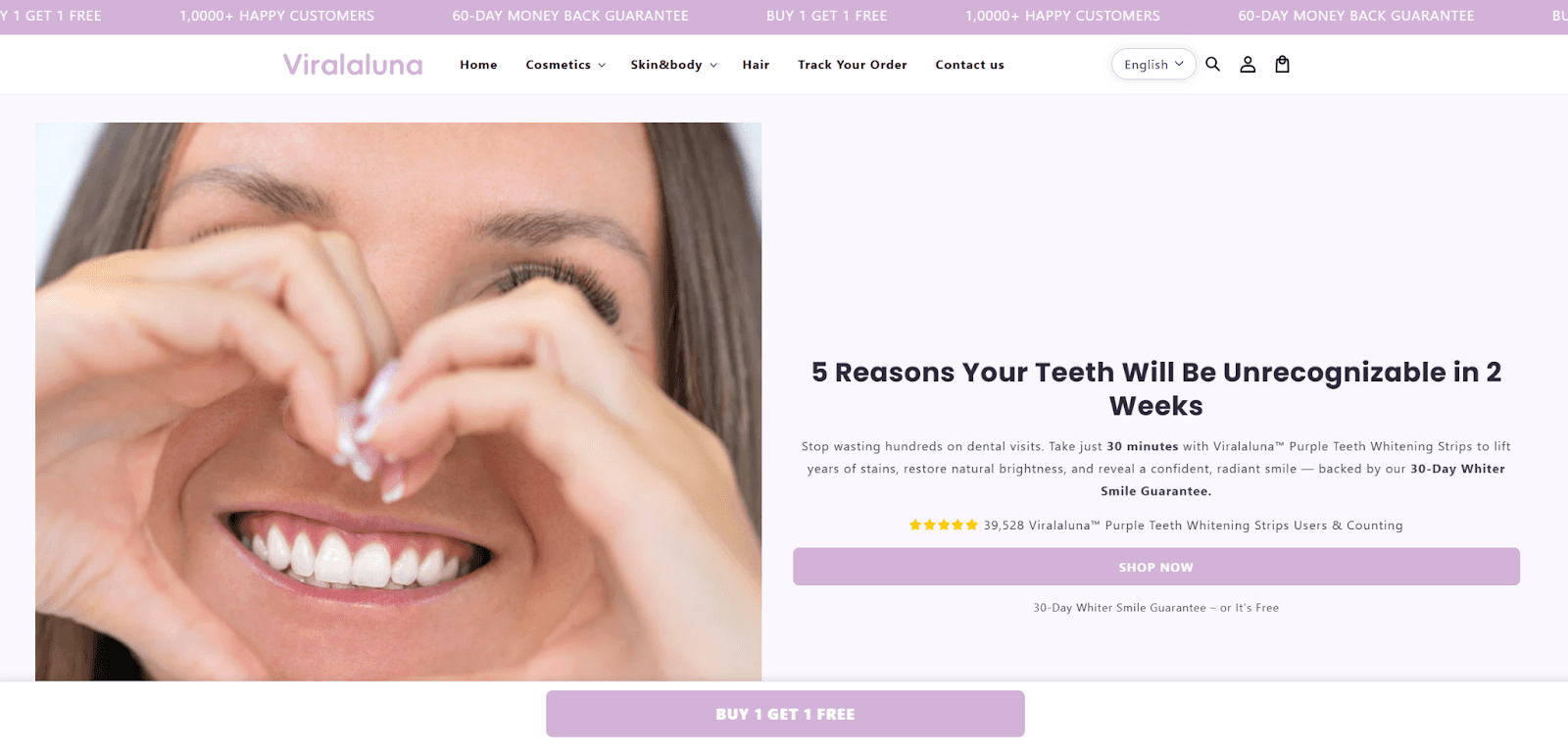
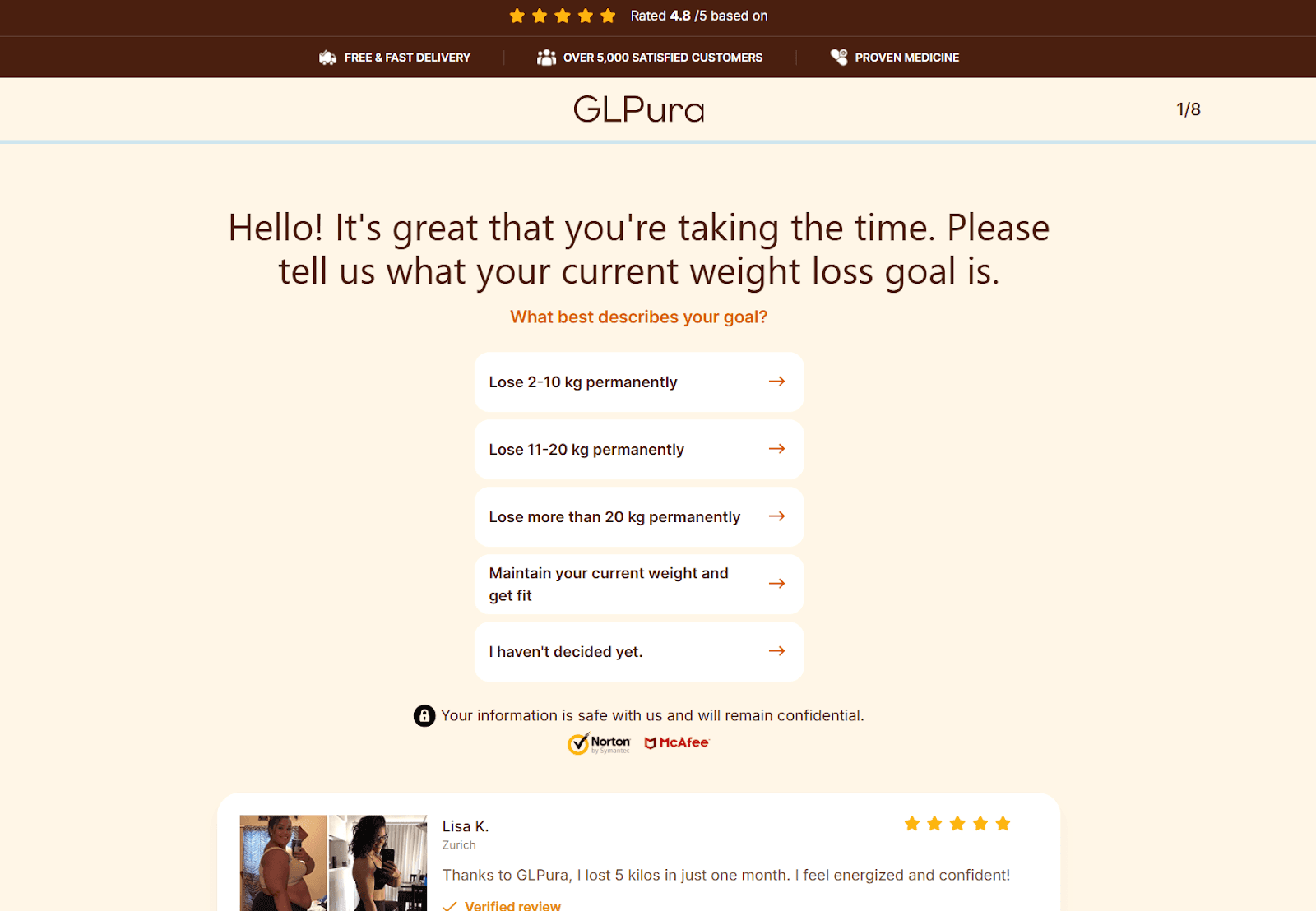
Quality check: After reading the page, you should be able to describe the funnel type in one sentence. If you cannot, the page is either badly built or you missed something. Try again.
Step 3: Trace the Full Redirect Chain
The URL you land on after clicking the ad is rarely the whole story. Most serious paid campaigns run their traffic through a tracking domain first, then redirect to the actual landing page.
Affiliate campaigns add another layer: a pre-lander between the ad and the offer page, with the affiliate network's tracking link somewhere in the chain.
You need to see the full redirect chain to understand what is actually happening.
The manual way to do this is to paste the ad's destination URL into a redirect checker (Redirect Checker, httpstatus.io, or the "Redirect Path" browser extension all work).
This shows you every hop in the redirect sequence, which domains are involved, what parameters are passed, and where the chain terminates.
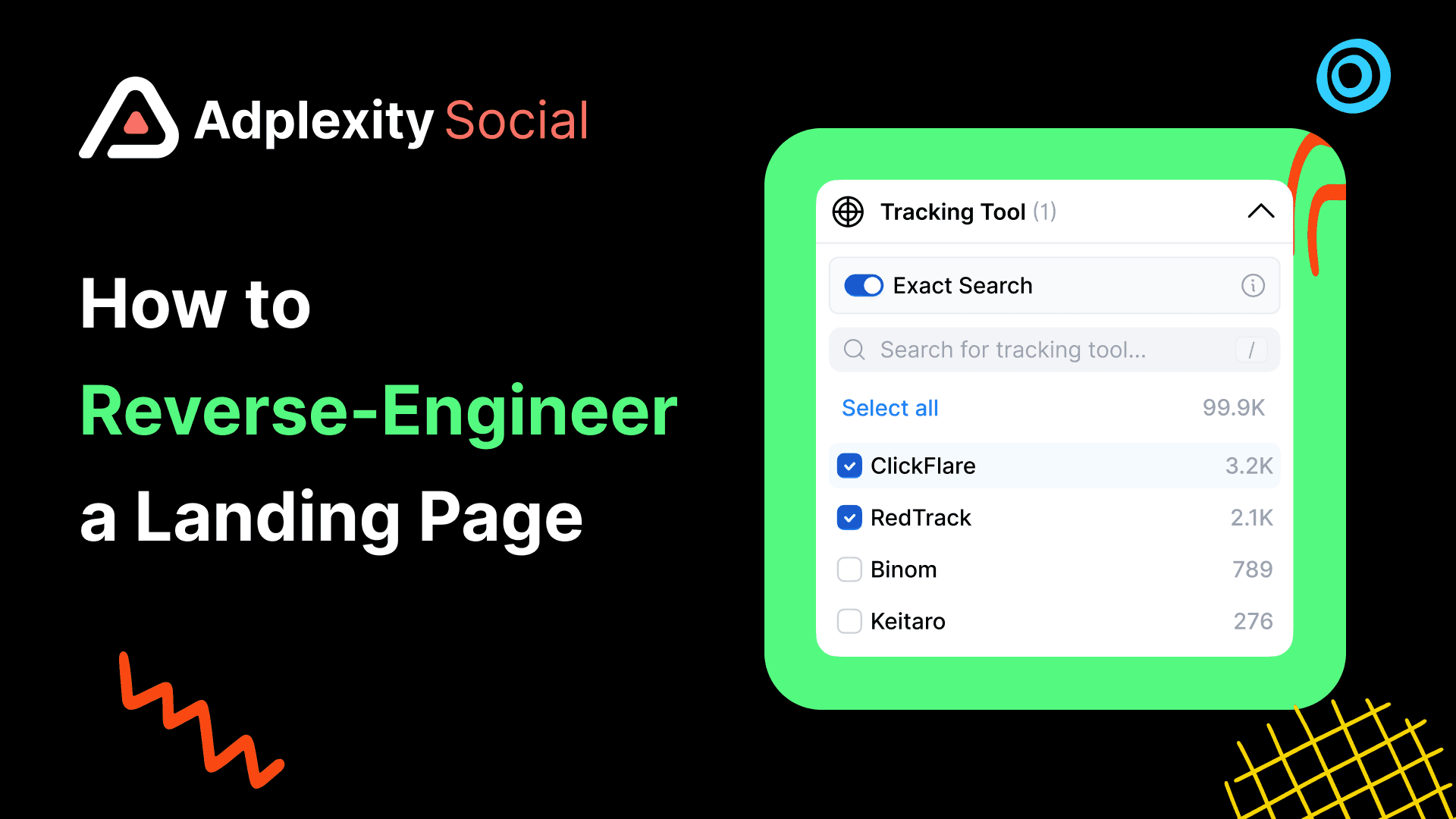
What you are looking for: tracking domains (which usually contain strings like "trk," "click," or known tracker domains used by Redtrack, ClickFlare, Voluum, or Binom), affiliate network domains in the chain (which will often include recognizable domains from ClickBank, BuyGoods, Digistore24, or similar networks), and the outgoing URL at the end of the chain (which is the actual offer or product destination).
If you see an affiliate network domain in the redirect chain, the advertiser is almost certainly a media buyer or affiliate running a performance campaign.
The pre-lander is designed to warm up cold traffic before the offer page.
That structure is fundamentally different from a brand that directly sells its own product, and the creative and copy logic that works for one will not work for the other.
This manual process works, but it is slow. If you are tracing 10 to 15 competitors, you are spending an hour or more on redirect analysis alone.
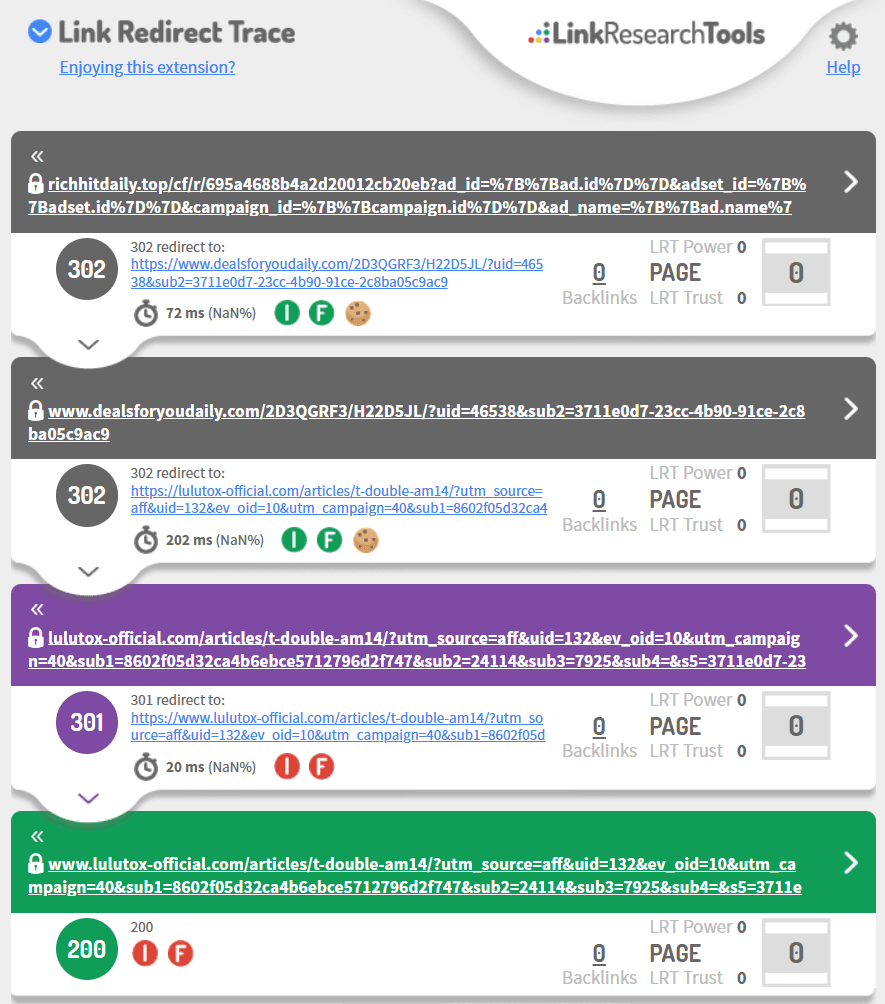
Quality check: If a redirect check shows only one hop (the ad URL lands directly on the destination page with no redirects), the advertiser is either running brand traffic directly or is using server-side tracking.
Look at the page source and check network requests in your browser's developer tools for pixel fires and tracking scripts.
Step 4: Identify the Tech Stack and Traffic Signals
The technology loaded on a landing page tells you more about a campaign's intent than the copy does.
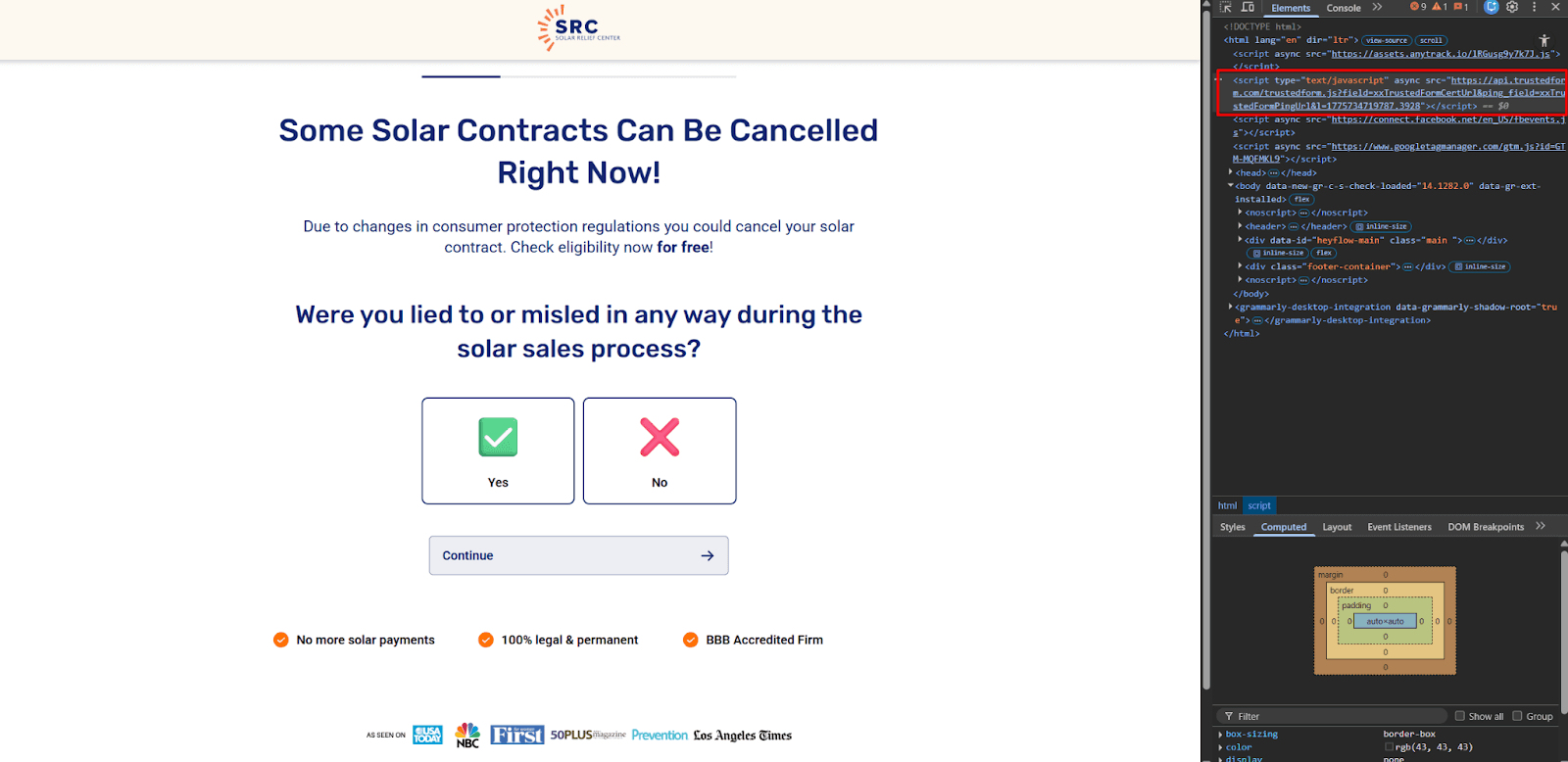
Open your browser developer tools (F12 in most browsers), go to the Network tab, and reload the page. Look at what fires: pixel IDs, tracking scripts, consent management platforms, checkout systems, CRM tools, and call tracking numbers.
This is what the tech stack reveals.
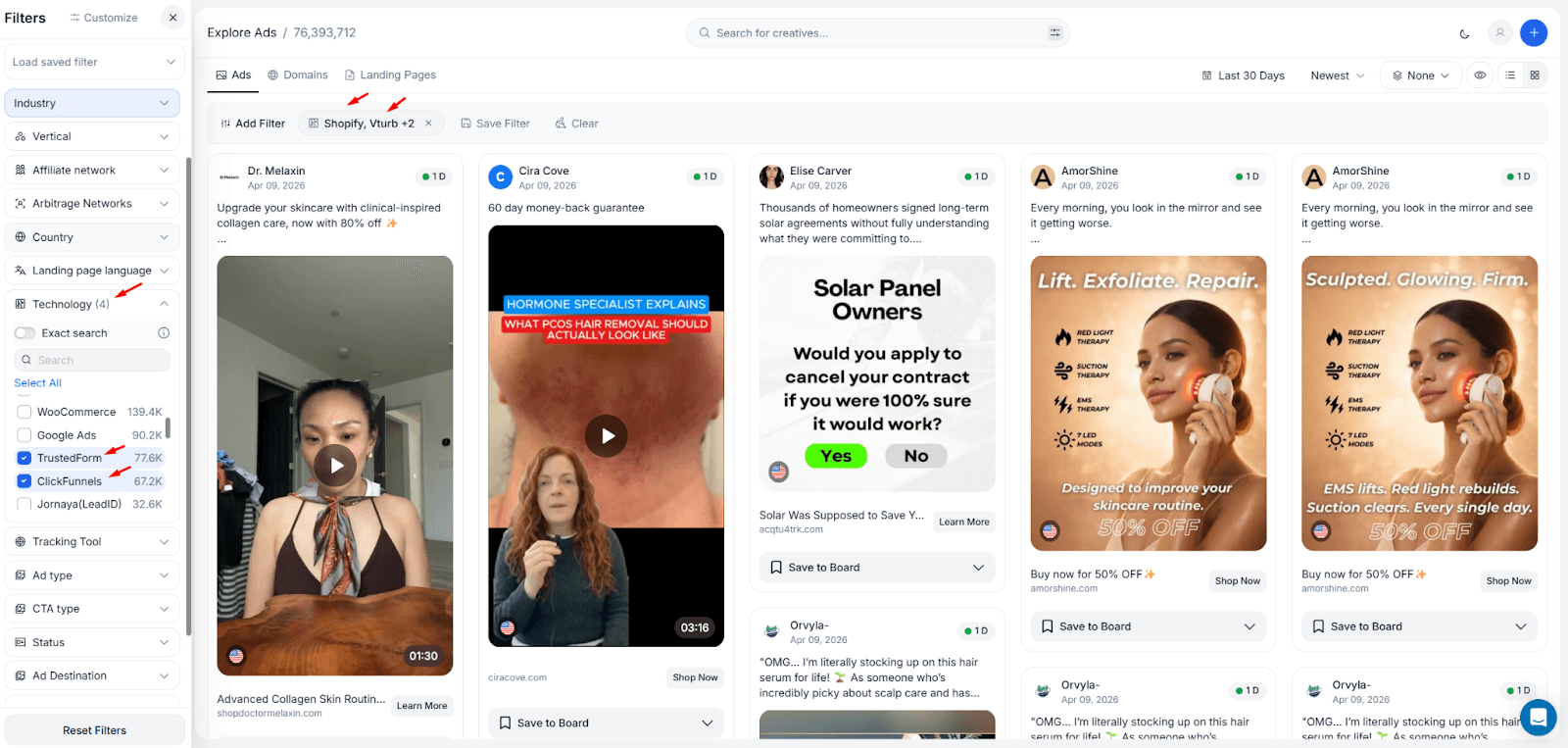
TrustedForm or Jornaya on the page signals a lead generation campaign feeding into a compliance-heavy ecosystem.
These are lead certification tools required by many call centers and high-value lead buyers. If you see them, the advertiser is probably selling leads at $20 to $100 per lead, not selling a product directly.
Ringba, or a similar call-tracking platform, indicates the campaign is pay-per-call. The funnel is optimized to generate inbound calls, not form fills or purchases.
VTurb or a standard video embed with custom controls usually means a VSL funnel. The conversion depends almost entirely on watching the video through to the end.
If the buy button only appears after a specific timestamp, the funnel is designed to pre-qualify buyers based on watch time.
Shopify checkout signals (the Shopify CDN loading or a checkout.shopify.com URL in network requests) confirm an ecommerce direct-purchase funnel, regardless of how the landing page is structured.
ClickFunnels in the page source or URL structure is a strong signal that the campaign was built using a template-based funnel builder.
These campaigns often have more predictable structures and are easier to reverse-engineer.
The manual version of this research involves digging through source code and network requests one page at a time.
Tools like BuiltWith or Wappalyzer can surface some of this automatically, but they are often limited and outdated.
This is where an ad intelligence platform with tech stack filtering changes what is possible.
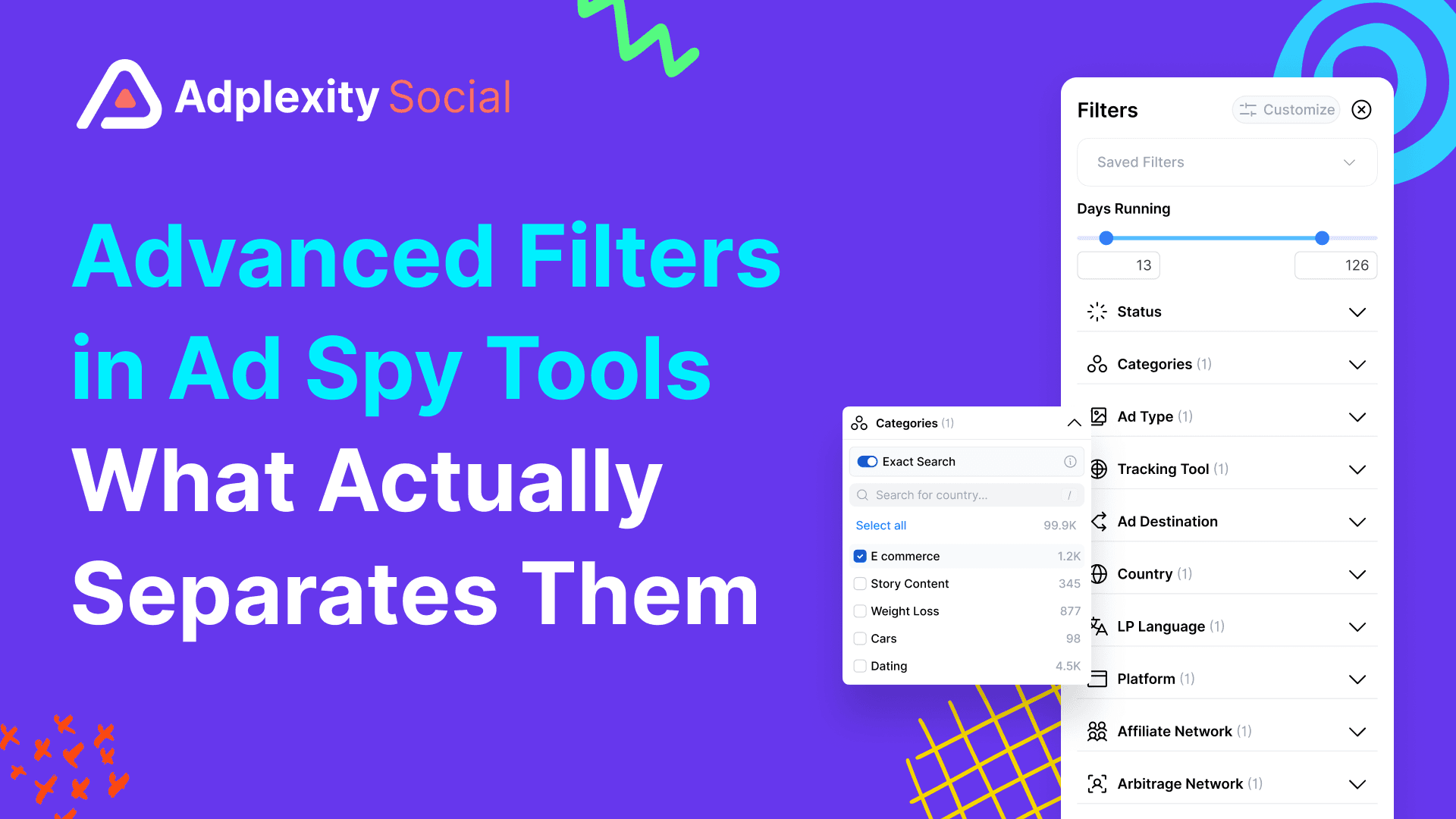
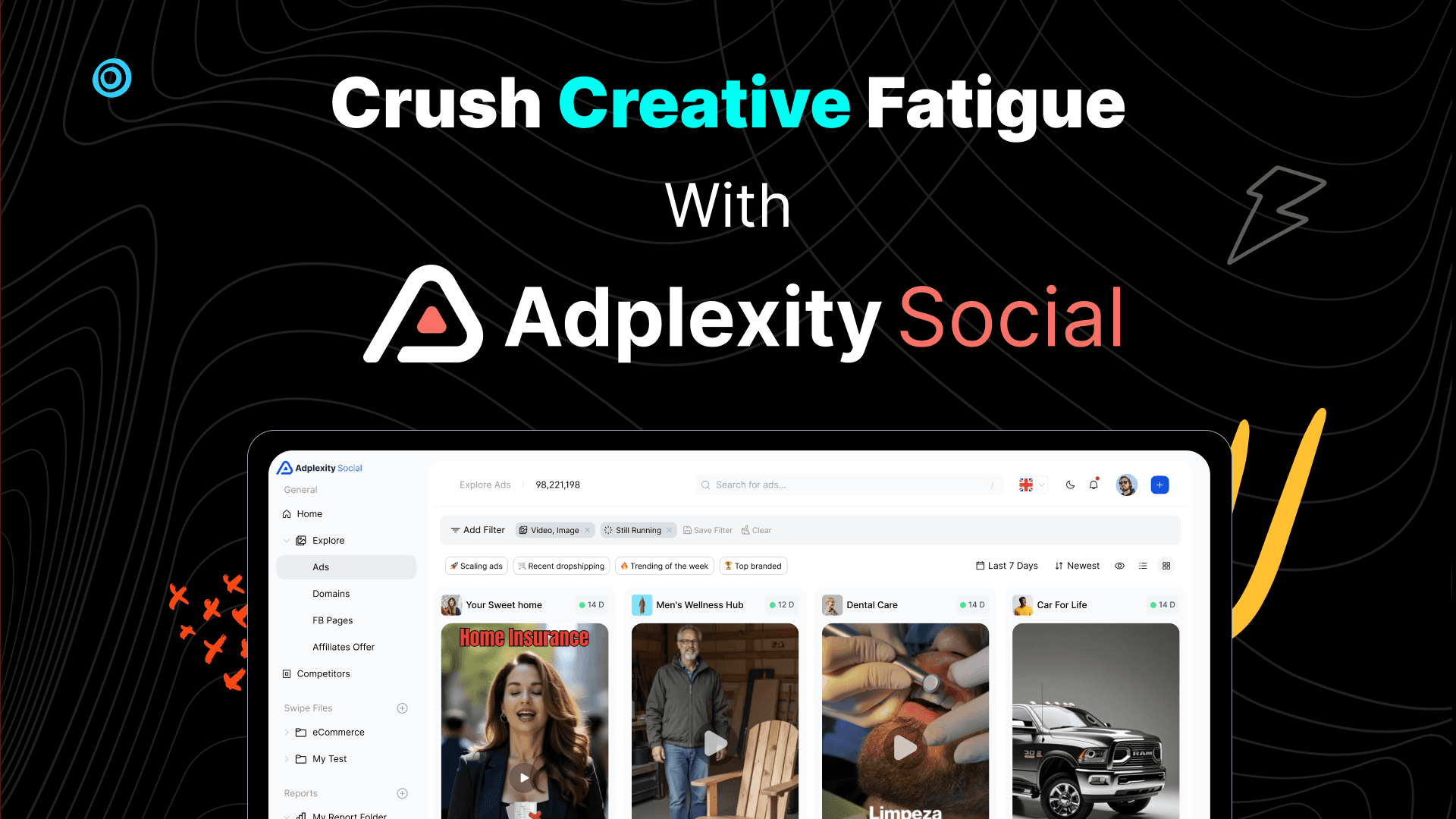
AdPlexity Social lets you filter the entire ad database by specific technologies, so instead of checking one competitor's tech stack manually, you can pull every advertiser in a vertical using TrustedForm, or every campaign running through ClickFunnels, or every VSL-based funnel in a specific country. That kind of filtering turns a 90-minute manual process into a 5-minute search.
Quality check: If you found two or more tracking tools on the same page, document them. Multiple tools usually indicate a sophisticated advertiser who is either testing platforms or feeding data into a stack with multiple buyers. This is not a beginner campaign.
Step 5: Reconstruct the Funnel Logic
At this point, you have the ad, the landing page, the redirect chain, and the tech stack. Now you put it together into a funnel map.
A funnel map does not need to be a diagram. A plain written description is fine. The goal is to force yourself to state what is happening at each stage and why.
Here is a template that works for most paid social funnels:
Traffic source: Facebook / Instagram / all platforms
Ad hook angle: What emotional trigger or claim opens the ad
Ad format: Video / Image / Carousel
Landing page type: Advertorial / Product page / Lead form / VSL / Quiz
Offer mechanic: Direct purchase / Lead gen / Call / Affiliate
Funnel depth: Single page / Pre-lander plus offer / Multi-step form
Post-click action: Purchase / Form fill / Phone call / Video completion
Tech signals: Tracking tools, checkout system, affiliate network, if visible
Campaign age: Estimated from ad run date
Scale signals: Multiple placements, multiple creatives, impression volume if available
Fill in this template for each competitor you are studying.
Once you have three to five filled in for the same vertical, patterns emerge fast.
You will start to see which funnel types are dominant, which offer mechanics appear to be scaling, and where the creative hooks cluster.
For a real-world example of this process applied to a specific vertical, the home improvement lead gen analysis on this blog walks through how funnel mapping revealed which campaign types dominated Meta spend in that space.
Quality check: After filling in the template, ask yourself: could I brief a copywriter and a designer from this map alone? If yes, the funnel map is complete. If there are gaps, go back and fill them.
Step 6: Apply What You Found to Your Own Campaigns
The output of this research is not a list of ads to copy. It is a set of hypotheses to test.
If three of your top five competitors in a supplement vertical are running long-form advertorials with clinical credentialing language, that is a signal that the vertical has trained its audience to respond to authority positioning. You can test whether that framing works for your offer.
But you are testing a hypothesis, not copying a campaign.
The most actionable takeaways from a funnel teardown are the hook category, the page structure, and the offer mechanic.
The hook category tells you where the audience is in their awareness journey: problem-aware hooks ("you have this symptom"), solution-aware hooks ("this ingredient works"), or product-aware hooks ("compare before you buy").
Your ad should start from the same awareness level that the market is already familiar with.
Page structure follows the same logic. If long-form pages with testimonials and studies are winning in a vertical, short pages will probably underperform on cold traffic. That is a structural insight worth testing before you spend on creative.
The offer mechanic matters most. If the market is dominated by affiliate pre-landers with quiz funnels, direct-to-product-page campaigns will almost certainly underperform on cold traffic.
Match the funnel type to what the audience has been conditioned to respond to.
And the tech stack. If every serious advertiser in your vertical is using TrustedForm, that suggests the downstream lead buyers have compliance requirements. If you want to sell leads into that ecosystem, you need the same infrastructure.
Pro Tips and Common Mistakes
Most people study the wrong ads. Pretty creatives are not the same as profitable ones. A video with massive shares might have terrible conversion economics. Filter for longevity or by number of ads using a specific creative, not surface appeal.
The pre-lander is usually the hardest thing to find manually. Redirect chains that run through affiliate tracking platforms often serve different pre-landers based on traffic source, device type, or geo.
What you see clicking from your desktop browser in one country may differ from what a mobile user sees elsewhere.
Ad intelligence platforms that crawl and index landing pages at scale capture these variations in ways manual checking cannot.
Do not ignore the thank-you page. A lot of funnel economics live in the upsell sequence, not the front-end offer. If you can complete a lead form or a checkout and see what follows, do it.
The back-end offer often reveals the true value per customer and explains why a brand can afford aggressive front-end pricing.
Tech stack signals decay. What is on the page today may not be what it ran with six months ago, when the campaign was first scaling.
Historical landing page archives in ad intelligence tools give you the version of the page that ran during peak spend, which is often more useful than the live version.
FAQs: Reverse-Engineering Competitor Funnels
Can I legally reverse-engineer a competitor's funnel?
Visiting publicly accessible web pages, reading ad copy in a public ad library, and using browser tools to inspect network requests on pages you have loaded are all legal in most jurisdictions.
You cannot access systems you are not authorized to access, and you cannot copy copyrighted creative works wholesale. But observing competitors' public actions and using those observations to inform your own strategy is standard market research.
Do I need a paid tool to do this, or can I use the Meta Ads Library?
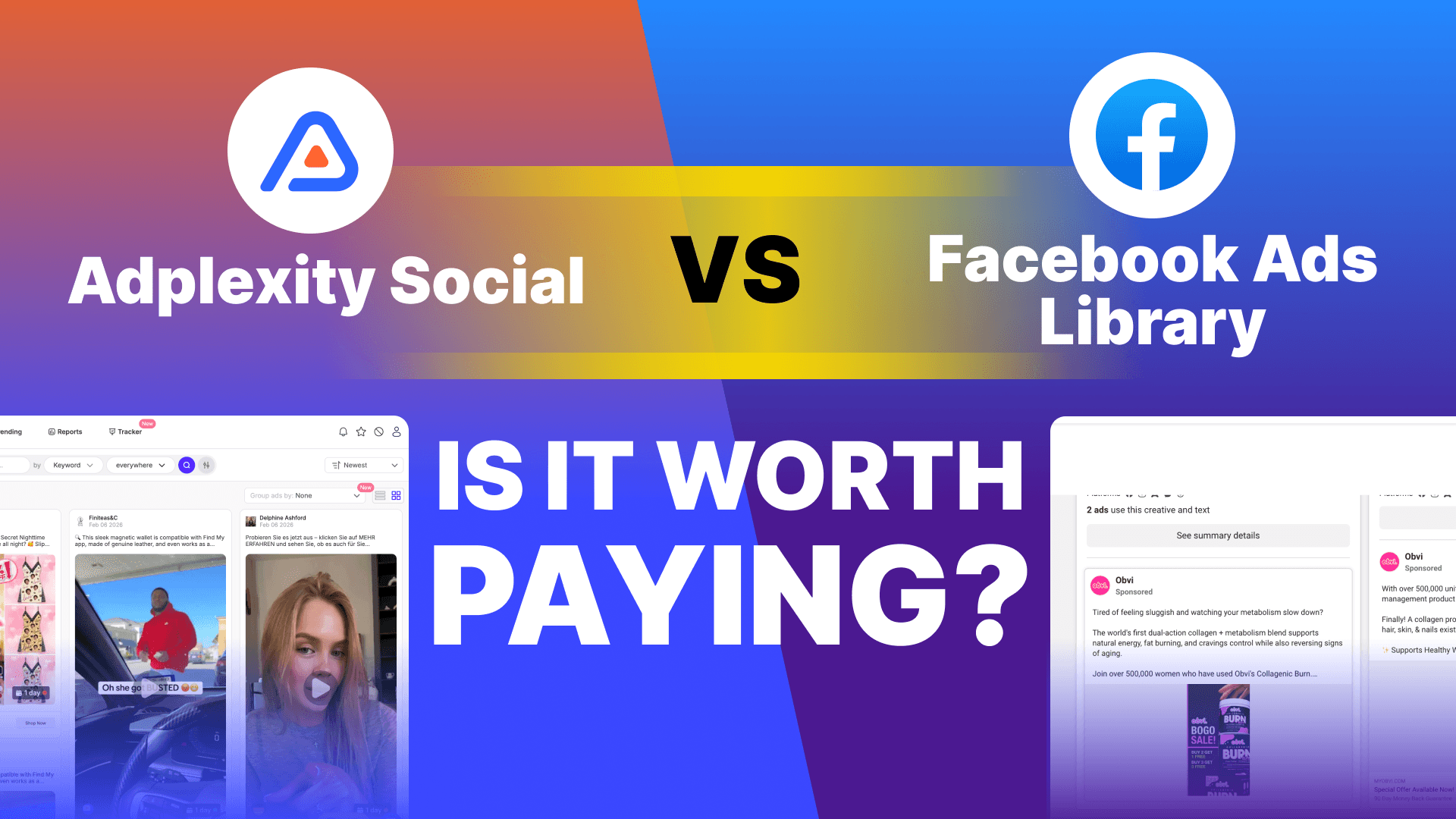
The Meta Ads Library is a legitimate starting point. You can see active ads for any advertiser by searching their page name, and the library shows the start date for active ads. But it does not show deleted ads, redirect chains, or landing page content, and does not let you filter by tech stack, vertical, or campaign longevity.
For basic awareness of what a competitor is running right now, it is fine. For the kind of funnel research described in this guide, it runs out of information quickly.
How long does this process take?
The manual version takes roughly 90 minutes to 2 hours per competitor funnel, depending on how deep you go.
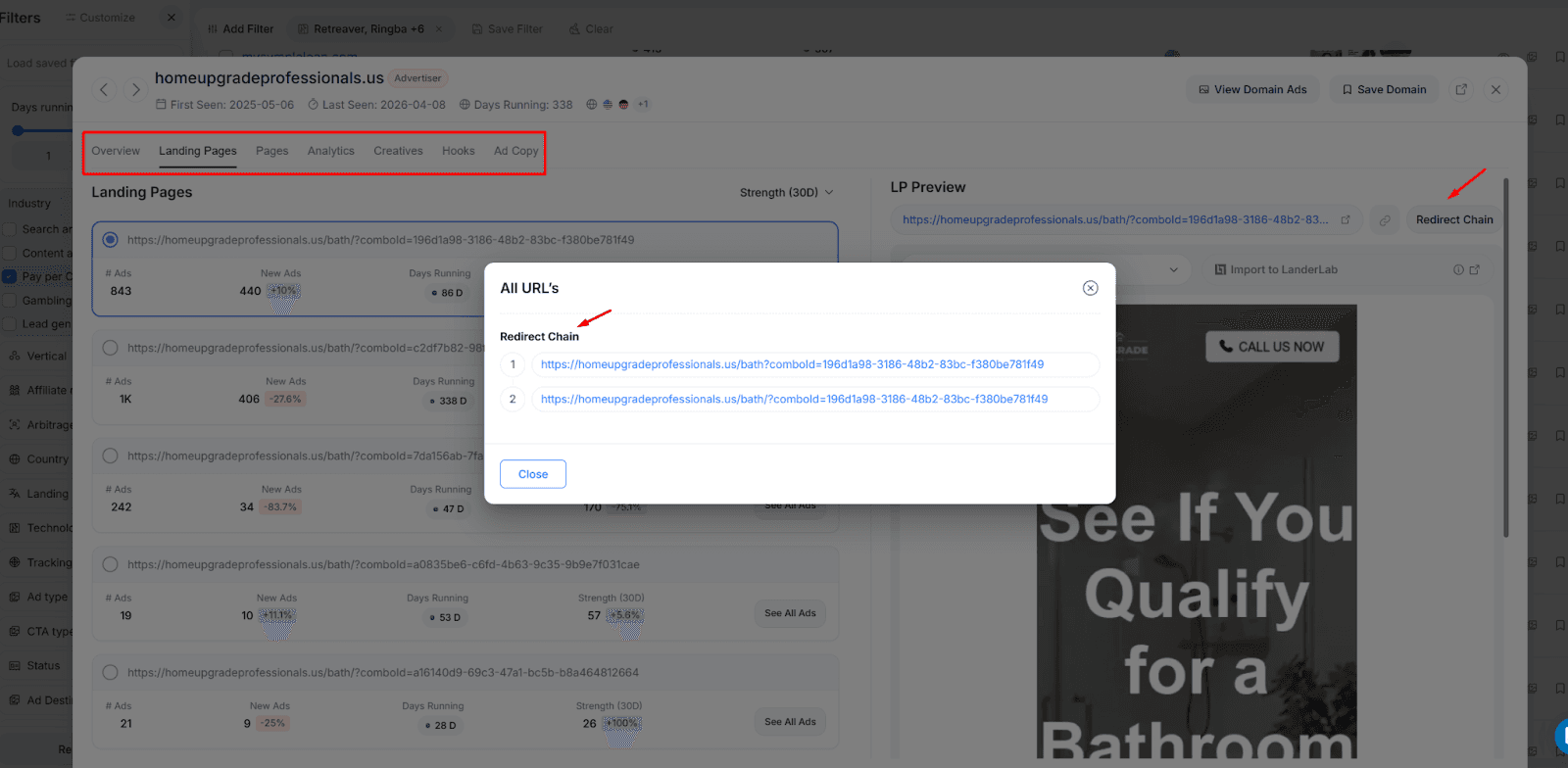
Checking the Ads Library, tracing redirects, inspecting source code, and mapping the funnel all add up. With an ad intelligence platform like AdPlexity Social, most of the data (landing pages, redirect chains, tech stack, campaign age, creative history) is indexed and searchable, which compresses that research to about 15 minutes per funnel.
What if the landing page only loads for certain traffic segments?
This happens, especially with high-volume affiliate campaigns that serve different pages based on geo, device, or traffic source. The manual workaround is to use a VPN and a mobile device to replicate different traffic segments.
Ad intelligence platforms that crawl at scale often capture multiple variations of the same landing page under different conditions, which is one reason they are worth using for this type of research.
How do I know if a competitor's funnel is actually profitable, or just well-funded?
Longevity is the most reliable signal. An ad campaign running 60 to 90 days on Meta is almost certainly generating positive returns, because the platform's CPMs are high enough that nobody keeps a losing campaign alive that long out of stubbornness. Scale signals (multiple placements, multiple creatives, consistent spend patterns over time) reinforce the picture.
What is the difference between an advertorial funnel and a direct product page funnel?
An advertorial is a landing page designed to look like editorial content, usually structured as an article, news story, or personal narrative. Its job is to move a cold traffic visitor from unaware to purchase-ready before sending them to a product page. A direct product page funnel sends ad traffic straight to the product, which works well when the audience is already aware of the category. Advertorials are more common in supplement, health, and financial verticals, where cold traffic needs education before converting.
Is this kind of funnel research useful for ecommerce brands, or mainly for affiliates?
Both. Affiliates use it to identify offers with proven funnel structures before committing to spend. Ecommerce brands use it to understand which positioning angles, page structures, and offer mechanics are working in their category before briefing their own creative and copy teams.
The research process is the same. What you do with the output depends on your business model.
Conclusion
If you are running paid campaigns and doing competitive research that stops at the ad creative, you are making decisions with incomplete information. The funnel is where strategy lives. The ad is just the entry point.
The process in this guide covers the full picture: finding ads worth studying, reading the landing page as a strategic document, tracing redirect chains, identifying the tech stack, mapping the funnel, and extracting hypotheses you can actually test.
The manual version of this is legitimate and worth doing at least once, because going through it step by step teaches you what to look for.
After that, the faster path is an ad intelligence platform that has already indexed the landing pages, crawled the redirect chains, and logged the tech stack for the ads you want to study.
That is what AdPlexity Social does. Try it yourself at adplexity.io.
Discover Winning Meta Ads
Similar Blogs