Best Instagram Ad Spy Tools in 2026 (What Most Marketers Still Get Wrong)

Share:
Instagram CPMs have been climbing steadily since 2024.
In most verticals, you are paying more per thousand impressions on Instagram than on Facebook.
Reels placements, Stories ads, and feed placements all compete for attention in a feed that is getting more crowded every quarter.
When the cost per impression goes up, the margin for error on creative goes down. A mediocre ad on Facebook might still break even.
That same ad on Instagram burns budget faster because you are paying more for every pair of eyes that scrolls past it.
This is why competitive intelligence on Instagram matters more than it did two years ago.
Not "inspiration browsing" where you scroll through a swipe file and hope something sparks an idea. Real intelligence.
The kind where you can see what a competitor's Instagram ad is actually selling, how the funnel behind it works, and whether the campaign has been running long enough to be profitable.
Most Instagram ad spy tools do not give you that. They give you the creative, some basic metadata (country, language, CTA button), and maybe a link. That is fine for mood boards. It is not enough for campaign planning.
So this guide skips the usual format of listing 15 tools with star ratings.
Instead, it compares four options based on the intelligence they actually provide, with a focus on what happens after someone taps an Instagram ad.
Best Instagram Ad Spy Tools (Quick Comparison)
Tool | Best For | Instagram Depth | Landing Page Data | Tech Stack Insights | Pricing |
|---|---|---|---|---|---|
AdPlexity Social | Full campaign intelligence | ⭐⭐⭐⭐⭐ | ✅ Full indexing + search | ✅ Advanced filters (Shopify, CF, etc.) | $99/mo |
AdHeart | Creative research (mid-tier) | ⭐⭐⭐⭐ | ❌ No | ❌ No | ~$53/mo |
BigSpy | Budget / beginners | ⭐⭐⭐ | ❌ No | ❌ No | Free – $99/mo |
Meta Ad Library | Quick brand lookup | ⭐⭐ | ❌ No | ❌ No | Free |
Best Instagram Ad Spy Tools by Use Case
Best overall (full funnel intelligence): AdPlexity Social
Best for creative inspiration: AdHeart
Best budget option: BigSpy
Best free tool: Meta Ad Library
Why Instagram Intelligence Requires More Than a Platform Filter
Most ad spy tools that claim "Instagram coverage" are really just Facebook spy tools with a platform filter bolted on.
You click "Instagram," the results narrow down, and you see Instagram ad creatives. That is the beginning and end of the Instagram-specific experience.
But Instagram campaigns behave differently from Facebook campaigns in ways that matter for competitive research.
Instagram funnels tend to be shorter and more visual. A Facebook ad might send traffic to a long-form advertorial or a detailed landing page.
An Instagram ad, especially from Reels or Stories, often sends traffic to a product page, a quick pre-lander, or a lead form.
The funnel is compressed because the user's mindset is different. They are in browse mode, not research mode. Understanding what is on the other end of that tap is crucial to building your own Instagram campaigns.
The same creative runs across multiple placements and pages. A brand or media buyer might run one video creative across Instagram Reels, Instagram Feed, Instagram Stories, and Facebook Feed simultaneously, often from multiple fan pages.
Without creative grouping, you see the same ad repeated dozens of times in your search results.
With it, you see a single entry indicating this creative is being pushed hard across 40+ pages, which is a much more useful signal.
Instagram ads increasingly drive traffic to specific tech stacks. Ecom brands are sending Instagram traffic to Shopify stores.
DTC brands using ClickFunnels or GoHighLevel for quiz funnels.
Lead gen campaigns running TrustedForm and Ringba behind pre-landers. The technology on the landing page tells you what kind of campaign you are looking at, sometimes more clearly than the ad creative itself.
A pretty lifestyle video on Instagram could be used to sell a $29 product on Shopify or drive calls to an insurance quote line. The tech stack tells you which.
Domain patterns reveal Instagram advertising operations at scale. If you can see all Instagram ads pointing to a single domain, regardless of which profile is running them, you can map an entire operation. How many creatives are they testing?
How many pages are they running from? Which countries are they targeting? This is the kind of intelligence that turns a casual "oh, interesting ad" into an actual competitive brief.
None of this is visible from just looking at the ad creative with a platform filter. It requires a tool that goes deeper.
1. AdPlexity Social: Best Overall for Instagram Campaign Intelligence
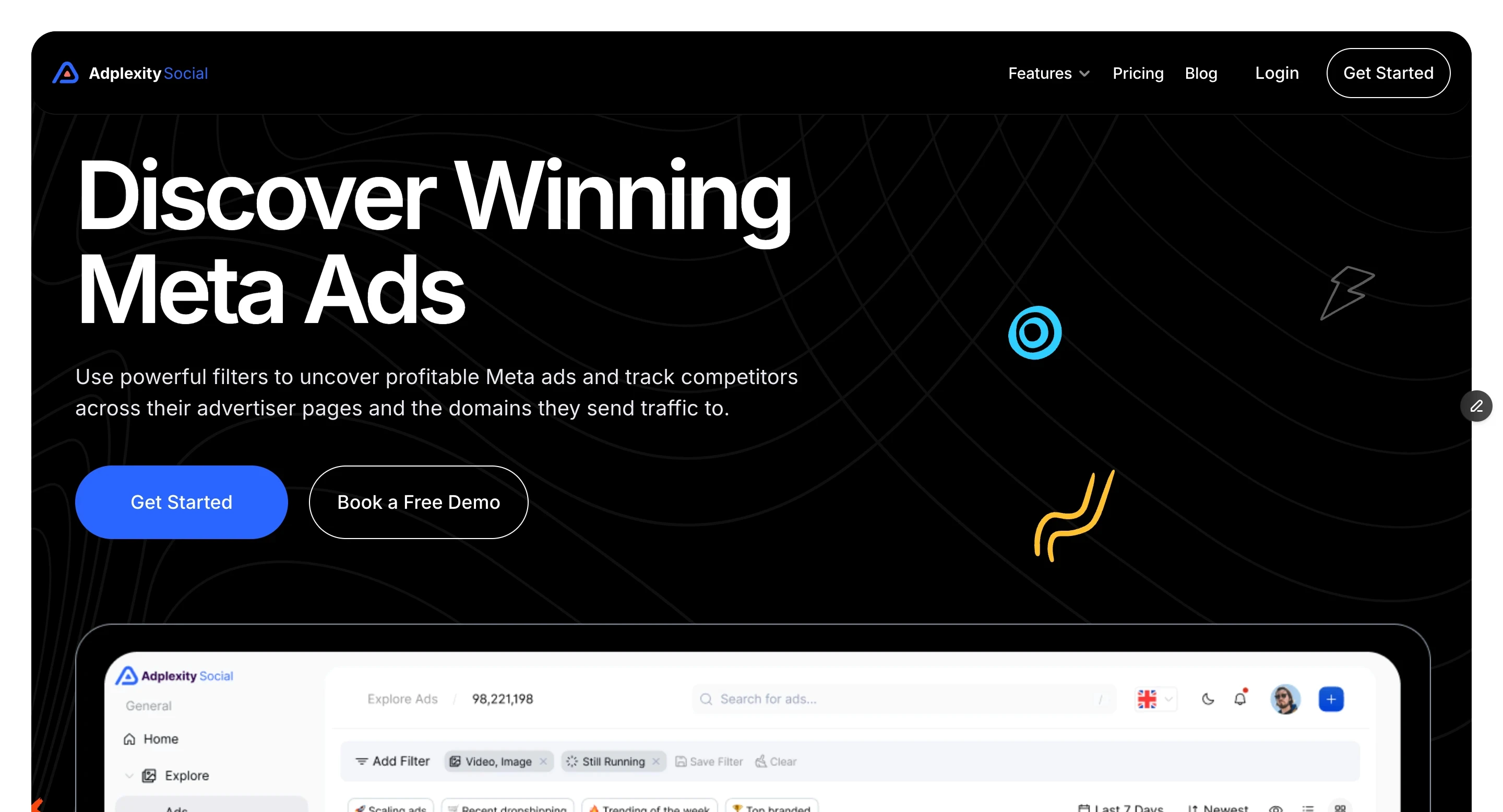
Pricing: $99/month | $950/year (save ~20%) | Additional seats $49/month
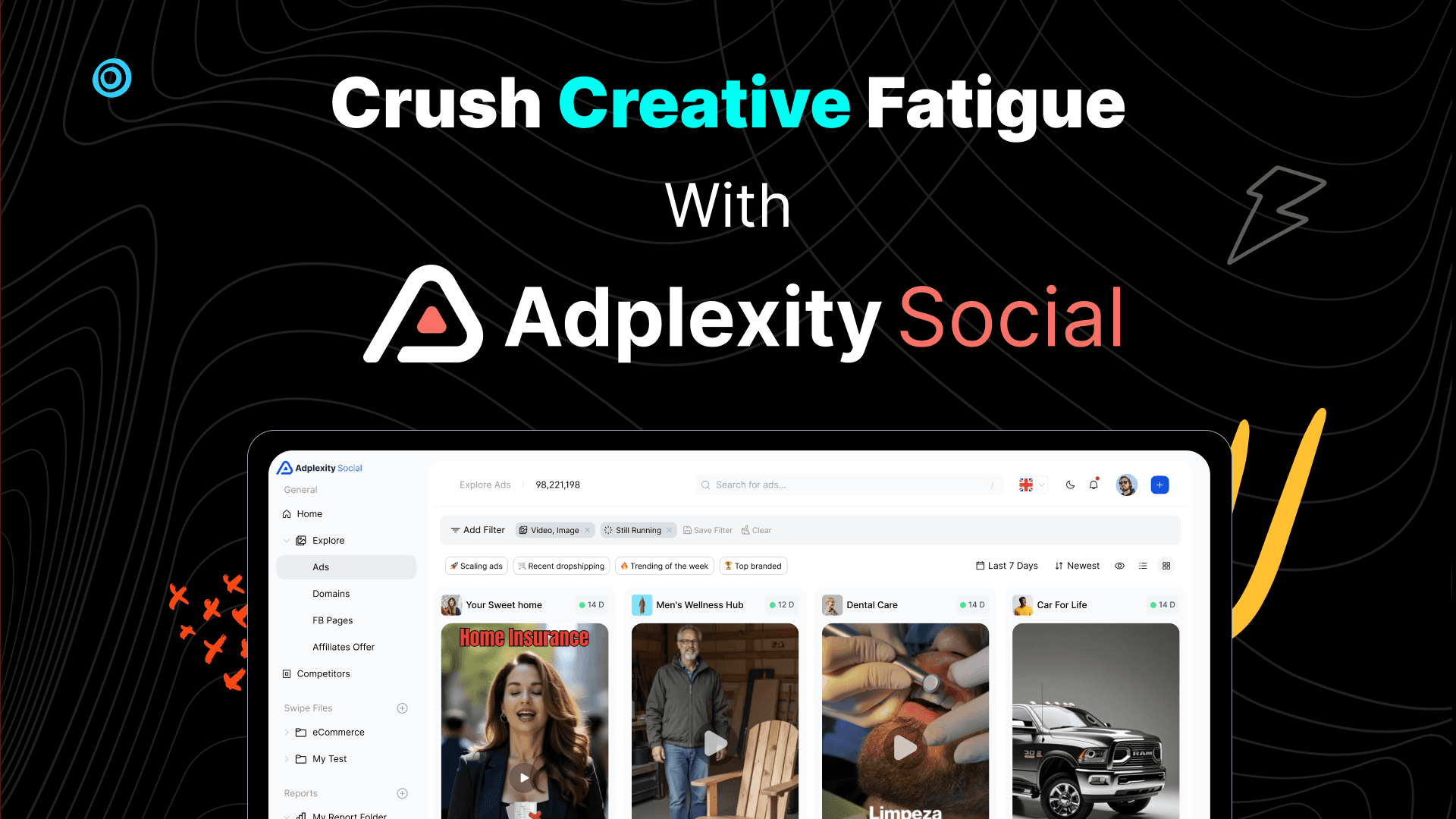
AdPlexity Social covers all Meta placements: Facebook, Instagram, Messenger, and Audience Network.
But unlike tools that treat Instagram as a secondary filter, AdPlexity Social indexes the full intelligence layer behind every ad, regardless of placement.
Every Instagram ad in the database includes the full landing page copy, indexed and searchable.
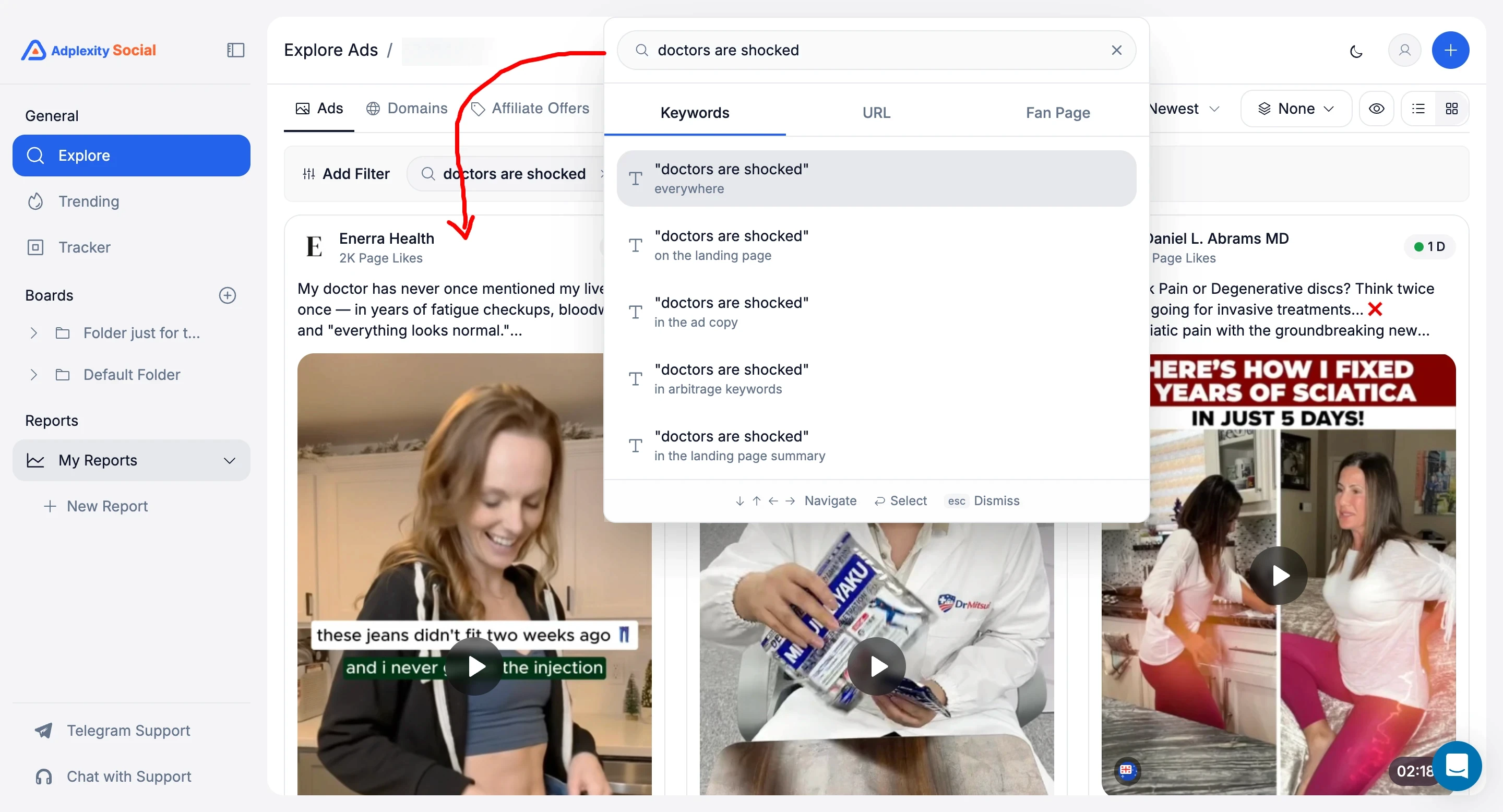
That means you can search by keywords that appear on the destination page, not just in the ad text.
If you are researching skincare campaigns on Instagram but the ads all use vague hooks like "doctors are shocked" without mentioning the product, you can still find them by searching for the ingredient name or product claim on the landing page.
The redirect chain is crawled end-to-end. When someone taps an Instagram ad, the URL usually passes through tracking domains, redirects, and intermediate pages before reaching the final destination.
AdPlexity Social shows you every step. You can see which tracking platform the advertiser uses, whether there is an affiliate network behind the campaign, and what the outgoing URLs from the landing page are.
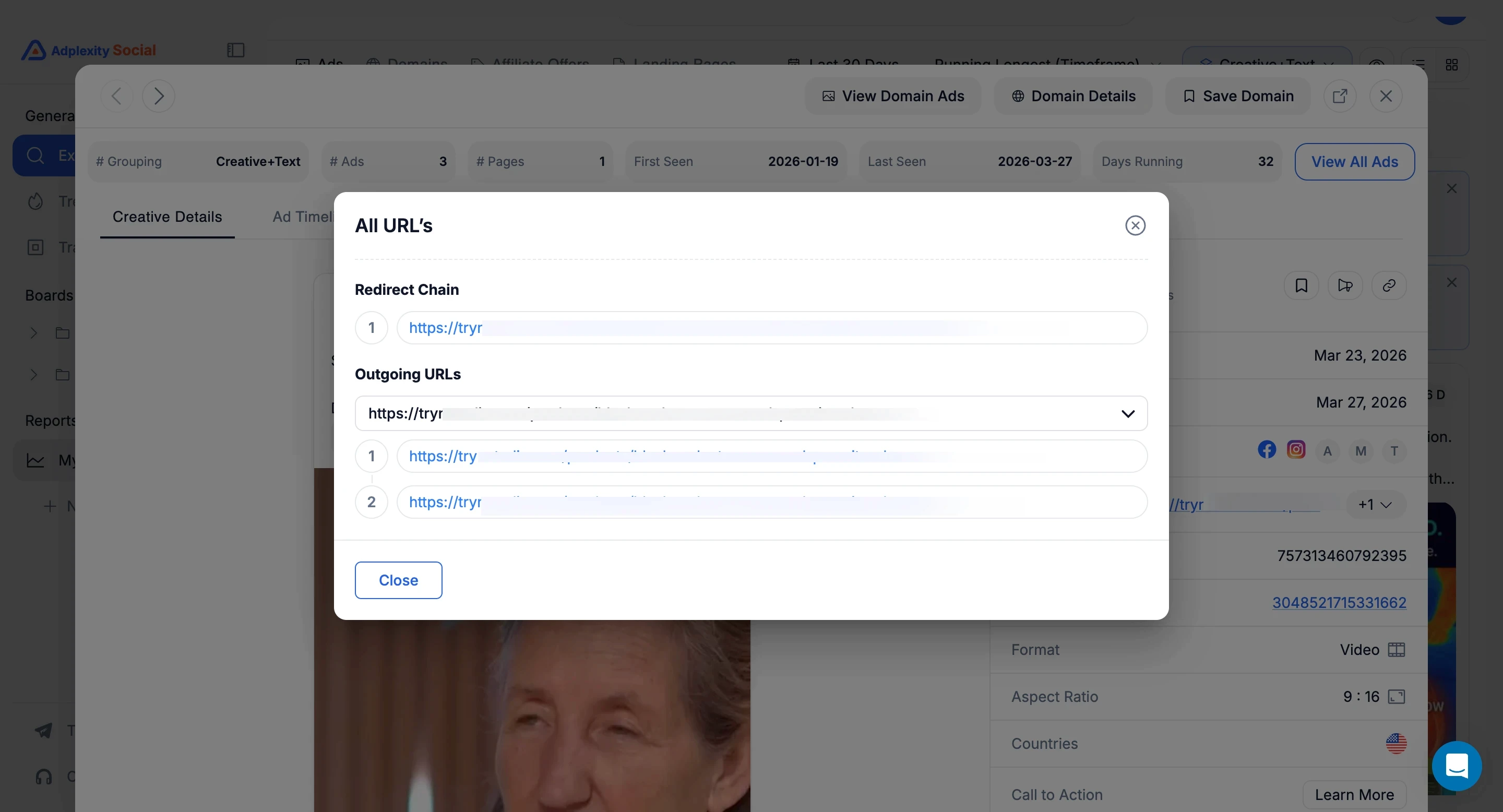
For affiliate marketers running Instagram traffic, this is how you identify which offers are being promoted behind polished IG creatives.
Technology stack filtering lets you search Instagram campaigns by the tools running on the destination page.
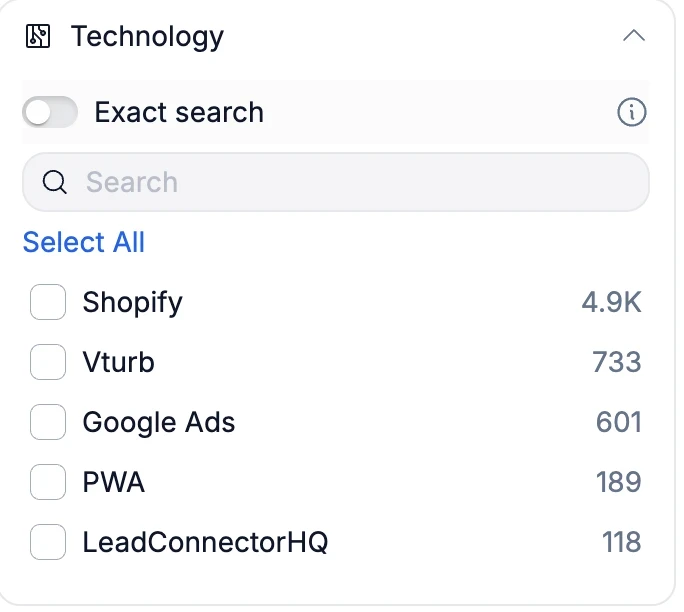
AdPlexity Social focuses on what happens after the click, not just the ad creative.
You can filter campaigns by the technology on the landing page, making it easy to identify e-commerce, lead gen, or affiliate funnels without guessing based on the ad itself.
The domain view shows every ad that points to a specific URL across all pages, helping you map entire campaigns rather than isolated creatives.
Creative grouping removes duplicates and shows how widely an ad is being run, which is a strong signal of performance.
Together, this gives you a clear view of what is actually working on Instagram, not just what it looks like
Where it falls short: No free tier. The $99/month price is higher than those tools that focus only on creative browsing. If all you need is to screenshot competitor Instagram ads for a mood board, this is more of a tool than you need. The interface is designed for campaign-level research, so there is a learning curve if you are coming from simpler tools.
Best for: Performance marketers, e-commerce brands, affiliates, and media buyers running Instagram traffic who need to understand the full campaign behind the creative. Especially strong for anyone running Instagram ads in verticals where the funnel matters as much as the ad: health, lead gen, DTC, dating, i-Gaming, and affiliate offers.
2. AdHeart: Solid Instagram Creative Research at a Mid-Range Price
Pricing: Starts at ~$53/month (discounts for multi-month commitments)
AdHeart covers Facebook, Instagram, Messenger, and Audience Network with a dedicated focus on Meta platforms.
The database refreshes frequently, and the tool has built a strong following in the CIS affiliate community.
For Instagram creative research specifically, AdHeart offers 15+ search parameters, including keywords, GEO, language, format, placement, campaign duration, domain, and IP filtering.
You can filter to Instagram-only results and narrow by ad format, which is useful for isolating Reels-style video ads from static feed images.
The IP filter is a feature that most competitors skip, and it can be useful for identifying campaigns running from specific infrastructure.
The team collaboration features (shared accounts, team libraries) make AdHeart practical for small agencies where multiple media buyers need access to the same Instagram research.
The pricing is straightforward with discounts on multi-month commitments.
Where it falls short: AdHeart stays at the creative and metadata level. There is no landing page copy indexing. No redirect chain crawling.
No affiliate network detection. No tech stack filtering. You can see where an Instagram ad links, but you cannot search by the landing page content, and you cannot see the full redirect path from tap to final destination.
For Instagram creative browsing and monitoring, AdHeart does a solid job at a reasonable price.
But if you need to understand the funnel behind an Instagram ad, not just the creative in front of it, you will need to do that research manually or use a tool with deeper post-click intelligence.
Best for: Media buyers and affiliates who need solid Instagram creative monitoring at a mid-range price, particularly those working in Russian-speaking and CIS markets. Good for teams that primarily need creative inspiration rather than full campaign intelligence.
3. BigSpy: Budget Instagram Browsing Across Multiple Platforms
Pricing: Free tier available | Basic from $9/month | Pro at $99/month
BigSpy covers Instagram alongside Facebook, TikTok, YouTube, Google, Pinterest, Twitter, AdMob, and Unity.
That is the broadest platform spread available, and the free tier makes it accessible to anyone who wants to start browsing Instagram competitor ads without spending anything.
The Instagram coverage is functional for basic research. You can search by keyword, filter by platform, and browse competitor creatives.
The free tier gives you enough daily searches to get a feel for what is running in your niche. The $9/month Basic plan is the cheapest paid Instagram spy tool on the market.
Where it falls short: The Instagram-specific filtering is shallow compared to dedicated Meta tools. No granular days-active filtering to isolate proven performers.
No domain zone analysis. No landing page indexing. No redirect chain data. No tech stack filters. Data freshness is inconsistent, and users report that some niches show stale results, particularly on lower tiers.
At the $99/month Pro level, you pay the same as AdPlexity Social but get surface-level creative browsing across 10 platforms instead of deep campaign intelligence on Meta. The value proposition is breadth, not depth.
Best for: Beginners who want to explore Instagram ad intelligence at zero or minimal cost. Also useful as a quick secondary tool for spot-checking what competitors are doing on TikTok or YouTube alongside your primary Instagram research.
4. Meta Ad Library: The Free Baseline
Pricing: Free
Meta's own Ad Library is the starting point everyone should know about. You can search for any advertiser and see their currently active Instagram ads. No account required. No cost.
For quick lookups, it works. You can see what a specific competitor is running right now, review the creative and copy, and see the start date.
If you already know which advertiser you want to check, the Ad Library gets you there in seconds.
Where it falls short: The Ad Library is a transparency tool, not an intelligence tool. No keyword search across ad copy.
No filtering by how long an ad has been running. No format filtering. No language filtering. No way to save searches or monitor competitors over time. No historical data for ads that have been taken down. You cannot search by vertical or niche, only by advertiser name or page.
For systematic Instagram competitor research, the Ad Library is a dead end. But for a quick, free check of a specific brand's current Instagram ads, it is the fastest option available.
Best for: Quick lookups of a specific advertiser's live Instagram campaigns. Not a substitute for an actual spy tool.
How Instagram Funnels Differ (And Why Post-Click Intelligence Matters More Here)
Instagram users behave differently from Facebook users when they interact with ads. They are typically in a faster, more visual browsing mode. They spend less time reading long copy. They make quicker decisions about whether to engage or keep scrolling.
This means Instagram funnels tend to be more compressed. Where a Facebook campaign might send traffic through a long-form advertorial, then to a sales page, then to checkout, an Instagram campaign is more likely to send traffic directly to a product page, a short pre-lander, or a lead capture form. The funnel is tighter because the user expects a faster experience.
For competitive research, this makes post-click intelligence even more important on Instagram than on Facebook. The landing page is doing more of the selling in fewer steps. Understanding what is on that page, what technology powers it, and how the checkout or conversion flow works gives you a much clearer picture of the campaign strategy than the Instagram creative alone.
A few patterns worth looking for when researching Instagram campaigns:
Reels to product page. The most common ecom pattern. A short, engaging Reel followed by a direct tap to a Shopify or similar product page. The creative does the emotional selling. The product page does the conversion. When you can see both the ad and the indexed landing page, you can reverse-engineer the complete story.
Stories to lead form. Common in lead gen verticals. A Stories ad with a swipe-up to a simple form page, often built on GoHighLevel or ClickFunnels. The tech stack tells you this is lead gen before you even read the form copy.
Reels to advertorial. Increasingly popular in health, finance, and supplement verticals. The Instagram Reel hooks attention, the tap goes to an advertorial that sells the story, and the advertorial links out to the product page or affiliate offer. Without redirect chain data, you only see the first step. With it, you see the full path.
Carousel to quiz funnel. A growing pattern in DTC and wellness. A carousel ad educates or entertains across multiple cards, then drives to a quiz (often on a tool like Typeform, Octane AI, or a custom ClickFunnels page). The quiz personalizes the recommendation and leads to a product page. The carousel creative tells you the hook. The tech stack tells you the funnel type.
Each of these patterns is visible when your spy tool indexes landing pages, crawls redirect chains, and detects technology stacks. If your tool only shows the Instagram creative and a destination URL, you are guessing at the funnel structure instead of seeing it.
A Practical Instagram Research Workflow
Here is a workflow that produces actionable output instead of aimless scrolling:
Start with the landing page, not the ad. If you know what kind of product or offer you want to promote on Instagram, search for it by landing page keywords rather than ad copy keywords.
Instagram ad copy tends to be short and curiosity-driven, making keyword searches in ad text unreliable. Landing page copy is where the real product claims, ingredient names, and offer details live.
Filter by longevity to find what works. Any tool that offers days-active filtering lets you eliminate test campaigns and brand awareness plays.
An Instagram ad running for 14+ days is almost certainly generating a positive return. An ad running for 30+ days is a proven winner. Start there.
Map the operation, not just the ad. When you find a promising Instagram campaign, do not stop at the creative. Check the domain view to see all ads pointing to that destination.
Check creative grouping to see if the same creative runs across multiple pages. Check the profile to see what else that advertiser is running. A single Instagram ad is a data point. The full operation around it is a strategy.
Build boards by campaign type, not by platform. Instead of creating an "Instagram Ads" board that becomes a dumping ground, create boards by campaign type or vertical.
A "DTC Skincare Funnels" board with the top-performing Instagram creatives, the domains they send traffic to, and the fan pages behind them gives you a complete competitive picture. You can revisit it weekly and immediately see what changed.
Watch for creative rotation patterns. When a competitor starts testing new Instagram creatives while their old ones are still running, it usually means the old creatives are fatiguing, but the offer is still converting. That is a signal to enter the market with fresh creative on a proven offer.
The Bottom Line
Instagram ad intelligence in 2026 is not about who has the prettiest swipe file or the longest feature list. It is about whether you can see past the creative into the campaign behind it.
For free, quick lookups of specific advertisers, the Meta Ad Library does the job.
For budget creative browsing across multiple platforms, BigSpy is a reasonable starting point. For solid Instagram creative monitoring at a mid-range price, AdHeart delivers.
But if you run Instagram traffic and need to understand the full funnel, the offer, the tech stack, and the operation behind competitor campaigns, AdPlexity Social is the tool that provides that depth.
At $99/month, it is not the cheapest option. It is the one that shows you what every other tool leaves out.
Discover Winning Meta Ads
Similar Blogs