How to Find Winning Ad Creatives in Any Niche (Step-by-Step)

Share:
Most people look at ads and guess what is working.
They scroll through Meta Ad Library, save a few creatives, and assume anything that looks polished must be profitable.
It is not.
You cannot see ROAS. You cannot see conversion rates. You cannot see spending.
So if you rely on visuals alone, you are guessing.
The advertisers who consistently find winning creatives do not guess. They read the signals.
They know how to spot which ads are actually making money, which ones are being scaled, and which ones will disappear in a few days.
This guide will show you exactly how to do that.
You read the proxy signals.
Longevity is the strongest signal.
An ad that has been running for 10 or more days is almost certainly covering its costs. An ad running for 20+ days is profitable.
Nobody keeps spending money on a creative that loses money, especially performance marketers and affiliates who watch their numbers daily.
Meta's own ad delivery system reinforces this: ads with poor performance get throttled and become more expensive to run. If an ad is still live after three weeks, the economics work.
Deployment volume is the second signal.
When the same creative appears across multiple ads, that means the advertiser is actively scaling it.
They are pushing it to new audiences, new geos, or new fan pages. If you see the same video or image deployed in 50 or 100 ads, that is not a test. That is a winner being scaled aggressively.
Cross-page deployment is the strongest scaling signal.
Some advertisers run the same creative across multiple fan pages or domains.
This is common in affiliate marketing and lead gen, where a winning creative is pushed across dozens of pages to maximize reach. If you can only see ads within a single fan page, you miss this entirely.
But when you can see the same creative running across 15 different pages, you are looking at something that has been validated at a level most marketers never see.
Geographic spread matters too.
An ad running in one country could be a local test. The same ad running in the US, UK, Canada, and Australia is a proven creative that works across markets.
Geographic expansion is a scaling decision that advertisers only make when the creative is already profitable domestically.
These signals are what separate research from guesswork. Learn to read them, and you will never have to wonder whether an ad is actually working or just sitting there burning money.
Step 1: Define Your Niche and Identify the Active Players
Do not start by searching for ads. Start by defining what you are looking for.
If you are entering the skincare niche, "skincare" is too broad a term.
Are you selling anti-aging serums? Acne treatments? SPF moisturizers? Korean skincare routines? Each of these is a distinct sub-niche with different competitors, hooks, landing page styles, and buyer psychology.
Get specific. Write down the product category, the target demographic, and the price range you are competing in. This clarity will save you hours of sifting through irrelevant ads later.
Finding the active players:
If you already know your competitors, great. Write down their brand names and Facebook page names. But the real value of this exercise is finding advertisers you did not know existed.
In most niches, the brands you recognize are a fraction of the advertisers actually spending money.
Affiliates, white-label brands, direct response marketers, and local players are often invisible until you look at the ad data.
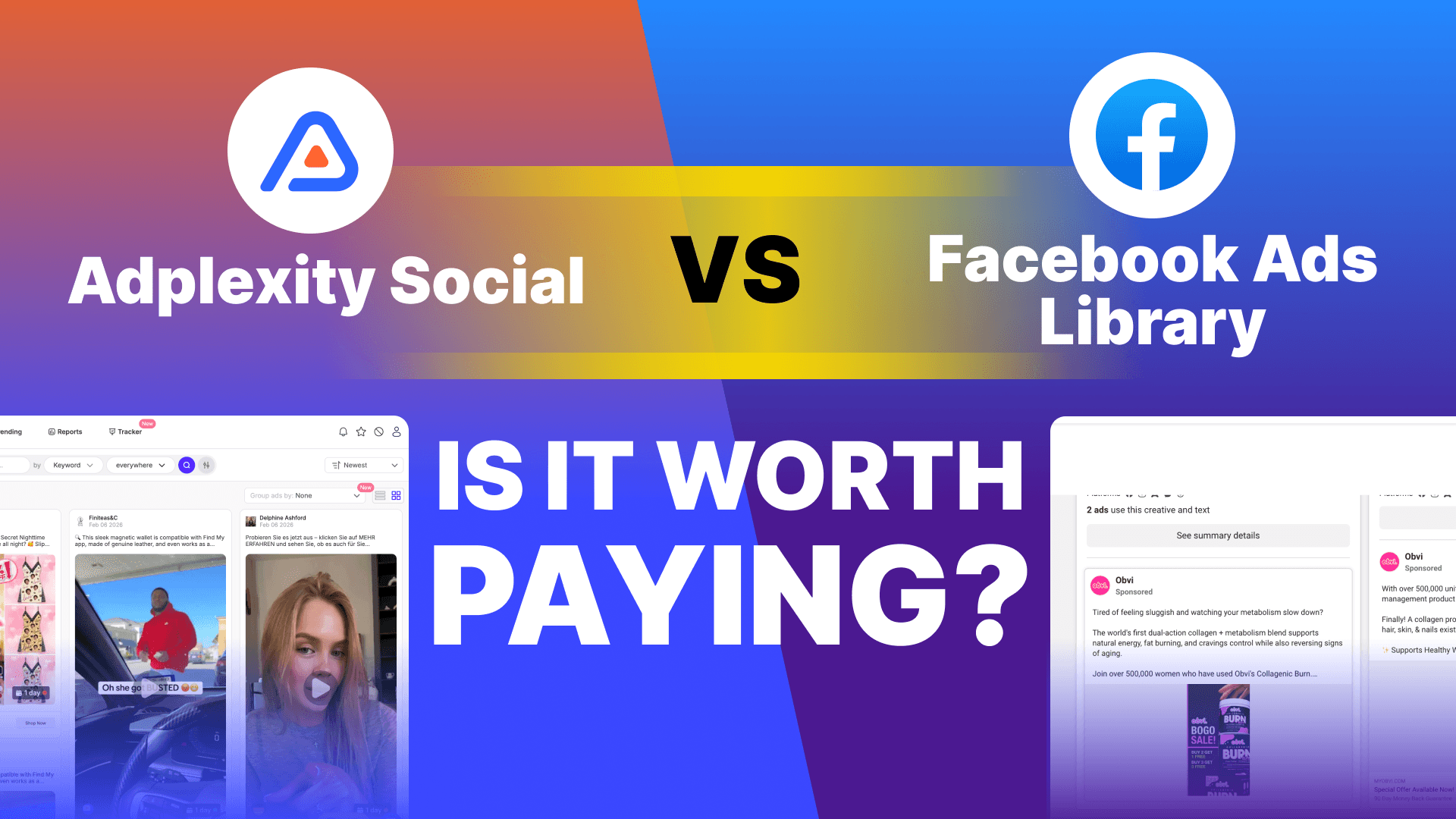
Start with Meta Ad Library.
Search for your product term and browse through the results.
Note which pages come up repeatedly. Note which ones have ads with older start dates, because those are the ones that have been running long enough to be worth studying.
Quality check: If your niche search returns fewer than 20 active ads across all the pages you checked, you are either searching too narrowly or the niche does not have enough paid social activity to support meaningful competitive research.
Broaden your product category or look at adjacent niches.
Step 2: Search by Keyword, Not by Competitor
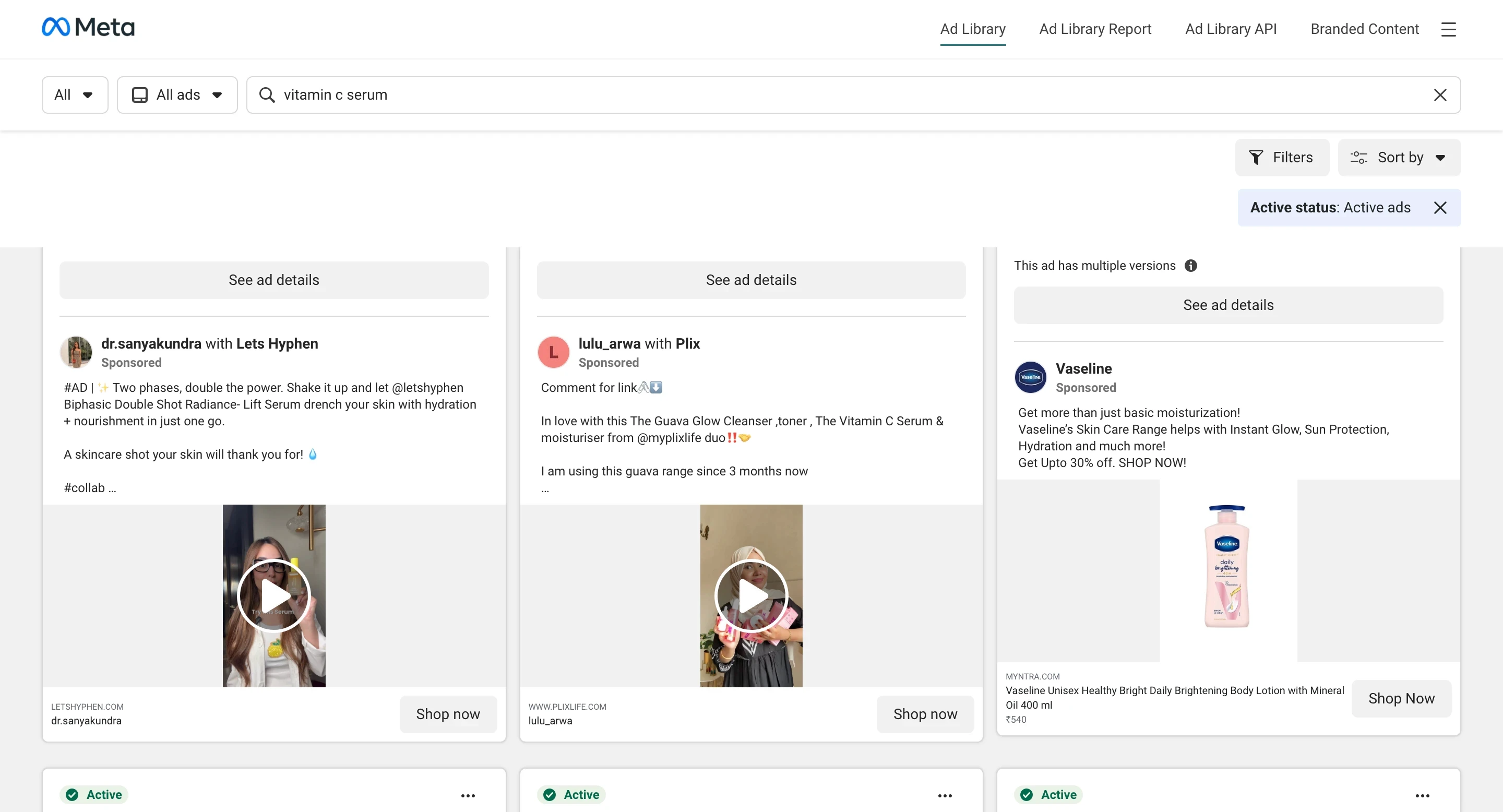
Most people use Meta Ad Library by searching for a specific competitor's page name.
That works for checking what one brand is doing, but it limits your research to advertisers you already know about.
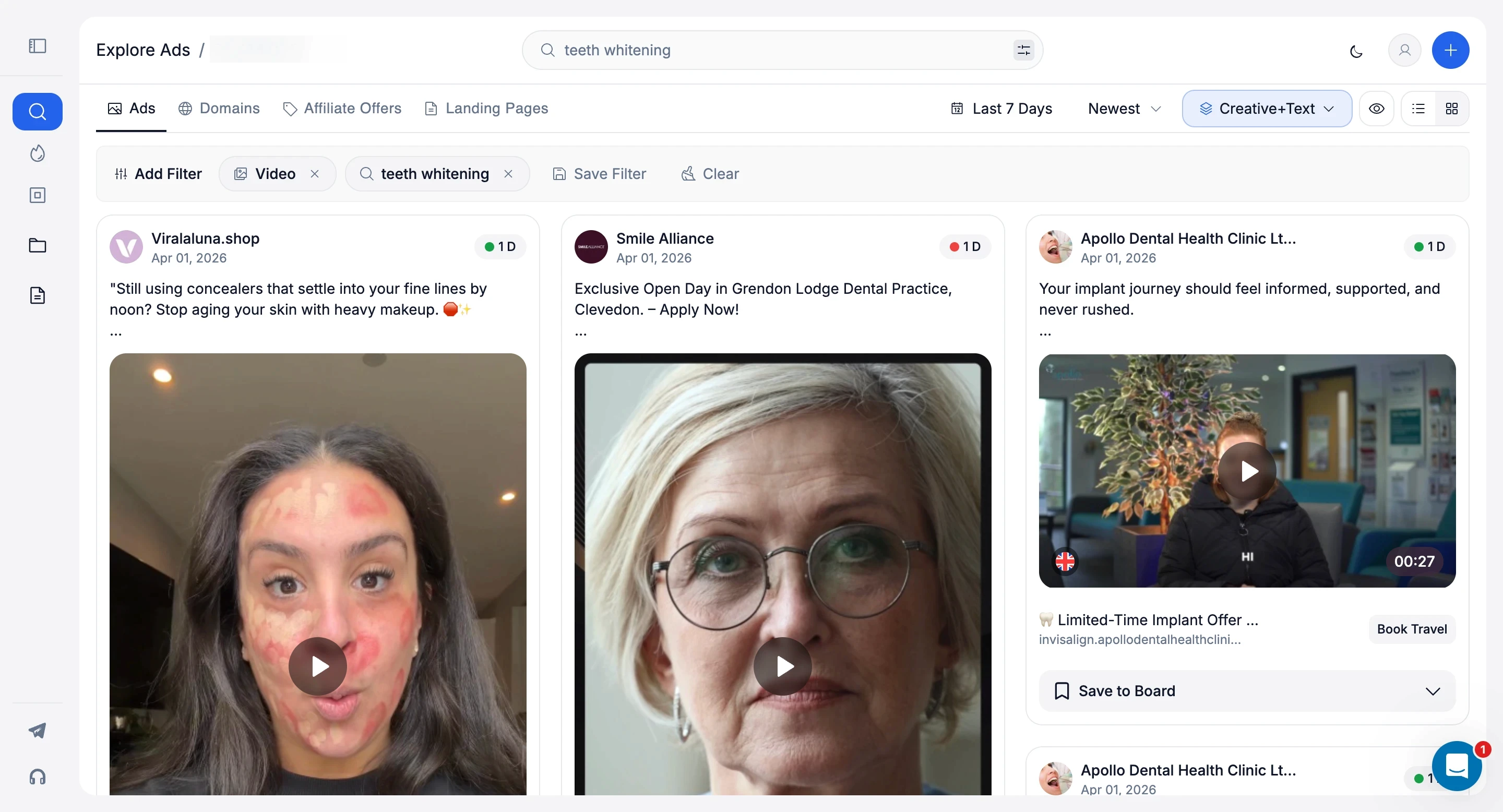
A better approach is to search by keyword.
Meta Ad Library does support keyword search across all advertisers.
If you type “teeth whitening” or “roof replacement estimate,” you will see ads from every page using those terms in their copy.
This is a solid starting point for discovering new advertisers and getting a broad view of messaging in your niche.
But the limitation becomes obvious immediately after the search.
Meta Ad Library gives you results, but almost no meaningful way to filter them.
You cannot filter by how long ads have been running, which is the most important signal for identifying winners.
You cannot isolate formats cleanly, and you cannot sort results to surface proven creatives first.
What you get is a wall of ads with no clear way to separate:
fresh tests
low-effort campaigns
actual winners
This is where ad spy tools change the game.
They take the same keyword search and add the filtering layer that makes research actionable.
Instead of scrolling through noise, you can:
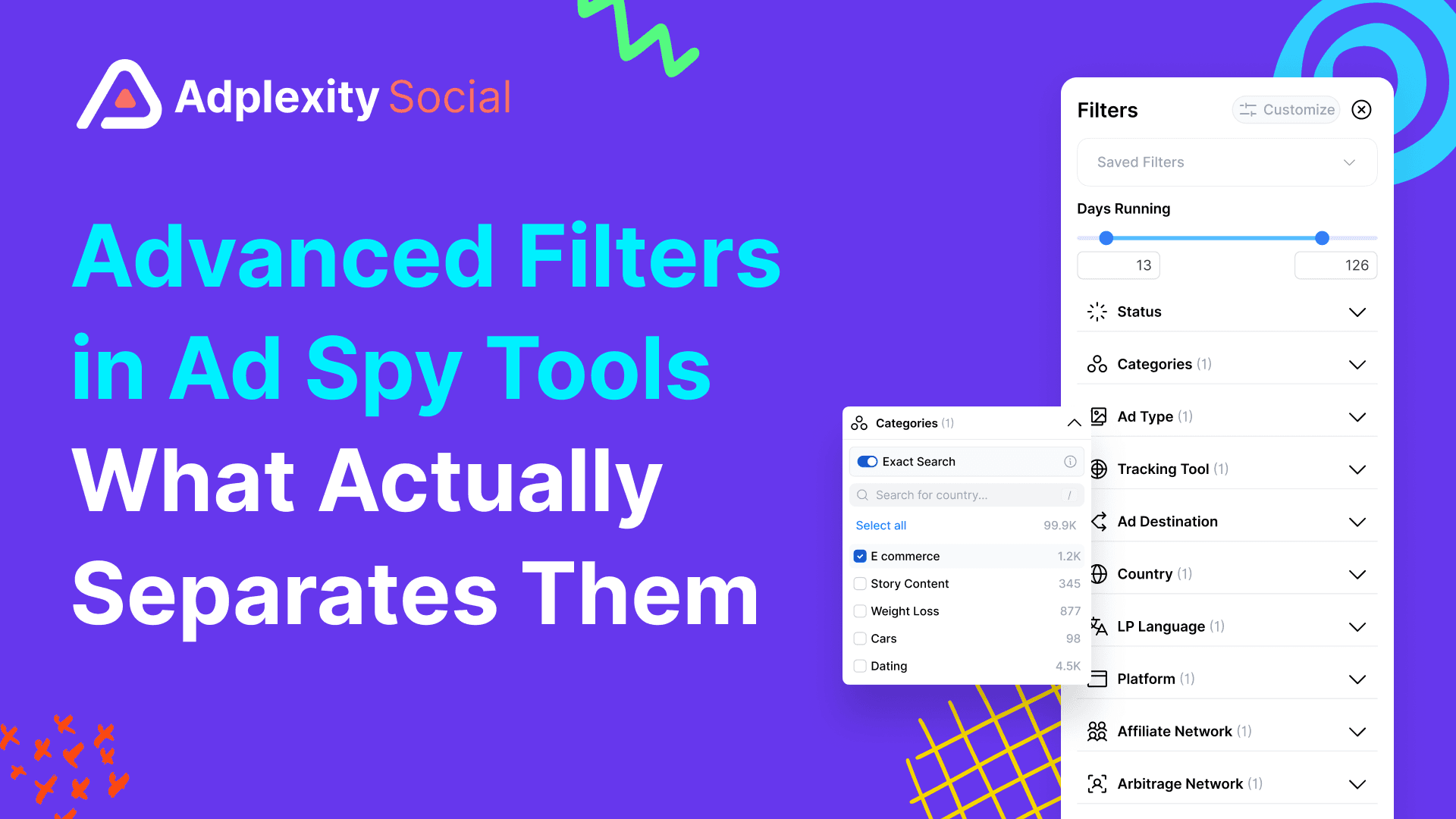
filter by days running to surface proven ads
filter by format to focus on what you plan to test
filter by country to match your target market
Some tools go further, letting you search by keywords on the landing page, not just in the ad copy.
This is especially powerful for affiliate and direct-response campaigns, where the real intent often lives on the page rather than in the ad itself.
AdPlexity Social supports both.
You can search for terms like “free quote” on the landing page and uncover entire categories of campaigns that would never appear in a standard ad copy search.
At that point, you are no longer browsing ads.
You are analyzing a strategy.
Step 3: Use Longevity and Deployment Signals to Filter Out the Noise
A keyword search in any decent-sized niche will return thousands of ads. Most of them are irrelevant. New tests that will be dead in three days.
Low-effort creatives from small advertisers. Retargeting ads that only make sense in context.
You need filters to cut through the noise and surface only the ads that are actually performing.
Filter by days running. Set a minimum of 10 days to start. This immediately eliminates all the fresh tests and short-lived campaigns. If you want to see only confirmed winners, push it to 20+ days.
What remains is a curated set of creatives that have survived long enough to prove their economics.
Filter by ad format. If you are specifically looking for video ad inspiration, filter out images. Mixing formats in your results adds noise without adding insight.
Filter by country or region. An ad winning in the US might not work in Germany, and vice versa. Filter by your target market first.
Then expand to other geos to see if the same creative is being scaled internationally, because that is an additional confirmation signal.
Filter by technology stack. This is where niche research gets surgical. If you are looking for ecommerce winners, filter for Shopify.
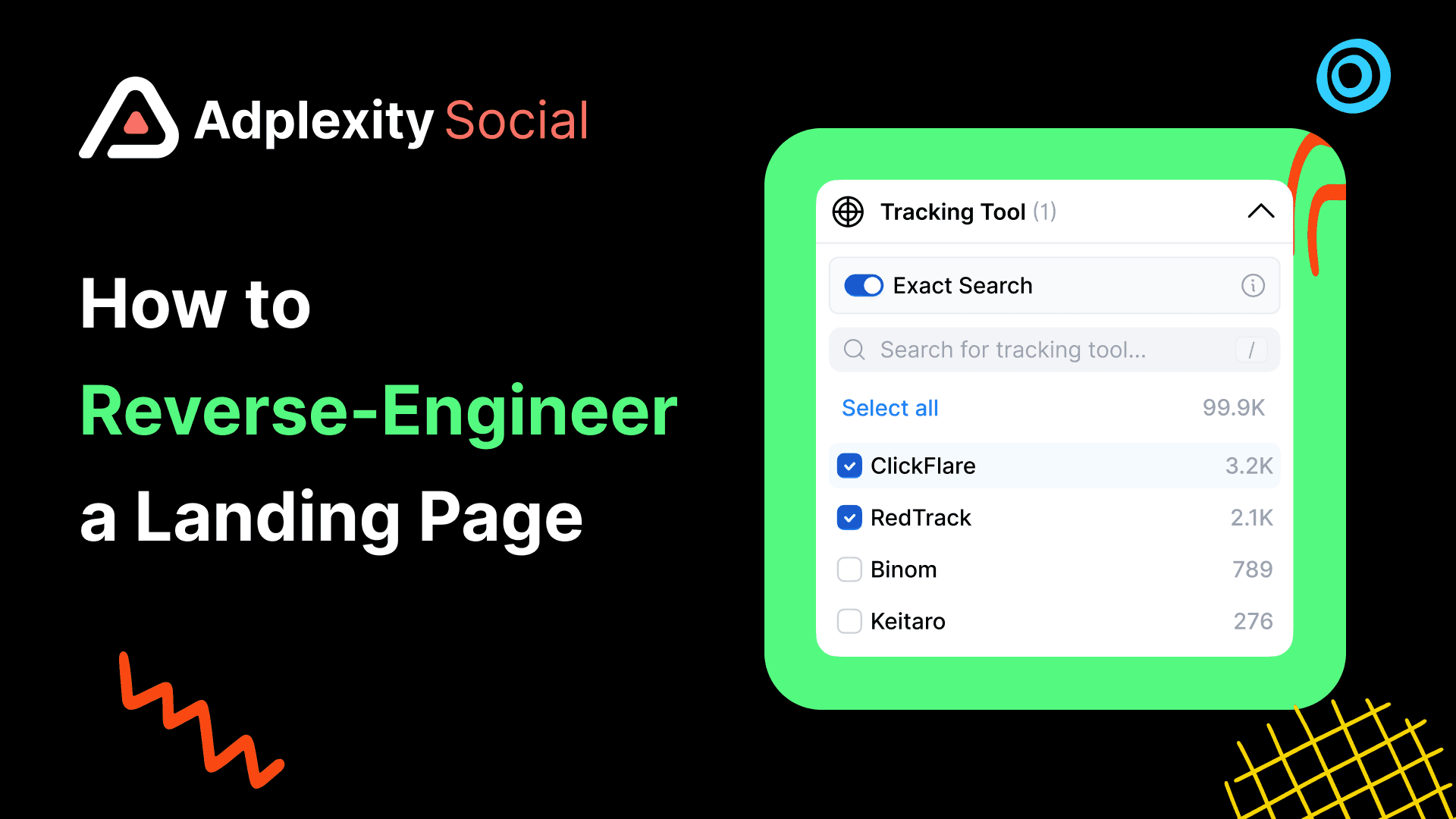
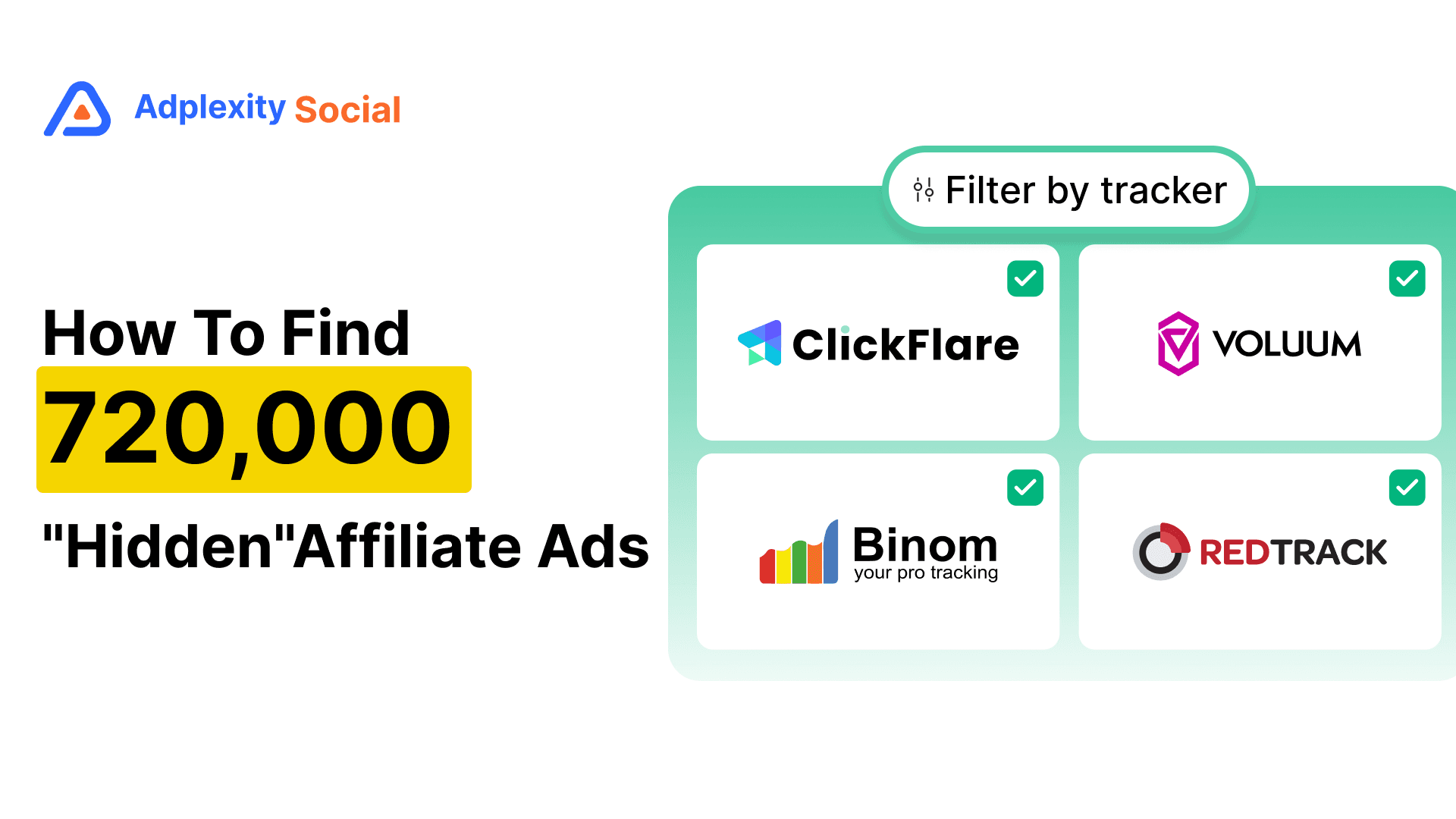
If you want to find direct-response or affiliate campaigns, filter by ClickFunnels, VTurb, or specific tracking tools like Redtrack or ClickFlare.
The tech stack tells you what kind of business is behind the ad, and that context determines how relevant the creative is to your own operation.
Look at the creative deployment volume. After filtering, pay attention to how many times each creative has been deployed.
A single ad running for 15 days is interesting.
The same creative, pushed across 80 ads on multiple fan pages, is a confirmed winner, being scaled with conviction.
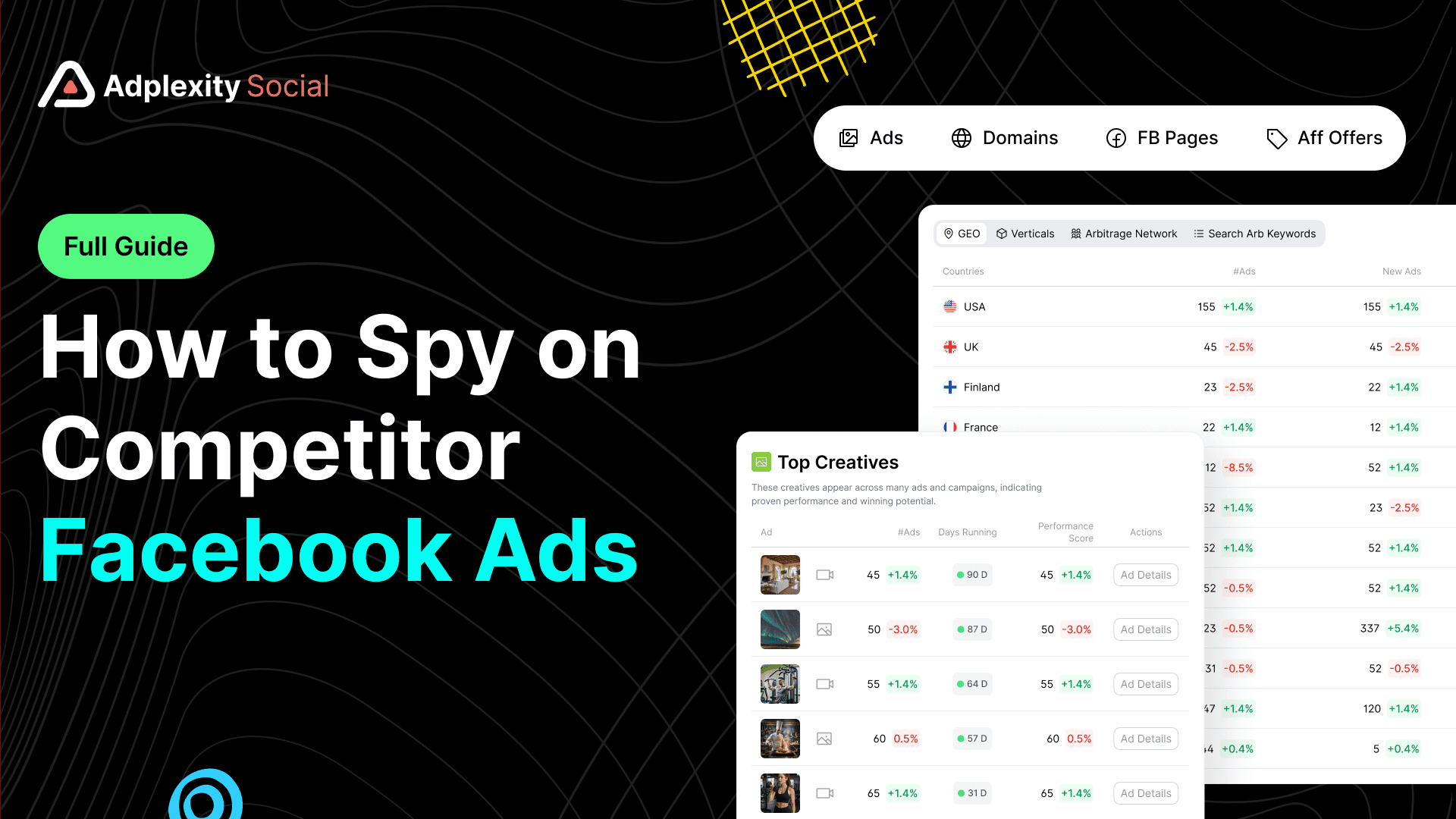
AdPlexity Social groups identical creatives across the entire database, not just within a single fan page, so you can see this cross-page deployment signal directly.
If a creative shows up in 200 ads across 15 different pages, that is one of the strongest signals you can get that the economics behind it are solid.
Quality check: After applying your filters, you should have a shortlist of hundreds of ads. If you have fewer than 100, loosen your filters.
If you have more than 1000, tighten them. The goal is a manageable set of proven creatives you can analyze deeply, not a wall of thumbnails you will never get through.
Step 4: Analyze the Full Funnel Behind the Winners
You have your shortlist of proven creatives.
Now comes the part most people skip: looking at what happens after the click.
Two ads can look identical on the surface, same format, same style, same type of hook, and lead to completely different businesses with completely different conversion strategies.
If you only study the ad creative, you are learning how to get clicks. If you study the full funnel, you learn how to drive conversions.
Start with the landing page.
What type of page does the ad send traffic to?
A product page means the advertiser is going for a direct sale. An advertorial is a way of warming up the prospect before presenting the offer.
A lead form means they are collecting information for follow-up. A VSL page means they are using a long-form video to sell.
Each of these represents a different conversion strategy, and the landing page type often matters more than the ad creative itself.
Check the redirect chain & tech stack.
When someone clicks the ad, the URL does not always go straight to the landing page. It often passes through redirect domains that reveal tracking tools and affiliate networks.
If you see Redtrack, ClickFlare, or Voluum in the chain, you are looking at a performance marketer or affiliate.
If you see ClickBank, BuyGoods, or Digistore24, you can identify the exact affiliate offer behind the ad.
If you see TrustedForm or Jornaya, you are looking at a lead gen campaign in a regulated vertical. These signals tell you the business model, the margin structure, and the sophistication of the operation.
Study the landing page copy.
The ad hook gets the click. The landing page copy drives conversions. Read it closely.
What objections does it address? What social proof does it use? What is the specific offer? How does the CTA differ from the ad's CTA?
The landing page is where you find the real persuasion strategy, and it is the most underleveraged source of competitive intelligence in performance marketing.
Look at the domain-level picture. A single product or offer is often advertised through multiple fan pages.
If you look at the ad from just one page, you see one version of the copy and one creative.
But at the domain level, you can see every ad copy variation, every video hook, and every creative that has been tested for that product across all its fan pages.
AdPlexity Social aggregates ad copy and video hooks at the domain level, so you can study the full testing history in one view.
For video ads, it also lets you extract the opening hooks directly from the creative, so you can see the exact words and framing advertisers use in those first few seconds without watching every video yourself.
This turns creative research from browsing individual ads into a structured analysis of what messaging is winning for a given product.
Step 5: Extract Patterns, Not Creatives
This is where most people go wrong. They find a winning ad and try to copy it.
That approach fails for three reasons: it can get your ad account flagged, it will not match your brand voice, and a copy is almost always worse than the original.
The right approach is to extract the pattern behind the winner and apply it to your own product with your own positioning.
What to extract from each winning creative:
The hook structure. Not the exact words, but the format. Does it start with a question? A bold claim?
A pain point? A before-and-after? A piece of social proof? The hook structure is the most transferable element of any winning ad, because it works at the psychological level regardless of the specific product.
The format and production style. Is it UGC-style testimonial? Studio product shot? Graphic design with text overlay? Screen recording? Talking head?
Note the production quality too. Sometimes raw, low-production content outperforms polished studio work. That is a pattern worth knowing in your niche.
The offer positioning. How is the product or service framed? Is it solving a specific problem, or selling an aspiration?
Is there a discount, a free trial, a bonus, or a money-back guarantee? The offer structure is often what makes the ad convert, not the visual.
The funnel structure. Does the ad send traffic to a product page, an advertorial, a lead form, or a VSL?
The funnel type is a pattern in itself. If every winning creative in your niche sends traffic to an advertorial before the product page, that is a signal about what the market needs to see before it converts.
Document your findings. Create a simple reference file organized by niche, hook type, format, and funnel structure.
When you need creative direction for your next campaign, open this file first. You are not starting from scratch. You are starting from validated patterns.
Quality check: After analyzing 10 to 15 winning creatives in your niche, you should see recurring patterns.
If every creative looks completely different with no common threads, either your niche is too broad or you need to look at a larger sample. Tighten your niche definition and pull more ads.
Step 6: Build a Repeatable Discovery System
Finding winning creatives once is useful. Finding them consistently is what gives you an ongoing creative advantage.
The market moves fast. Hooks that work today fatigue in weeks. New competitors enter your niche every month.
Formats shift as platforms evolve and audiences adapt. If your creative research is a one-time project, you will be behind again within a month.
Set up a weekly discovery session. Block 30 minutes on your calendar, same day every week.
Use it to run your core niche searches with longevity filters applied, check for new high-deployment creatives, and flag any format or hook trends you have not seen before.
Save your searches. If your ad spy tool supports saved searches or automated reports, use them.
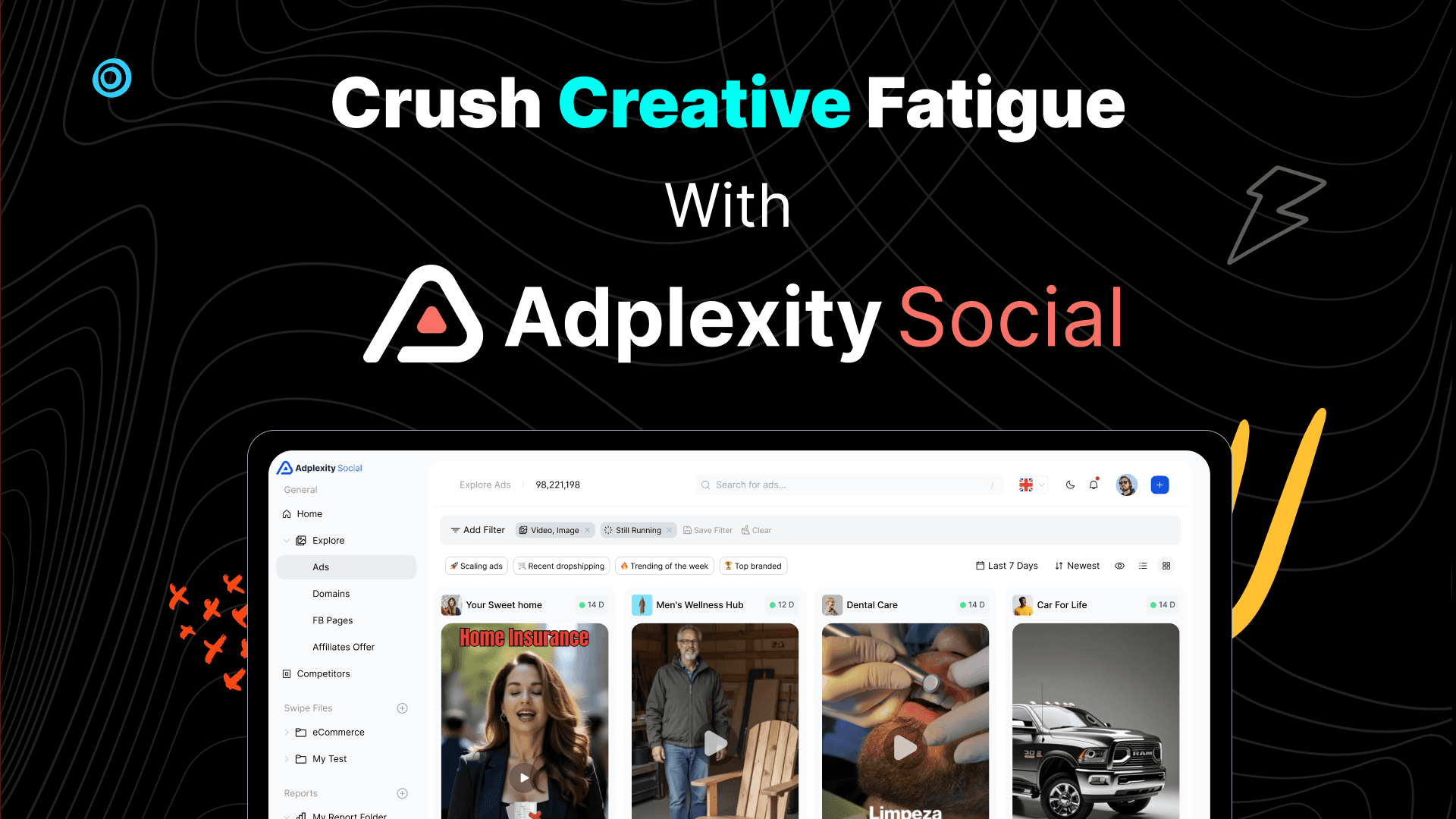
AdPlexity Social's Reports feature lets you set your search criteria, choose which data columns to include, and schedule the report to arrive in your Slack or email daily or weekly.
That means the scanning step happens automatically and your weekly session can focus entirely on analysis and pattern extraction.
Organize your winners. Screenshots and bookmarks get messy fast. Use a tool that lets you save and organize winning ads, landing pages, and domains in one place.
AdPlexity Social's Boards let you save all three element types into organized folders, so your creative intelligence library lives inside the same platform you use for research.
That is faster and more reliable than maintaining a separate swipe file in Google Drive or Notion.
Rotate your niche focus. If you work across multiple verticals or product categories, dedicate each weekly session to a different niche.
A four-niche rotation means you cover each one at least once a month, which is frequent enough to catch trends without burning out on any single market.
Quality check: After four weeks of running this system, you should have a library of 30 to 50 winning creatives with documented patterns.
If you have fewer than 15, you are not casting a wide enough net. Broaden your keyword searches or loosen your longevity filters.
Common Mistakes That Waste Your Research Time
Copying instead of extracting. The goal is to understand why a creative works, not to recreate it. Copy the principle, not the ad. If a competitor's hook starts with a customer complaint, the insight is "complaint-driven hooks work in this niche," not "use their exact complaint."
Ignoring the landing page. The ad creative is half the story. Two ads with identical formats can have completely different conversion rates if one sends traffic to a product page and the other sends it to a high-converting advertorial. Always look at what happens after the click.
Searching too broadly. "Fitness" returns 50,000 ads. "Home workout equipment for small apartments" returns 200 targeted results you can actually analyze. Get specific with your keywords and you will find relevant winners faster.
Mistaking brand awareness ads for direct response winners. Large brands often run the same creative for months because they are optimizing for reach and impressions, not conversions. A Nike ad running for 90 days does not mean that creative would work as a direct response ad for your product. Filter for the business models and funnel types that match your own operation.
Researching without acting. Every research session should produce at least one actionable insight you can apply to your next campaign. If you are spending 30 minutes browsing ads every week and never changing anything about your own creatives, you are not doing research. You are procrastinating.
Only looking at your own niche. Some of the best creative patterns come from adjacent or completely different verticals. The hook structure that works in skincare might transfer to supplements. The advertorial funnel that converts in home services might work in financial services. Cross-niche research often produces the most original ideas.
FAQs: Finding Winning Ad Creatives
How many winning ads do I need to analyze before I see patterns?
Aim for 10 to 15 winning creatives in a single niche. That is usually enough to identify 2 to 3 recurring patterns in hook style, format, and funnel structure. If you analyze fewer than 10, you risk basing decisions on outliers rather than trends.
Can I find winning creatives using only free tools?
You can get started with Meta Ad Library, but its limitations make systematic research difficult. You cannot filter by longevity, and you lose any ad that was deleted by the advertiser or removed by Meta. For a one-time competitor check, it works. For ongoing creative discovery across a niche, a paid tool saves significant time and surfaces signals that free tools simply cannot show.
How often should I search for new winning creatives?
Weekly is the ideal cadence. That is frequent enough to catch new trends and spot emerging winners before they become common knowledge in your niche, but not so frequent that it eats into your campaign management time. If you automate the scanning step with scheduled reports, the weekly session becomes pure analysis.
Do winning creative patterns transfer across niches?
The hook structure and format often transfer. A pain-point UGC hook that works in skincare can work in supplements or home fitness. The specific messaging and offer need to be adapted, but the underlying psychological pattern, which starts with the problem, shows the transformation, and presents the solution, tends to work across verticals. Cross-niche research is one of the most underused sources of creative ideas.
How can I tell if an ad is from an affiliate or a brand?
Check the post-click data. If the redirect chain includes tracking tools like Redtrack, ClickFlare, or Voluum, or passes through affiliate networks like ClickBank or BuyGoods, you are looking at an affiliate campaign. If traffic goes directly to a branded store or company website, it is likely a brand. This matters because affiliates and brands use different creative strategies, funnel types, and margin structures.
Should I save winning creatives or just take notes?
Both. Save the creative itself so you can reference the visual and copy format later. But also document the pattern: which hook type, which format, which funnel structure, and which offer positioning. The creative will eventually fatigue or get taken down. The pattern is what you will actually use when building your next campaign.
How do I know if a creative is genuinely profitable or just running on a large brand budget?
Look at the business model signals. Large brand awareness campaigns typically run through verified brand pages, send traffic to company homepages or product category pages, and use polished studio creative. Direct response winners tend to use UGC-style creative, send traffic to dedicated landing pages or advertorials, and include urgency in the copy. The technology stack and redirect chain also help: affiliate tracking tools and network domains are a clear sign that the campaign is performance-driven, not brand-driven.
Conclusion
Finding winning ad creatives is not about scrolling through an ad library and hoping something catches your eye.
It is a systematic process: define your niche, search by keyword across the entire market, filter by the signals that indicate real profitability, analyze the full funnel behind the winners, and extract the patterns you can apply to your own campaigns.
The advertisers who consistently produce winning creatives are not more creative than you. They are better researchers.
They know what is working before they start testing, and they use that intelligence to stack the odds in their favor from day one.
Build a weekly discovery system, keep your pattern library organized, and your creative process will never start from a blank page again.
Want to see the full funnel behind winning ads in your niche?
AdPlexity Social indexes millions of Meta ads and shows you the landing pages, redirect chains, tech stacks, and creative deployment data that free tools cannot.
Discover Winning Meta Ads
Similar Blogs