Atria is one of the most capable AI creative tools on the market right now.
It connects to your ad account. It scores your creatives with its Radar engine. It tells you what to test next. Its AI strategist, Raya, will even write the next batch of ads for you.
If your problem is producing better creative faster, Atria is built for exactly that.
But competitive research is a different job.
Competitive research is not about your account. It is about everyone else's. It is about seeing what your competitors are actually running, where their traffic goes after the click, and which offer sits at the end of the funnel.
That is the job AdPlexity Social was built for. And it is where these two tools separate hard.
This article compares them on the dimensions that matter when your goal is to study the competition, not just optimize yourself.
TL;DR
Best for competitive research and funnel intelligence: AdPlexity Social
Best for AI creative generation and optimizing your own ads: Atria
AdPlexity Social wins on library size and freshness, filter depth, landing page indexing, redirect chain crawling, and competitive research workflow. Atria wins on first-party performance analytics, AI creative production, and TikTok coverage. They are built for two different jobs, and most of the confusion between them comes from treating them as the same category.
Tools at a Glance
Rank
Tool
Best For
Starting Price
Post-Click Intelligence
1
AdPlexity Social
Performance marketers, media buyers, affiliates, and agencies researching competitors
Creative teams and brands generating and optimizing their own ads
$159/mo
Creative layer only, no landing page or redirect data
What Each Tool Is Built For
This is the distinction that decides everything else, so it is worth being clear up front.
Atria points inward. You connect your Meta and TikTok ad accounts, and Radar analyzes your own performance data to tell you which creatives are working and what to test next. Raya layers competitor signals and market data on top, then generates new scripts and image variations for you. It is a creative engine with an analytics layer wrapped around it.
AdPlexity Social points outward. It does not connect to your ad account, and it does not generate creatives. It indexes the live Meta ad ecosystem so you can see what other advertisers are running, then crawls the destination to show you the funnel behind each ad.
One tool helps you make your ads. The other shows you what the rest of the market is doing. Keep that split in mind, because it explains every difference below.
The Competitive Ad Library: Size, Freshness, and Coverage
Atria's ad library holds around 25 million ads across Meta and TikTok. For creative inspiration and for studying brands you follow, that is a solid base, and TikTok coverage is a real advantage if you run ads there.
AdPlexity Social indexes 15 million new Meta ads per month, with a total database of more than 100 million ads built in under a year. The tradeoff is platform scope. AdPlexity Social is Meta only, covering Facebook, Instagram, Messenger, and Audience Network. If TikTok is core to your research, that is a genuine gap.
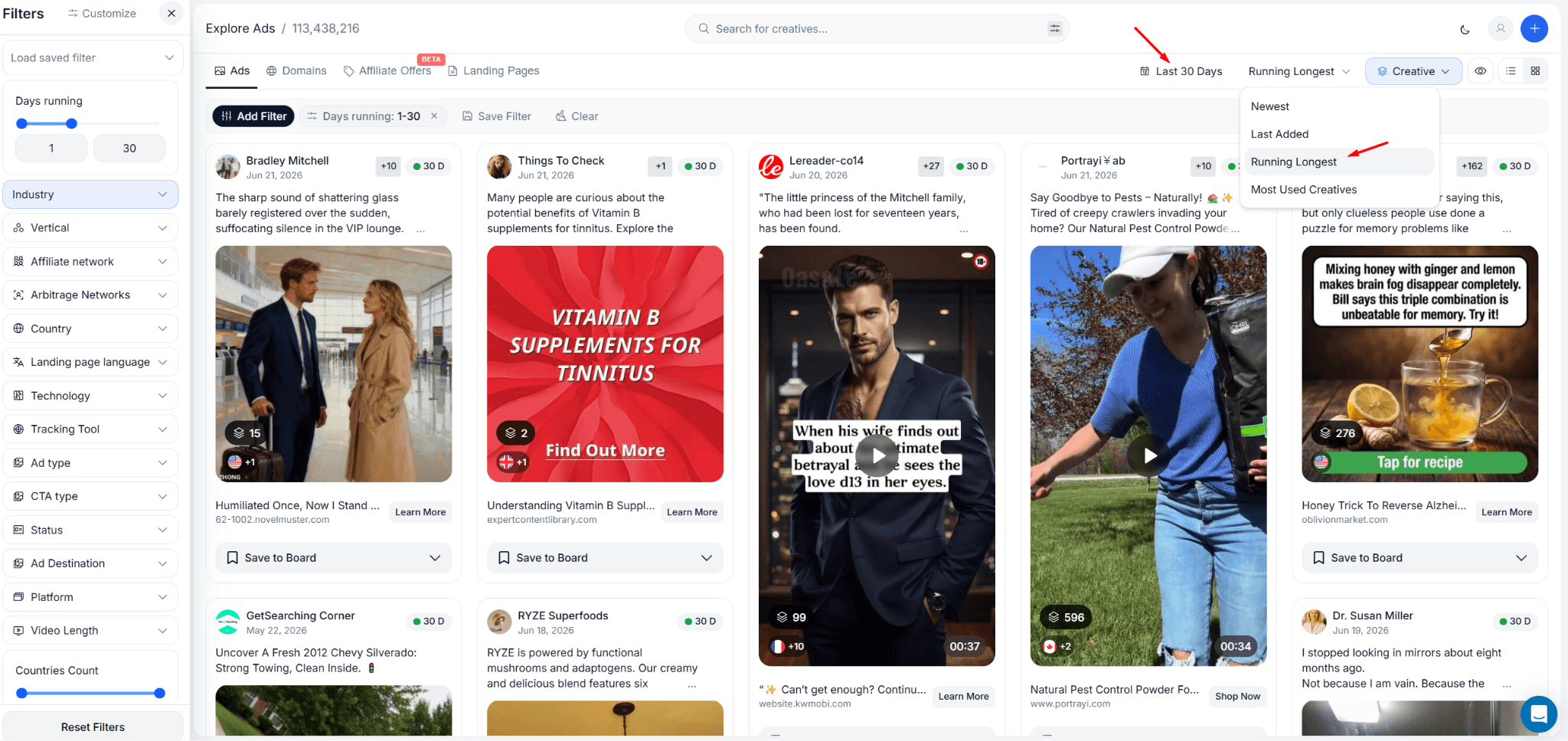
But for Meta specifically, the freshness curve matters more than the headline number. An ad that ran six months ago tells you what worked in a different market. An ad that has been live for the last 30 days tells you what is winning right now. AdPlexity Social surfaces active campaigns within days, which is the entire point when you are scouting live competitors.
Filter Depth: Finding Advertiser Types, Not Just Creatives
Atria filters around creative attributes. You can sort by hooks, angles, personas, themes, and the brands you track. That is useful when the question is "what does good creative look like in my space."
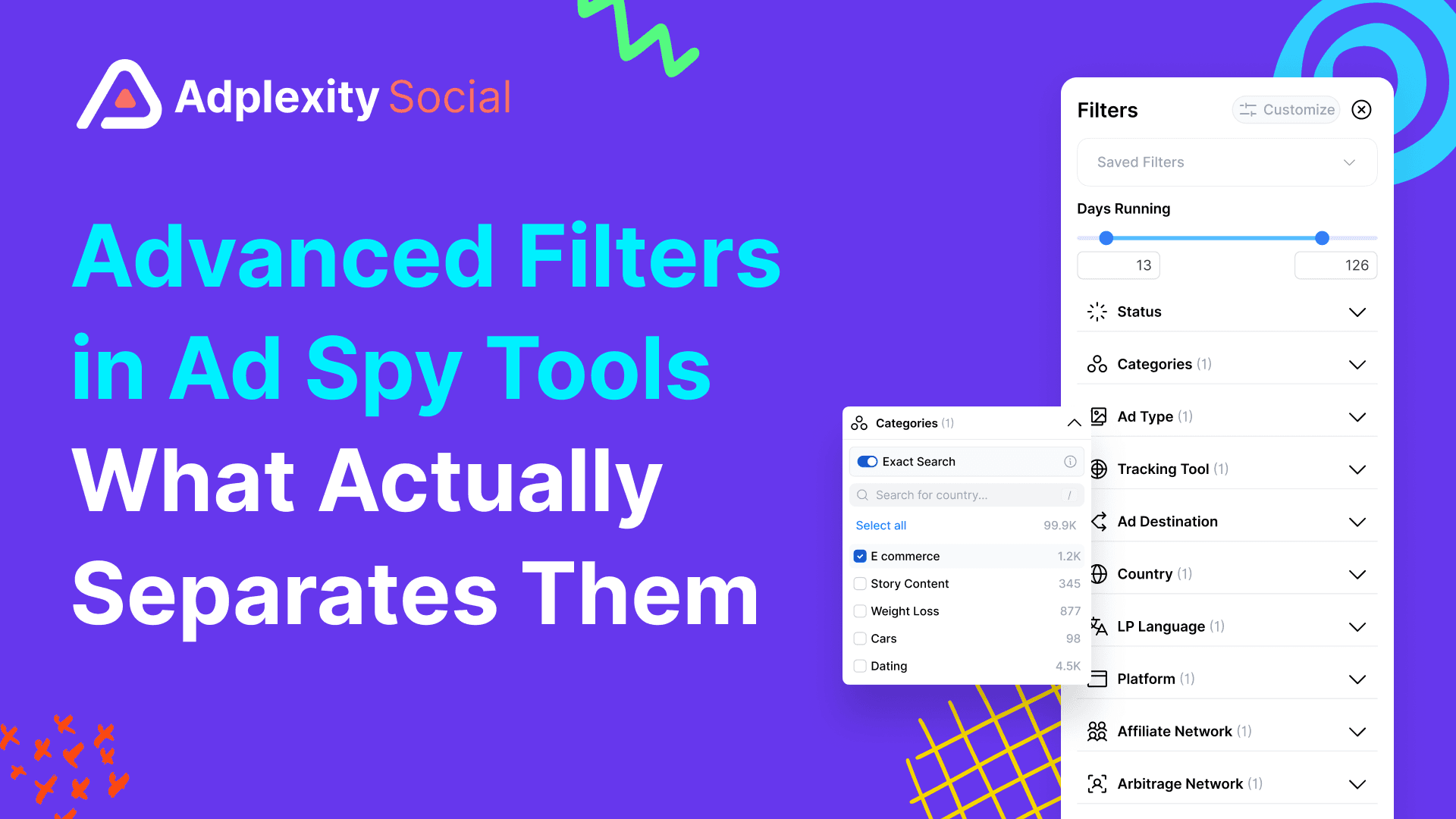
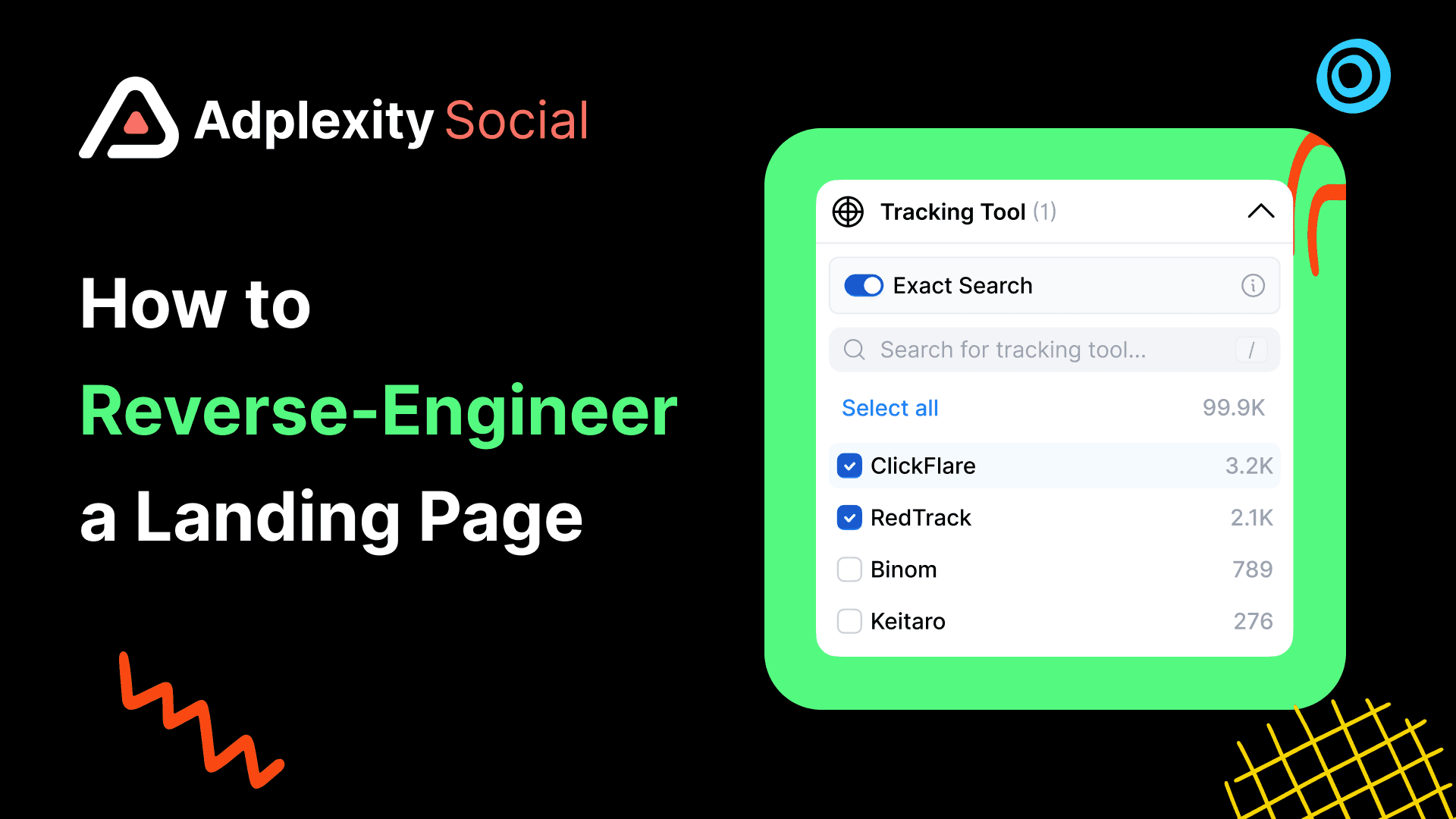
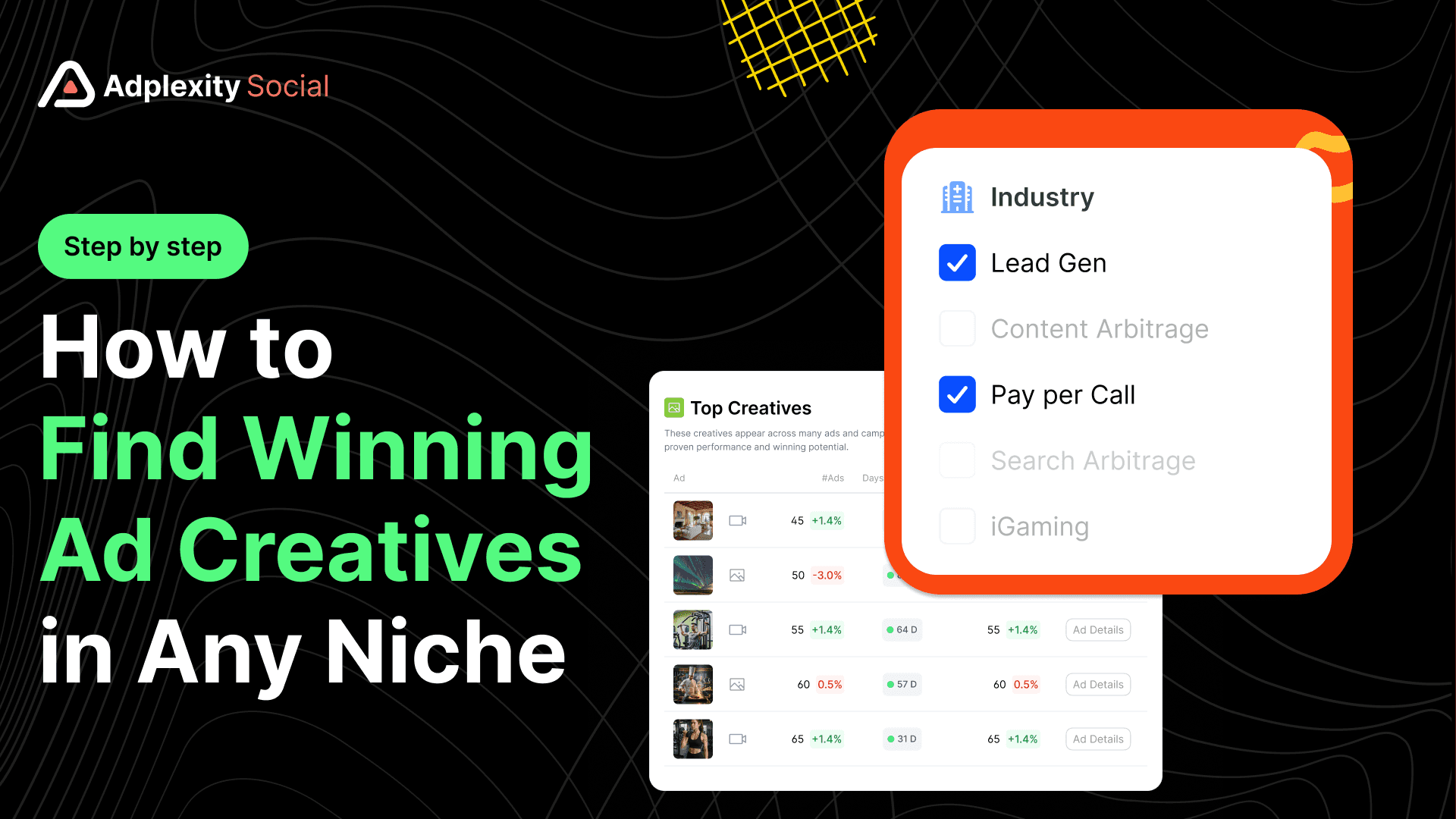
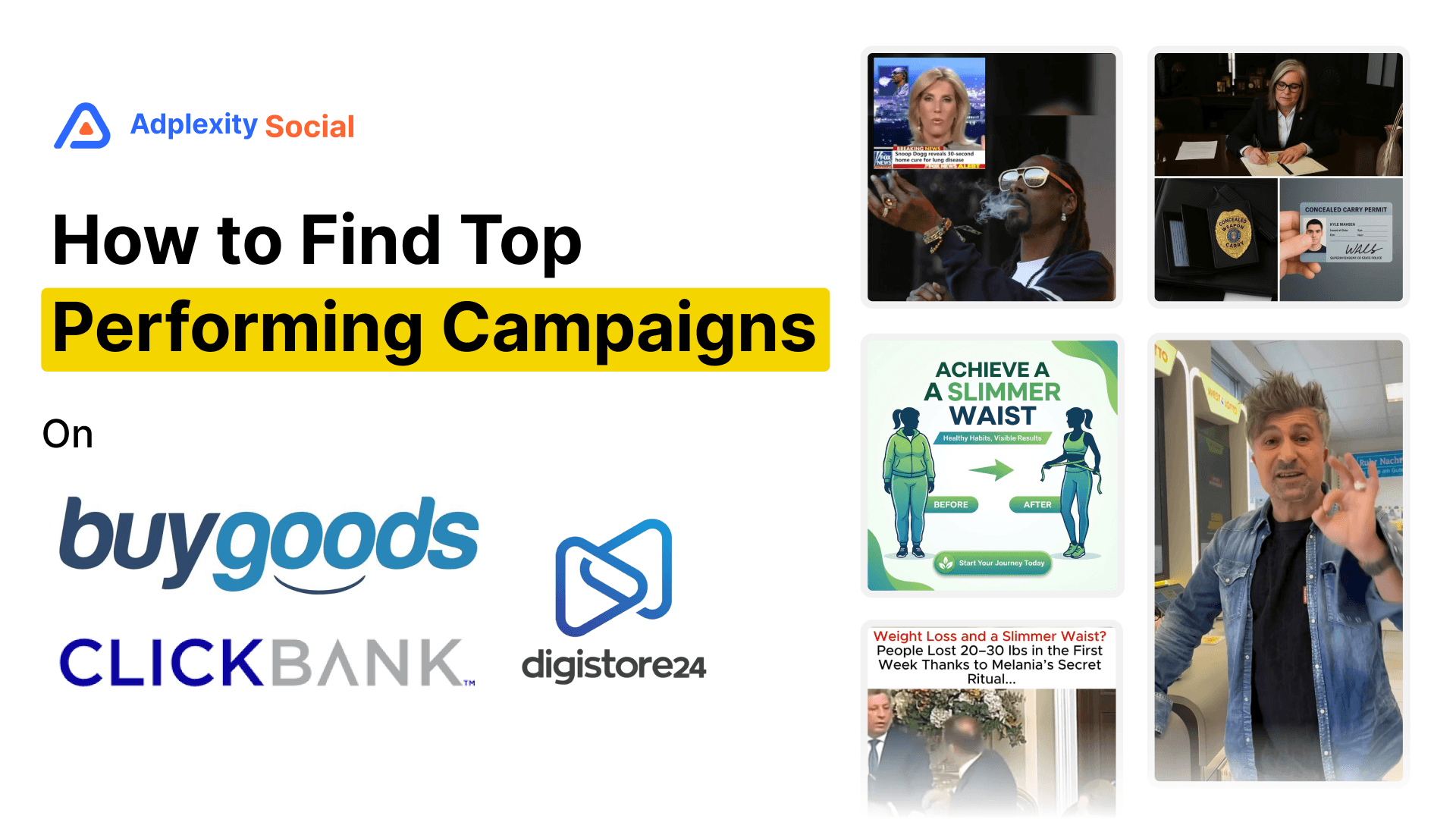
AdPlexity Social filters around the funnel. You can filter by technology stack, which means Shopify, ClickFunnels, TrustedForm, Ringba, VTurb, Lead Connector, Jornaya, and more. Want only ecom brands running Shopify? One filter. Want only VSL funnels running VTurb? One filter. You can filter by affiliate network, including ClickBank, BuyGoods, Digistore24, GiddyUp, and more. You can filter by vertical sub-niche, like Weight Loss, Diabetes, ED, Dental, and Skin. You can filter by longevity to isolate ads running 30, 60, or 90 plus days, which is how you separate tested winners from experiments.
And every one of these filters stacks in a single search.
The difference is what you are filtering toward. Atria helps you find a creative style. AdPlexity Social helps you find a type of advertiser and the exact campaigns they are running.
Post-Click Intelligence: What Happens After the Click
This is the widest gap between the two tools.
Atria reads the ad. It can analyze the creative, tag the hook, and even pull URL data to help brief a landing page. But it does not index the full landing page copy of competitor funnels, and it does not crawl the redirect chain to the final offer.
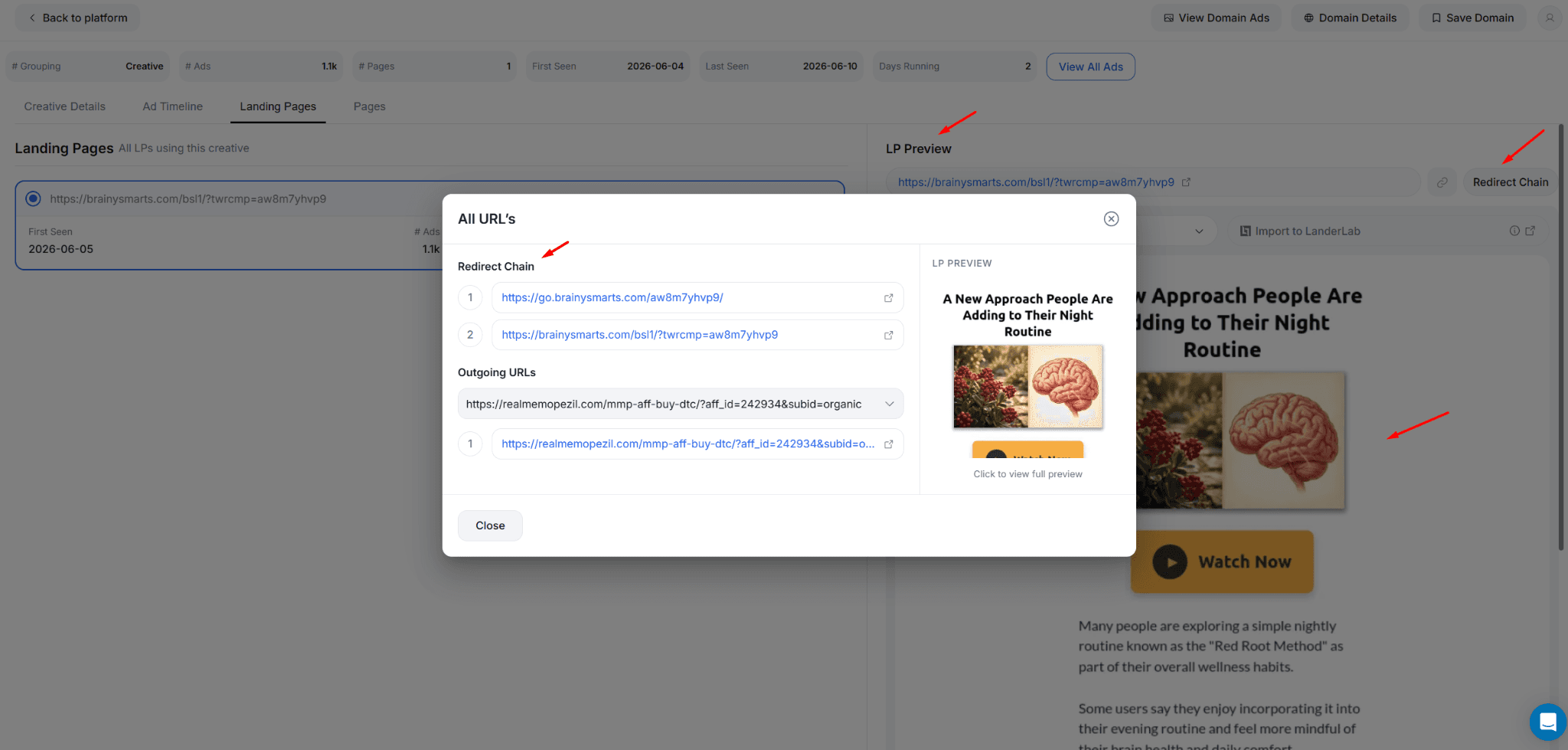
AdPlexity Social does both, end to end. It indexes the full text of the landing page behind each ad, and it follows the entire URL chain, including tracking domains, redirects, parameters, and outgoing links.
This matters in two concrete ways.
First, you can search for keywords that appear on landing pages, not just in ad copy. An advertiser may never mention an ingredient or a claim in the ad itself, but their pre-lander does. AdPlexity Social finds them anyway.
Second, the redirect chain exposes affiliate offers hidden behind pre-landers. When a media buyer runs an affiliate offer through a custom advertorial, the ad copy tells you nothing. The redirect chain gives you the offer, the network, and the tracking setup.
Practical example: Searching the keyword "blood sugar" while filtering by VTurb in the tech stack filter surfaces the VSL funnels currently running in the supplement space, along with the advertisers behind them and the exact pages those videos lead to. That search combines a keyword and a tech signal to return a list of advertiser types Atria cannot identify, because identifying them requires crawling the destination and detecting the video player. It is structurally outside what a creative-layer tool can do.
Multi-Dimension Search: Ads, Domains, and Landing Pages
Atria is organized around creatives and brands. You search ads and the accounts that run them.
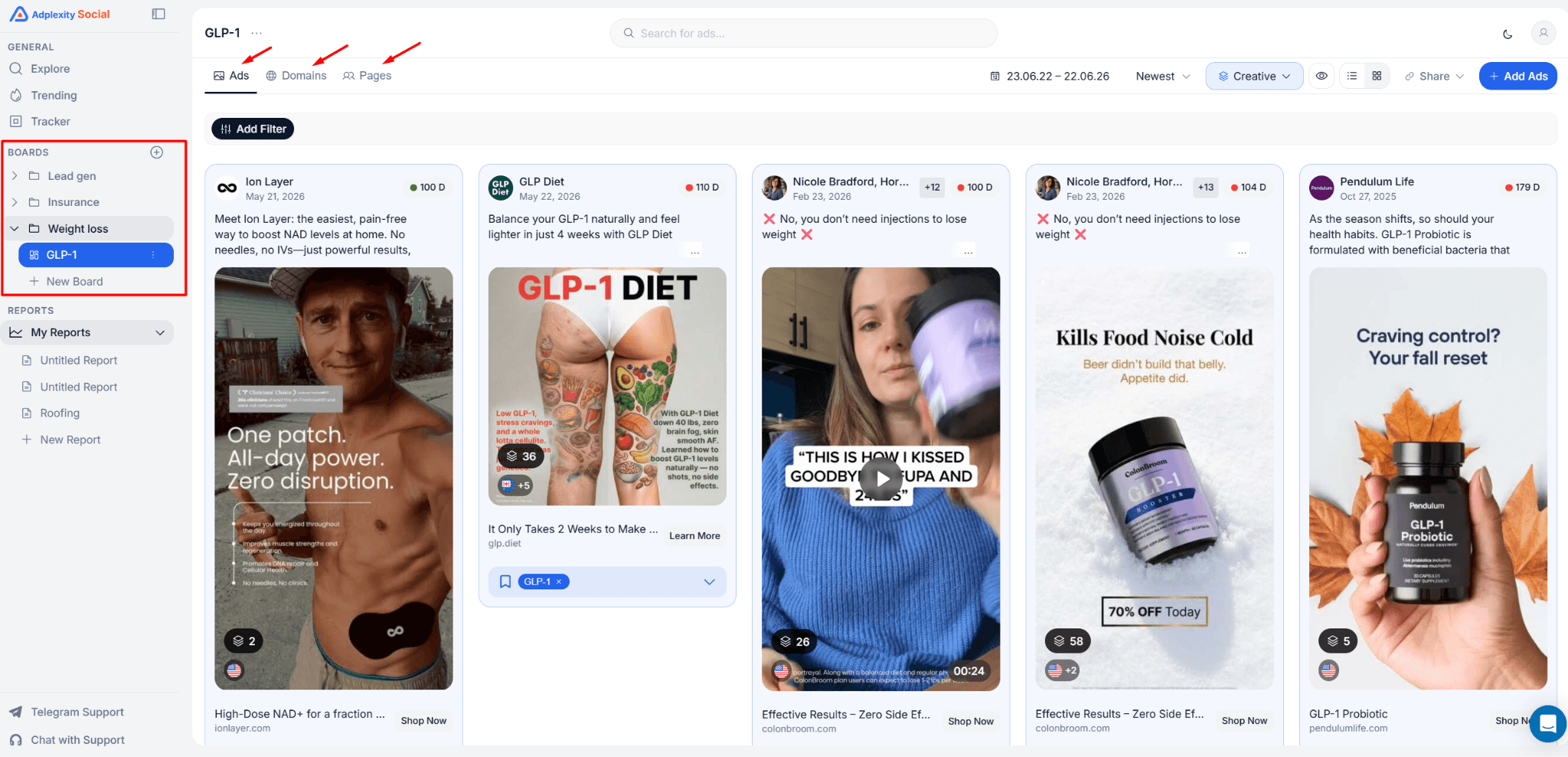
AdPlexity Social separates research into three searchable dimensions: Ads, Domains, and Landing Pages. Search by domain, and you see every ad pointing to that domain, regardless of which fan page or profile is running it. This matters because serious advertisers run the same offer across multiple accounts, and a brand-organized tool fragments that activity into pieces. AdPlexity Social aggregates it into one view, with period-over-period analytics so you can track how a competitor's footprint shifts over time.
Search by landing page, and you can find creative angles by destination URL, which is how you reverse-engineer a competitor's entire funnel structure rather than collecting isolated ads.
What Atria Does That AdPlexity Social Does Not
Here is the honest part, because pretending Atria is weak would be wrong.
Atria connects to your own ad accounts and analyzes your first-party performance data. AdPlexity Social does not do this at all. If you want a tool that scores your live creatives and tells you which of your own ads to scale or kill, that is Radar, and AdPlexity Social has no equivalent.
Atria generates creative. Raya builds briefs from your data and turns winning formulas into new scripts and image variations automatically. AdPlexity Social is not a creative production tool. It will show you what is working and how a funnel is built, but it will not write your next ad for you.
Atria also does review mining, AI copywriting, and brand asset management in one hub, and it covers TikTok alongside Meta.
So if your bottleneck is creative volume and account optimization, Atria solves a problem AdPlexity Social does not touch. Plenty of teams will end up running both: Atria to produce and optimize, AdPlexity Social to research the market they are competing in.
The mistake is expecting Atria to do deep competitive funnel research. That is not what it is for.
Boards: How Research Gets Saved and Shared
Atria stores creatives and brand data inside its workflow.
AdPlexity Social Boards save three element types in the same folder structure: ads, domains, and Facebook pages or profiles. You can organize them by client, vertical, or campaign concept, and share a Board through a public URL with control over which element types the viewer can see.
For an agency, that is the difference between a screenshot deck and a live competitive intelligence Board you hand to a client. For a solo media buyer, it is the difference between rebuilding research every week and keeping a library that compounds.
Pricing
AdPlexity Social is $99 per month, or $950 per year at 20 percent off, with extra seats at $49 per month.
Atria starts at $159 per month on its Core plan, or $129 per month billed annually, with the Plus plan at $329 per month. Business and Enterprise plans are custom priced.
The comparison is not purely about the lower number. You are paying for two different jobs. But if competitive research is the job, AdPlexity Social delivers deeper market intelligence at a lower entry price.
Where Atria Is the Right Call
If your team produces a high volume of creative, runs on both Meta and TikTok, and wants AI that analyzes your own account and generates new ads on demand, Atria is a strong fit. The Radar and Raya combination is genuinely useful for that workflow, and review mining adds a layer most research tools skip.
That is the legitimate, and frankly compelling, use case.
But for studying competitors, mapping funnels, scouting affiliate offers, and building competitive intelligence systems, Atria stops at the creative. The work happens after the click, and that is where AdPlexity Social lives.
Frequently Asked Questions
Is AdPlexity Social or Atria better for competitor research?
For competitor research specifically, AdPlexity Social is the stronger tool. It indexes full landing page copy and crawls the entire redirect chain, so you see the funnel and the offer behind each ad, not just the creative. Atria's competitor research stays at the creative layer, tagging hooks and angles without revealing where the traffic goes after the click.
Does Atria show landing pages and redirect chains like AdPlexity Social?
No. Atria can analyze ad creatives and pull some URL data to help brief a landing page, but it does not index competitor landing page copy for keyword search or crawl the full redirect chain. AdPlexity Social follows the entire URL path end to end, including tracking domains, parameters, and the final destination.
Can Atria detect affiliate offers behind pre-landers?
Not reliably. Detecting an affiliate offer hidden behind a pre-lander requires crawling the redirect chain to the network at the end of it. AdPlexity Social does this and offers dedicated filters for networks like ClickBank, BuyGoods, Digistore24, and GiddyUp. Atria reads the ad, so offers concealed behind advertorials stay invisible to it.
Does AdPlexity Social generate ad creatives the way Atria does?
No. AdPlexity Social is a competitive research and intelligence platform, not a creative production tool. It shows you what is working and how funnels are built, but it does not write scripts or generate images. For AI creative generation, Atria's Raya engine is built for that, and AdPlexity Social has no equivalent.
Does AdPlexity Social cover TikTok?
No. AdPlexity Social covers all Meta placements, meaning Facebook, Instagram, Messenger, and Audience Network. If your research extends to TikTok, Atria covers both Meta and TikTok, which is one of its clearer advantages.
How much does AdPlexity Social cost compared to Atria?
AdPlexity Social is $99 per month, or $950 per year, with extra seats at $49 per month. Atria starts at $159 per month, or $129 billed annually, with higher tiers at $329 per month and up. AdPlexity Social is the lower entry price while delivering deeper competitive research capability.
Should I use both AdPlexity Social and Atria together?
Many teams do, because they solve different problems. Atria optimizes and produces your own creative, while AdPlexity Social researches what the rest of the market is running and the funnels behind it. If your budget allows, pairing a production tool with a competitive intelligence platform is a reasonable setup.
Bottom Line
Atria is a genuinely good tool for making and optimizing your own ads.
But competitive research is a different job, and that is where the gap opens.
Landing page copy, indexed and searchable.
Redirect chains, crawled to the final offer.
Tech stack and affiliate network filters that surface advertiser types by name.
A domain dimension that shows a competitor's full footprint, not a slice of it.
Boards that save ads, domains, and pages in one shareable place.
If your job is to know what your competitors are actually running before you spend a dollar, AdPlexity Social is the stronger choice. Sign up atadplexity.io to see the funnels a creative tool will never show you.
Atria is one of the most capable AI creative tools on the market right now.
It connects to your ad account. It scores your creatives with its Radar engine. It tells you what to test next. Its AI strategist, Raya, will even write the next batch of ads for you.
If your problem is producing better creative faster, Atria is built for exactly that.
But competitive research is a different job.
Competitive research is not about your account. It is about everyone else's. It is about seeing what your competitors are actually running, where their traffic goes after the click, and which offer sits at the end of the funnel.
That is the job AdPlexity Social was built for. And it is where these two tools separate hard.
This article compares them on the dimensions that matter when your goal is to study the competition, not just optimize yourself.
TL;DR
Best for competitive research and funnel intelligence: AdPlexity Social
Best for AI creative generation and optimizing your own ads: Atria
AdPlexity Social wins on library size and freshness, filter depth, landing page indexing, redirect chain crawling, and competitive research workflow. Atria wins on first-party performance analytics, AI creative production, and TikTok coverage. They are built for two different jobs, and most of the confusion between them comes from treating them as the same category.
Tools at a Glance
Rank
Tool
Best For
Starting Price
Post-Click Intelligence
1
AdPlexity Social
Performance marketers, media buyers, affiliates, and agencies researching competitors
Creative teams and brands generating and optimizing their own ads
$159/mo
Creative layer only, no landing page or redirect data
What Each Tool Is Built For
This is the distinction that decides everything else, so it is worth being clear up front.
Atria points inward. You connect your Meta and TikTok ad accounts, and Radar analyzes your own performance data to tell you which creatives are working and what to test next. Raya layers competitor signals and market data on top, then generates new scripts and image variations for you. It is a creative engine with an analytics layer wrapped around it.
AdPlexity Social points outward. It does not connect to your ad account, and it does not generate creatives. It indexes the live Meta ad ecosystem so you can see what other advertisers are running, then crawls the destination to show you the funnel behind each ad.
One tool helps you make your ads. The other shows you what the rest of the market is doing. Keep that split in mind, because it explains every difference below.
The Competitive Ad Library: Size, Freshness, and Coverage
Atria's ad library holds around 25 million ads across Meta and TikTok. For creative inspiration and for studying brands you follow, that is a solid base, and TikTok coverage is a real advantage if you run ads there.
AdPlexity Social indexes 15 million new Meta ads per month, with a total database of more than 100 million ads built in under a year. The tradeoff is platform scope. AdPlexity Social is Meta only, covering Facebook, Instagram, Messenger, and Audience Network. If TikTok is core to your research, that is a genuine gap.
But for Meta specifically, the freshness curve matters more than the headline number. An ad that ran six months ago tells you what worked in a different market. An ad that has been live for the last 30 days tells you what is winning right now. AdPlexity Social surfaces active campaigns within days, which is the entire point when you are scouting live competitors.
Filter Depth: Finding Advertiser Types, Not Just Creatives
Atria filters around creative attributes. You can sort by hooks, angles, personas, themes, and the brands you track. That is useful when the question is "what does good creative look like in my space."
AdPlexity Social filters around the funnel. You can filter by technology stack, which means Shopify, ClickFunnels, TrustedForm, Ringba, VTurb, Lead Connector, Jornaya, and more. Want only ecom brands running Shopify? One filter. Want only VSL funnels running VTurb? One filter. You can filter by affiliate network, including ClickBank, BuyGoods, Digistore24, GiddyUp, and more. You can filter by vertical sub-niche, like Weight Loss, Diabetes, ED, Dental, and Skin. You can filter by longevity to isolate ads running 30, 60, or 90 plus days, which is how you separate tested winners from experiments.
And every one of these filters stacks in a single search.
The difference is what you are filtering toward. Atria helps you find a creative style. AdPlexity Social helps you find a type of advertiser and the exact campaigns they are running.
Post-Click Intelligence: What Happens After the Click
This is the widest gap between the two tools.
Atria reads the ad. It can analyze the creative, tag the hook, and even pull URL data to help brief a landing page. But it does not index the full landing page copy of competitor funnels, and it does not crawl the redirect chain to the final offer.
AdPlexity Social does both, end to end. It indexes the full text of the landing page behind each ad, and it follows the entire URL chain, including tracking domains, redirects, parameters, and outgoing links.
This matters in two concrete ways.
First, you can search for keywords that appear on landing pages, not just in ad copy. An advertiser may never mention an ingredient or a claim in the ad itself, but their pre-lander does. AdPlexity Social finds them anyway.
Second, the redirect chain exposes affiliate offers hidden behind pre-landers. When a media buyer runs an affiliate offer through a custom advertorial, the ad copy tells you nothing. The redirect chain gives you the offer, the network, and the tracking setup.
Practical example: Searching the keyword "blood sugar" while filtering by VTurb in the tech stack filter surfaces the VSL funnels currently running in the supplement space, along with the advertisers behind them and the exact pages those videos lead to. That search combines a keyword and a tech signal to return a list of advertiser types Atria cannot identify, because identifying them requires crawling the destination and detecting the video player. It is structurally outside what a creative-layer tool can do.
Multi-Dimension Search: Ads, Domains, and Landing Pages
Atria is organized around creatives and brands. You search ads and the accounts that run them.
AdPlexity Social separates research into three searchable dimensions: Ads, Domains, and Landing Pages. Search by domain, and you see every ad pointing to that domain, regardless of which fan page or profile is running it. This matters because serious advertisers run the same offer across multiple accounts, and a brand-organized tool fragments that activity into pieces. AdPlexity Social aggregates it into one view, with period-over-period analytics so you can track how a competitor's footprint shifts over time.
Search by landing page, and you can find creative angles by destination URL, which is how you reverse-engineer a competitor's entire funnel structure rather than collecting isolated ads.
What Atria Does That AdPlexity Social Does Not
Here is the honest part, because pretending Atria is weak would be wrong.
Atria connects to your own ad accounts and analyzes your first-party performance data. AdPlexity Social does not do this at all. If you want a tool that scores your live creatives and tells you which of your own ads to scale or kill, that is Radar, and AdPlexity Social has no equivalent.
Atria generates creative. Raya builds briefs from your data and turns winning formulas into new scripts and image variations automatically. AdPlexity Social is not a creative production tool. It will show you what is working and how a funnel is built, but it will not write your next ad for you.
Atria also does review mining, AI copywriting, and brand asset management in one hub, and it covers TikTok alongside Meta.
So if your bottleneck is creative volume and account optimization, Atria solves a problem AdPlexity Social does not touch. Plenty of teams will end up running both: Atria to produce and optimize, AdPlexity Social to research the market they are competing in.
The mistake is expecting Atria to do deep competitive funnel research. That is not what it is for.
Boards: How Research Gets Saved and Shared
Atria stores creatives and brand data inside its workflow.
AdPlexity Social Boards save three element types in the same folder structure: ads, domains, and Facebook pages or profiles. You can organize them by client, vertical, or campaign concept, and share a Board through a public URL with control over which element types the viewer can see.
For an agency, that is the difference between a screenshot deck and a live competitive intelligence Board you hand to a client. For a solo media buyer, it is the difference between rebuilding research every week and keeping a library that compounds.
Pricing
AdPlexity Social is $99 per month, or $950 per year at 20 percent off, with extra seats at $49 per month.
Atria starts at $159 per month on its Core plan, or $129 per month billed annually, with the Plus plan at $329 per month. Business and Enterprise plans are custom priced.
The comparison is not purely about the lower number. You are paying for two different jobs. But if competitive research is the job, AdPlexity Social delivers deeper market intelligence at a lower entry price.
Where Atria Is the Right Call
If your team produces a high volume of creative, runs on both Meta and TikTok, and wants AI that analyzes your own account and generates new ads on demand, Atria is a strong fit. The Radar and Raya combination is genuinely useful for that workflow, and review mining adds a layer most research tools skip.
That is the legitimate, and frankly compelling, use case.
But for studying competitors, mapping funnels, scouting affiliate offers, and building competitive intelligence systems, Atria stops at the creative. The work happens after the click, and that is where AdPlexity Social lives.
Frequently Asked Questions
Is AdPlexity Social or Atria better for competitor research?
For competitor research specifically, AdPlexity Social is the stronger tool. It indexes full landing page copy and crawls the entire redirect chain, so you see the funnel and the offer behind each ad, not just the creative. Atria's competitor research stays at the creative layer, tagging hooks and angles without revealing where the traffic goes after the click.
Does Atria show landing pages and redirect chains like AdPlexity Social?
No. Atria can analyze ad creatives and pull some URL data to help brief a landing page, but it does not index competitor landing page copy for keyword search or crawl the full redirect chain. AdPlexity Social follows the entire URL path end to end, including tracking domains, parameters, and the final destination.
Can Atria detect affiliate offers behind pre-landers?
Not reliably. Detecting an affiliate offer hidden behind a pre-lander requires crawling the redirect chain to the network at the end of it. AdPlexity Social does this and offers dedicated filters for networks like ClickBank, BuyGoods, Digistore24, and GiddyUp. Atria reads the ad, so offers concealed behind advertorials stay invisible to it.
Does AdPlexity Social generate ad creatives the way Atria does?
No. AdPlexity Social is a competitive research and intelligence platform, not a creative production tool. It shows you what is working and how funnels are built, but it does not write scripts or generate images. For AI creative generation, Atria's Raya engine is built for that, and AdPlexity Social has no equivalent.
Does AdPlexity Social cover TikTok?
No. AdPlexity Social covers all Meta placements, meaning Facebook, Instagram, Messenger, and Audience Network. If your research extends to TikTok, Atria covers both Meta and TikTok, which is one of its clearer advantages.
How much does AdPlexity Social cost compared to Atria?
AdPlexity Social is $99 per month, or $950 per year, with extra seats at $49 per month. Atria starts at $159 per month, or $129 billed annually, with higher tiers at $329 per month and up. AdPlexity Social is the lower entry price while delivering deeper competitive research capability.
Should I use both AdPlexity Social and Atria together?
Many teams do, because they solve different problems. Atria optimizes and produces your own creative, while AdPlexity Social researches what the rest of the market is running and the funnels behind it. If your budget allows, pairing a production tool with a competitive intelligence platform is a reasonable setup.
Bottom Line
Atria is a genuinely good tool for making and optimizing your own ads.
But competitive research is a different job, and that is where the gap opens.
Landing page copy, indexed and searchable.
Redirect chains, crawled to the final offer.
Tech stack and affiliate network filters that surface advertiser types by name.
A domain dimension that shows a competitor's full footprint, not a slice of it.
Boards that save ads, domains, and pages in one shareable place.
If your job is to know what your competitors are actually running before you spend a dollar, AdPlexity Social is the stronger choice. Sign up atadplexity.io to see the funnels a creative tool will never show you.
Table of Contents
Quickly navigate through the key sections of this article.