Facebook Ad Hook Examples From the Most-Scaled Video Ads (2026)

Share:
A hook is the first three seconds of a video ad. These are the spoken openings advertisers deployed hardest, on hundreds to thousands of ads each, and how to find them in your own niche.
A hook is the first three seconds of a video ad. These are the spoken openings advertisers deployed hardest, on hundreds to thousands of ads each, and how to find them in your own niche.
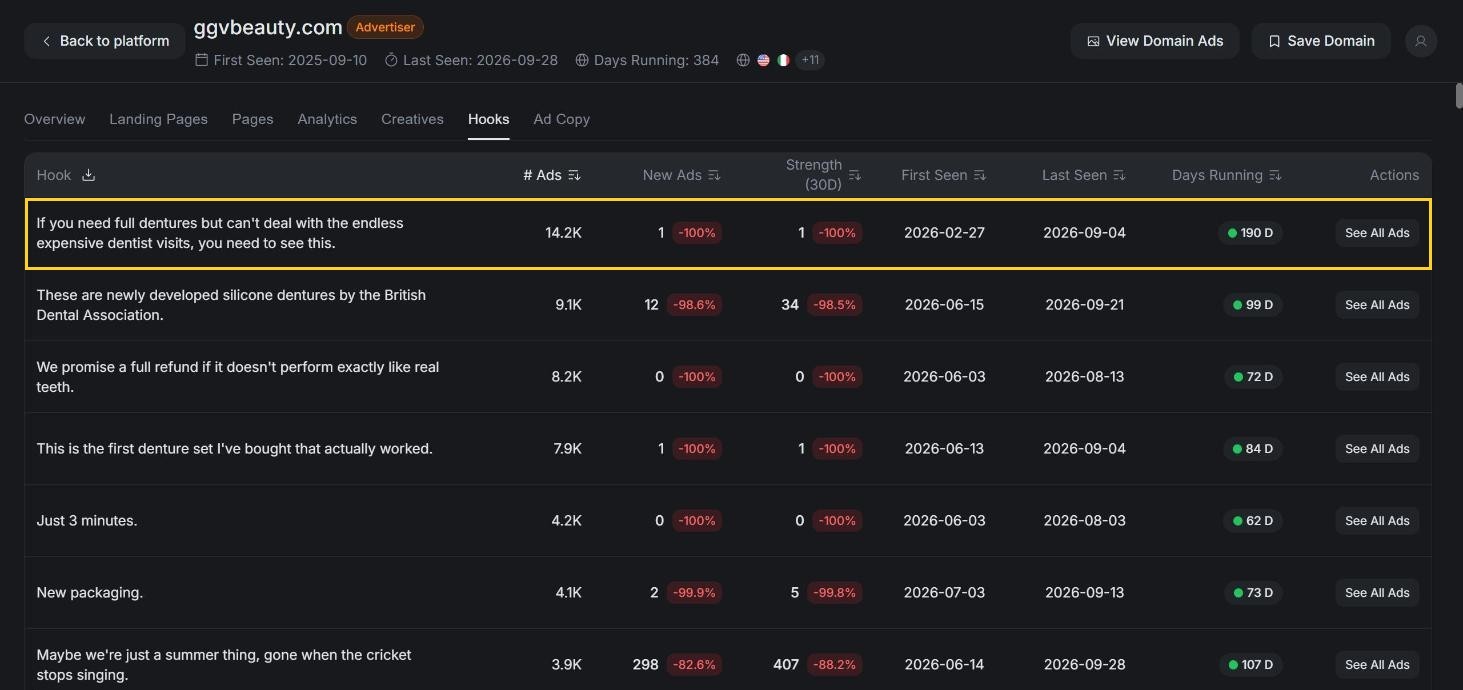
"If you need full dentures but can't deal with the endless expensive dentist visits, you need to see this." That line opened more than 14,000 ads for ggvbeauty.com, a store that sells silicone dentures, over about six months. This list does not come from memory or view counts. It comes from what advertisers keep paying to run.
If you run video ads on Facebook and want hooks that already work instead of guesses, this guide shows you the openings advertisers scale hardest and how to find them in your own niche in about 20 minutes. By the end, you will be able to:
Spot what a video hook is and where it sits
Read how hard an advertiser is scaling a hook
Find the most-deployed hooks in your own industry
Turn a winning hook into your own without copying it
Key takeaways. A hook is the first three seconds of a Facebook video: the opening frame, any text on screen and the first spoken line. You cannot see a competitor's hook rate or cost per result, but you can see how hard they are scaling a hook, in copies of the same video and in new videos built on the same opening line. AdPlexity Social's Hooks tab adds up that scale per advertiser, from a denture brand running one line on thousands of ads to a learning app rebuilding its best opening into new videos for months. Filter to your own industry and you can find the openings your competitors are scaling hardest in about 20 minutes, then borrow the pattern instead of the sentence.
Table of Contents
What Is a Hook in a Facebook Ad?
What Are the Main Types of Facebook Ad Hooks?
How Can You Tell a Hook Is Actually Winning?
What Are the Best Facebook Ad Hook Examples Right Now?
Which Hook Type Works Best on Facebook?
How Do You Find Winning Hooks in Your Own Niche?
How Do You Turn a Winning Hook Into Your Own?
Which Hook Mistakes Cost the Most?
Frequently Asked Questions
Conclusion
What Is a Hook in a Facebook Ad?
On a Facebook video ad, the hook is the first three seconds: the opening frame, any text on screen and the first spoken line, all working together. Meta's own research with Nielsen found that up to 47 percent of a video campaign's value landed in those first three seconds, and up to 74 percent landed in the first ten.
Image ads carry a version of the same thing: the text on the image and the first line of ad text above it. That gets its own answer in the FAQ. This guide is about video, and its examples are the spoken first lines.
The hook is the first three seconds.
What Are the Main Types of Facebook Ad Hooks?
Eight types cover most hook openings. If a hook fits none of them, call it Other.
Table A: Eight hook types and how to spot them
Type (also called) | What the opening does | How to spot it | Pattern (a template, not a real ad) |
|---|---|---|---|
Offer (price or discount hook) | Leads with a price, discount, sale, bundle or free shipping | The first number is a price or a percentage | "[Discount] off [product] this week" |
Call-out (direct address) | Names who the ad is for | The first words name a group, role, place or situation | "[Audience]: [what changes for them]" |
Problem (pain point) | Names a frustration | The first clause is the problem | "Still [annoying thing]?" |
Social proof (testimonial, reviews) | Opens with other people's verdict | A customer count, rating, review, press line or creator reaction comes first | "[Who] on why they switched" |
Demonstration (demo, before and after, unboxing) | Shows the product working | The first frame carries the hook, with no line or a line that narrates it | "Watch [product] [do the job]" |
Story (confessional) | Opens in the first person | "I", "my" or "we" in the first words | "I stopped [old habit] when..." |
Bold claim (result, news, first) | States an outcome or something new as fact | A promise or an announcement | "The first [product] that [does X]" |
Curiosity (curiosity gap) | Holds back the answer | The line only makes sense if you keep going | "The reason your [thing] keeps [doing X]" |
Tag each hook by its first words, spoken or on screen. When two types fit, the higher row in the table wins, and every hook gets exactly one type.
"Question hooks" top most hook lists, but a question is not its own type. "Tired of...?" is a problem hook. "Dog owners, is your...?" is a call-out. "Why does your...?" is curiosity.
A question is a format, not a hook type.
How Can You Tell a Hook Is Actually Winning?
Nobody outside the account sees hook rate or cost per result. Those numbers stay inside the advertiser's own Ads Manager.
What you can see is what the advertiser does: how many ads open with the same line, whether new ones are still launching, and how long it has run. A winning hook gets deployed heavily: copies of the same video, and new videos built on the same opening.
In AdPlexity Social, the Hooks tab adds this up per advertiser. It sits on each advertiser's Domain Details page, groups the advertiser's video ads by the spoken opening line, and shows how many ads use each one, how many are new, and how long each has run. Sort by ad count and the openings the advertiser deployed hardest rise to the top.
A winning hook is one the advertiser keeps paying to show.
What Are the Best Facebook Ad Hook Examples Right Now?
These are the spoken openings advertisers deployed hardest, one industry at a time.
How we picked these. We filtered Explore to Domains, United States, last 30 days, video ads only, split by Industry (Ecom, Lead gen, App Downloads), and sorted each list by ad count. Then we opened the biggest advertisers in each group and sorted their Hooks tabs by # Ads.
Table B: The most-deployed hooks at a glance
Industry | Advertiser | The spoken hook | Ads that open with it | Still launching? |
|---|---|---|---|---|
Ecom | ggvbeauty.com | "If you need full dentures but can't deal with the endless expensive dentist visits..." | More than 14,000 | No, ended early September |
Lead gen | RoofingCalculator.com | "Roofing prices are a joke." (one of about 20 still running) | About 390 | Yes |
Lead gen | autopolicyguru.com | "Alright, ladies, what y'all driving and what y'all paying for car insurance in 2026?" | About 1,300 (four versions) | No, ended late August |
App Downloads | SmartyMe | "Never, and I mean never, ask, 'How was your weekend?'" | About 3,500 | Yes |
Every hook below ran on hundreds or thousands of ads.
Ecom: A Dentures Store (ggvbeauty.com)
The store ggvbeauty.com sells silicone dentures and advertises almost entirely with video, and its top hook names the buyer's problem in one sentence: "If you need full dentures but can't deal with the endless expensive dentist visits, you need to see this." That is a call-out, aimed straight at someone who needs dentures and dreads what the next dentist visit will cost. More than 14,000 ads opened with this line, over about six months, from late February to early September 2026.
This was not one lucky video. The store found several hooks that worked and pushed each one hard. Three more openings ran alongside this one: a testimonial line, a refund guarantee, and a line about summer ending, each carrying thousands of ads of its own. The dentures line is simply the biggest, and it names the buyer's situation before it asks for anything.
Lead Gen: RoofingCalculator.com and autopolicyguru.com
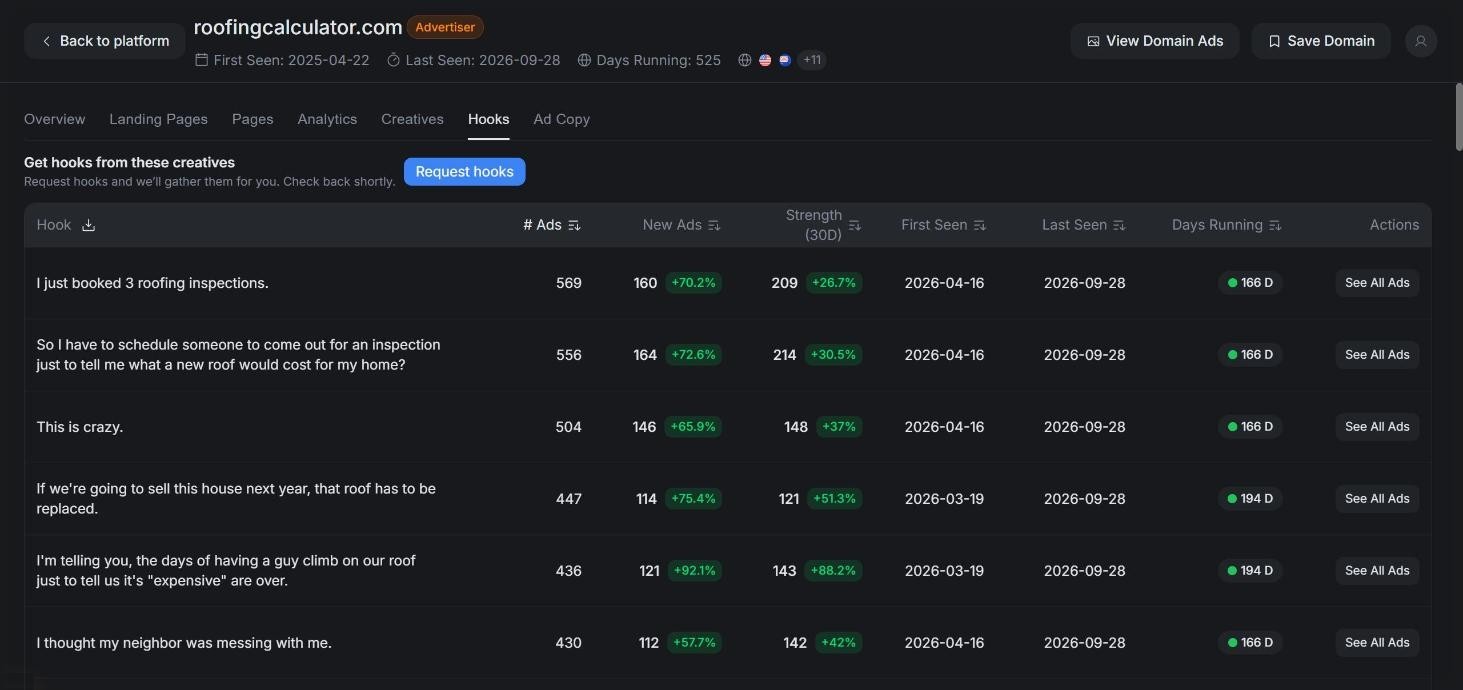
RoofingCalculator.com runs a roofing cost calculator built to collect homeowner leads. It has tried 73 different spoken openings, and instead of settling on one, it keeps about 20 running at the same time, the biggest on roughly 300 to 570 ads each. Among them: "Roofing prices are a joke.", "I just booked 3 roofing inspections.", "I thought my neighbor was messing with me." and "So I have to schedule someone to come out for an inspection just to tell me what a new roof would cost for my home?" The mix covers problem lines and stories, all pointed at the same offer, and the advertiser keeps paying for every one of them, which is the best public sign that each one still works.
On autopolicyguru.com, a car insurance quote site, the hook calls out the exact audience it wants watching: "Alright, ladies, what y'all driving and what y'all paying for car insurance in 2026?" The line runs in four spoken versions with small changes in wording, and together they carried about 1,300 ads between mid-July and late August 2026. Then the push stopped. That is the other half of this story. A winning hook does not run forever. This one had a clear start and a clear end, and the Hooks tab shows both.
App Downloads: SmartyMe
SmartyMe, a learning app that sells through its own web page before sending users to the app store, built its top hook around one moment of curiosity: "Never, and I mean never, ask, 'How was your weekend?'" That opening ran on about 3,500 ads over more than seven months, since late February 2026, and it was still pulling new ads in late September.
The idea worked well enough that the advertiser kept rebuilding it instead of retiring it. The Hooks tab lists 18 different spoken openings built on the same weekend question, from a plain "How was your weekend?" to "If you ask, 'How was your weekend?'", together on more than 5,000 ads. Same idea, many different videos. That is the clearest case in this list of a winning hook getting reused instead of replaced.

Which Hook Type Works Best on Facebook?
None of them, on their own. The examples above use four different approaches, and every one worked. The dentures line is a call-out: it names who it is for, and their problem, in the first sentence. The roofing hooks mix problem lines, such as "Roofing prices are a joke.", with stories, such as "I just booked 3 roofing inspections." The car insurance line is a call-out question that names exactly who should be watching. SmartyMe's weekend line runs on curiosity, an opening that makes you wait for the rest of the sentence.
What these hooks share is not their format. Every winner here names a specific person or a specific situation in the first few seconds, and every winner got rebuilt after it landed: into more ads, more videos, or both. That rebuilding is the real signal. A hook type does not win on its own. The type that works is whichever one your niche's advertisers keep deploying right now.
How Do You Find Winning Hooks in Your Own Niche?
Every hook example in this guide came from the same five-step process, and it takes about 20 minutes to run against your own industry. Open AdPlexity Social and follow the steps in order.
Step 1: Filter to Video Ads in Your Industry
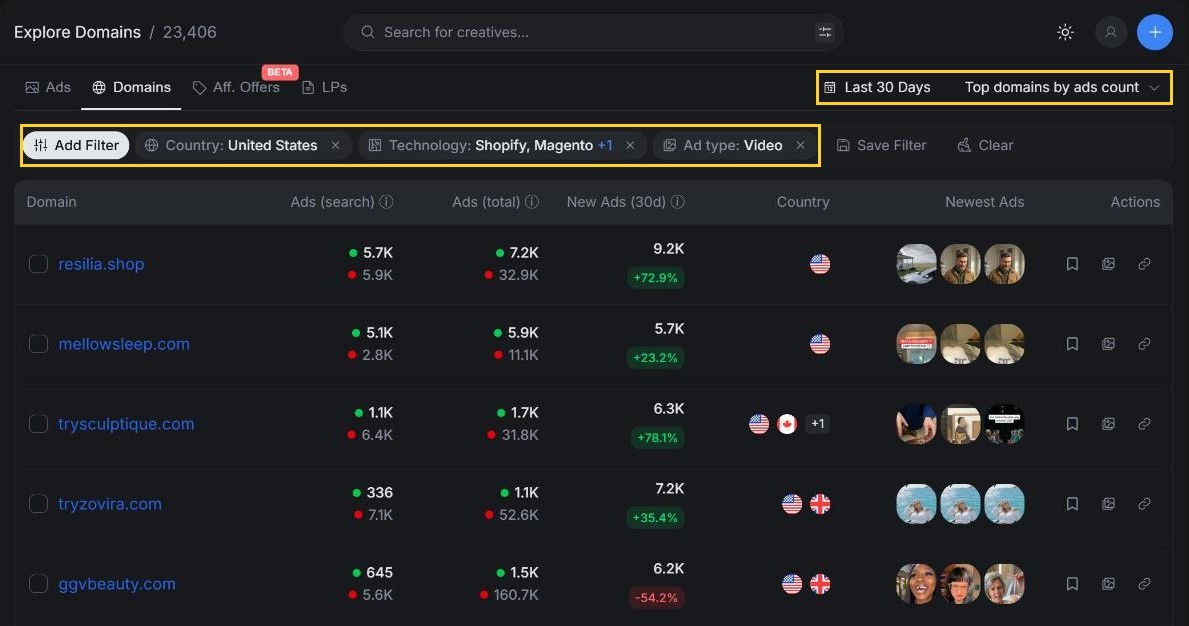
Open Explore and switch to Domains. Set the Ad type filter to Video, choose the Industry that matches your business (or a Vertical, for a narrower niche), pick your Country, and set the date range to Last 30 Days. Sort the results by ads count. In the filter bar, the Industry shows up as its technologies: Ecom, for example, appears as Shopify, Magento and one more. What comes back is a ranked list of the advertisers running the most video ads in your industry right now, a ranking the Meta Ad Library cannot produce since it has no way to sort advertisers by ad volume. After this step you have a short list of names worth opening one at a time.
Step 2: Open the Biggest Advertisers' Hooks Tab
Click into the top name on your list to open its Domain Details page, then select the Hooks tab. Sort by # Ads. If the tab comes back empty, that advertiser has not been processed yet: click "Request hooks" and check back shortly, then move on to the next name while you wait. Once it loads, you have the spoken openings of this advertiser's videos, ranked by how many ads open with each, the same view behind every example earlier in this guide.
Step 3: Read the Numbers Before You Trust a Hook
A long list of openings is not the same as a list of winners. Before you act on any single hook, check what the Hooks tab actually reports for it.
Table C: What the Hooks tab tells you
Column | What it tells you |
|---|---|
# Ads | How many ads have opened with this line in total |
New Ads | How many launched in the last 30 days, and whether that count is climbing or falling |
Days Running | How long the advertiser has kept this opening in rotation |
First Seen | When this hook first went live |
Last Seen | Whether the advertiser is still running it today or has already moved on |
A hook with thousands of ads and New Ads still climbing is being scaled right now. One whose New Ads count has dropped to zero has stopped, no matter how large its lifetime total looks. After this step you can tell the two apart at a glance.
Step 4: Look for the Same Hook in New Videos
Scan the list for openings that say close to the same thing in different words, not just one line repeated ad for ad. SmartyMe's Hooks tab shows this pattern directly: next to "Never, and I mean never, ask, 'How was your weekend?'" you will find "If you ask, 'How was your weekend?'", a plain "How was your weekend?" and more versions of the same question further down the list. One idea, rebuilt into new videos rather than copied as the same clip. That rebuild is the strongest signal on the page: the advertiser trusted the opening enough to build new videos around it. After this step you know which openings in your niche have earned that kind of investment.
Step 5: Save the Winners to a Board
Save every advertiser whose hooks clear the checks above to a Board, straight from its Domain Details page, and keep a note of each hook that passes, not only the single best one. The same habit is worth building whenever you find winning ad creatives in any niche, because a shortlist gives you a ready alternate once today's leader starts to fade. Open those Hooks tabs again in a week: New Ads and Days Running will have moved, and a runner-up today can rank first next week. After this step you have a working shortlist, not a one-time snapshot.
See the hooks your competitors scale. Sign up at adplexity.io and run these same five steps on your own industry. AdPlexity Social indexes more than 100 million Meta ads, with more than 15 million new ones every month.
How Do You Turn a Winning Hook Into Your Own?
Borrow the type and the structure, never the words or the claims. Take the dentures line, "If you need full dentures but can't deal with the endless expensive dentist visits, you need to see this," and strip it to its pattern: "If you need [the outcome] but can't deal with [the painful alternative], you need to see this." Then refill it with your own audience, product and proof. For a meal kit, as an illustration rather than a real ad, it could read "If you want home-cooked dinners but can't deal with the nightly planning, you need to see this."
Write three to five openings for one video body and change only the hook. Judge them by hook rate first, in your own Ads Manager, then by cost per result.
Before you borrow a hook, open the landing page behind the creative and see how it picks up the opening line, because the page has to keep the hook's promise. AdPlexity Social shows the landing page, redirect chain and tech stack behind an ad, which is how you reverse-engineer the landing page behind a competitor's ad.
Never borrow a claim you cannot prove. A copied claim is still yours when Meta reviews the ad.
Borrow the pattern, not the sentence.
Which Hook Mistakes Cost the Most?
The first is copying a hook from a test. A line on plenty of ads does not prove much when First Seen and Last Seen sit only days apart, which is why Step 3 comes before any borrowing.
The second is judging hooks by views or likes. Attention is not a purchase. A provocative opening can pull arguments from people who will never buy.
The third is borrowing across niches. A call-out built for someone shopping for car insurance means nothing to someone who needs dentures, so research inside your own niche and country.
The fourth is changing the hook and the body at once. Now the test cannot tell you which change worked.
Frequently Asked Questions
How long should a Facebook ad hook be?
About three seconds on video: the opening frame, any on-screen text and the first spoken line need to land together. Meta's own research with Nielsen found that up to 47 percent of a video campaign's value landed in the first three seconds. Keep the spoken line short enough to finish inside that window.
What is a good hook rate for Facebook ads?
Hook rate is 3-second video plays divided by impressions. Meta publishes no official benchmark; one 2026 industry guide calls 25 to 35 percent good and below 20 percent weak. You can only see your own hook rate inside your own Ads Manager, so judge a competitor's hook by how many ads open with it and whether new ones are still launching instead.
Do hooks matter for static image ads?
Yes. On an image, the hook is the text printed on the image and the first line of the ad text above it, since there is no opening video frame to carry the message. This guide focuses on video hooks, where the first three seconds do that job instead. The same instinct, naming a problem or calling out an audience in the first words, applies to both formats.
How many hooks should I test for one ad?
Three to five openings on the same video body is common practice: change one thing at a time, then keep the winner. Treat that range as a working habit rather than a rule backed by data.
How long does a winning hook keep working?
As long as advertisers keep deploying it. SmartyMe's weekend hook has run for more than seven months and was still pulling new ads in late September. When a hook's new ads drop to zero, the advertiser has stopped launching it, often a sign of creative fatigue.
How can I find the hooks my competitors are using?
The Meta Ad Library shows them one ad at a time, for free, with no way to rank them. In AdPlexity Social, open the advertiser's Domain Details and go to the Hooks tab. If it is empty, hit "Request hooks" and check back shortly. Once it populates, sort by # Ads to see the openings that advertiser has deployed hardest.
Is it OK to copy a competitor's ad hook?
Borrow the structure and write it in your own words. Never copy claims, trademarks or testimonials, and remember that a word-for-word copy reads as the original brand's ad to anyone who already saw it once.
Conclusion
A hook is the first three seconds a viewer meets: the opening frame, any on-screen text and the first spoken line, working together. The hooks worth studying are not the cleverest ones. They are the ones advertisers keep deploying: the dentures line that opened more than 14,000 ads, RoofingCalculator.com running about 20 openings at once, SmartyMe rebuilding new videos around one weekend hook. Label every hook by type, borrow the pattern rather than the sentence, and test one change at a time.
Sign up at adplexity.io and open the Hooks tab for the biggest video advertisers in your niche.
"If you need full dentures but can't deal with the endless expensive dentist visits, you need to see this." That line opened more than 14,000 ads for ggvbeauty.com, a store that sells silicone dentures, over about six months. This list does not come from memory or view counts. It comes from what advertisers keep paying to run.
If you run video ads on Facebook and want hooks that already work instead of guesses, this guide shows you the openings advertisers scale hardest and how to find them in your own niche in about 20 minutes. By the end, you will be able to:
Spot what a video hook is and where it sits
Read how hard an advertiser is scaling a hook
Find the most-deployed hooks in your own industry
Turn a winning hook into your own without copying it
Key takeaways. A hook is the first three seconds of a Facebook video: the opening frame, any text on screen and the first spoken line. You cannot see a competitor's hook rate or cost per result, but you can see how hard they are scaling a hook, in copies of the same video and in new videos built on the same opening line. AdPlexity Social's Hooks tab adds up that scale per advertiser, from a denture brand running one line on thousands of ads to a learning app rebuilding its best opening into new videos for months. Filter to your own industry and you can find the openings your competitors are scaling hardest in about 20 minutes, then borrow the pattern instead of the sentence.
Table of Contents
What Is a Hook in a Facebook Ad?
What Are the Main Types of Facebook Ad Hooks?
How Can You Tell a Hook Is Actually Winning?
What Are the Best Facebook Ad Hook Examples Right Now?
Which Hook Type Works Best on Facebook?
How Do You Find Winning Hooks in Your Own Niche?
How Do You Turn a Winning Hook Into Your Own?
Which Hook Mistakes Cost the Most?
Frequently Asked Questions
Conclusion
What Is a Hook in a Facebook Ad?
On a Facebook video ad, the hook is the first three seconds: the opening frame, any text on screen and the first spoken line, all working together. Meta's own research with Nielsen found that up to 47 percent of a video campaign's value landed in those first three seconds, and up to 74 percent landed in the first ten.
Image ads carry a version of the same thing: the text on the image and the first line of ad text above it. That gets its own answer in the FAQ. This guide is about video, and its examples are the spoken first lines.
The hook is the first three seconds.
What Are the Main Types of Facebook Ad Hooks?
Eight types cover most hook openings. If a hook fits none of them, call it Other.
Table A: Eight hook types and how to spot them
Type (also called) | What the opening does | How to spot it | Pattern (a template, not a real ad) |
|---|---|---|---|
Offer (price or discount hook) | Leads with a price, discount, sale, bundle or free shipping | The first number is a price or a percentage | "[Discount] off [product] this week" |
Call-out (direct address) | Names who the ad is for | The first words name a group, role, place or situation | "[Audience]: [what changes for them]" |
Problem (pain point) | Names a frustration | The first clause is the problem | "Still [annoying thing]?" |
Social proof (testimonial, reviews) | Opens with other people's verdict | A customer count, rating, review, press line or creator reaction comes first | "[Who] on why they switched" |
Demonstration (demo, before and after, unboxing) | Shows the product working | The first frame carries the hook, with no line or a line that narrates it | "Watch [product] [do the job]" |
Story (confessional) | Opens in the first person | "I", "my" or "we" in the first words | "I stopped [old habit] when..." |
Bold claim (result, news, first) | States an outcome or something new as fact | A promise or an announcement | "The first [product] that [does X]" |
Curiosity (curiosity gap) | Holds back the answer | The line only makes sense if you keep going | "The reason your [thing] keeps [doing X]" |
Tag each hook by its first words, spoken or on screen. When two types fit, the higher row in the table wins, and every hook gets exactly one type.
"Question hooks" top most hook lists, but a question is not its own type. "Tired of...?" is a problem hook. "Dog owners, is your...?" is a call-out. "Why does your...?" is curiosity.
A question is a format, not a hook type.
How Can You Tell a Hook Is Actually Winning?
Nobody outside the account sees hook rate or cost per result. Those numbers stay inside the advertiser's own Ads Manager.
What you can see is what the advertiser does: how many ads open with the same line, whether new ones are still launching, and how long it has run. A winning hook gets deployed heavily: copies of the same video, and new videos built on the same opening.
In AdPlexity Social, the Hooks tab adds this up per advertiser. It sits on each advertiser's Domain Details page, groups the advertiser's video ads by the spoken opening line, and shows how many ads use each one, how many are new, and how long each has run. Sort by ad count and the openings the advertiser deployed hardest rise to the top.
A winning hook is one the advertiser keeps paying to show.
What Are the Best Facebook Ad Hook Examples Right Now?
These are the spoken openings advertisers deployed hardest, one industry at a time.
How we picked these. We filtered Explore to Domains, United States, last 30 days, video ads only, split by Industry (Ecom, Lead gen, App Downloads), and sorted each list by ad count. Then we opened the biggest advertisers in each group and sorted their Hooks tabs by # Ads.
Table B: The most-deployed hooks at a glance
Industry | Advertiser | The spoken hook | Ads that open with it | Still launching? |
|---|---|---|---|---|
Ecom | ggvbeauty.com | "If you need full dentures but can't deal with the endless expensive dentist visits..." | More than 14,000 | No, ended early September |
Lead gen | RoofingCalculator.com | "Roofing prices are a joke." (one of about 20 still running) | About 390 | Yes |
Lead gen | autopolicyguru.com | "Alright, ladies, what y'all driving and what y'all paying for car insurance in 2026?" | About 1,300 (four versions) | No, ended late August |
App Downloads | SmartyMe | "Never, and I mean never, ask, 'How was your weekend?'" | About 3,500 | Yes |
Every hook below ran on hundreds or thousands of ads.
Ecom: A Dentures Store (ggvbeauty.com)
The store ggvbeauty.com sells silicone dentures and advertises almost entirely with video, and its top hook names the buyer's problem in one sentence: "If you need full dentures but can't deal with the endless expensive dentist visits, you need to see this." That is a call-out, aimed straight at someone who needs dentures and dreads what the next dentist visit will cost. More than 14,000 ads opened with this line, over about six months, from late February to early September 2026.
This was not one lucky video. The store found several hooks that worked and pushed each one hard. Three more openings ran alongside this one: a testimonial line, a refund guarantee, and a line about summer ending, each carrying thousands of ads of its own. The dentures line is simply the biggest, and it names the buyer's situation before it asks for anything.
Lead Gen: RoofingCalculator.com and autopolicyguru.com
RoofingCalculator.com runs a roofing cost calculator built to collect homeowner leads. It has tried 73 different spoken openings, and instead of settling on one, it keeps about 20 running at the same time, the biggest on roughly 300 to 570 ads each. Among them: "Roofing prices are a joke.", "I just booked 3 roofing inspections.", "I thought my neighbor was messing with me." and "So I have to schedule someone to come out for an inspection just to tell me what a new roof would cost for my home?" The mix covers problem lines and stories, all pointed at the same offer, and the advertiser keeps paying for every one of them, which is the best public sign that each one still works.
On autopolicyguru.com, a car insurance quote site, the hook calls out the exact audience it wants watching: "Alright, ladies, what y'all driving and what y'all paying for car insurance in 2026?" The line runs in four spoken versions with small changes in wording, and together they carried about 1,300 ads between mid-July and late August 2026. Then the push stopped. That is the other half of this story. A winning hook does not run forever. This one had a clear start and a clear end, and the Hooks tab shows both.
App Downloads: SmartyMe
SmartyMe, a learning app that sells through its own web page before sending users to the app store, built its top hook around one moment of curiosity: "Never, and I mean never, ask, 'How was your weekend?'" That opening ran on about 3,500 ads over more than seven months, since late February 2026, and it was still pulling new ads in late September.
The idea worked well enough that the advertiser kept rebuilding it instead of retiring it. The Hooks tab lists 18 different spoken openings built on the same weekend question, from a plain "How was your weekend?" to "If you ask, 'How was your weekend?'", together on more than 5,000 ads. Same idea, many different videos. That is the clearest case in this list of a winning hook getting reused instead of replaced.
Which Hook Type Works Best on Facebook?
None of them, on their own. The examples above use four different approaches, and every one worked. The dentures line is a call-out: it names who it is for, and their problem, in the first sentence. The roofing hooks mix problem lines, such as "Roofing prices are a joke.", with stories, such as "I just booked 3 roofing inspections." The car insurance line is a call-out question that names exactly who should be watching. SmartyMe's weekend line runs on curiosity, an opening that makes you wait for the rest of the sentence.
What these hooks share is not their format. Every winner here names a specific person or a specific situation in the first few seconds, and every winner got rebuilt after it landed: into more ads, more videos, or both. That rebuilding is the real signal. A hook type does not win on its own. The type that works is whichever one your niche's advertisers keep deploying right now.
How Do You Find Winning Hooks in Your Own Niche?
Every hook example in this guide came from the same five-step process, and it takes about 20 minutes to run against your own industry. Open AdPlexity Social and follow the steps in order.
Step 1: Filter to Video Ads in Your Industry
Open Explore and switch to Domains. Set the Ad type filter to Video, choose the Industry that matches your business (or a Vertical, for a narrower niche), pick your Country, and set the date range to Last 30 Days. Sort the results by ads count. In the filter bar, the Industry shows up as its technologies: Ecom, for example, appears as Shopify, Magento and one more. What comes back is a ranked list of the advertisers running the most video ads in your industry right now, a ranking the Meta Ad Library cannot produce since it has no way to sort advertisers by ad volume. After this step you have a short list of names worth opening one at a time.
Step 2: Open the Biggest Advertisers' Hooks Tab
Click into the top name on your list to open its Domain Details page, then select the Hooks tab. Sort by # Ads. If the tab comes back empty, that advertiser has not been processed yet: click "Request hooks" and check back shortly, then move on to the next name while you wait. Once it loads, you have the spoken openings of this advertiser's videos, ranked by how many ads open with each, the same view behind every example earlier in this guide.
Step 3: Read the Numbers Before You Trust a Hook
A long list of openings is not the same as a list of winners. Before you act on any single hook, check what the Hooks tab actually reports for it.
Table C: What the Hooks tab tells you
Column | What it tells you |
|---|---|
# Ads | How many ads have opened with this line in total |
New Ads | How many launched in the last 30 days, and whether that count is climbing or falling |
Days Running | How long the advertiser has kept this opening in rotation |
First Seen | When this hook first went live |
Last Seen | Whether the advertiser is still running it today or has already moved on |
A hook with thousands of ads and New Ads still climbing is being scaled right now. One whose New Ads count has dropped to zero has stopped, no matter how large its lifetime total looks. After this step you can tell the two apart at a glance.
Step 4: Look for the Same Hook in New Videos
Scan the list for openings that say close to the same thing in different words, not just one line repeated ad for ad. SmartyMe's Hooks tab shows this pattern directly: next to "Never, and I mean never, ask, 'How was your weekend?'" you will find "If you ask, 'How was your weekend?'", a plain "How was your weekend?" and more versions of the same question further down the list. One idea, rebuilt into new videos rather than copied as the same clip. That rebuild is the strongest signal on the page: the advertiser trusted the opening enough to build new videos around it. After this step you know which openings in your niche have earned that kind of investment.
Step 5: Save the Winners to a Board
Save every advertiser whose hooks clear the checks above to a Board, straight from its Domain Details page, and keep a note of each hook that passes, not only the single best one. The same habit is worth building whenever you find winning ad creatives in any niche, because a shortlist gives you a ready alternate once today's leader starts to fade. Open those Hooks tabs again in a week: New Ads and Days Running will have moved, and a runner-up today can rank first next week. After this step you have a working shortlist, not a one-time snapshot.
See the hooks your competitors scale. Sign up at adplexity.io and run these same five steps on your own industry. AdPlexity Social indexes more than 100 million Meta ads, with more than 15 million new ones every month.
How Do You Turn a Winning Hook Into Your Own?
Borrow the type and the structure, never the words or the claims. Take the dentures line, "If you need full dentures but can't deal with the endless expensive dentist visits, you need to see this," and strip it to its pattern: "If you need [the outcome] but can't deal with [the painful alternative], you need to see this." Then refill it with your own audience, product and proof. For a meal kit, as an illustration rather than a real ad, it could read "If you want home-cooked dinners but can't deal with the nightly planning, you need to see this."
Write three to five openings for one video body and change only the hook. Judge them by hook rate first, in your own Ads Manager, then by cost per result.
Before you borrow a hook, open the landing page behind the creative and see how it picks up the opening line, because the page has to keep the hook's promise. AdPlexity Social shows the landing page, redirect chain and tech stack behind an ad, which is how you reverse-engineer the landing page behind a competitor's ad.
Never borrow a claim you cannot prove. A copied claim is still yours when Meta reviews the ad.
Borrow the pattern, not the sentence.
Which Hook Mistakes Cost the Most?
The first is copying a hook from a test. A line on plenty of ads does not prove much when First Seen and Last Seen sit only days apart, which is why Step 3 comes before any borrowing.
The second is judging hooks by views or likes. Attention is not a purchase. A provocative opening can pull arguments from people who will never buy.
The third is borrowing across niches. A call-out built for someone shopping for car insurance means nothing to someone who needs dentures, so research inside your own niche and country.
The fourth is changing the hook and the body at once. Now the test cannot tell you which change worked.
Frequently Asked Questions
How long should a Facebook ad hook be?
About three seconds on video: the opening frame, any on-screen text and the first spoken line need to land together. Meta's own research with Nielsen found that up to 47 percent of a video campaign's value landed in the first three seconds. Keep the spoken line short enough to finish inside that window.
What is a good hook rate for Facebook ads?
Hook rate is 3-second video plays divided by impressions. Meta publishes no official benchmark; one 2026 industry guide calls 25 to 35 percent good and below 20 percent weak. You can only see your own hook rate inside your own Ads Manager, so judge a competitor's hook by how many ads open with it and whether new ones are still launching instead.
Do hooks matter for static image ads?
Yes. On an image, the hook is the text printed on the image and the first line of the ad text above it, since there is no opening video frame to carry the message. This guide focuses on video hooks, where the first three seconds do that job instead. The same instinct, naming a problem or calling out an audience in the first words, applies to both formats.
How many hooks should I test for one ad?
Three to five openings on the same video body is common practice: change one thing at a time, then keep the winner. Treat that range as a working habit rather than a rule backed by data.
How long does a winning hook keep working?
As long as advertisers keep deploying it. SmartyMe's weekend hook has run for more than seven months and was still pulling new ads in late September. When a hook's new ads drop to zero, the advertiser has stopped launching it, often a sign of creative fatigue.
How can I find the hooks my competitors are using?
The Meta Ad Library shows them one ad at a time, for free, with no way to rank them. In AdPlexity Social, open the advertiser's Domain Details and go to the Hooks tab. If it is empty, hit "Request hooks" and check back shortly. Once it populates, sort by # Ads to see the openings that advertiser has deployed hardest.
Is it OK to copy a competitor's ad hook?
Borrow the structure and write it in your own words. Never copy claims, trademarks or testimonials, and remember that a word-for-word copy reads as the original brand's ad to anyone who already saw it once.
Conclusion
A hook is the first three seconds a viewer meets: the opening frame, any on-screen text and the first spoken line, working together. The hooks worth studying are not the cleverest ones. They are the ones advertisers keep deploying: the dentures line that opened more than 14,000 ads, RoofingCalculator.com running about 20 openings at once, SmartyMe rebuilding new videos around one weekend hook. Label every hook by type, borrow the pattern rather than the sentence, and test one change at a time.
Sign up at adplexity.io and open the Hooks tab for the biggest video advertisers in your niche.
Table of Contents
Quickly navigate through the key sections of this article.
Discover Winning Meta Ads
Similar Blogs
Check related blogs
Check related blogs
Check related blogs







Ready to See What’s Really Working on Meta?
Adplexity
Social
© Copyright 2026 All Rights Reserved
Ready to See What’s Really Working on Meta?
Adplexity
Social
© Copyright 2026 All Rights Reserved
Ready to See What’s Really Working on Meta?
Adplexity
Social
© Copyright 2026 All Rights Reserved