Three months ago, we pulled the first real numbers on the VSL space using the VTurb filter. The dataset was around 400,000 ads. Weight loss owned the space. The biggest single operator was running an apple cider vinegar creative across 59,000 ads.
We pulled the same view this week. The numbers do not look like the same market.
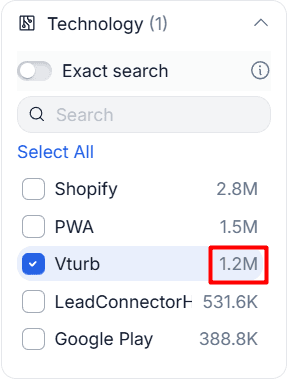
There are now 1.2 million VTurb-tagged ads indexed in the last 30 days alone. That is roughly three times the volume in 90 days. Weight loss is no longer the dominant vertical. Brain health and ED have taken its spot. And the operators winning right now are not running a few hundred ads. They are running through more than a thousand fan pages at once.
If you are in the VSL space, or you are thinking about getting in, the playbook from February still works. But the leaderboard has changed, and the infrastructure required to compete has gone up.
Here is what the data shows.
Watch video:
Key takeaways
The VSL space on Meta has roughly tripled in 90 days. Brain health and ED are now running at a higher volume than weight loss for the first time in our data. Image creatives outnumber video by almost 2:1 in this space, and the reason is structural rather than stylistic. The top operators are launching tens of thousands of new ads per month from a single domain, which is only possible with agency ad account infrastructure. The standout new capability for tracking this is Boards, which lets you save ads, domains, and pages into one place and monitor them as a competitor set.
If you want the full breakdown of how the VTurb filter works as a VSL signal, the February piece covers the foundation. This post focuses on what has changed since.
The market tripled and most operators have not noticed
The headline number is 1.2 million VSL-tagged ads in 30 days. To put that in context, the entire dataset on this filter was around 400,000 ads in February. That is not a market that is maturing. That is a market that is still in the middle of its run.
If you switch to the active filter and only look at ads currently running, the number drops to 315,000 active ads right now. That is not historical data. That is what is in the feed today.
A market this active is doing two things at once. It is rewarding operators who can launch volume, and it is generating enough signal in the data that you do not have to guess what is working. The volume itself tells you.
The vertical shift nobody is talking about yet
In February, weight loss was the single largest VSL vertical, with more than 130,000 ads tagged. It was not close.
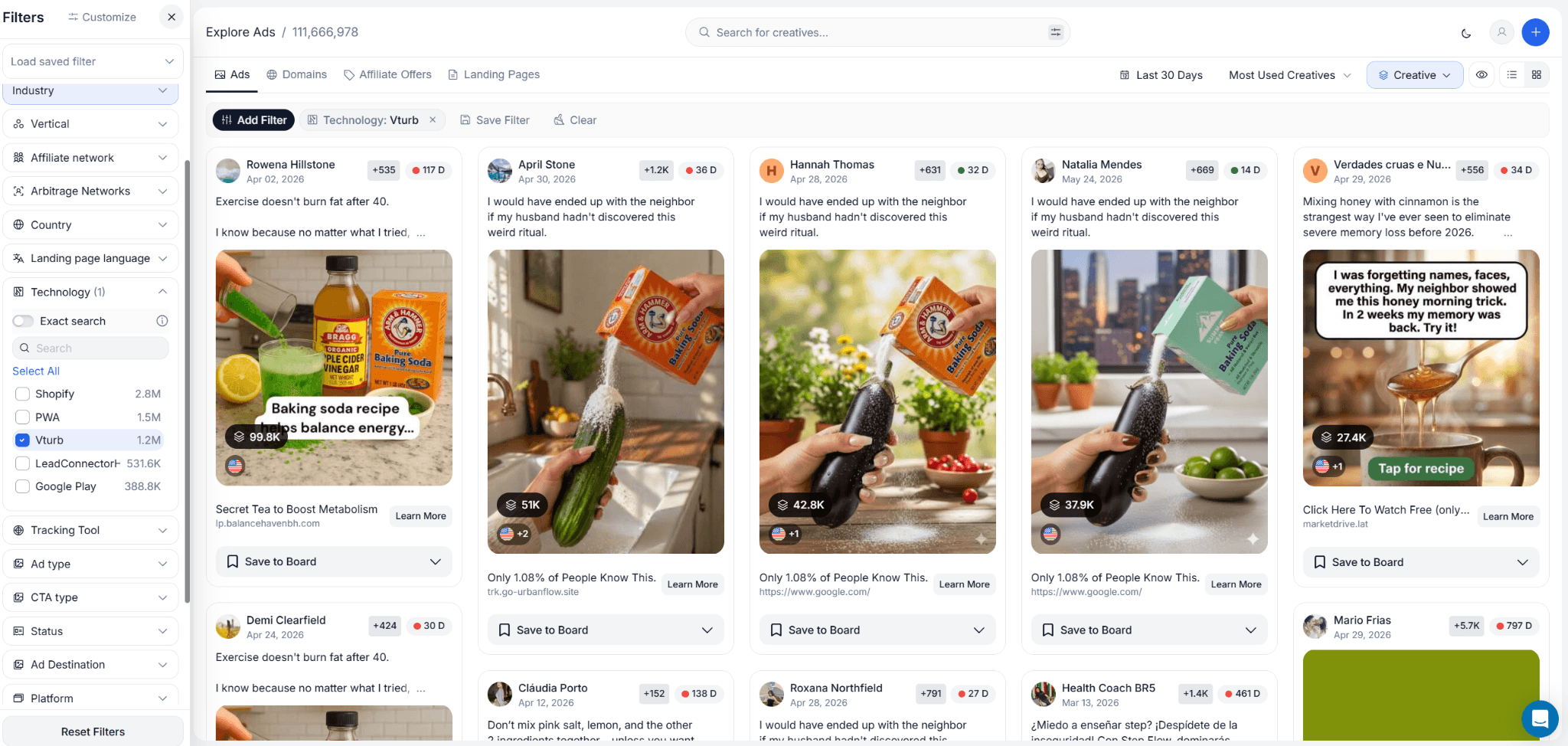
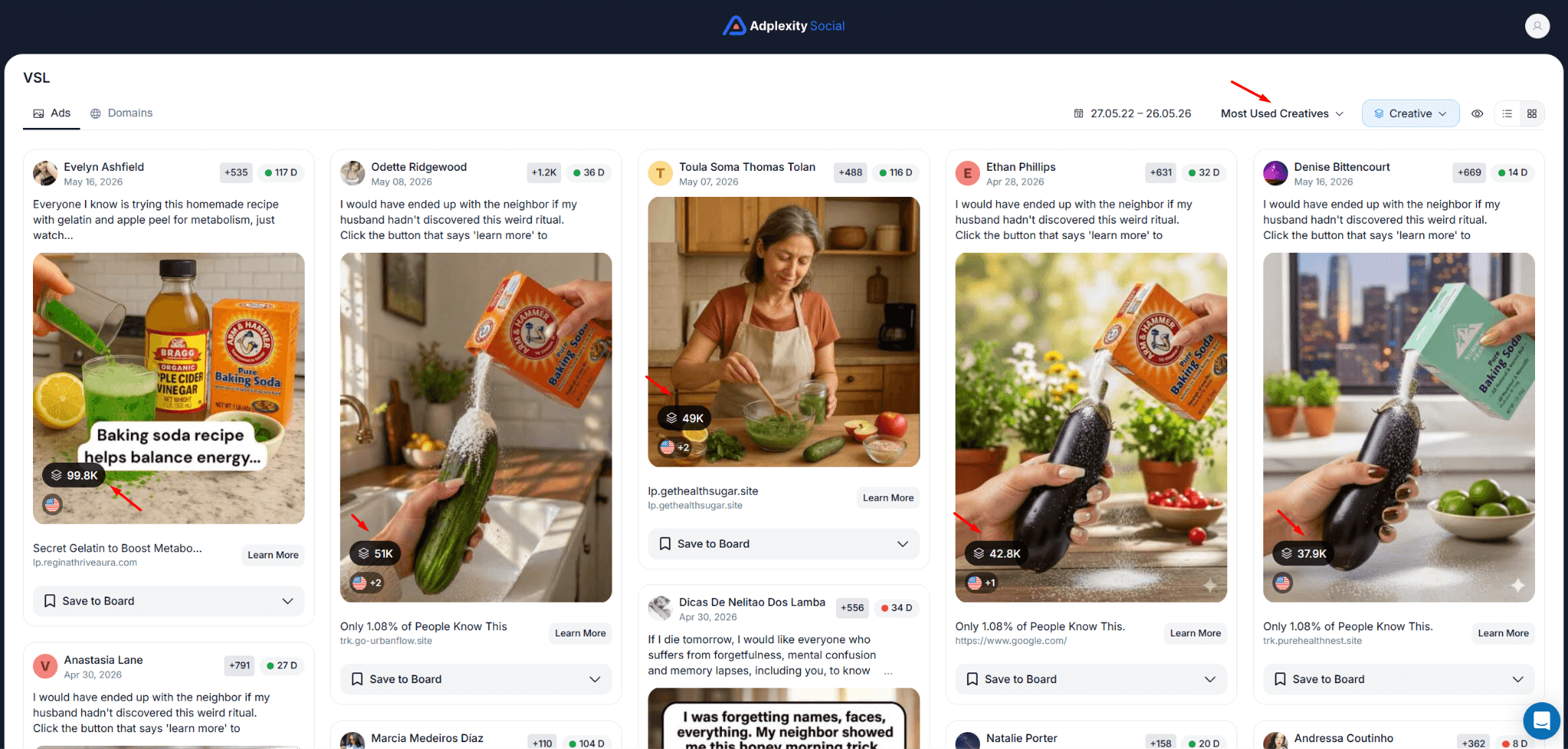
That has changed. Pulling the most-used creatives in the VSL space this week, the top angles are dominated by two verticals.
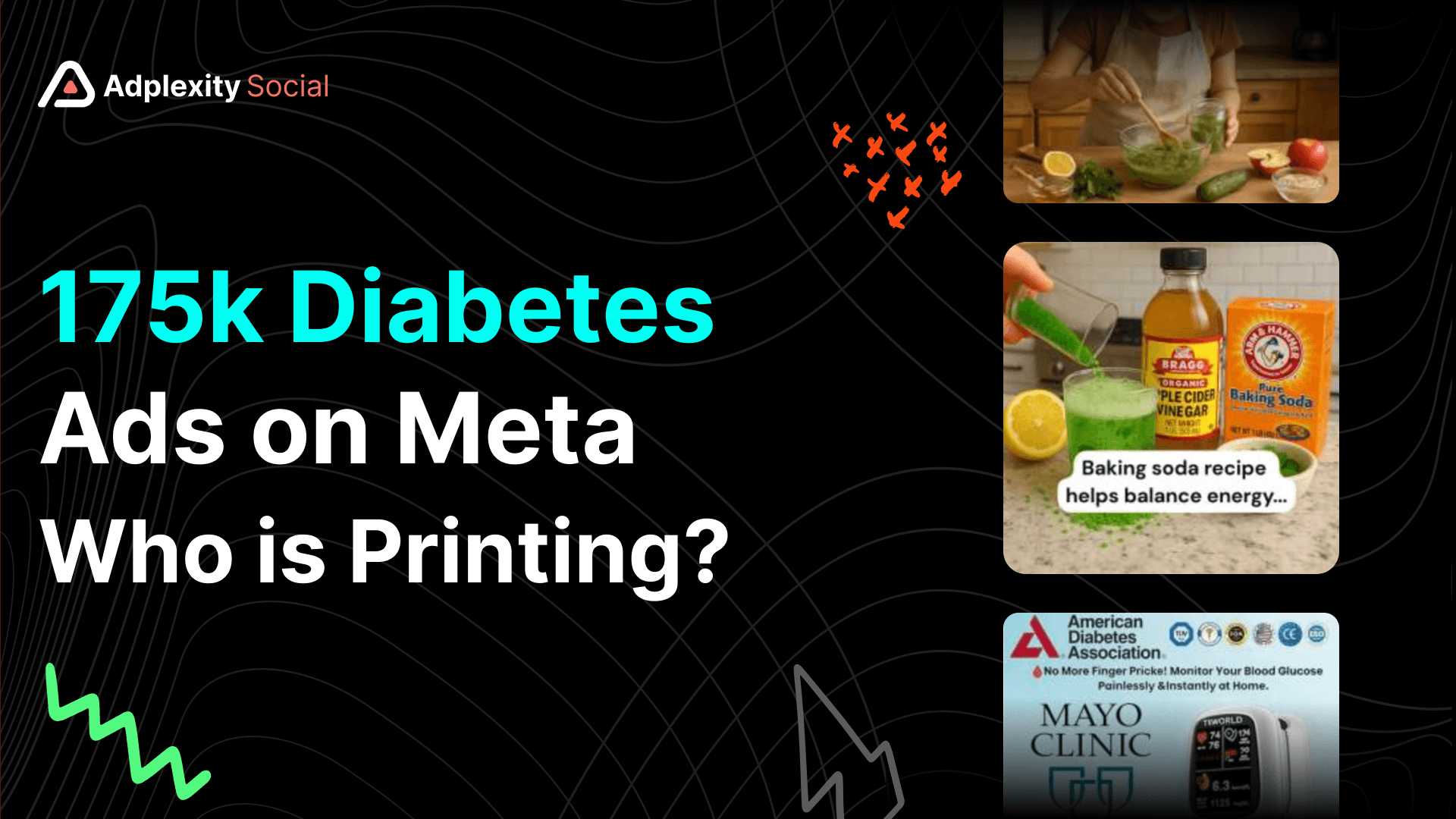
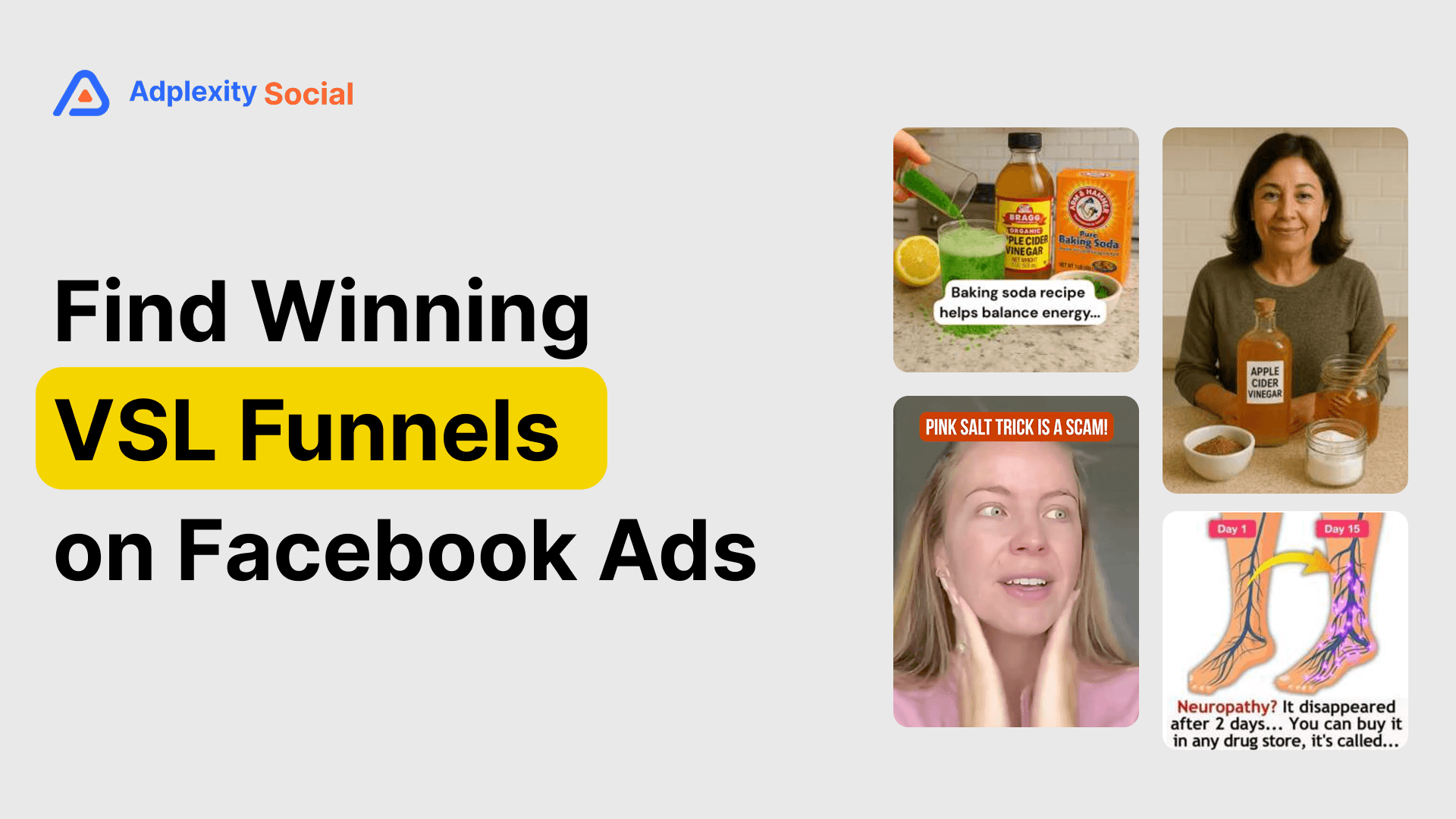
The honey-and-cucumber-and-baking-soda creatives are everywhere. Those are running brain health offers, mostly Alzheimer's and dementia angles. The thumbnails look almost identical at first glance, but the variations are deliberately tiny. One creative will have slightly more baking soda powder visible than the next. That is how granular the testing is.
The other angle running at a massive scale right now is ED. Different visual approach, similar funnel structure, similar VSL length.
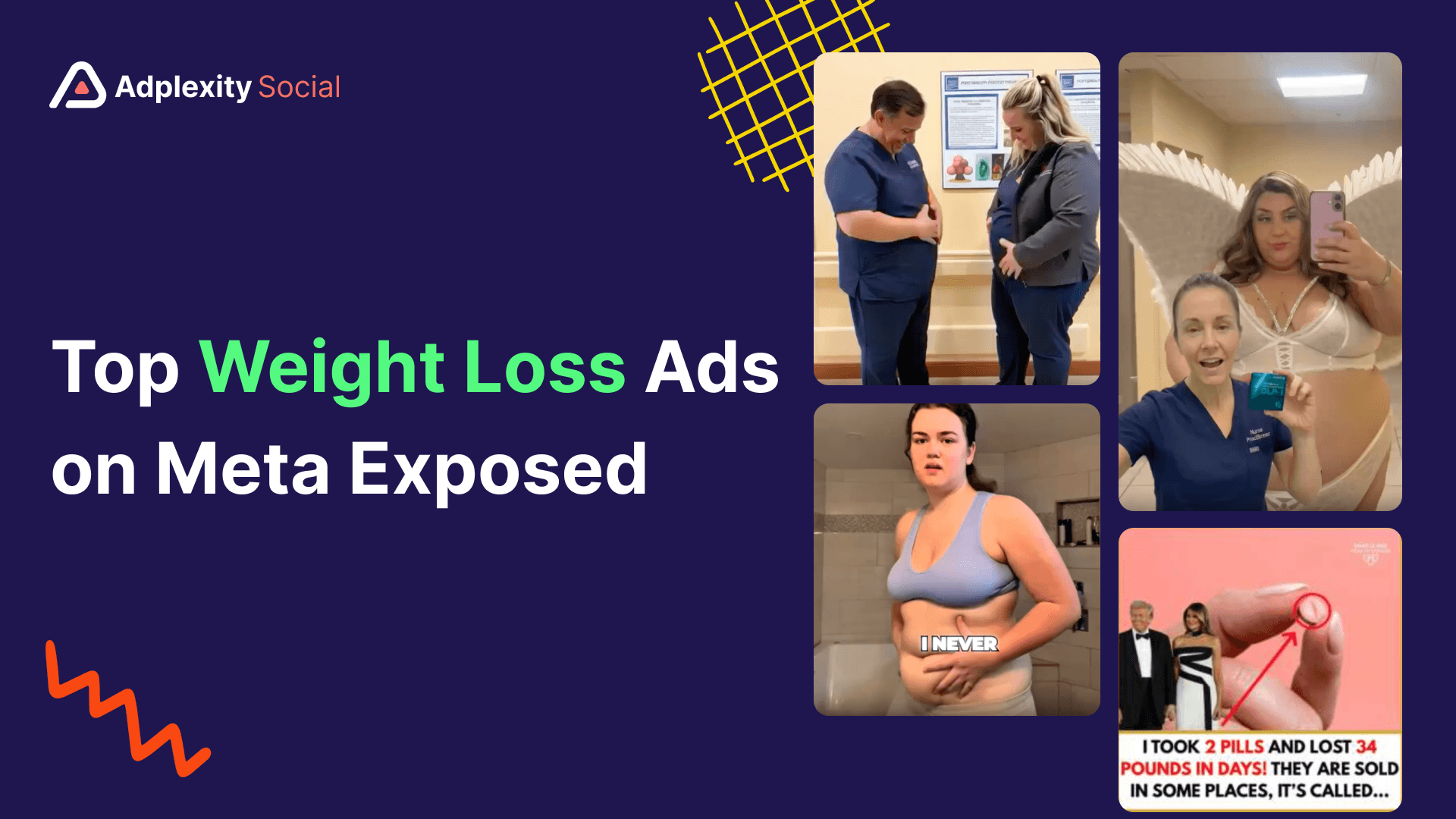
Weight loss has not disappeared. But it has visibly lost share to brain health and ED in the top creatives view. If you had to bet on which verticals are absorbing the most aggressive media buying right now, it is those two.
Why does this matter? Because if you are building creatives, the angles that are dominating the most-used view are the ones being scaled hardest. They are not necessarily the best angles to copy directly. But they are the ones being validated with the highest spend.
Image ads beat video by almost 2:1 (and the reason is structural)
When you filter the VSL space by ad type, the split is striking. Around 756,000 image ads versus roughly half that in video. In a space defined by long-form video sales letters, the ads themselves are mostly static images.
This is not a creative preference. It is a funnel design choice.
The VSL is doing the heavy conversion work. The ad is not trying to qualify the user or close them. It is doing one job: getting a curious click. A static image with a punchy headline does that job for a lower CPM than video, and it does not need to compete with the VSL for the viewer's attention.
If you have been trying to make every Facebook ad in the VSL space a polished video, this is worth thinking about. The operators running at scale are not. They are using image ads as the cheapest possible attention grab, and letting the VSL handle qualification and conversion.
The fan page count is the real signal
This is the data point that changes how you think about the VSL space.
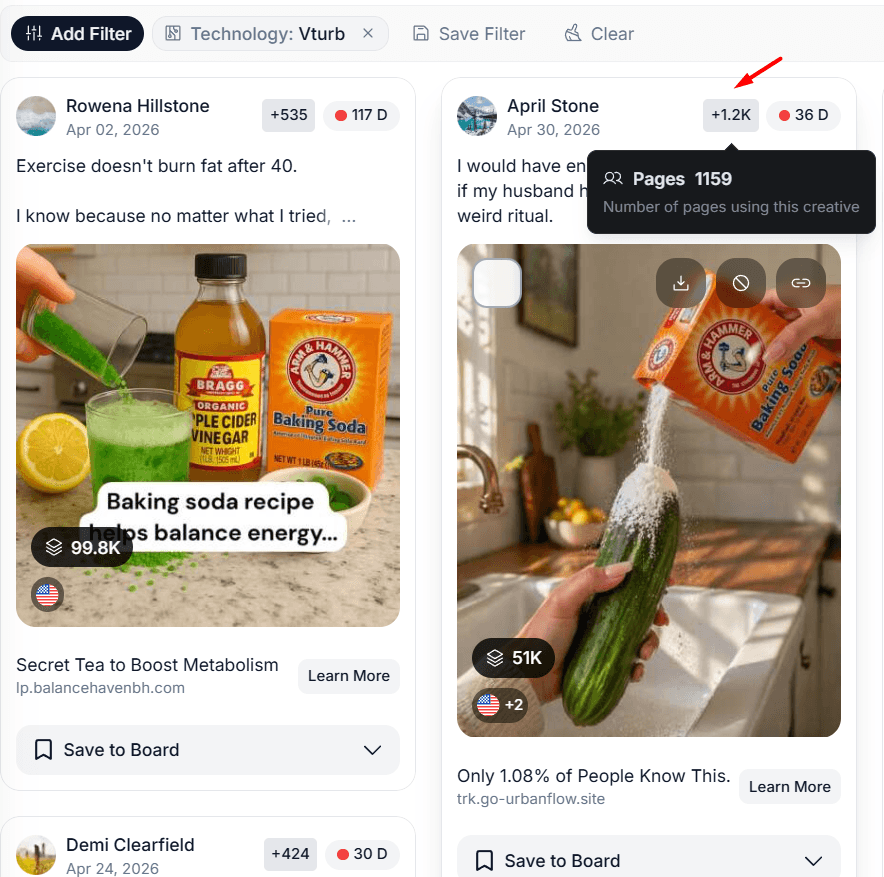
Take the top brain health creative running right now. One image. Almost 100,000 ads using it. That alone is impressive. But the part that matters is how those ads are distributed: over 1,100 different fan pages are deploying that single creative.
That is not one operator running a successful creative. That is one operator running it across more than a thousand ad accounts.
There is only one way that infrastructure exists. You cannot do it with personal ad accounts. You cannot do it with one business manager. The only way you run a single creative across 1,000+ fan pages is with agency ad accounts, at scale, on multiple billing rails, with the team and the spend to keep them all live.
This is why the top VSL operators are functionally inaccessible to a solo affiliate. The creative angle is copyable. The VSL script is reverse-engineerable. The funnel structure is observable. But the ad account infrastructure is the actual moat.
Domains are launching 100,000 ads in 30 days
If the creative-level view shows you what is working, the domain view shows you who is doing it.
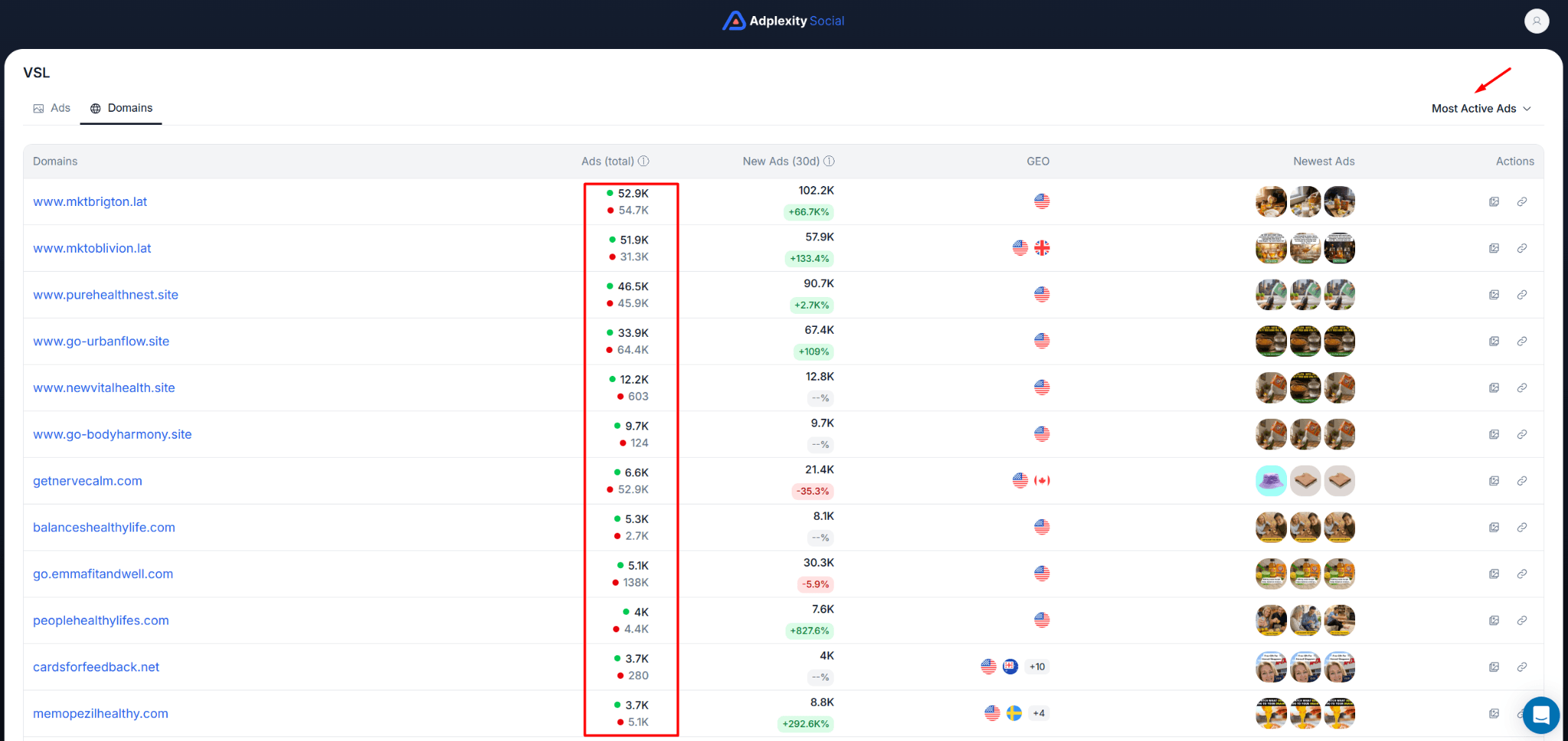
Switch from ads to domains, keep the VTurb filter on, and sort by new ads in the last 30 days. The numbers at the top of that list look almost made up.
One domain went from less than 1,000 ads in the previous 30 days to over 100,000 in the most recent 30. Another moved from 18 to 82,000. These are not gradual scaling curves. These are operators flipping from testing into full scale, and doing it fast.
The period-over-period comparison column is the part to pay attention to. A domain showing a massive percentage increase in new ads is one that has just found a winning angle and is pouring fuel on it. A domain with steady or declining numbers has probably moved on or burned out.
If you are doing competitive research in this space, sorting by new ads rather than total ads is what surfaces the operators who are scaling right now. Total ads includes everything historical. New ads only counts the present.
Then click into the domain, and you get the full picture. Which landing pages they are sending traffic to, which creatives they are leaning on, which verticals they are running, and which countries they are buying in. You can read the entire operation from one screen.
Boards: how to actually track all of this without losing it
This is new since February.
When you find a domain, a creative, or a fan page that matters, you can save it to a Board. Boards group ads, domains, and pages together inside a folder you control. So a "VSL" board might contain the top ten domains scaling right now, the creatives you want your team to riff on, and the pages worth watching for new launches.
You can share a board via a public URL, with control over which element types are visible. So you can hand a board to a creative team showing only the ads, or hand one to a research partner showing only the domains.
For VSL research specifically, this is the workflow shift. Instead of pulling up the platform every day and rebuilding the same search, you maintain a board of the operators that matter and let the data update underneath you. New ads from those domains show up in the board automatically.
To save you the setup, here is the actual VSL Board we built while researching this article:View the VSL Board. It includes the top VSL domains scaling right now and the creatives leading the brain health, ED, and weight loss verticals. Open it, browse the ads and domains directly, or use it as a starting point for your own board.
Pro tips for VSL research right now
A few things that separate people who get value out of this data from people who scroll past it.
Sort by most-used creatives, not by newest. Newest is interesting for spotting trends but noisy. Most-used surfaces the creatives that have already been validated by the operators with the biggest budgets. That is the signal that matters when you are building.
Use the active filter when you want present-tense data. A creative with 47,000 historical ads but zero active is a creative that has stopped converting. A creative with 5,000 ads and 4,000 of them active is a different story. The active filter cuts out the past.
Read the redirect chains, not just the landing pages. The redirect chain is where you find out which affiliate network is behind the offer, which tracking tools the operator is using, and where the traffic actually ends up. Sometimes the landing page is a prelander, and the real offer is one hop deeper. The redirect chain is what shows you that.
If you want to run at the same scale, you need agency ad account infrastructure. This is the part most affiliates underestimate. The top VSL operators are not running on personal Facebook accounts. They are running on hundreds or thousands of accounts at once. If you are serious about scaling VSL offers and need that kind of infrastructure, Buumerang Agency specializes in agency ad accounts for affiliates running VSLs. That is the kind of partner you need on the infrastructure side before the rest of the playbook is worth executing.
Keep an eye on the period-over-period column. Domains with triple-digit percentage growth in new ads are the ones with momentum. That is where the smart competitive research time goes.
What is coming next
The affiliate offer dimension is in testing right now with a small group of users. When it ships, it will let you look at a single offer (a ClickBank product, a BuyGoods offer, a Digistore product) and see every advertiser, every page, every creative, and every landing page pointing at that offer.
For VSL research, this is the missing layer. Today, you can trace a redirect chain from one domain to one offer. Soon, you will be able to start from the offer and see the entire ecosystem of operators promoting it. That changes how affiliate competitive research works.
We will cover it properly when it goes live.
FAQs: VSL ads on Meta in 2026
What is a VSL funnel on Facebook?
A VSL (video sales letter) funnel on Facebook is a paid traffic setup where a Meta ad sends users to a landing page hosting a long-form video, usually 15 minutes or longer, that walks the viewer through a problem-agitation-solution narrative before revealing the offer at the end. The ads themselves are often static images designed to spark curiosity, with the VSL doing the qualification and conversion work.
How can I find which VSL ads are working on Facebook right now?
The fastest way is to filter Meta ad data by a technology signal that VSL pages use, then sort by the number of ads using a given creative. In AdPlexity Social, the VTurb tech stack filter surfaces over 1.2 million VSL ads from the last 30 days alone. Sorting by most-used creatives shows the ones that have been validated by the operators spending the most. Layering the active filter on top narrows it to creatives running right now.
Why are most Facebook VSL ads images instead of videos?
Because the VSL itself is doing the heavy conversion work. The ad only needs to spark a click. A static image with a curiosity-driven headline performs that job at lower CPM than a video, and it does not compete with the VSL for the viewer's attention later in the funnel. In current data, image ads in the VSL space outnumber video ads by nearly 2:1.
Which verticals are running the most VSL ads on Meta right now?
Brain health and ED are currently running at higher volume than weight loss in the VSL space, which is a notable shift from earlier in 2026. Brain health angles often use food-based curiosity hooks like honey, cucumber, or baking soda to lead into Alzheimer's or dementia VSLs. ED angles use a different visual approach but follow similar funnel structures. Weight loss is still active, but has lost relative share.
How do operators run a single VSL creative across thousands of fan pages?
They use agency ad accounts. Running one creative across 1,000+ fan pages is not possible with personal accounts or a single business manager. It requires hundreds or thousands of ad accounts on multiple billing rails, which is what specialist agency account providers exist to supply. This infrastructure is the real competitive moat in the VSL space, not the creative itself.
Do I need a paid tool to find VSL ads on Facebook?
You can find some VSL ads through the Facebook Ad Library, but you will not be able to filter by the underlying technology stack (like VTurb), sort by ad volume, see fan page distribution counts, trace redirect chains to the offer, or compare advertiser activity period-over-period. Those are the data points that actually surface scaling operators, and they require a tool with deeper indexing than the free Ad Library offers.
How long does the typical VSL on Facebook run before the call-to-action?
Most VSLs running on Meta right now are 15 minutes or longer, and they gate the call-to-action until the viewer has watched the majority of the video. This is a deliberate choice. Operators have tested shorter formats and consistently found that long-form converts better in health and supplement verticals, even though it requires more attention from the viewer to qualify.
Which countries are running the most VSL ads on Meta?
The US is the largest market by a wide margin. Canada and Brazil round out the top three. Brazil is the surprise in the data because it ranks higher for VSL specifically than it does for most other ad categories on Meta, suggesting Brazilian operators are running VSL funnels aggressively and that US operators may be expanding there to find lower-competition inventory.
The bottom line
The VSL space on Meta is bigger, faster, and more concentrated than it was three months ago. The operators winning right now are not winning because of creative genius. They are winning because they have built infrastructure capable of running a single proven creative across more than a thousand fan pages, and because they have the discipline to keep feeding traffic to a VSL that converts.
The data to see all of this exists. The VTurb filter surfaces 1.2 million VSL ads in 30 days. The most-used creatives view tells you which angles are being scaled. The domain view tells you who is doing the scaling. Boards lets you keep all of it organized as a live competitor set.
If you want a head start, the VSL Board we built for this article is shared publicly. It contains the top domains and creatives covered above, and it updates as those operators launch new ads.
Three months ago, we pulled the first real numbers on the VSL space using the VTurb filter. The dataset was around 400,000 ads. Weight loss owned the space. The biggest single operator was running an apple cider vinegar creative across 59,000 ads.
We pulled the same view this week. The numbers do not look like the same market.
There are now 1.2 million VTurb-tagged ads indexed in the last 30 days alone. That is roughly three times the volume in 90 days. Weight loss is no longer the dominant vertical. Brain health and ED have taken its spot. And the operators winning right now are not running a few hundred ads. They are running through more than a thousand fan pages at once.
If you are in the VSL space, or you are thinking about getting in, the playbook from February still works. But the leaderboard has changed, and the infrastructure required to compete has gone up.
Here is what the data shows.
Watch video:
Key takeaways
The VSL space on Meta has roughly tripled in 90 days. Brain health and ED are now running at a higher volume than weight loss for the first time in our data. Image creatives outnumber video by almost 2:1 in this space, and the reason is structural rather than stylistic. The top operators are launching tens of thousands of new ads per month from a single domain, which is only possible with agency ad account infrastructure. The standout new capability for tracking this is Boards, which lets you save ads, domains, and pages into one place and monitor them as a competitor set.
If you want the full breakdown of how the VTurb filter works as a VSL signal, the February piece covers the foundation. This post focuses on what has changed since.
The market tripled and most operators have not noticed
The headline number is 1.2 million VSL-tagged ads in 30 days. To put that in context, the entire dataset on this filter was around 400,000 ads in February. That is not a market that is maturing. That is a market that is still in the middle of its run.
If you switch to the active filter and only look at ads currently running, the number drops to 315,000 active ads right now. That is not historical data. That is what is in the feed today.
A market this active is doing two things at once. It is rewarding operators who can launch volume, and it is generating enough signal in the data that you do not have to guess what is working. The volume itself tells you.
The vertical shift nobody is talking about yet
In February, weight loss was the single largest VSL vertical, with more than 130,000 ads tagged. It was not close.
That has changed. Pulling the most-used creatives in the VSL space this week, the top angles are dominated by two verticals.
The honey-and-cucumber-and-baking-soda creatives are everywhere. Those are running brain health offers, mostly Alzheimer's and dementia angles. The thumbnails look almost identical at first glance, but the variations are deliberately tiny. One creative will have slightly more baking soda powder visible than the next. That is how granular the testing is.
The other angle running at a massive scale right now is ED. Different visual approach, similar funnel structure, similar VSL length.
Weight loss has not disappeared. But it has visibly lost share to brain health and ED in the top creatives view. If you had to bet on which verticals are absorbing the most aggressive media buying right now, it is those two.
Why does this matter? Because if you are building creatives, the angles that are dominating the most-used view are the ones being scaled hardest. They are not necessarily the best angles to copy directly. But they are the ones being validated with the highest spend.
Image ads beat video by almost 2:1 (and the reason is structural)
When you filter the VSL space by ad type, the split is striking. Around 756,000 image ads versus roughly half that in video. In a space defined by long-form video sales letters, the ads themselves are mostly static images.
This is not a creative preference. It is a funnel design choice.
The VSL is doing the heavy conversion work. The ad is not trying to qualify the user or close them. It is doing one job: getting a curious click. A static image with a punchy headline does that job for a lower CPM than video, and it does not need to compete with the VSL for the viewer's attention.
If you have been trying to make every Facebook ad in the VSL space a polished video, this is worth thinking about. The operators running at scale are not. They are using image ads as the cheapest possible attention grab, and letting the VSL handle qualification and conversion.
The fan page count is the real signal
This is the data point that changes how you think about the VSL space.
Take the top brain health creative running right now. One image. Almost 100,000 ads using it. That alone is impressive. But the part that matters is how those ads are distributed: over 1,100 different fan pages are deploying that single creative.
That is not one operator running a successful creative. That is one operator running it across more than a thousand ad accounts.
There is only one way that infrastructure exists. You cannot do it with personal ad accounts. You cannot do it with one business manager. The only way you run a single creative across 1,000+ fan pages is with agency ad accounts, at scale, on multiple billing rails, with the team and the spend to keep them all live.
This is why the top VSL operators are functionally inaccessible to a solo affiliate. The creative angle is copyable. The VSL script is reverse-engineerable. The funnel structure is observable. But the ad account infrastructure is the actual moat.
Domains are launching 100,000 ads in 30 days
If the creative-level view shows you what is working, the domain view shows you who is doing it.
Switch from ads to domains, keep the VTurb filter on, and sort by new ads in the last 30 days. The numbers at the top of that list look almost made up.
One domain went from less than 1,000 ads in the previous 30 days to over 100,000 in the most recent 30. Another moved from 18 to 82,000. These are not gradual scaling curves. These are operators flipping from testing into full scale, and doing it fast.
The period-over-period comparison column is the part to pay attention to. A domain showing a massive percentage increase in new ads is one that has just found a winning angle and is pouring fuel on it. A domain with steady or declining numbers has probably moved on or burned out.
If you are doing competitive research in this space, sorting by new ads rather than total ads is what surfaces the operators who are scaling right now. Total ads includes everything historical. New ads only counts the present.
Then click into the domain, and you get the full picture. Which landing pages they are sending traffic to, which creatives they are leaning on, which verticals they are running, and which countries they are buying in. You can read the entire operation from one screen.
Boards: how to actually track all of this without losing it
This is new since February.
When you find a domain, a creative, or a fan page that matters, you can save it to a Board. Boards group ads, domains, and pages together inside a folder you control. So a "VSL" board might contain the top ten domains scaling right now, the creatives you want your team to riff on, and the pages worth watching for new launches.
You can share a board via a public URL, with control over which element types are visible. So you can hand a board to a creative team showing only the ads, or hand one to a research partner showing only the domains.
For VSL research specifically, this is the workflow shift. Instead of pulling up the platform every day and rebuilding the same search, you maintain a board of the operators that matter and let the data update underneath you. New ads from those domains show up in the board automatically.
To save you the setup, here is the actual VSL Board we built while researching this article:View the VSL Board. It includes the top VSL domains scaling right now and the creatives leading the brain health, ED, and weight loss verticals. Open it, browse the ads and domains directly, or use it as a starting point for your own board.
Pro tips for VSL research right now
A few things that separate people who get value out of this data from people who scroll past it.
Sort by most-used creatives, not by newest. Newest is interesting for spotting trends but noisy. Most-used surfaces the creatives that have already been validated by the operators with the biggest budgets. That is the signal that matters when you are building.
Use the active filter when you want present-tense data. A creative with 47,000 historical ads but zero active is a creative that has stopped converting. A creative with 5,000 ads and 4,000 of them active is a different story. The active filter cuts out the past.
Read the redirect chains, not just the landing pages. The redirect chain is where you find out which affiliate network is behind the offer, which tracking tools the operator is using, and where the traffic actually ends up. Sometimes the landing page is a prelander, and the real offer is one hop deeper. The redirect chain is what shows you that.
If you want to run at the same scale, you need agency ad account infrastructure. This is the part most affiliates underestimate. The top VSL operators are not running on personal Facebook accounts. They are running on hundreds or thousands of accounts at once. If you are serious about scaling VSL offers and need that kind of infrastructure, Buumerang Agency specializes in agency ad accounts for affiliates running VSLs. That is the kind of partner you need on the infrastructure side before the rest of the playbook is worth executing.
Keep an eye on the period-over-period column. Domains with triple-digit percentage growth in new ads are the ones with momentum. That is where the smart competitive research time goes.
What is coming next
The affiliate offer dimension is in testing right now with a small group of users. When it ships, it will let you look at a single offer (a ClickBank product, a BuyGoods offer, a Digistore product) and see every advertiser, every page, every creative, and every landing page pointing at that offer.
For VSL research, this is the missing layer. Today, you can trace a redirect chain from one domain to one offer. Soon, you will be able to start from the offer and see the entire ecosystem of operators promoting it. That changes how affiliate competitive research works.
We will cover it properly when it goes live.
FAQs: VSL ads on Meta in 2026
What is a VSL funnel on Facebook?
A VSL (video sales letter) funnel on Facebook is a paid traffic setup where a Meta ad sends users to a landing page hosting a long-form video, usually 15 minutes or longer, that walks the viewer through a problem-agitation-solution narrative before revealing the offer at the end. The ads themselves are often static images designed to spark curiosity, with the VSL doing the qualification and conversion work.
How can I find which VSL ads are working on Facebook right now?
The fastest way is to filter Meta ad data by a technology signal that VSL pages use, then sort by the number of ads using a given creative. In AdPlexity Social, the VTurb tech stack filter surfaces over 1.2 million VSL ads from the last 30 days alone. Sorting by most-used creatives shows the ones that have been validated by the operators spending the most. Layering the active filter on top narrows it to creatives running right now.
Why are most Facebook VSL ads images instead of videos?
Because the VSL itself is doing the heavy conversion work. The ad only needs to spark a click. A static image with a curiosity-driven headline performs that job at lower CPM than a video, and it does not compete with the VSL for the viewer's attention later in the funnel. In current data, image ads in the VSL space outnumber video ads by nearly 2:1.
Which verticals are running the most VSL ads on Meta right now?
Brain health and ED are currently running at higher volume than weight loss in the VSL space, which is a notable shift from earlier in 2026. Brain health angles often use food-based curiosity hooks like honey, cucumber, or baking soda to lead into Alzheimer's or dementia VSLs. ED angles use a different visual approach but follow similar funnel structures. Weight loss is still active, but has lost relative share.
How do operators run a single VSL creative across thousands of fan pages?
They use agency ad accounts. Running one creative across 1,000+ fan pages is not possible with personal accounts or a single business manager. It requires hundreds or thousands of ad accounts on multiple billing rails, which is what specialist agency account providers exist to supply. This infrastructure is the real competitive moat in the VSL space, not the creative itself.
Do I need a paid tool to find VSL ads on Facebook?
You can find some VSL ads through the Facebook Ad Library, but you will not be able to filter by the underlying technology stack (like VTurb), sort by ad volume, see fan page distribution counts, trace redirect chains to the offer, or compare advertiser activity period-over-period. Those are the data points that actually surface scaling operators, and they require a tool with deeper indexing than the free Ad Library offers.
How long does the typical VSL on Facebook run before the call-to-action?
Most VSLs running on Meta right now are 15 minutes or longer, and they gate the call-to-action until the viewer has watched the majority of the video. This is a deliberate choice. Operators have tested shorter formats and consistently found that long-form converts better in health and supplement verticals, even though it requires more attention from the viewer to qualify.
Which countries are running the most VSL ads on Meta?
The US is the largest market by a wide margin. Canada and Brazil round out the top three. Brazil is the surprise in the data because it ranks higher for VSL specifically than it does for most other ad categories on Meta, suggesting Brazilian operators are running VSL funnels aggressively and that US operators may be expanding there to find lower-competition inventory.
The bottom line
The VSL space on Meta is bigger, faster, and more concentrated than it was three months ago. The operators winning right now are not winning because of creative genius. They are winning because they have built infrastructure capable of running a single proven creative across more than a thousand fan pages, and because they have the discipline to keep feeding traffic to a VSL that converts.
The data to see all of this exists. The VTurb filter surfaces 1.2 million VSL ads in 30 days. The most-used creatives view tells you which angles are being scaled. The domain view tells you who is doing the scaling. Boards lets you keep all of it organized as a live competitor set.
If you want a head start, the VSL Board we built for this article is shared publicly. It contains the top domains and creatives covered above, and it updates as those operators launch new ads.