
Pay Per Call in 2026: What Actually Works, According to Someone Who Has Been Running It for a Decade
Share:
Key Takeaways
Alex Shkarupa has been at Marketcall since the Pay Per Call channel was a niche corner of affiliate marketing. Ten years later, he is running a seven-person in-house media buying team, adding an AI layer to their operations, and finding serious ROI on traffic sources most affiliates have never tested. The verticals most people chase are either saturated or require more budget than beginners realize. And the compliance conversation is more nuanced than most networks will admit.
Watch Full Interview Here:
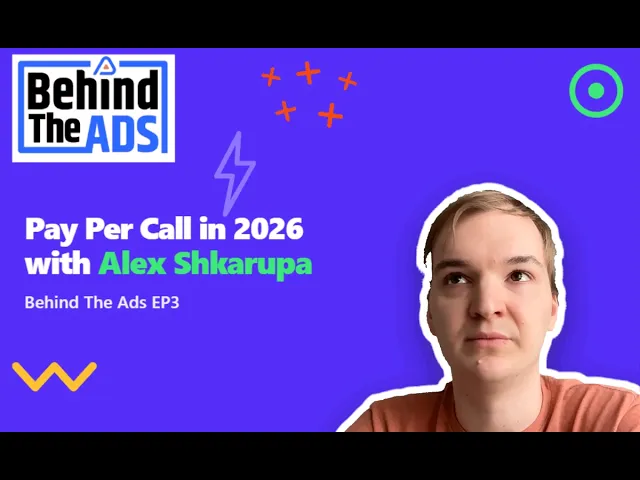
If you run performance marketing campaigns on Meta and want to understand what Pay Per Call actually looks like at the operator level, not the conference pitch version, the real day-to-day version, this episode is worth your time.
Alexander Shkarupa is VP of Operations at Marketcall, one of the leading Pay Per Call affiliate networks in the US market. He has been at the company for ten years, starting as an affiliate manager and working his way up through head of affiliates to his current role managing both the affiliate department and an in-house media buying team. He was also one of the first people to start testing the AdPlexity Social API and MCP integration for AI-powered ad research, which tells you something about how he thinks.
We covered a lot of ground in this episode. Here is what stood out.
Marketcall Runs Its Own Media Buying Team and That Is Not an Accident
Most affiliate networks do not buy their own traffic. Marketcall does, and Alex is direct about why. Running an in-house team of seven media buyers, a creative manager, and a technical person gives them ground-level visibility into what is actually working across their offers, visibility they could not get from affiliate data alone.
The team structure itself is worth paying attention to. Until recently, media buyers at Marketcall were handling both campaign management and creative production. Alex separated those roles deliberately. One person launches and optimizes campaigns on Facebook. A different person manages all creative work. The insight behind this is something Gabriel Ansel touched on in our first episode, while emphasizing that creative has become the dominant variable in performance marketing, and treating it as a side task for whoever has bandwidth is how you fall behind.
The creative workflow Alex described runs like this. The creative manager researches competitors inside AdPlexity Social and studies organic content to identify angles. He uses Claude to write scripts. From there, AI-generated videos are produced using UGC avatar tools, a video editor adds captions and B-roll, and the team ends up with roughly 15 videos per batch, three angles with five variations each. Media buyers take that batch to Facebook and scale whatever wins.
Right now, 90% of their videos are AI-generated. The remaining 10% use real creators sourced from Fiverr and Upwork. Alex was asked whether real humans outperform AI. His answer was honest: he has not found a consistent correlation. Sometimes AI wins, sometimes humans win. Since AI costs five to ten dollars per video versus a hundred to a hundred and fifty for a real creator, and since volume is what lets you find winners, the math points toward AI.
"90% of our videos are AI generated. For AI, the cost to produce those is maybe five to ten dollars per video versus a hundred and fifty for a real creator."
The Funnels That Work in Pay Per Call (And One That Mostly Does Not)
If you look at Pay Per Call campaigns in AdPlexity Social, you will see three funnel types coming up repeatedly: advertorials, quizzes, and chatbots. Alex confirmed that two of those three are doing the real work.
The quiz funnel is the workhorse. A landing page opens immediately into a one or two question quiz, pre-qualifies the user, and surfaces a phone number to call. Marketcall has used this across ACA, debt settlement, and auto insurance. It transfers across verticals cleanly because the mechanic matches what the user expects, a brief, relevant interaction before they commit to a call.
The chatbot funnel works similarly in structure but performs better on in-app traffic than on Facebook. Users engaging with in-app inventory are already in an app-like context, so a chatbot interface feels native rather than intrusive.
Advertorials are mostly a native traffic play. On Facebook, Marketcall does not use them much. Alex said he occasionally sees them in debt relief and final expense on Meta, but they are a minority compared to quiz and chatbot volume.
Compliance Is a Moving Target: Here Is How to Navigate It
Pay Per Call runs predominantly in regulated verticals. Insurance, debt relief, and home services. Compliance is not optional, and Alex is direct about the failure mode: run too aggressive, get short-term results, and get shut down by the advertiser. He has seen it happen across affiliate marketing broadly, not just Pay Per Call.
His approach has two steps. First, understand the compliance requirements from your advertisers. Marketcall typically routes traffic across multiple advertisers and identifies the most common requirements across that group. Second, research what other affiliates are actually running. This is where competitive intelligence tools matter, you need to know what angles are in the market, because if your creative is not competitive on CTR you will not generate enough volume to be profitable, regardless of how compliant it is.
The goal is finding a middle ground. Compliant enough to keep advertiser relationships intact. Aggressive enough to catch user attention and convert. That line moves over time. What an advertiser accepted a year ago may not be acceptable now, which means you need ongoing dialogue with your advertisers and your media buyers to know where the red lines currently sit.
What Separates Affiliates Who Scale From Affiliates Who Quit
Alex has spent years watching affiliates come through Marketcall, some who scale to five or six figures a day, some who burn through their first budget and disappear. The pattern he sees most often on the ones who fail: not enough creative volume and not enough budget to find the signal.
Testing five to ten creatives is not enough. He said it plainly. You may need to test hundreds of creatives to find the winner. Affiliates who stop after the first batch and declare the offer does not work are usually stopping too early. The creative they needed was in the next batch they never made.
"You may need to test hundreds of creatives to find the winner."
Budget is the other factor. Starting with a thousand dollars in a competitive US vertical does not give you enough runway to find what works. And offer timing matters, ACA was an opportunity three years ago. Running it now is swimming against the current.
Then there is luck. Alex said it, and it is worth acknowledging: the same offer, the same creative, on two different Facebook ad accounts can produce completely different results. Some of what looks like skill in this business is timing and account history. Anyone telling you otherwise is selling something.
"Sometimes you run the same offer, the same creative on two different Facebook ad accounts and it can perform completely different."
Agency Ad Accounts: Are They Necessary?
For most white-hat Pay Per Call campaigns, no. If you have a US entity and a business manager with history, that is sufficient to operate and scale. Marketcall runs on their own business manager and has for years.
Where agency accounts make more sense is for overseas affiliates who do not have a US company. The additional trust layer from an established agency account can smooth over the friction of running from outside the US. But if you can set up a US LLC, which is not that difficult even as a non-US resident, you are better off building your own business manager over time.
The Spanish Traffic Opportunity (And Where It Stands Now)
Marketcall was among the first Pay Per Call networks to run Spanish-language campaigns targeting the US market. They started with ACA in 2022, and the numbers were strong on both Facebook and YouTube. The reason is structural: roughly 30 to 50 million people in the US speak Spanish, CPMs are two to three times cheaper than English, and advertiser competition is significantly lower because most US call centers are set up for English-speaking callers.
"CPM on Spanish is two to three times cheaper. Any vertical in the US in Spanish is quite lucrative because the audience is still huge and not many advertisers are setting up campaigns specifically in Spanish."
They carried that playbook into debt settlement, and the case study Alex referenced shows what is possible when you find an underserved audience before everyone else does.
That window has narrowed. ACA in Spanish is now saturated. Debt in Spanish is oversaturated. The next frontier they are looking at is auto insurance in Spanish, but there is a structural problem: most auto insurance call centers do not have Spanish-speaking agents, so the buyer side has not caught up with the traffic opportunity. Whoever solves that infrastructure problem first is going to be well positioned.
The Traffic Sources Most Pay Per Call Affiliates Have Not Tested
This was the part of the conversation I found most interesting. Alex runs Meta as the primary channel, but Marketcall has found real ROI on two sources that most affiliates in this space either do not know about or have written off.
In-app traffic: platforms like BIGO Ads, Kaizen, Moloco, Unity, and AppLovin sell traffic inside mobile games and apps. The inventory is massive, the competition from performance marketers is still low, and the CPMs reflect that. Alex mentioned one cent per click and five to ten dollar CPMs. The trade-off is quality: bot traffic, fraud, and misclick traffic are real problems. But Marketcall has been running debt settlement on in-app for three months, and the ROI is holding.
Connected TV: CTV is the one that surprised me most. Platforms like Roku and Disney Plus now sell ad inventory at ten to twenty dollar CPMs. For verticals targeting older audiences such as Medicare, finance, and insurance, CTV puts your ad in front of people who are actively watching TV, which is where they already expect to encounter this category of advertising. The mechanic is simple: put the phone number in the ad itself. You can track which placement drove which call. For ten to twenty dollars CPM, that is television-level reach at a fraction of historical TV ad costs.
Alex also mentioned NewsBreak as a good entry point for affiliates who want to test outside of Meta without the complexity of in-app. Marketcall has affiliates running it successfully. They tried it themselves and did not crack it, but he is clear that this could be an execution problem rather than a platform problem.
TikTok they have tested and moved on from for Pay Per Call specifically. The audience skews younger, and the behavior pattern on TikTok is form submission, not phone calls. It is a reasonable lead gen platform. It is not a Pay Per Call platform.
Which Verticals Are Worth Exploring Right Now
Alex's framing here is worth remembering: do not start with a vertical, start with a traffic source. The vertical you should run is the one that maps to where you already have expertise, not the one you heard is hot at a conference.
For affiliates who are already strong on Meta, debt and auto insurance are still viable. ACA is not, that ship has sailed. Final expense comes up occasionally as an interesting angle, but it is a competitive national market, which means budget requirements are higher.
For affiliates who want somewhere with less competition, Alex pointed to home services and home improvement. These campaigns target specific cities, zip codes, or states, which means you are not going up against every national affiliate running the same offer. Pest control is a specific example he raised, it looks niche, but the call volume during summer is in the hundreds or thousands per day, and the demand from pest control companies to buy those calls is real. It is seasonal, but seasonal does not mean small.
The meta-principle: research before you commit. What looks niche often is not. What looks open often is not. Use the data available to you before you spend.
What Sets Marketcall Apart
Alex was asked directly what makes Marketcall different from other Pay Per Call networks. He gave a straightforward answer.
The first is technology. Marketcall built its own call tracking, lead tracking, and affiliate management platform from scratch over ten years. Affiliates who work with them get free call tracking and access to Keitaro for traffic tracking at no additional cost. That removes two significant infrastructure costs for publishers starting out.
The second is the expertise they share publicly. The YouTube channel and the bi-monthly Zoom calls Alex runs with affiliates are not just content marketing. They are a mechanism for getting affiliates to a level where they can actually generate quality volume. A network that helps its publishers get better at buying traffic is investing in its own supply chain.
The third is relationships. Marketcall attends conferences across the US, Europe, Bangkok, and Dubai. Alex is direct that this is intentional, the affiliate business runs on trust and communication, and face time still matters.
The AdPlexity API and What Alex Is Building With It
The final segment of the conversation went somewhere I did not expect. Alex has been one of the early testers of the AdPlexity Social API and MCP integration, and what he described is a genuinely different way of using an ad intelligence platform.
As a human analyst, you can review maybe twenty or thirty ads in a session. Alex is building AI systems that pull from the AdPlexity API, analyze hundreds of ads at once, extract the most common hooks and angles, transcribe the audio from video creatives, analyze individual frames, and produce a structured summary report. The research that would take a creative team a full day happens in minutes.
"I can have AI analyze hundreds of ads and produce a summary report covering the most used hooks, angles, and landing pages. Things no human analyst could do at that speed."
He is not doing this as an experiment. He is building it into Marketcall's operations. When your creative manager is responsible for producing fifteen videos per batch, knowing what the hundred most-run ads in your vertical are doing before you start writing scripts changes the quality of everything downstream.
Frequently Asked Questions
What is Pay Per Call affiliate marketing and how does it work?
Pay Per Call is a performance marketing model where affiliates are paid for generating inbound phone calls to advertisers rather than form submissions or sales. An affiliate runs ads, typically on Meta, Google, or other platforms, that direct users to call a phone number. The advertiser pays the affiliate for each qualified call that meets defined criteria, such as call duration or geographic location. Payouts are significantly higher than standard CPL models because a live phone call converts at a much higher rate for advertisers.
What are the best verticals for Pay Per Call on Facebook in 2026?
Debt settlement and auto insurance remain viable on Meta. Home services and home improvement are underrated entry points with less competition because campaigns target specific cities and zip codes rather than the full national market. ACA is saturated. Final expense is competitive but viable for affiliates with budget to test properly. Pest control is a seasonal opportunity with genuine buyer demand that is underserved by Facebook traffic specifically.
Do you need an agency ad account to run Pay Per Call on Meta?
Not necessarily. If you have a US entity and a business manager with account history, you can scale Pay Per Call campaigns without an agency account. Agency accounts are more useful for affiliates based outside the US who do not have a US company, as the additional trust layer helps with account stability. For white-hat Pay Per Call verticals, a well-managed personal business manager is sufficient.
What funnel types work best for Pay Per Call campaigns?
The quiz funnel is the most consistent performer across verticals, a landing page that immediately presents one or two qualifying questions before surfacing a phone number. It works in ACA, debt, and auto insurance. The chatbot funnel is structurally similar but performs better on in-app traffic than on Facebook. Advertorials are primarily a native traffic format and see less use on Meta in the Pay Per Call space.
Is Spanish-language traffic still a good opportunity for Pay Per Call?
The early window has closed for ACA and debt settlement in Spanish, both of which are now saturated. The opportunity is still real in other verticals where the buyer infrastructure exists to handle Spanish-speaking callers. Auto insurance in Spanish is the next frontier Marketcall is working toward, but it requires call centers with Spanish-speaking agents, which most US auto insurance operations currently do not have. Any affiliate who can find buyers set up for Spanish calls has a structural CPM advantage of two to three times versus English traffic.
What traffic sources beyond Meta are working for Pay Per Call?
In-app traffic (BIGO Ads, Kaizen, Moloco, Unity, AppLovin) offers CPMs of five to ten dollars and CPC as low as one cent, with the trade-off of lower traffic quality and fraud risk. Marketcall has been running debt settlement on in-app for three months with positive ROI. Connected TV (Roku, Disney Plus) is emerging for verticals targeting older audiences like Medicare and finance, with CPMs of ten to twenty dollars. NewsBreak is a viable alternative entry point for affiliates moving off Meta for the first time.
How do you stay compliant while running aggressive Pay Per Call creatives?
The process starts with understanding advertiser requirements, then mapping what competitors are actually running in the market. The goal is finding a middle ground, compliant enough to maintain advertiser relationships, competitive enough to generate CTR. That line is not fixed. Compliance requirements shift over time, so ongoing communication with advertisers and regular competitive research are both necessary to know where the current boundaries are.
How is AI changing Pay Per Call creative production?
AI-generated UGC video avatars now account for the majority of creative volume for operators running at scale. The cost difference is significant, five to ten dollars per AI video versus a hundred to a hundred and fifty for a real creator. More importantly, AI allows teams to produce enough creative volume to actually find winners, since the limiting factor in most campaigns is not budget but the number of angles tested. Performance between AI and human creatives is not consistently different enough to justify the cost and time premium of human production at scale.
Conclusion
Pay Per Call is not a mysterious channel. It runs on the same platforms, the same creative principles, and the same funnel logic as everything else in performance marketing. What it has that most channels do not is higher payouts, a compliance environment that filters out low-effort operators, and a set of underexplored traffic sources that most Meta-native affiliates have never touched.
Alex Shkarupa has been building in this space for a decade, and the throughline of everything he shared is the same: do the research, test more than you think you need to, and understand your traffic source before you commit to a vertical.
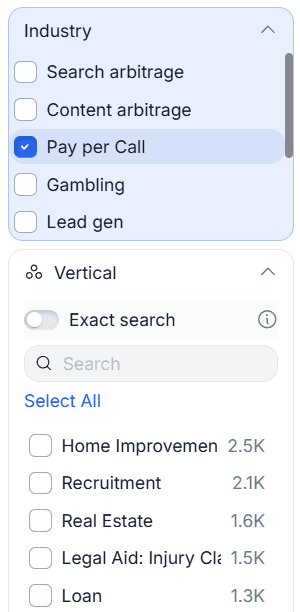
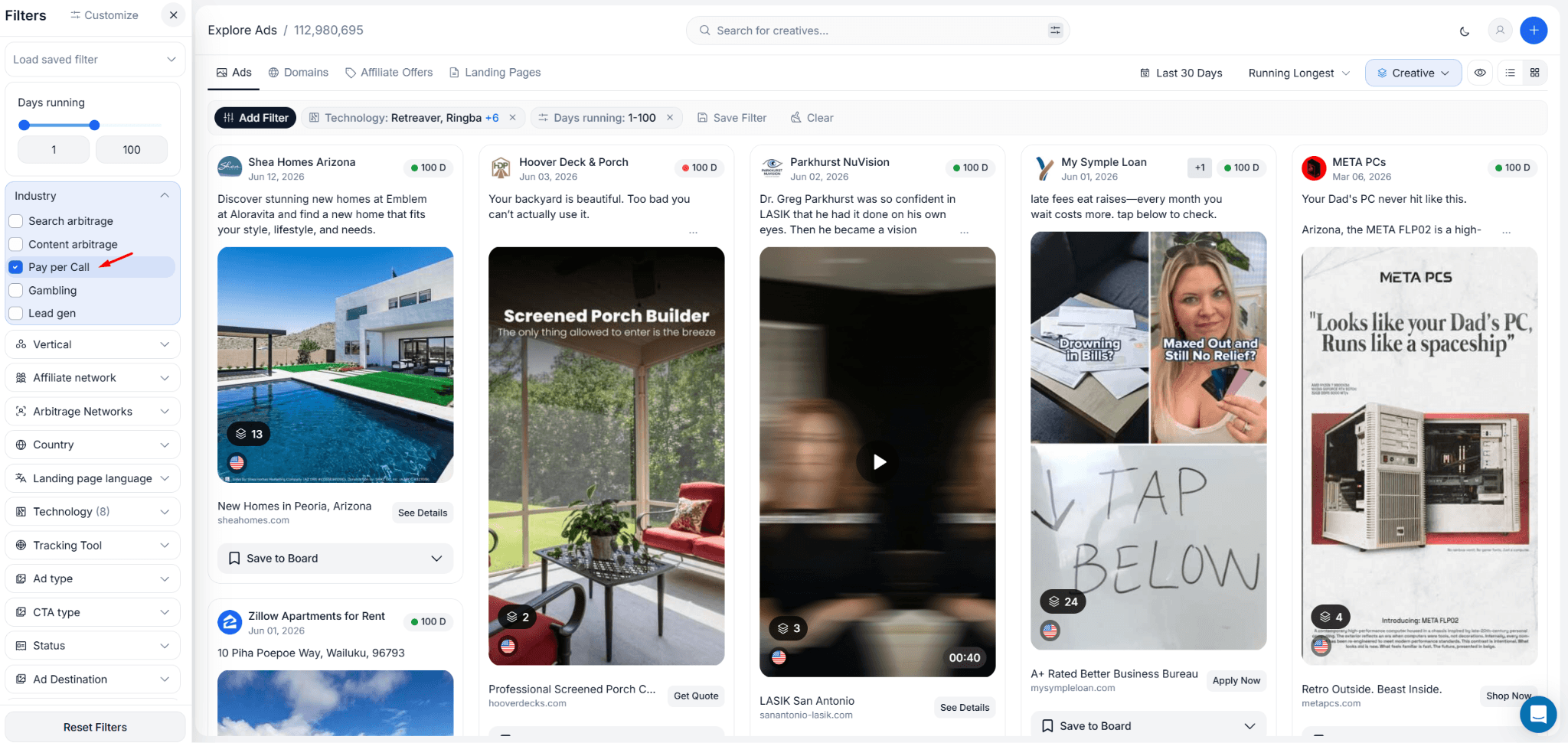
If you want to see what Pay Per Call campaigns actually look like, the funnels, the creative approaches, the tech stacks behind the ads, sign up at adplexity.io and run a search filtered by the Pay Per Call vertical. The data is there.
Key Takeaways
Alex Shkarupa has been at Marketcall since the Pay Per Call channel was a niche corner of affiliate marketing. Ten years later, he is running a seven-person in-house media buying team, adding an AI layer to their operations, and finding serious ROI on traffic sources most affiliates have never tested. The verticals most people chase are either saturated or require more budget than beginners realize. And the compliance conversation is more nuanced than most networks will admit.
Watch Full Interview Here:
If you run performance marketing campaigns on Meta and want to understand what Pay Per Call actually looks like at the operator level, not the conference pitch version, the real day-to-day version, this episode is worth your time.
Alexander Shkarupa is VP of Operations at Marketcall, one of the leading Pay Per Call affiliate networks in the US market. He has been at the company for ten years, starting as an affiliate manager and working his way up through head of affiliates to his current role managing both the affiliate department and an in-house media buying team. He was also one of the first people to start testing the AdPlexity Social API and MCP integration for AI-powered ad research, which tells you something about how he thinks.
We covered a lot of ground in this episode. Here is what stood out.
Marketcall Runs Its Own Media Buying Team and That Is Not an Accident
Most affiliate networks do not buy their own traffic. Marketcall does, and Alex is direct about why. Running an in-house team of seven media buyers, a creative manager, and a technical person gives them ground-level visibility into what is actually working across their offers, visibility they could not get from affiliate data alone.
The team structure itself is worth paying attention to. Until recently, media buyers at Marketcall were handling both campaign management and creative production. Alex separated those roles deliberately. One person launches and optimizes campaigns on Facebook. A different person manages all creative work. The insight behind this is something Gabriel Ansel touched on in our first episode, while emphasizing that creative has become the dominant variable in performance marketing, and treating it as a side task for whoever has bandwidth is how you fall behind.
The creative workflow Alex described runs like this. The creative manager researches competitors inside AdPlexity Social and studies organic content to identify angles. He uses Claude to write scripts. From there, AI-generated videos are produced using UGC avatar tools, a video editor adds captions and B-roll, and the team ends up with roughly 15 videos per batch, three angles with five variations each. Media buyers take that batch to Facebook and scale whatever wins.
Right now, 90% of their videos are AI-generated. The remaining 10% use real creators sourced from Fiverr and Upwork. Alex was asked whether real humans outperform AI. His answer was honest: he has not found a consistent correlation. Sometimes AI wins, sometimes humans win. Since AI costs five to ten dollars per video versus a hundred to a hundred and fifty for a real creator, and since volume is what lets you find winners, the math points toward AI.
"90% of our videos are AI generated. For AI, the cost to produce those is maybe five to ten dollars per video versus a hundred and fifty for a real creator."
The Funnels That Work in Pay Per Call (And One That Mostly Does Not)
If you look at Pay Per Call campaigns in AdPlexity Social, you will see three funnel types coming up repeatedly: advertorials, quizzes, and chatbots. Alex confirmed that two of those three are doing the real work.
The quiz funnel is the workhorse. A landing page opens immediately into a one or two question quiz, pre-qualifies the user, and surfaces a phone number to call. Marketcall has used this across ACA, debt settlement, and auto insurance. It transfers across verticals cleanly because the mechanic matches what the user expects, a brief, relevant interaction before they commit to a call.
The chatbot funnel works similarly in structure but performs better on in-app traffic than on Facebook. Users engaging with in-app inventory are already in an app-like context, so a chatbot interface feels native rather than intrusive.
Advertorials are mostly a native traffic play. On Facebook, Marketcall does not use them much. Alex said he occasionally sees them in debt relief and final expense on Meta, but they are a minority compared to quiz and chatbot volume.
Compliance Is a Moving Target: Here Is How to Navigate It
Pay Per Call runs predominantly in regulated verticals. Insurance, debt relief, and home services. Compliance is not optional, and Alex is direct about the failure mode: run too aggressive, get short-term results, and get shut down by the advertiser. He has seen it happen across affiliate marketing broadly, not just Pay Per Call.
His approach has two steps. First, understand the compliance requirements from your advertisers. Marketcall typically routes traffic across multiple advertisers and identifies the most common requirements across that group. Second, research what other affiliates are actually running. This is where competitive intelligence tools matter, you need to know what angles are in the market, because if your creative is not competitive on CTR you will not generate enough volume to be profitable, regardless of how compliant it is.
The goal is finding a middle ground. Compliant enough to keep advertiser relationships intact. Aggressive enough to catch user attention and convert. That line moves over time. What an advertiser accepted a year ago may not be acceptable now, which means you need ongoing dialogue with your advertisers and your media buyers to know where the red lines currently sit.
What Separates Affiliates Who Scale From Affiliates Who Quit
Alex has spent years watching affiliates come through Marketcall, some who scale to five or six figures a day, some who burn through their first budget and disappear. The pattern he sees most often on the ones who fail: not enough creative volume and not enough budget to find the signal.
Testing five to ten creatives is not enough. He said it plainly. You may need to test hundreds of creatives to find the winner. Affiliates who stop after the first batch and declare the offer does not work are usually stopping too early. The creative they needed was in the next batch they never made.
"You may need to test hundreds of creatives to find the winner."
Budget is the other factor. Starting with a thousand dollars in a competitive US vertical does not give you enough runway to find what works. And offer timing matters, ACA was an opportunity three years ago. Running it now is swimming against the current.
Then there is luck. Alex said it, and it is worth acknowledging: the same offer, the same creative, on two different Facebook ad accounts can produce completely different results. Some of what looks like skill in this business is timing and account history. Anyone telling you otherwise is selling something.
"Sometimes you run the same offer, the same creative on two different Facebook ad accounts and it can perform completely different."
Agency Ad Accounts: Are They Necessary?
For most white-hat Pay Per Call campaigns, no. If you have a US entity and a business manager with history, that is sufficient to operate and scale. Marketcall runs on their own business manager and has for years.
Where agency accounts make more sense is for overseas affiliates who do not have a US company. The additional trust layer from an established agency account can smooth over the friction of running from outside the US. But if you can set up a US LLC, which is not that difficult even as a non-US resident, you are better off building your own business manager over time.
The Spanish Traffic Opportunity (And Where It Stands Now)
Marketcall was among the first Pay Per Call networks to run Spanish-language campaigns targeting the US market. They started with ACA in 2022, and the numbers were strong on both Facebook and YouTube. The reason is structural: roughly 30 to 50 million people in the US speak Spanish, CPMs are two to three times cheaper than English, and advertiser competition is significantly lower because most US call centers are set up for English-speaking callers.
"CPM on Spanish is two to three times cheaper. Any vertical in the US in Spanish is quite lucrative because the audience is still huge and not many advertisers are setting up campaigns specifically in Spanish."
They carried that playbook into debt settlement, and the case study Alex referenced shows what is possible when you find an underserved audience before everyone else does.
That window has narrowed. ACA in Spanish is now saturated. Debt in Spanish is oversaturated. The next frontier they are looking at is auto insurance in Spanish, but there is a structural problem: most auto insurance call centers do not have Spanish-speaking agents, so the buyer side has not caught up with the traffic opportunity. Whoever solves that infrastructure problem first is going to be well positioned.
The Traffic Sources Most Pay Per Call Affiliates Have Not Tested
This was the part of the conversation I found most interesting. Alex runs Meta as the primary channel, but Marketcall has found real ROI on two sources that most affiliates in this space either do not know about or have written off.
In-app traffic: platforms like BIGO Ads, Kaizen, Moloco, Unity, and AppLovin sell traffic inside mobile games and apps. The inventory is massive, the competition from performance marketers is still low, and the CPMs reflect that. Alex mentioned one cent per click and five to ten dollar CPMs. The trade-off is quality: bot traffic, fraud, and misclick traffic are real problems. But Marketcall has been running debt settlement on in-app for three months, and the ROI is holding.
Connected TV: CTV is the one that surprised me most. Platforms like Roku and Disney Plus now sell ad inventory at ten to twenty dollar CPMs. For verticals targeting older audiences such as Medicare, finance, and insurance, CTV puts your ad in front of people who are actively watching TV, which is where they already expect to encounter this category of advertising. The mechanic is simple: put the phone number in the ad itself. You can track which placement drove which call. For ten to twenty dollars CPM, that is television-level reach at a fraction of historical TV ad costs.
Alex also mentioned NewsBreak as a good entry point for affiliates who want to test outside of Meta without the complexity of in-app. Marketcall has affiliates running it successfully. They tried it themselves and did not crack it, but he is clear that this could be an execution problem rather than a platform problem.
TikTok they have tested and moved on from for Pay Per Call specifically. The audience skews younger, and the behavior pattern on TikTok is form submission, not phone calls. It is a reasonable lead gen platform. It is not a Pay Per Call platform.
Which Verticals Are Worth Exploring Right Now
Alex's framing here is worth remembering: do not start with a vertical, start with a traffic source. The vertical you should run is the one that maps to where you already have expertise, not the one you heard is hot at a conference.
For affiliates who are already strong on Meta, debt and auto insurance are still viable. ACA is not, that ship has sailed. Final expense comes up occasionally as an interesting angle, but it is a competitive national market, which means budget requirements are higher.
For affiliates who want somewhere with less competition, Alex pointed to home services and home improvement. These campaigns target specific cities, zip codes, or states, which means you are not going up against every national affiliate running the same offer. Pest control is a specific example he raised, it looks niche, but the call volume during summer is in the hundreds or thousands per day, and the demand from pest control companies to buy those calls is real. It is seasonal, but seasonal does not mean small.
The meta-principle: research before you commit. What looks niche often is not. What looks open often is not. Use the data available to you before you spend.
What Sets Marketcall Apart
Alex was asked directly what makes Marketcall different from other Pay Per Call networks. He gave a straightforward answer.
The first is technology. Marketcall built its own call tracking, lead tracking, and affiliate management platform from scratch over ten years. Affiliates who work with them get free call tracking and access to Keitaro for traffic tracking at no additional cost. That removes two significant infrastructure costs for publishers starting out.
The second is the expertise they share publicly. The YouTube channel and the bi-monthly Zoom calls Alex runs with affiliates are not just content marketing. They are a mechanism for getting affiliates to a level where they can actually generate quality volume. A network that helps its publishers get better at buying traffic is investing in its own supply chain.
The third is relationships. Marketcall attends conferences across the US, Europe, Bangkok, and Dubai. Alex is direct that this is intentional, the affiliate business runs on trust and communication, and face time still matters.
The AdPlexity API and What Alex Is Building With It
The final segment of the conversation went somewhere I did not expect. Alex has been one of the early testers of the AdPlexity Social API and MCP integration, and what he described is a genuinely different way of using an ad intelligence platform.
As a human analyst, you can review maybe twenty or thirty ads in a session. Alex is building AI systems that pull from the AdPlexity API, analyze hundreds of ads at once, extract the most common hooks and angles, transcribe the audio from video creatives, analyze individual frames, and produce a structured summary report. The research that would take a creative team a full day happens in minutes.
"I can have AI analyze hundreds of ads and produce a summary report covering the most used hooks, angles, and landing pages. Things no human analyst could do at that speed."
He is not doing this as an experiment. He is building it into Marketcall's operations. When your creative manager is responsible for producing fifteen videos per batch, knowing what the hundred most-run ads in your vertical are doing before you start writing scripts changes the quality of everything downstream.
Frequently Asked Questions
What is Pay Per Call affiliate marketing and how does it work?
Pay Per Call is a performance marketing model where affiliates are paid for generating inbound phone calls to advertisers rather than form submissions or sales. An affiliate runs ads, typically on Meta, Google, or other platforms, that direct users to call a phone number. The advertiser pays the affiliate for each qualified call that meets defined criteria, such as call duration or geographic location. Payouts are significantly higher than standard CPL models because a live phone call converts at a much higher rate for advertisers.
What are the best verticals for Pay Per Call on Facebook in 2026?
Debt settlement and auto insurance remain viable on Meta. Home services and home improvement are underrated entry points with less competition because campaigns target specific cities and zip codes rather than the full national market. ACA is saturated. Final expense is competitive but viable for affiliates with budget to test properly. Pest control is a seasonal opportunity with genuine buyer demand that is underserved by Facebook traffic specifically.
Do you need an agency ad account to run Pay Per Call on Meta?
Not necessarily. If you have a US entity and a business manager with account history, you can scale Pay Per Call campaigns without an agency account. Agency accounts are more useful for affiliates based outside the US who do not have a US company, as the additional trust layer helps with account stability. For white-hat Pay Per Call verticals, a well-managed personal business manager is sufficient.
What funnel types work best for Pay Per Call campaigns?
The quiz funnel is the most consistent performer across verticals, a landing page that immediately presents one or two qualifying questions before surfacing a phone number. It works in ACA, debt, and auto insurance. The chatbot funnel is structurally similar but performs better on in-app traffic than on Facebook. Advertorials are primarily a native traffic format and see less use on Meta in the Pay Per Call space.
Is Spanish-language traffic still a good opportunity for Pay Per Call?
The early window has closed for ACA and debt settlement in Spanish, both of which are now saturated. The opportunity is still real in other verticals where the buyer infrastructure exists to handle Spanish-speaking callers. Auto insurance in Spanish is the next frontier Marketcall is working toward, but it requires call centers with Spanish-speaking agents, which most US auto insurance operations currently do not have. Any affiliate who can find buyers set up for Spanish calls has a structural CPM advantage of two to three times versus English traffic.
What traffic sources beyond Meta are working for Pay Per Call?
In-app traffic (BIGO Ads, Kaizen, Moloco, Unity, AppLovin) offers CPMs of five to ten dollars and CPC as low as one cent, with the trade-off of lower traffic quality and fraud risk. Marketcall has been running debt settlement on in-app for three months with positive ROI. Connected TV (Roku, Disney Plus) is emerging for verticals targeting older audiences like Medicare and finance, with CPMs of ten to twenty dollars. NewsBreak is a viable alternative entry point for affiliates moving off Meta for the first time.
How do you stay compliant while running aggressive Pay Per Call creatives?
The process starts with understanding advertiser requirements, then mapping what competitors are actually running in the market. The goal is finding a middle ground, compliant enough to maintain advertiser relationships, competitive enough to generate CTR. That line is not fixed. Compliance requirements shift over time, so ongoing communication with advertisers and regular competitive research are both necessary to know where the current boundaries are.
How is AI changing Pay Per Call creative production?
AI-generated UGC video avatars now account for the majority of creative volume for operators running at scale. The cost difference is significant, five to ten dollars per AI video versus a hundred to a hundred and fifty for a real creator. More importantly, AI allows teams to produce enough creative volume to actually find winners, since the limiting factor in most campaigns is not budget but the number of angles tested. Performance between AI and human creatives is not consistently different enough to justify the cost and time premium of human production at scale.
Conclusion
Pay Per Call is not a mysterious channel. It runs on the same platforms, the same creative principles, and the same funnel logic as everything else in performance marketing. What it has that most channels do not is higher payouts, a compliance environment that filters out low-effort operators, and a set of underexplored traffic sources that most Meta-native affiliates have never touched.
Alex Shkarupa has been building in this space for a decade, and the throughline of everything he shared is the same: do the research, test more than you think you need to, and understand your traffic source before you commit to a vertical.
If you want to see what Pay Per Call campaigns actually look like, the funnels, the creative approaches, the tech stacks behind the ads, sign up at adplexity.io and run a search filtered by the Pay Per Call vertical. The data is there.
Table of Contents
Quickly navigate through the key sections of this article.
Discover Winning Meta Ads
Similar Blogs
Check related blogs
Check related blogs
Check related blogs




















Ready to See What’s Really Working on Meta?
Adplexity
Social
© Copyright 2026 All Rights Reserved
Ready to See What’s Really Working on Meta?
Adplexity
Social
© Copyright 2026 All Rights Reserved
Ready to See What’s Really Working on Meta?
Adplexity
Social
© Copyright 2026 All Rights Reserved