What Is Search Arbitrage? How RSOC Works on Meta in 2026

Share:

Nobody in this model sells a product. Here is where the money comes from, why Google rewrote the rules, and what live RSOC funnels on Meta look like.
Nobody in this model sells a product. Here is where the money comes from, why Google rewrote the rules, and what live RSOC funnels on Meta look like.
In search arbitrage, the media buyer never sells anything. They get paid when the visitor they paid Meta for turns around and clicks somebody else's ad on a search results page that has nothing to do with the product in the original ad. That is the whole model. If you run paid traffic on Meta and keep seeing search arbitrage or RSOC mentioned in spy tools and forums, this guide explains the model in plain terms: who pays whom, what RSOC changed, and what the live funnels look like right now.
Key takeaways. Search arbitrage earns money on the search-ad click a visitor makes after landing, not on a sale, and on Meta the working version is RSOC: an ad, an article, a related search term, and a sponsored result. Google has tightened this from two directions: it removed parked-domain ads from its Search Partner Network on February 10, 2026, and since November 1, 2025 it has required publishers to pass along the exact text of the ad that sent each visitor. That means the Meta creative you write is now effectively part of Google's review. AdPlexity Social detects 16 named search arbitrage networks, most tagged separately for RSOC and the older AFD model, and 8 of those had RSOC ads live on Meta in a 30-day check in September 2026. Across all countries in the last 30 days, Visymo led with about 505,000 RSOC ads on Meta, Tonic followed with about 122,500, and System1 trailed with about 4,900.
What Is Search Arbitrage?
Search arbitrage means buying a visit on a platform such as Meta, sending it to a page built around a search topic, and earning a share of the revenue when that visitor clicks a sponsored search result further down the page. Simple enough: profit is just the gap between what the visit cost you and what the search click paid out. People also call this search feed arbitrage, search arb, or RSOC arbitrage; take your pick.
Five parties make this work. Meta is the traffic source here, though the same model runs on TikTok and other native networks, and Taboola and Outbrain get named as traffic sources for it too. You, the media buyer, pay for that traffic. The feed provider holds the actual search partnership; Visymo, Tonic, and System1 are well-known names in that seat. Behind RSOC sits the search ad network: Google's AdSense for Search infrastructure, though PropellerAds also lists Bing and Yahoo among the search engines in this model. And the advertisers are the businesses bidding on the keywords that end up on the results page.
Two numbers matter before anything else. CPC or CPM is what you pay Meta for the visit. RPC or RPM is the revenue per click, or per thousand visits, that the feed reports back. The entire business is RPC minus CPC.
How Does Search Arbitrage Make Money?
Here is the only part of this chain that actually pays: a visitor clicking a sponsored result on a search results page. The advertiser bidding on that result pays the search network, the network pays its publisher partner, and the partner pays your cut as the media buyer. Everything before that, the Meta ad view, the article view, the related-search click, either costs you money or costs nothing at all. Only that last click pays anyone.
Step | What the visitor does | Money that moves | Who receives it |
|---|---|---|---|
1 | Clicks the Meta ad | The media buyer pays Meta a CPC or CPM | Meta |
2 | Lands on the article, sees the related search terms | Nothing yet | Nobody |
3 | Clicks a related search term, a results page loads | Nothing yet | Nobody |
4 | Clicks a sponsored result on that page | The advertiser pays its click price to Google | |
5 | Nothing more. The split happens behind the scenes | Google keeps its share of that click price | Google, then the feed provider, then the media buyer with what is left |
Google confirmed the only number in this chain back in 2010: AdSense for Search partners keep 51 percent of the revenue from the search ads on their sites. What the feed provider pays you, the media buyer, is negotiated case by case, and nobody publishes it. Treat any specific split you see online as one operator's deal, not an industry figure.
Here is that chain on a real ad. A Page called Auto Finder ran a post about classic Chevy C10 pickups that reads like any nostalgic car content: the trucks are turning heads again, and collectors cannot get enough of them. Nothing in it mentions search, a feed or a keyword. It does not need to: the ad only has to earn the click. The one clue comes from AdPlexity Social, which tags the ad System1 (RSOC).
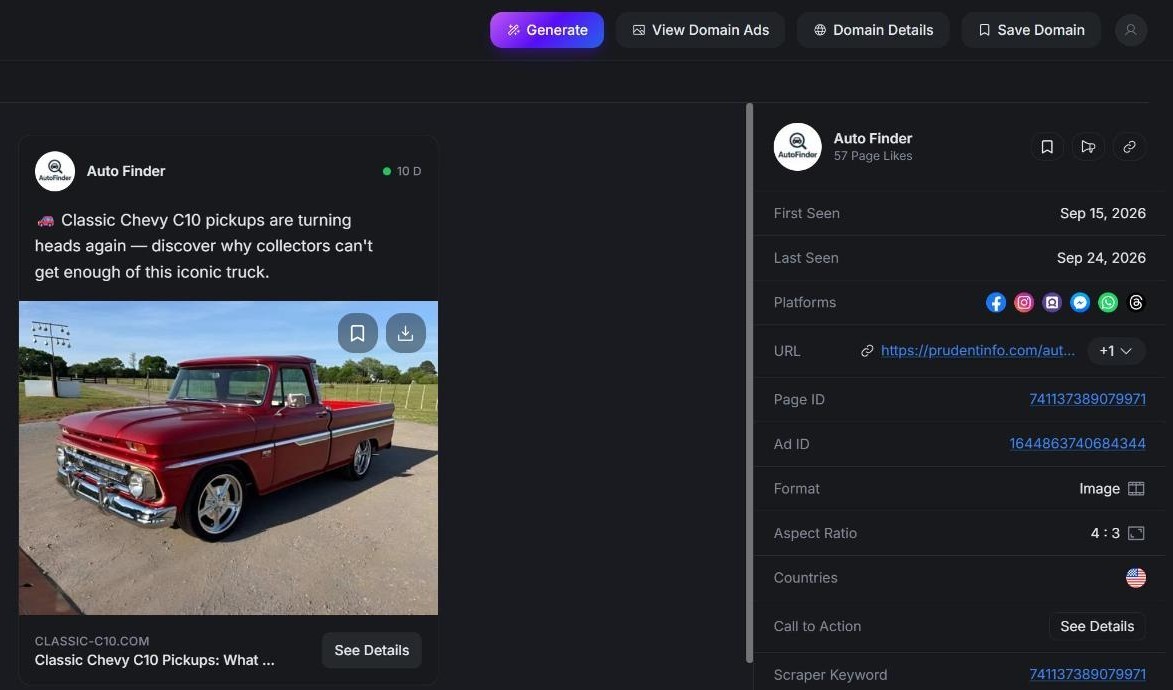
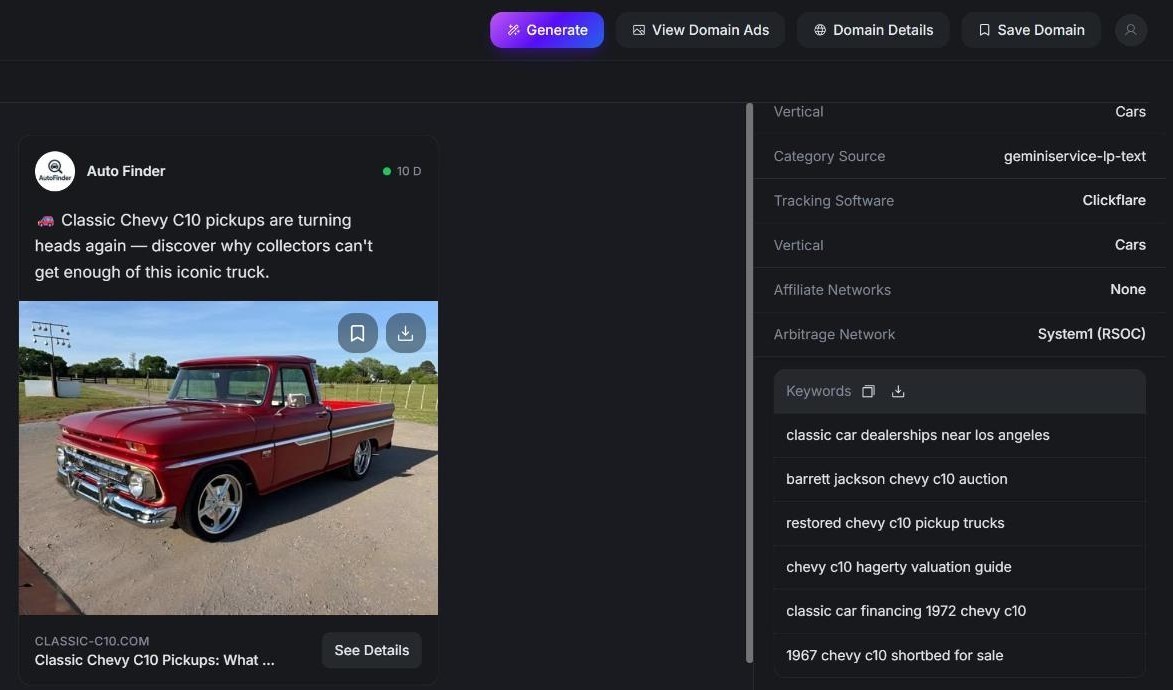
A ClickFlare redirect carries Meta's tracking parameters through, then lands on the real article at prudentinfo.com, a domain that has nothing to do with the classic-c10.com caption or the Auto Finder page.
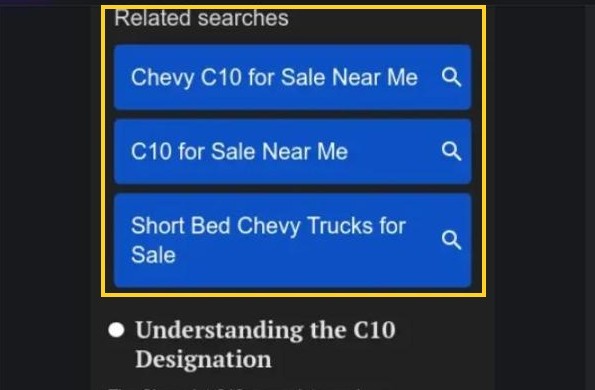
The article, "Classic Chevy C10 Pickups for Collectors," reads like an ordinary automotive blog post. But it carries two related-search blocks of three buttons each, phrases such as "Chevy C10 for Sale Near Me" and "Short Bed Chevy Trucks for Sale." Click one and a search results page loads. The sponsored links there are what earn the RPC.
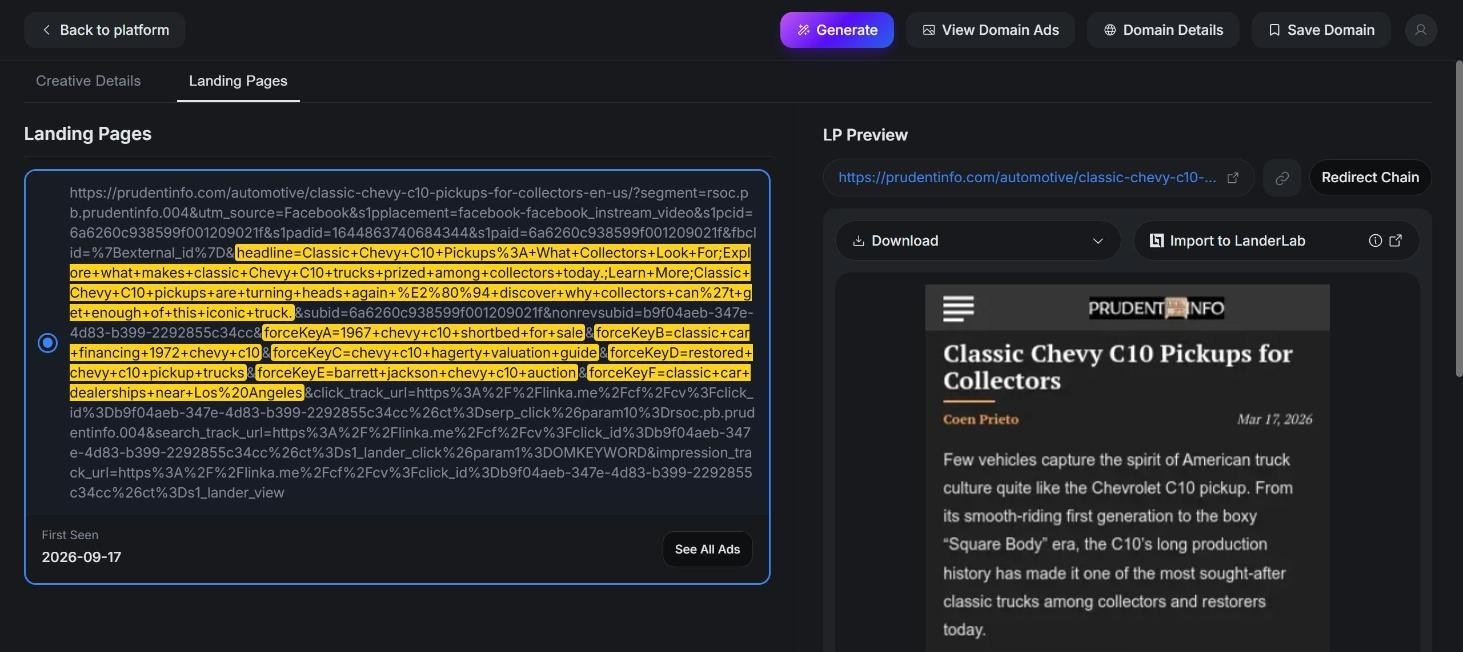
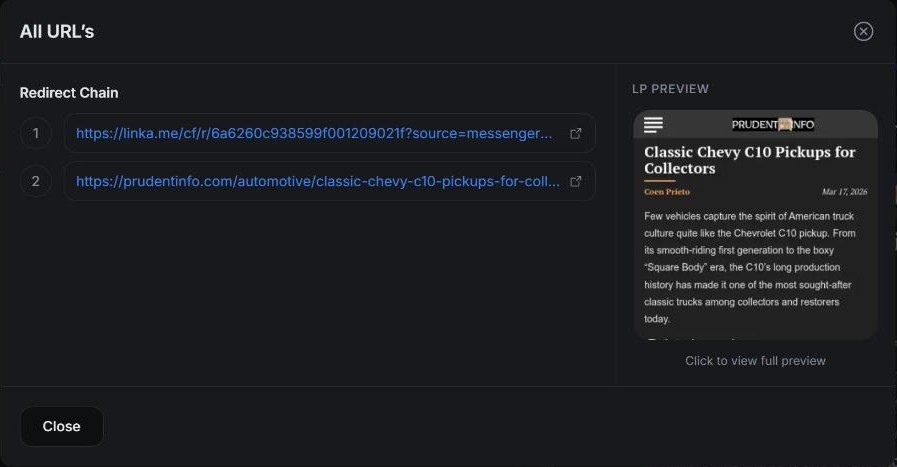
Open the landing URL in full and six parameters show up, forceKeyA through forceKeyF, holding phrases such as "1967 chevy c10 shortbed for sale" and "chevy c10 hagerty valuation guide." Those are the keywords the funnel feeds the page and the ones AdPlexity records against the ad. They are not a guaranteed preview of what a visitor sees: the article's related-search blocks showed six different phrases, and none matched a forceKey value word for word. Treat the parameters as what the funnel targets, not a guarantee of what is on the page.
The same URL also carries three tracker event links, for the article view, the related-search click, and the sponsored-result click, matching steps 2 through 4 in the table above.
Margins are thin. ClickFlare's 2026 guide to native-to-search arbitrage puts profit at a few cents per click, or 10 to 25 percent, and calls for a working budget of $100 to $300 a day to test and $1,000 or more a day once a campaign scales. Traffic Cardinal puts typical search feed arbitrage margins at 15 to 30 percent. SearchADX breaks down the arithmetic per visitor: $0.12 cost, $0.15 revenue, $0.03 profit. That is one illustration, not a rate to expect consistently.
Every one of those numbers hangs on RPC, and you do not control that. Advertiser bids set it. That is also why campaigns can stop working overnight.
What Is RSOC, and How Is It Different From Classic Search Arbitrage?
RSOC stands for Related Search on Content. Google's own name for it is plainer: related search for content. The mechanic is simple: search terms tied to the page's content show up on that page, you click one, and it opens a search results page on the publisher's own site.
You cannot just sign up for it. Google offers RSOC to publishers holding an AdSense for Search contract, and most media buyers reach it through a feed provider that already holds one on their behalf.
RSOC did not come out of nowhere. Before it, the same idea ran two simpler ways: a one-click flow that sent the Meta ad straight to a page built to look like a results page, and a two-click flow that added a keyword-themed pre-lander before that. PropellerAds has documented both flows running behind Google, Bing, and Yahoo.
Classic | RSOC | |
|---|---|---|
Where the click lands | A parked domain or a results-style page | An article built around the topic |
Clicks before revenue | One, on a sponsored link on that page | A related search term, then a sponsored result |
Content needed | Little to none | A real article |
Google product behind it | AdSense for Domains (AFD) | AFS related search for content |
Status in 2026 | Dead: parked-domain ads removed from Google's Search Partner Network on February 10, 2026 | Active, under restricted access features and the referrer ad creative rule |
How AdPlexity labels it | The network name alone, for example System1, its classic tag for AFD funnels | The network name plus RSOC, for example System1 (RSOC) |
AdPlexity's own tags make the difference visible in the landing URLs. The classic tag marks an AFD funnel, the RSOC tag marks the current model.
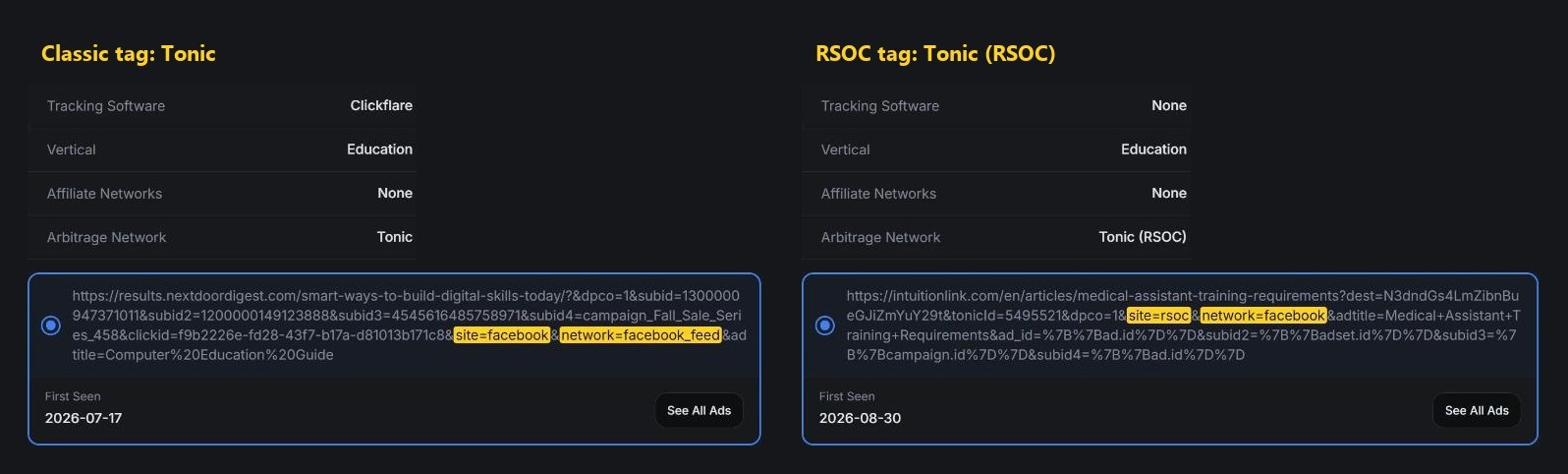
Pull up a classic-tagged Tonic ad ("Computer Education Programs") next to an RSOC-tagged Tonic ad ("Medical Assistant Training Requirements"), both active in the same 30-day check, and they land in very different places.
The classic ad runs through a ClickFlare redirect to a page on a results subdomain, results.nextdoordigest.com, with site=facebook in the URL. The network value names the exact Facebook placement: network=facebook_search on one landing URL, network=facebook_feed on another.
The RSOC ad skips the redirect entirely. It lands straight on an /articles/ page on intuitionlink.com, with site=rsoc in the query string.
Here is what that tells you: classic-tagged ads still turn up on Meta in 2026, but the model behind them no longer has Google's parked-domain ads to sell. The wrapper kept running. The parked-domain payout behind it did not.
What Changed in the Rules in 2025 and 2026?
Google moved fast. In less than two years it shut down the older parked-domain version of this model, tightened the version that replaced it, and started reading the actual ad text that sends the traffic. Three changes, one direction.
AdSense for Domains did not end in one move. It ended in three stages: starting in late 2024, Google first stopped adding new advertisers, then let existing ones opt out through 2025, and on February 10, 2026, switched parked domains off for everyone. By that third stage, there was nothing left to opt out of.
RSOC tightened too, absorbing AFD's leftover demand. From August 2025, Google's restricted access features cap publishers at five suggested terms per ad block and one related-search block per page, on top of limits on styling and reporting. Publishers in good standing can get those limits lifted, but only case by case.
SearchADX reports a three-strike system running alongside those restrictions: 90 days of probation, then 90 more days of severe restriction with an account hold, then permanent loss of the feature. The AdSense account itself stays open. That three-strike structure comes from SearchADX's own reporting, not from Google, which has not published anything like it.
The bigger change for Meta buyers is the referrer ad creative rule. Starting November 1, 2025, publishers have to supply the precise, complete text of the ad or link that sent each visitor, whenever that source is under their control, including any third-party network or affiliate. Google wants a literal transcription, not a summary: title lines, body copy, button text, on-image text, and any video or audio transcript.
That means Google now effectively sees your Meta ad's headline and text. A mismatch between the ad and the article is no longer just a Meta problem. It shows up on Google's side too.
Meta's own ad standards sit on top of this. Withhold information, run an exaggerated headline the landing page does not deliver on, or bait likes, comments, and shares, and you are looking at reduced distribution or disapproval. That policy has been in place since 2018. None of it was written with search arbitrage in mind. It does not have to be: a search arbitrage ad gets reviewed like anything else on the platform.
The fallout shows up in the public numbers. System1 reported 2025 revenue down 23 percent to $266.1 million. System1's annual report shows 67 percent of that revenue came from its agreements with Google. That is how exposed one company was to a single relationship.
Sedo, a domain-parking company built on the older model, saw Q3 2025 revenue fall 66 percent and was put up for sale. Bodis, another parking platform, shut down on January 31, 2026.
The creative itself shifted too, and it shows up in AdPlexity's own data. Our research into identifying profitable RSOC ads and domains tracked a move toward softer, image-plus-headline creatives once the compliance push started. That is the kind of ad that is harder to accuse of misdescribing anything.
Search Arbitrage vs Affiliate Marketing: What Is the Difference?
Search arbitrage pays you on the click. Affiliate marketing pays you on the action. A visitor clicks a sponsored search result and you get paid, or a visitor buys something or submits a lead form and that triggers the payout instead. That is the entire difference.
This split is not new: the line between click-based and action-based payouts was already being drawn in 2007, and it still holds.
Search arbitrage | Affiliate marketing | |
|---|---|---|
What you are paid for | A click on a sponsored search result | A sale or a lead |
Who pays you | The feed provider, out of search-ad revenue | The advertiser, usually through a network such as ClickBank, BuyGoods, Digistore24, or GiddyUp |
What the visitor has to do | Click a search ad | Buy something or sign up |
Where the traffic goes | An article or a keyword page | The offer, often behind a pre-lander, an advertorial, or a VSL |
What moves your margin | RPC, set by advertiser bids on the keyword | Payout and conversion rate |
Main rulebook | The feed provider's and Google's policies, plus Meta's ad standards | The network's and advertiser's terms, plus Meta's ad standards |
How AdPlexity labels it | The arbitrage network filter | The affiliate network and affiliate offer filters |
Three other terms get tossed around as if they mean the same thing as search arbitrage. They do not. Content arbitrage monetizes page views directly with display ads, no search click required. Click arbitrage buys clicks on Google search results and resells that traffic into affiliate offers, the model Joey Babineau ran on Google search for years before margins collapsed. Traffic arbitrage is the umbrella term for all three: buy traffic cheap, monetize it elsewhere for more.
Which Search Arbitrage Networks (Feed Providers) Run on Meta?
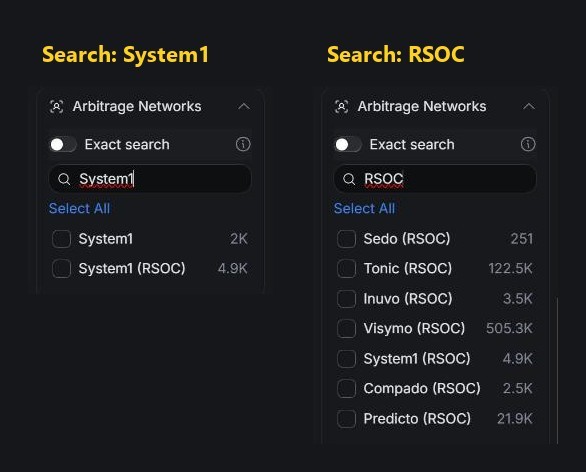
A feed provider holds the AdSense for Search partnership. It approves media buyers, supplies the feed, sets the revenue share, and pays out. AdPlexity Social tags 16 named feed providers behind search arbitrage ads, most carrying two tags: RSOC for the current model, and a classic tag for the older AFD funnels. Funnels that are clearly arbitrage but do not trace back to a named feed land in the Unknown bucket.
Network | RSOC ads live on Meta, last 30 days | Classic (AFD) ads live on Meta, last 30 days |
|---|---|---|
System1 | yes | yes |
Tonic | yes | yes |
Sedo | yes | yes |
Clicksco | yes | yes |
Inuvo | yes | yes |
Compado | yes | none found |
Predicto | yes | none found |
Visymo | yes | no classic tag |
Yahoo Search | none found | yes |
Media.net | none found | yes |
Codefuel | none found | yes |
AFS | none found | yes |
DomainActive | none found | none found |
Ads.com | none found | none found |
Aporia | none found | none found |
AirFind | none found | no classic tag |
Eight of those 16 networks had RSOC-tagged ads live on Meta in the 30-day check: Visymo, System1, Tonic, Sedo, Clicksco, Inuvo, Compado, and Predicto. Four more, Yahoo Search, Media.net, Codefuel, and AFS, showed up only under the classic tag. DomainActive, Ads.com, Aporia, and AirFind returned nothing, though the Unknown bucket still had live ads.
The table only tells you who is present. Volume tells a different story. Over the last 30 days, across all countries, Visymo carries about 505,000 RSOC ads on Meta, Tonic about 122,500, Predicto about 21,900, System1 about 4,900 plus another 2,000 under its classic tag, Inuvo about 3,500, Compado about 2,500, and Sedo about 250. Visymo is where most of the RSOC volume on Meta sits right now. Tonic is a clear second. System1, for all its name recognition, is a small player in this data.
Inside AdPlexity Social, the fastest way into this vertical is the Industry filter. Set it to Search arbitrage and you are in. You do not need to build that filter combination yourself.
What Do Search Arbitrage Ads on Meta Look Like Right Now?
The creative almost never sells a product. It sells a topic, a hook about cars, travel, home services, whatever the feed has inventory for, and the money sits in the keyword behind the article, not in anything the ad asks you to buy.
Lined up together, these ads show one clear pattern: the same topic running on more than one page at once. Take the System1 (RSOC) ad on the page Nustar Trenz. The headline reads "Understanding Amtrak All-Inclusive Packages." The identical creative also ran on Daily Dose Hub, and a second Amtrak creative ran on both Nustar Trenz and FactFlow. That repetition, not any one ad on its own, is the signal worth watching for.
Longevity tells you something too. On the Tonic (RSOC) side, the page Things Needed to You has run "Car Key Replacement" for at least three weeks. The page Discount Magic has been running "🚘 Learn more about Ford Maverick Truck Clearance 🚘" for more than three months. An ad that sticks around that long is well past the testing stage.
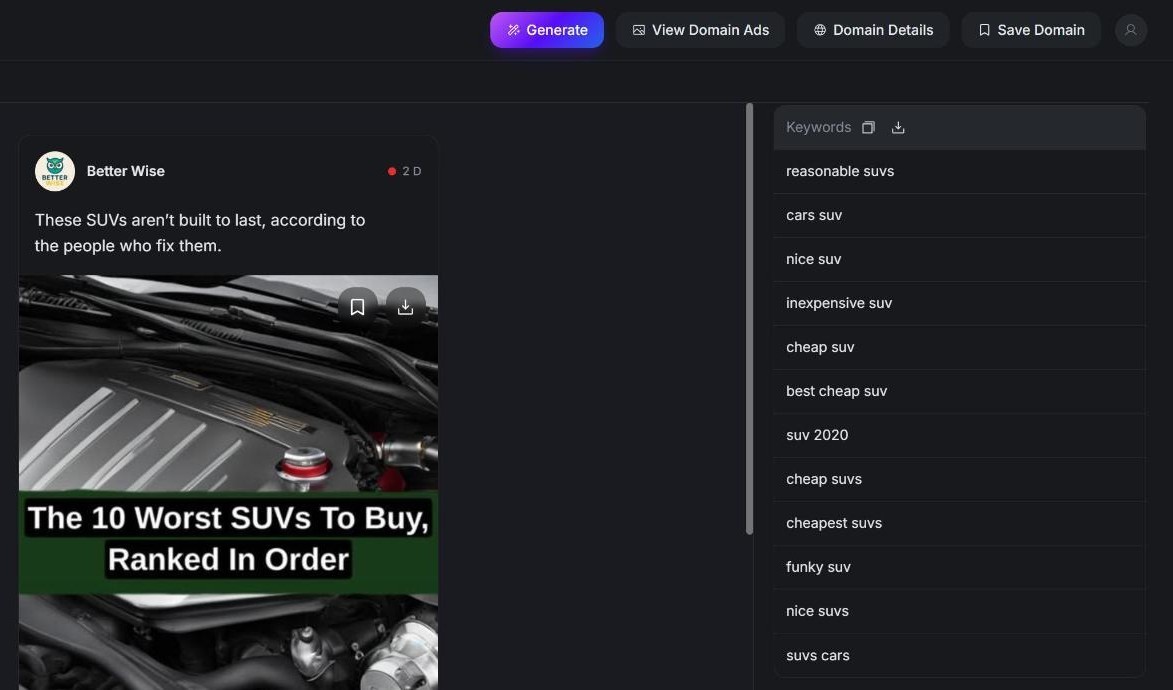
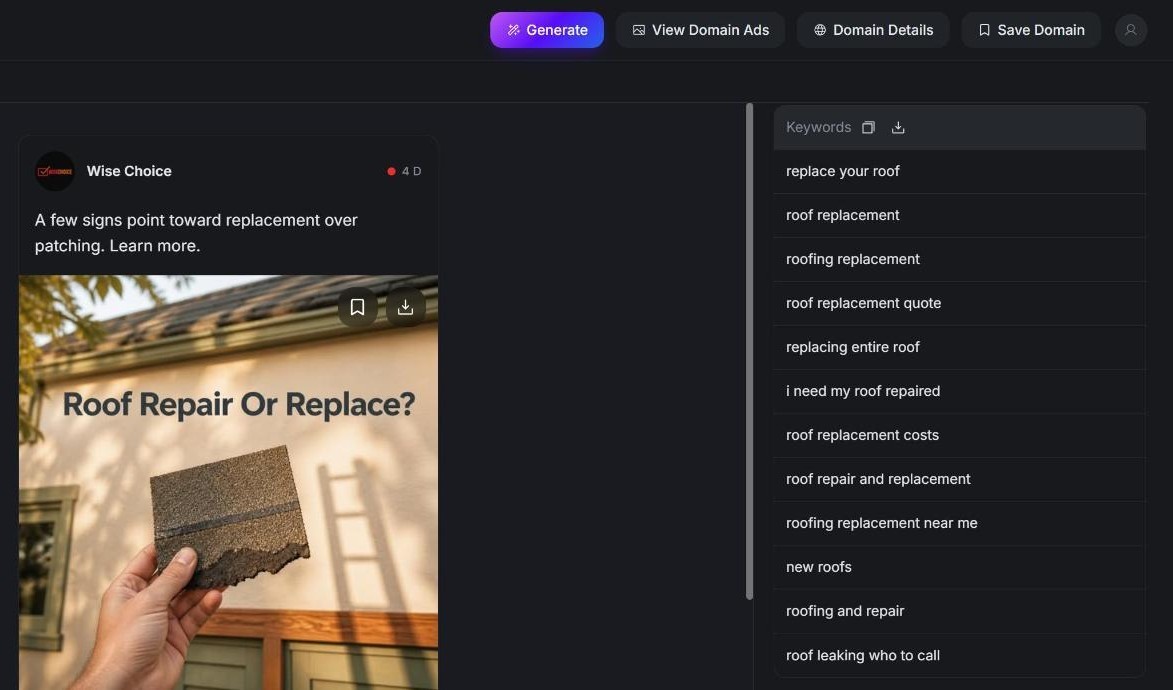
Line up a headline against the page it lands on and the picture gets sharper. The Better Wise ad reads "Mechanics Warn About the Long-Term Costs of These SUVs," and the click lands on a creatorrule.com article about the 10 worst SUVs to buy for long-term reliability: same topic, repackaged as a ranked list. The Wise Choice ad reads "When A Roof Needs Replacing Instead Of Patching," and lands on a goodprojectideas.com article about the clear signs a roof needs replacing rather than repairing.
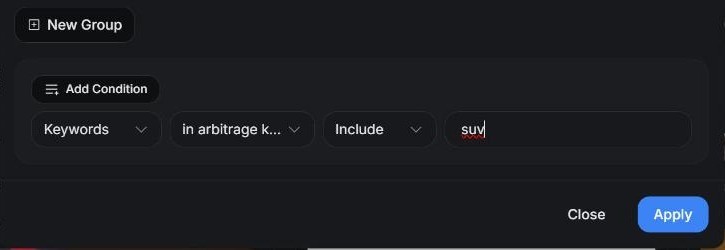
AdPlexity surfaced both through the arbitrage keywords "suv" and "roof replacement," but neither landing URL carries keyword parameters. The topic sits in the slug instead. Check the slug, not just the query string.
This lines up with AdPlexity's own research from December 2025: cars and travel lead RSOC ads in the US, with home services close behind. The September 2026 examples above sit in those same three areas. If you want to find the search arbitrage keywords operators are scaling right now, that post walks through the exact filters.

How Do You Pick the Right Keywords for Search Arbitrage?
The keyword is the decision that matters most, more than the creative or the page it lands on. Advertiser bids on that keyword set the RPC, so the same visitor, on the same kind of article, can be worth almost nothing or genuinely good money depending only on which term the funnel feeds the page. A great hook on a weak keyword still loses money, because RPC is the half you do not control.
Picking well means watching where other operators are adding ad volume right now, not where volume piled up historically. A keyword growing week over week is the clearest signal: other buyers are finding it and scaling into it. A brand-new keyword already picking up ads fast is usually the most interesting case, since nobody has crowded into it yet. A shrinking keyword usually means either enough operators piled in and ate the payout, or the advertiser bids behind it dropped and the RPC went with them.
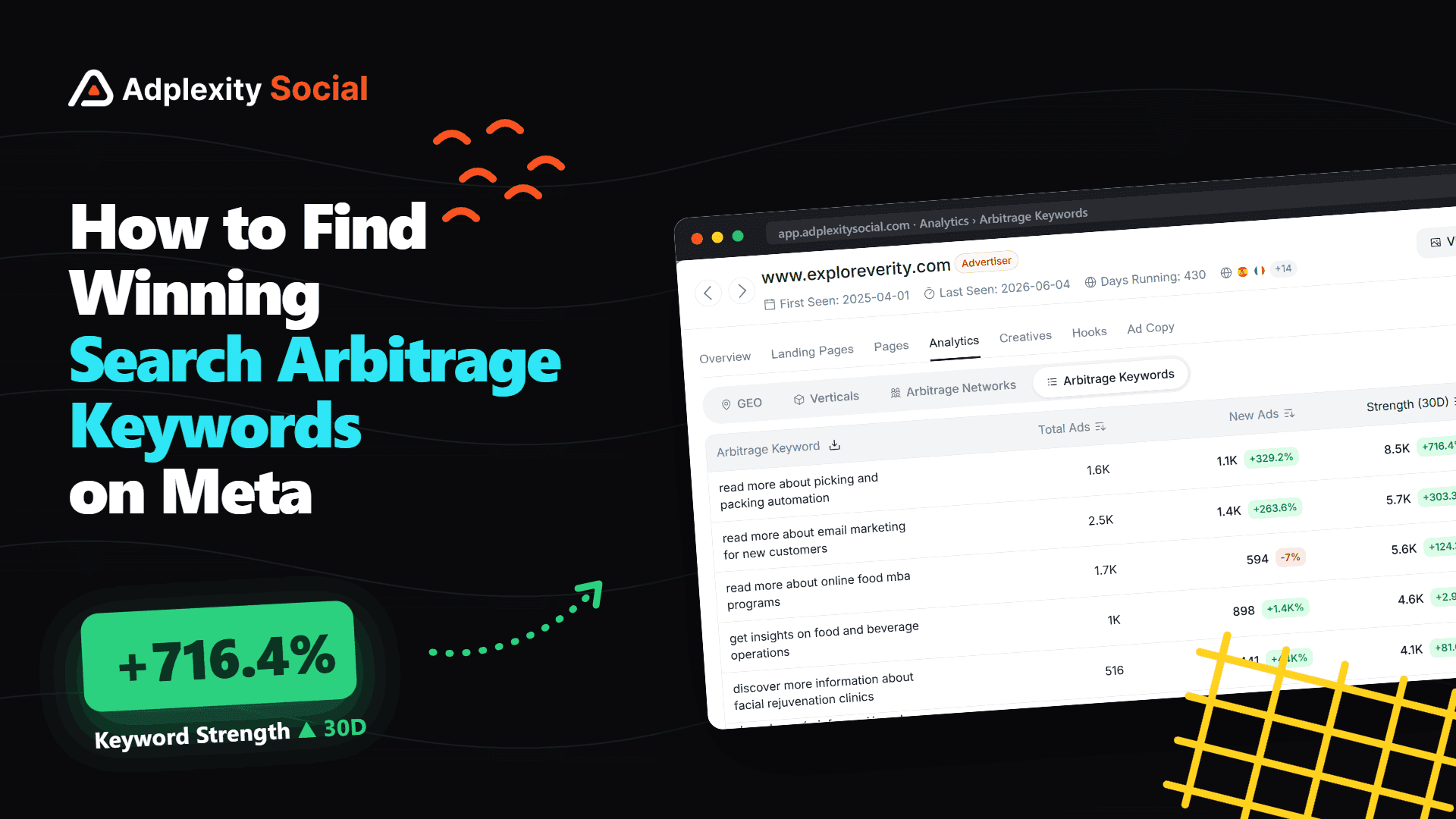
This is what the Arbitrage Keywords view in AdPlexity Social is built for. Open a search arbitrage domain in Domain Details, go to Analytics, then Arbitrage Keywords. AdPlexity Social rolls up the keywords from every ad pointing at that domain into one table: each keyword with its total ads, its new ads and how they compare with the previous period, a 30-day Strength score, and how many days it has been running. Sort it by new ads to see where operators are launching right now. The single ads shown earlier in this guide each carried their own arbitrage keywords; this view is the same data aggregated at the domain level.
Take exploreverity.com, a Visymo (RSOC) domain with about 961,500 ads behind it and 164,000 of them launched in the last 30 days. Near the top of its table, "read more about medical service platform consulting" sits on about 2,500 ads, almost all of them new, on a keyword that has been running for 20 days. That is the brand-new, fast-moving kind. A few rows down, "get insights on environmental testing" has about 3,500 ads over 90 days, but its new ads are down 5.3 percent on the previous period. Still big, no longer growing.
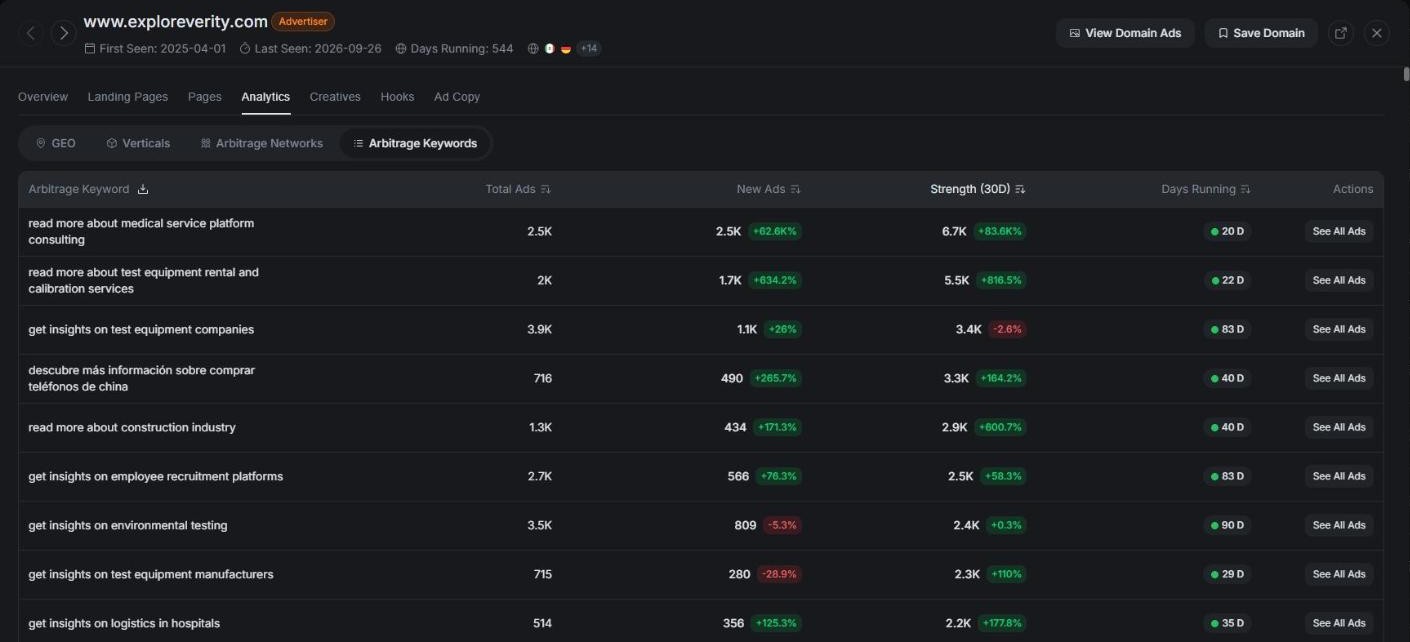
The download icon on the Arbitrage Keyword header exports the whole table, so you can take the keyword list with you and use it to build and test your own campaigns.
How Do You Spot a Search Arbitrage Funnel Behind a Meta Ad?
A search arbitrage ad tips its hand before you even click: an informational, topic-led headline where a product pitch should be. What confirms it is everything AdPlexity Social shows you after that click, the layer most spy tools never reach.
No single signal proves it. You need a combination, and once you know what to look for, they stack up fast.
Start with the domain. It rarely matches the advertiser's own page name or caption.
Then check the landing URL. Sometimes the topic shows up in keyword parameters. Sometimes it is baked into the article slug instead.
Look for a related-search block on the page, and for a tracker riding in the redirect path. ClickFlare and Binom both turned up across the ads pulled for this guide.
Last, check the network tag AdPlexity attaches. Either it names the feed provider, or it comes back Unknown: arbitrage AdPlexity can detect but cannot attribute.
AdPlexity's technical fingerprint method was originally built for hidden affiliate offers, but it reads the same clues here: tracker names, redirect patterns, script signatures.
Is Search Arbitrage Still Profitable in 2026?
Yes, but only if you can run on thin margins under stricter rules than the model had two years ago. The arithmetic has not changed: RPC minus CPC is still the entire business. What changed is the tolerance for sloppy traffic and thin pages, and that tolerance has dropped hard.
The model still pays if you get the details right. The margin estimates quoted earlier, a few cents per click or roughly 10 to 30 percent depending on the source, come from current practitioner guides. What changed is the cost of getting it wrong, visible in the System1, Sedo, and Bodis numbers covered above. Working campaigns leave a footprint too: once a creative angle works, the same advertiser repeats it across dozens of active ads, one SUV angle across more than 80. That is exactly the kind of pattern AdPlexity Social surfaces.
Three things can end a campaign's profitability overnight, and none of them are under your control. RPC moves whenever advertiser bids on that keyword move. Meta's own costs move independently, on their own schedule. And enforcement, a policy strike, a lost related-search feature, or a feed provider dropping a buyer, can cut the revenue side entirely while the cost side keeps running.
Frequently Asked Questions
Is search arbitrage legal?
Yes, search arbitrage is legal. Google's AdSense for Search policies spell out how a publisher buying traffic has to run it: traffic that misdescribes the destination page is a violation, and so are related-search placements on pages without enough real content to back them up. Meta's own ad standards apply on top of that.
What does RSOC stand for in search arbitrage?
RSOC stands for Related Search on Content, Google's related search feature for content pages. A page carries search terms tied to its topic, and clicking one opens a search results page, styled to match the site, that lives on the publisher's own domain.
What is the difference between AFD and RSOC?
The difference is what each one runs on. AFD, short for AdSense for Domains, let ads sit on parked domains with little or no content, and Google removed it from its Search Partner Network on February 10, 2026. RSOC, related search for content, replaced it: the related search terms now sit on a real article instead of a bare parked page, and Google reviews the ad creative that sent the visitor there too.
Is search arbitrage the same as traffic arbitrage?
No. Traffic arbitrage is the umbrella term: buying traffic cheap in one place and monetizing it for more somewhere else. Search arbitrage is just the version paid on a sponsored search click. Content arbitrage, sometimes called display arbitrage, monetizes page views directly, and affiliate arbitrage pays on a sale or a lead instead of a click.
How do search feed providers pay media buyers?
They pay a revenue share: a cut of whatever the search ads on their feed generate from a buyer's visitors, reported back by the feed itself. Each provider sets its own split and payout terms, and none of them publish it. Google disclosed in 2010 that its AdSense for Search partners kept 51 percent of that revenue.
How much money do you need to start search arbitrage?
Budget $100 to $300 a day for testing, per practitioner guides. ClickFlare's 2026 guide suggests $1,000 or more a day once a campaign scales. Treat both numbers as estimates, not guarantees: RPC on any given keyword can swing the math a lot.
Why do search arbitrage campaigns suddenly stop being profitable?
Because the variables are not under your control. Advertiser bids set RPC, Meta sets its own costs on its own schedule, and either one can shift without warning. Add enforcement on top, a strike, a lost related-search feature, or a feed dropping a buyer, and revenue can stop while your costs keep running.
Can you research search arbitrage campaigns in the Meta Ad Library?
Only partly. The Ad Library shows you the creative itself, but not the feed network behind it, the article the click lands on, the keyword that article is built around, or the tracker running the redirect: the parts that actually explain the model. AdPlexity Social's post on what the Meta Ad Library leaves out covers the gap in more detail.
Where to Start Researching Search Arbitrage
Want a working method instead of theory? The two posts linked above, one on finding the keywords operators are scaling right now and one on identifying profitable RSOC ads and domains, walk through the exact filters step by step. Inside AdPlexity Social, set Industry to Search arbitrage and open any ad: the article it points to, the keyword behind it, and the network tag all sit in the same view. Sign up at adplexity.io to see it on your own vertical.
In search arbitrage, the media buyer never sells anything. They get paid when the visitor they paid Meta for turns around and clicks somebody else's ad on a search results page that has nothing to do with the product in the original ad. That is the whole model. If you run paid traffic on Meta and keep seeing search arbitrage or RSOC mentioned in spy tools and forums, this guide explains the model in plain terms: who pays whom, what RSOC changed, and what the live funnels look like right now.
Key takeaways. Search arbitrage earns money on the search-ad click a visitor makes after landing, not on a sale, and on Meta the working version is RSOC: an ad, an article, a related search term, and a sponsored result. Google has tightened this from two directions: it removed parked-domain ads from its Search Partner Network on February 10, 2026, and since November 1, 2025 it has required publishers to pass along the exact text of the ad that sent each visitor. That means the Meta creative you write is now effectively part of Google's review. AdPlexity Social detects 16 named search arbitrage networks, most tagged separately for RSOC and the older AFD model, and 8 of those had RSOC ads live on Meta in a 30-day check in September 2026. Across all countries in the last 30 days, Visymo led with about 505,000 RSOC ads on Meta, Tonic followed with about 122,500, and System1 trailed with about 4,900.
What Is Search Arbitrage?
Search arbitrage means buying a visit on a platform such as Meta, sending it to a page built around a search topic, and earning a share of the revenue when that visitor clicks a sponsored search result further down the page. Simple enough: profit is just the gap between what the visit cost you and what the search click paid out. People also call this search feed arbitrage, search arb, or RSOC arbitrage; take your pick.
Five parties make this work. Meta is the traffic source here, though the same model runs on TikTok and other native networks, and Taboola and Outbrain get named as traffic sources for it too. You, the media buyer, pay for that traffic. The feed provider holds the actual search partnership; Visymo, Tonic, and System1 are well-known names in that seat. Behind RSOC sits the search ad network: Google's AdSense for Search infrastructure, though PropellerAds also lists Bing and Yahoo among the search engines in this model. And the advertisers are the businesses bidding on the keywords that end up on the results page.
Two numbers matter before anything else. CPC or CPM is what you pay Meta for the visit. RPC or RPM is the revenue per click, or per thousand visits, that the feed reports back. The entire business is RPC minus CPC.
How Does Search Arbitrage Make Money?
Here is the only part of this chain that actually pays: a visitor clicking a sponsored result on a search results page. The advertiser bidding on that result pays the search network, the network pays its publisher partner, and the partner pays your cut as the media buyer. Everything before that, the Meta ad view, the article view, the related-search click, either costs you money or costs nothing at all. Only that last click pays anyone.
Step | What the visitor does | Money that moves | Who receives it |
|---|---|---|---|
1 | Clicks the Meta ad | The media buyer pays Meta a CPC or CPM | Meta |
2 | Lands on the article, sees the related search terms | Nothing yet | Nobody |
3 | Clicks a related search term, a results page loads | Nothing yet | Nobody |
4 | Clicks a sponsored result on that page | The advertiser pays its click price to Google | |
5 | Nothing more. The split happens behind the scenes | Google keeps its share of that click price | Google, then the feed provider, then the media buyer with what is left |
Google confirmed the only number in this chain back in 2010: AdSense for Search partners keep 51 percent of the revenue from the search ads on their sites. What the feed provider pays you, the media buyer, is negotiated case by case, and nobody publishes it. Treat any specific split you see online as one operator's deal, not an industry figure.
Here is that chain on a real ad. A Page called Auto Finder ran a post about classic Chevy C10 pickups that reads like any nostalgic car content: the trucks are turning heads again, and collectors cannot get enough of them. Nothing in it mentions search, a feed or a keyword. It does not need to: the ad only has to earn the click. The one clue comes from AdPlexity Social, which tags the ad System1 (RSOC).
A ClickFlare redirect carries Meta's tracking parameters through, then lands on the real article at prudentinfo.com, a domain that has nothing to do with the classic-c10.com caption or the Auto Finder page.
The article, "Classic Chevy C10 Pickups for Collectors," reads like an ordinary automotive blog post. But it carries two related-search blocks of three buttons each, phrases such as "Chevy C10 for Sale Near Me" and "Short Bed Chevy Trucks for Sale." Click one and a search results page loads. The sponsored links there are what earn the RPC.
Open the landing URL in full and six parameters show up, forceKeyA through forceKeyF, holding phrases such as "1967 chevy c10 shortbed for sale" and "chevy c10 hagerty valuation guide." Those are the keywords the funnel feeds the page and the ones AdPlexity records against the ad. They are not a guaranteed preview of what a visitor sees: the article's related-search blocks showed six different phrases, and none matched a forceKey value word for word. Treat the parameters as what the funnel targets, not a guarantee of what is on the page.
The same URL also carries three tracker event links, for the article view, the related-search click, and the sponsored-result click, matching steps 2 through 4 in the table above.
Margins are thin. ClickFlare's 2026 guide to native-to-search arbitrage puts profit at a few cents per click, or 10 to 25 percent, and calls for a working budget of $100 to $300 a day to test and $1,000 or more a day once a campaign scales. Traffic Cardinal puts typical search feed arbitrage margins at 15 to 30 percent. SearchADX breaks down the arithmetic per visitor: $0.12 cost, $0.15 revenue, $0.03 profit. That is one illustration, not a rate to expect consistently.
Every one of those numbers hangs on RPC, and you do not control that. Advertiser bids set it. That is also why campaigns can stop working overnight.
What Is RSOC, and How Is It Different From Classic Search Arbitrage?
RSOC stands for Related Search on Content. Google's own name for it is plainer: related search for content. The mechanic is simple: search terms tied to the page's content show up on that page, you click one, and it opens a search results page on the publisher's own site.
You cannot just sign up for it. Google offers RSOC to publishers holding an AdSense for Search contract, and most media buyers reach it through a feed provider that already holds one on their behalf.
RSOC did not come out of nowhere. Before it, the same idea ran two simpler ways: a one-click flow that sent the Meta ad straight to a page built to look like a results page, and a two-click flow that added a keyword-themed pre-lander before that. PropellerAds has documented both flows running behind Google, Bing, and Yahoo.
Classic | RSOC | |
|---|---|---|
Where the click lands | A parked domain or a results-style page | An article built around the topic |
Clicks before revenue | One, on a sponsored link on that page | A related search term, then a sponsored result |
Content needed | Little to none | A real article |
Google product behind it | AdSense for Domains (AFD) | AFS related search for content |
Status in 2026 | Dead: parked-domain ads removed from Google's Search Partner Network on February 10, 2026 | Active, under restricted access features and the referrer ad creative rule |
How AdPlexity labels it | The network name alone, for example System1, its classic tag for AFD funnels | The network name plus RSOC, for example System1 (RSOC) |
AdPlexity's own tags make the difference visible in the landing URLs. The classic tag marks an AFD funnel, the RSOC tag marks the current model.
Pull up a classic-tagged Tonic ad ("Computer Education Programs") next to an RSOC-tagged Tonic ad ("Medical Assistant Training Requirements"), both active in the same 30-day check, and they land in very different places.
The classic ad runs through a ClickFlare redirect to a page on a results subdomain, results.nextdoordigest.com, with site=facebook in the URL. The network value names the exact Facebook placement: network=facebook_search on one landing URL, network=facebook_feed on another.
The RSOC ad skips the redirect entirely. It lands straight on an /articles/ page on intuitionlink.com, with site=rsoc in the query string.
Here is what that tells you: classic-tagged ads still turn up on Meta in 2026, but the model behind them no longer has Google's parked-domain ads to sell. The wrapper kept running. The parked-domain payout behind it did not.
What Changed in the Rules in 2025 and 2026?
Google moved fast. In less than two years it shut down the older parked-domain version of this model, tightened the version that replaced it, and started reading the actual ad text that sends the traffic. Three changes, one direction.
AdSense for Domains did not end in one move. It ended in three stages: starting in late 2024, Google first stopped adding new advertisers, then let existing ones opt out through 2025, and on February 10, 2026, switched parked domains off for everyone. By that third stage, there was nothing left to opt out of.
RSOC tightened too, absorbing AFD's leftover demand. From August 2025, Google's restricted access features cap publishers at five suggested terms per ad block and one related-search block per page, on top of limits on styling and reporting. Publishers in good standing can get those limits lifted, but only case by case.
SearchADX reports a three-strike system running alongside those restrictions: 90 days of probation, then 90 more days of severe restriction with an account hold, then permanent loss of the feature. The AdSense account itself stays open. That three-strike structure comes from SearchADX's own reporting, not from Google, which has not published anything like it.
The bigger change for Meta buyers is the referrer ad creative rule. Starting November 1, 2025, publishers have to supply the precise, complete text of the ad or link that sent each visitor, whenever that source is under their control, including any third-party network or affiliate. Google wants a literal transcription, not a summary: title lines, body copy, button text, on-image text, and any video or audio transcript.
That means Google now effectively sees your Meta ad's headline and text. A mismatch between the ad and the article is no longer just a Meta problem. It shows up on Google's side too.
Meta's own ad standards sit on top of this. Withhold information, run an exaggerated headline the landing page does not deliver on, or bait likes, comments, and shares, and you are looking at reduced distribution or disapproval. That policy has been in place since 2018. None of it was written with search arbitrage in mind. It does not have to be: a search arbitrage ad gets reviewed like anything else on the platform.
The fallout shows up in the public numbers. System1 reported 2025 revenue down 23 percent to $266.1 million. System1's annual report shows 67 percent of that revenue came from its agreements with Google. That is how exposed one company was to a single relationship.
Sedo, a domain-parking company built on the older model, saw Q3 2025 revenue fall 66 percent and was put up for sale. Bodis, another parking platform, shut down on January 31, 2026.
The creative itself shifted too, and it shows up in AdPlexity's own data. Our research into identifying profitable RSOC ads and domains tracked a move toward softer, image-plus-headline creatives once the compliance push started. That is the kind of ad that is harder to accuse of misdescribing anything.
Search Arbitrage vs Affiliate Marketing: What Is the Difference?
Search arbitrage pays you on the click. Affiliate marketing pays you on the action. A visitor clicks a sponsored search result and you get paid, or a visitor buys something or submits a lead form and that triggers the payout instead. That is the entire difference.
This split is not new: the line between click-based and action-based payouts was already being drawn in 2007, and it still holds.
Search arbitrage | Affiliate marketing | |
|---|---|---|
What you are paid for | A click on a sponsored search result | A sale or a lead |
Who pays you | The feed provider, out of search-ad revenue | The advertiser, usually through a network such as ClickBank, BuyGoods, Digistore24, or GiddyUp |
What the visitor has to do | Click a search ad | Buy something or sign up |
Where the traffic goes | An article or a keyword page | The offer, often behind a pre-lander, an advertorial, or a VSL |
What moves your margin | RPC, set by advertiser bids on the keyword | Payout and conversion rate |
Main rulebook | The feed provider's and Google's policies, plus Meta's ad standards | The network's and advertiser's terms, plus Meta's ad standards |
How AdPlexity labels it | The arbitrage network filter | The affiliate network and affiliate offer filters |
Three other terms get tossed around as if they mean the same thing as search arbitrage. They do not. Content arbitrage monetizes page views directly with display ads, no search click required. Click arbitrage buys clicks on Google search results and resells that traffic into affiliate offers, the model Joey Babineau ran on Google search for years before margins collapsed. Traffic arbitrage is the umbrella term for all three: buy traffic cheap, monetize it elsewhere for more.
Which Search Arbitrage Networks (Feed Providers) Run on Meta?
A feed provider holds the AdSense for Search partnership. It approves media buyers, supplies the feed, sets the revenue share, and pays out. AdPlexity Social tags 16 named feed providers behind search arbitrage ads, most carrying two tags: RSOC for the current model, and a classic tag for the older AFD funnels. Funnels that are clearly arbitrage but do not trace back to a named feed land in the Unknown bucket.
Network | RSOC ads live on Meta, last 30 days | Classic (AFD) ads live on Meta, last 30 days |
|---|---|---|
System1 | yes | yes |
Tonic | yes | yes |
Sedo | yes | yes |
Clicksco | yes | yes |
Inuvo | yes | yes |
Compado | yes | none found |
Predicto | yes | none found |
Visymo | yes | no classic tag |
Yahoo Search | none found | yes |
Media.net | none found | yes |
Codefuel | none found | yes |
AFS | none found | yes |
DomainActive | none found | none found |
Ads.com | none found | none found |
Aporia | none found | none found |
AirFind | none found | no classic tag |
Eight of those 16 networks had RSOC-tagged ads live on Meta in the 30-day check: Visymo, System1, Tonic, Sedo, Clicksco, Inuvo, Compado, and Predicto. Four more, Yahoo Search, Media.net, Codefuel, and AFS, showed up only under the classic tag. DomainActive, Ads.com, Aporia, and AirFind returned nothing, though the Unknown bucket still had live ads.
The table only tells you who is present. Volume tells a different story. Over the last 30 days, across all countries, Visymo carries about 505,000 RSOC ads on Meta, Tonic about 122,500, Predicto about 21,900, System1 about 4,900 plus another 2,000 under its classic tag, Inuvo about 3,500, Compado about 2,500, and Sedo about 250. Visymo is where most of the RSOC volume on Meta sits right now. Tonic is a clear second. System1, for all its name recognition, is a small player in this data.
Inside AdPlexity Social, the fastest way into this vertical is the Industry filter. Set it to Search arbitrage and you are in. You do not need to build that filter combination yourself.
What Do Search Arbitrage Ads on Meta Look Like Right Now?
The creative almost never sells a product. It sells a topic, a hook about cars, travel, home services, whatever the feed has inventory for, and the money sits in the keyword behind the article, not in anything the ad asks you to buy.
Lined up together, these ads show one clear pattern: the same topic running on more than one page at once. Take the System1 (RSOC) ad on the page Nustar Trenz. The headline reads "Understanding Amtrak All-Inclusive Packages." The identical creative also ran on Daily Dose Hub, and a second Amtrak creative ran on both Nustar Trenz and FactFlow. That repetition, not any one ad on its own, is the signal worth watching for.
Longevity tells you something too. On the Tonic (RSOC) side, the page Things Needed to You has run "Car Key Replacement" for at least three weeks. The page Discount Magic has been running "🚘 Learn more about Ford Maverick Truck Clearance 🚘" for more than three months. An ad that sticks around that long is well past the testing stage.
Line up a headline against the page it lands on and the picture gets sharper. The Better Wise ad reads "Mechanics Warn About the Long-Term Costs of These SUVs," and the click lands on a creatorrule.com article about the 10 worst SUVs to buy for long-term reliability: same topic, repackaged as a ranked list. The Wise Choice ad reads "When A Roof Needs Replacing Instead Of Patching," and lands on a goodprojectideas.com article about the clear signs a roof needs replacing rather than repairing.
AdPlexity surfaced both through the arbitrage keywords "suv" and "roof replacement," but neither landing URL carries keyword parameters. The topic sits in the slug instead. Check the slug, not just the query string.
This lines up with AdPlexity's own research from December 2025: cars and travel lead RSOC ads in the US, with home services close behind. The September 2026 examples above sit in those same three areas. If you want to find the search arbitrage keywords operators are scaling right now, that post walks through the exact filters.
How Do You Pick the Right Keywords for Search Arbitrage?
The keyword is the decision that matters most, more than the creative or the page it lands on. Advertiser bids on that keyword set the RPC, so the same visitor, on the same kind of article, can be worth almost nothing or genuinely good money depending only on which term the funnel feeds the page. A great hook on a weak keyword still loses money, because RPC is the half you do not control.
Picking well means watching where other operators are adding ad volume right now, not where volume piled up historically. A keyword growing week over week is the clearest signal: other buyers are finding it and scaling into it. A brand-new keyword already picking up ads fast is usually the most interesting case, since nobody has crowded into it yet. A shrinking keyword usually means either enough operators piled in and ate the payout, or the advertiser bids behind it dropped and the RPC went with them.
This is what the Arbitrage Keywords view in AdPlexity Social is built for. Open a search arbitrage domain in Domain Details, go to Analytics, then Arbitrage Keywords. AdPlexity Social rolls up the keywords from every ad pointing at that domain into one table: each keyword with its total ads, its new ads and how they compare with the previous period, a 30-day Strength score, and how many days it has been running. Sort it by new ads to see where operators are launching right now. The single ads shown earlier in this guide each carried their own arbitrage keywords; this view is the same data aggregated at the domain level.
Take exploreverity.com, a Visymo (RSOC) domain with about 961,500 ads behind it and 164,000 of them launched in the last 30 days. Near the top of its table, "read more about medical service platform consulting" sits on about 2,500 ads, almost all of them new, on a keyword that has been running for 20 days. That is the brand-new, fast-moving kind. A few rows down, "get insights on environmental testing" has about 3,500 ads over 90 days, but its new ads are down 5.3 percent on the previous period. Still big, no longer growing.
The download icon on the Arbitrage Keyword header exports the whole table, so you can take the keyword list with you and use it to build and test your own campaigns.
How Do You Spot a Search Arbitrage Funnel Behind a Meta Ad?
A search arbitrage ad tips its hand before you even click: an informational, topic-led headline where a product pitch should be. What confirms it is everything AdPlexity Social shows you after that click, the layer most spy tools never reach.
No single signal proves it. You need a combination, and once you know what to look for, they stack up fast.
Start with the domain. It rarely matches the advertiser's own page name or caption.
Then check the landing URL. Sometimes the topic shows up in keyword parameters. Sometimes it is baked into the article slug instead.
Look for a related-search block on the page, and for a tracker riding in the redirect path. ClickFlare and Binom both turned up across the ads pulled for this guide.
Last, check the network tag AdPlexity attaches. Either it names the feed provider, or it comes back Unknown: arbitrage AdPlexity can detect but cannot attribute.
AdPlexity's technical fingerprint method was originally built for hidden affiliate offers, but it reads the same clues here: tracker names, redirect patterns, script signatures.
Is Search Arbitrage Still Profitable in 2026?
Yes, but only if you can run on thin margins under stricter rules than the model had two years ago. The arithmetic has not changed: RPC minus CPC is still the entire business. What changed is the tolerance for sloppy traffic and thin pages, and that tolerance has dropped hard.
The model still pays if you get the details right. The margin estimates quoted earlier, a few cents per click or roughly 10 to 30 percent depending on the source, come from current practitioner guides. What changed is the cost of getting it wrong, visible in the System1, Sedo, and Bodis numbers covered above. Working campaigns leave a footprint too: once a creative angle works, the same advertiser repeats it across dozens of active ads, one SUV angle across more than 80. That is exactly the kind of pattern AdPlexity Social surfaces.
Three things can end a campaign's profitability overnight, and none of them are under your control. RPC moves whenever advertiser bids on that keyword move. Meta's own costs move independently, on their own schedule. And enforcement, a policy strike, a lost related-search feature, or a feed provider dropping a buyer, can cut the revenue side entirely while the cost side keeps running.
Frequently Asked Questions
Is search arbitrage legal?
Yes, search arbitrage is legal. Google's AdSense for Search policies spell out how a publisher buying traffic has to run it: traffic that misdescribes the destination page is a violation, and so are related-search placements on pages without enough real content to back them up. Meta's own ad standards apply on top of that.
What does RSOC stand for in search arbitrage?
RSOC stands for Related Search on Content, Google's related search feature for content pages. A page carries search terms tied to its topic, and clicking one opens a search results page, styled to match the site, that lives on the publisher's own domain.
What is the difference between AFD and RSOC?
The difference is what each one runs on. AFD, short for AdSense for Domains, let ads sit on parked domains with little or no content, and Google removed it from its Search Partner Network on February 10, 2026. RSOC, related search for content, replaced it: the related search terms now sit on a real article instead of a bare parked page, and Google reviews the ad creative that sent the visitor there too.
Is search arbitrage the same as traffic arbitrage?
No. Traffic arbitrage is the umbrella term: buying traffic cheap in one place and monetizing it for more somewhere else. Search arbitrage is just the version paid on a sponsored search click. Content arbitrage, sometimes called display arbitrage, monetizes page views directly, and affiliate arbitrage pays on a sale or a lead instead of a click.
How do search feed providers pay media buyers?
They pay a revenue share: a cut of whatever the search ads on their feed generate from a buyer's visitors, reported back by the feed itself. Each provider sets its own split and payout terms, and none of them publish it. Google disclosed in 2010 that its AdSense for Search partners kept 51 percent of that revenue.
How much money do you need to start search arbitrage?
Budget $100 to $300 a day for testing, per practitioner guides. ClickFlare's 2026 guide suggests $1,000 or more a day once a campaign scales. Treat both numbers as estimates, not guarantees: RPC on any given keyword can swing the math a lot.
Why do search arbitrage campaigns suddenly stop being profitable?
Because the variables are not under your control. Advertiser bids set RPC, Meta sets its own costs on its own schedule, and either one can shift without warning. Add enforcement on top, a strike, a lost related-search feature, or a feed dropping a buyer, and revenue can stop while your costs keep running.
Can you research search arbitrage campaigns in the Meta Ad Library?
Only partly. The Ad Library shows you the creative itself, but not the feed network behind it, the article the click lands on, the keyword that article is built around, or the tracker running the redirect: the parts that actually explain the model. AdPlexity Social's post on what the Meta Ad Library leaves out covers the gap in more detail.
Where to Start Researching Search Arbitrage
Want a working method instead of theory? The two posts linked above, one on finding the keywords operators are scaling right now and one on identifying profitable RSOC ads and domains, walk through the exact filters step by step. Inside AdPlexity Social, set Industry to Search arbitrage and open any ad: the article it points to, the keyword behind it, and the network tag all sit in the same view. Sign up at adplexity.io to see it on your own vertical.
Table of Contents
Quickly navigate through the key sections of this article.
Discover Winning Meta Ads
Similar Blogs
Check related blogs
Check related blogs
Check related blogs












Ready to See What’s Really Working on Meta?
Adplexity
Social
© Copyright 2026 All Rights Reserved
Ready to See What’s Really Working on Meta?
Adplexity
Social
© Copyright 2026 All Rights Reserved
Ready to See What’s Really Working on Meta?
Adplexity
Social
© Copyright 2026 All Rights Reserved