Pick the tool by the job, not the database size. Here is which one to open depending on what you actually need to know.
Pick the tool by the job, not the database size. Here is which one to open depending on what you actually need to know.
If you buy Meta traffic in one niche and one country and want to know which creatives are actually working there, the tool you pick depends on which question you are asking. This guide sorts eight tools by the job they actually do, then walks through the search that turns a niche and GEO combination into a usable shortlist in about fifteen minutes.
TL;DR: Start with the question, not the tool. “What ads exist here” is answered by Meta Ad Library, AdSpy, or BigSpy. “What products are selling here” is Minea's job. “Help me organize what I already found” is Foreplay or GetHookd. “Who is actually behind this creative, and is it worth copying?” is the one question none of those answer, because it requires reading the landing page, the redirect chain, and the tech stack, not just the ad. AdPlexity Social is built around that layer specifically: it indexes landing page text, crawls redirects end to end, and flags the affiliate network, arbitrage network, and technology behind each funnel.
Start with the question you are actually asking
Most people shop for an ad spy tool by database size. Wrong axis. The better question is what you need the tool to prove, because the eight tools below split cleanly into three jobs.
Job one: what ads exist in this niche and country. Meta Ad Library, AdSpy, and BigSpy all answer this. They differ in coverage and how far back their archive goes, but the output is the same: a list of ads and where they lead.
Job two: what products or offers are moving in this market. Minea answers this specifically, starting from the product rather than the ad.
Job three: organize what you already found into something usable. Foreplay and GetHookd do this. Neither one discovers ads on its own; both take a shortlist you built somewhere else and turn it into tagged boards or briefs.
Job four: tell me what is actually behind this creative. This is the job most tools skip, and it is the one that decides whether a “winning” ad in your result set is a real brand worth studying or an arbitrage funnel with nothing to teach you about your own product. AdPlexity Social and, to a lesser extent, SocialPeta are the two tools here, and only one of them does it at the individual-ad level with landing page detail.
Here is the same split in a table.
Tool
Best job
Niche filtering
GEO targeting
Post-click detail
AdPlexity Social
Job four: identify the business behind a creative
Vertical and sub-niche filters, plus keyword search inside landing page text
Why job four is the one that actually decides “winning”
Nobody can see a competitor's spend or ROAS. Meta does not publish either for commercial ads, so any tool claiming to show them is estimating. What every tool on this list can observe instead is behavior: how long an ad runs, how many duplicates of the same creative exist across advertiser profiles, how many of those duplicates appeared in the last week, and what the ad leads to.
The first three signals tell you a creative has traction somewhere. They do not tell you whose traction it is, and that gap matters more than it sounds. Two ads can run the same number of days, in the same country, with nearly the same creative, and be completely different businesses: one a brand selling a product, the other an arbitrage operator monetizing the click and passing the visitor along. If your tool stops at the creative, both look identical.
Here is what that looks like with real numbers.
One search, five ads, three different businesses
On 2 September 2026, we ran “retinol” through AdPlexity Social against Germany, matching the keyword in either the ad copy or the landing page text, with the Longevity filter set to 30 days or more.
Three results were straightforward DTC brands. Mádara Organic Skincare had a creative running 76 days across Germany and Spain, pointing to madaracosmetics.com, a Shopify store. ARYA LAYA had one at 65 days landing on a specific product page, arya-laya.de/hyaluron-miracle-night. KLAPP Skin Care Science had one at 32 days on klapp-skincare.com, also Shopify. Nothing unusual here: real products, own domains, sustained campaigns.
The fourth result, Radiant Feeds Insights, had been running 44 days with a plain German headline, “Pigmentflecken Im Gesicht Entfernen,” over a caption reading radiantfeeds.com. By creative alone, it reads as a fourth skincare advertiser. The landing page tells a different story. The actual destination is related.radiantfeeds.com/topics/2224904/BCC42CF/, a search feed page carrying an encoded keyword parameter and three sub-ID slots mapped to the Meta campaign, ad set, and ad IDs. The outgoing links from that page resolve to retixol.de. This is not a skincare brand. It is buying a German click and monetizing it through a search feed before passing the visitor on.
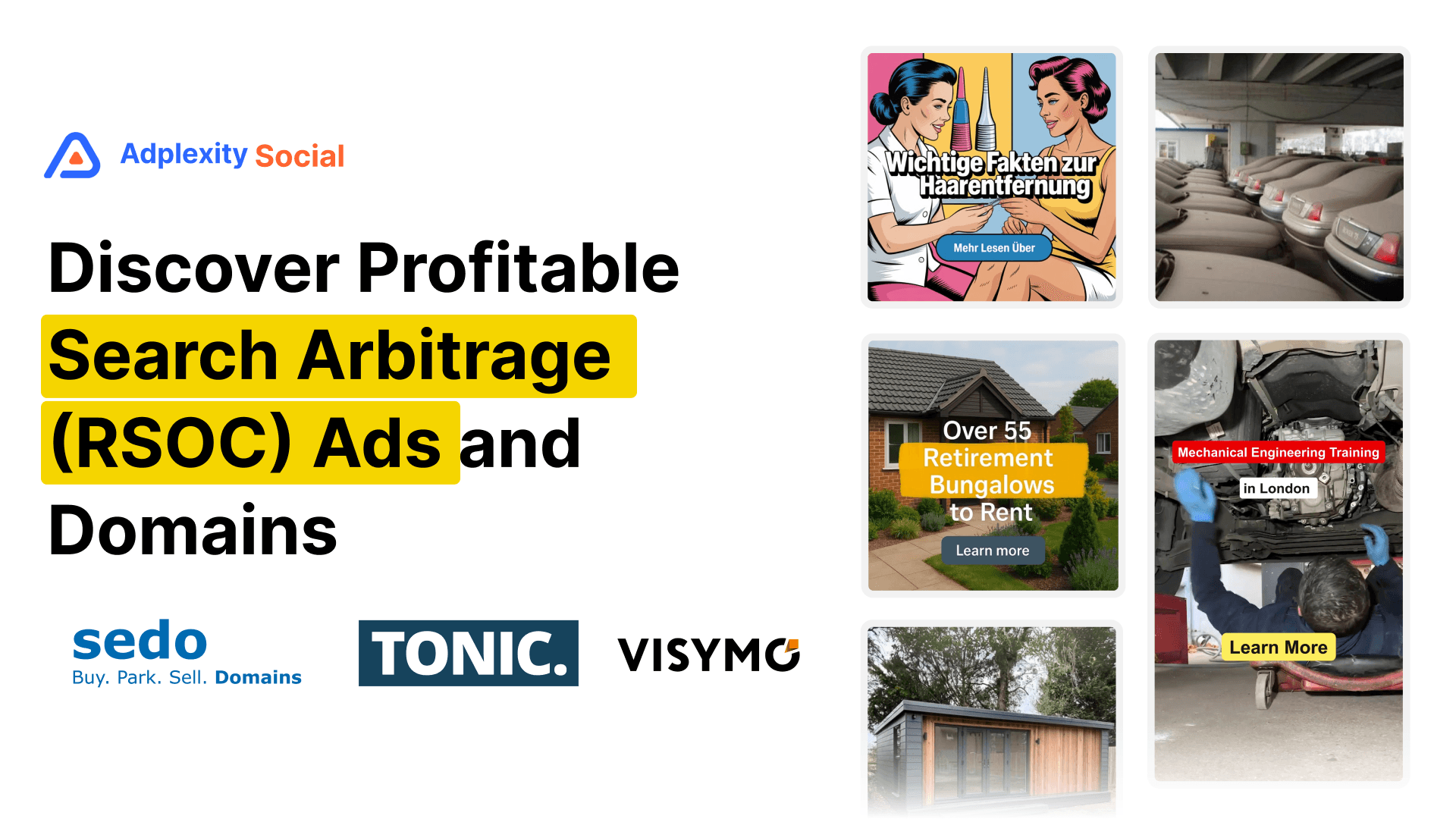
Widen the same search past the 30-day filter and a fifth advertiser shows up: Dave Tips of the Day, an English creative headlined “Best Creams for Skin Tightening,” aimed at Germany, landing on clueblog.com. AdPlexity Social tags the ad record with Visymo (RSOC), an arbitrage network, before you ever open the destination URL. The URL itself confirms it: a dynamic search results path carrying pub=fb and parameters that remap standard conversion events onto search feed actions.
Five ads, similar run times, one German market, three different kinds of business. If you sell skincare in Germany, three of those five are your real competitive set. If you buy search arbitrage traffic, the other two are the only lesson worth studying. Neither group tells you anything useful about the other, and a tool that only shows the creative cannot make that split for you. AdPlexity Social does, because the affiliate network, arbitrage network, and technology detections sit right on the ad record. We go deeper into reading that infrastructure in the technical fingerprint of hidden affiliate ads and in our breakdown of profitable RSOC search arbitrage ads.
The search, step by step
Substitute your own niche and country for skincare and Germany.
Search the landing page, not just the creative. Set the search to match ad copy or landing page text, and enter your keyword against your target country. This one setting is what caught Radiant Feeds. Its creative is four words long and would never have matched on ad copy alone.
Filter for longevity before you look at anything else. Thirty days or more is the cheapest quality filter available. It clears out the tests and leaves the campaigns somebody decided were worth continuing to fund.
Check the post-click detail before the hook. Look at what the record shows for technology and network detections first. Shopify or ClickFunnels on the advertiser's own domain usually means a product business. A redirect, a tracker, or a network tag usually means the click is being monetized differently. Sort what you have into those two groups before you study either one.
Save what matters to a Board. Group by niche and country so the next research session starts from a shortlist instead of a blank search.
To run the same job-one search in Meta Ad Library, AdSpy, or BigSpy, set the country and keyword filters and expect to open each destination URL by hand, since none of the three classify what a landing page actually is. For job two, work from Minea's product side rather than the keyword side. For job three, bring your shortlist into Foreplay or GetHookd once you already know which ads are worth keeping.
Picking the tool
If the question is simply what is running right now in a country, Meta Ad Library is free and correct, and there is no reason to pay for that alone.
If the question is what is behind a creative, meaning the network, the redirect path, and the landing page itself, AdPlexity Social is the only tool here built specifically around that layer, and it is the one that makes a niche and GEO shortlist mean something rather than just be long. Pricing is 99 dollars per month.
For a large historical archive to search by hand, AdSpy. For volume on a tight budget, BigSpy. For product and dropshipping research, Minea. For turning a shortlist into creative briefs, Foreplay. For agency reporting across several ad networks at once, SocialPeta.
Most people doing this seriously end up running two tools rather than one: something that finds and classifies, and something that organizes what survives.
Frequently Asked Questions
Can any ad spy tool show me a competitor's Meta ad spend or ROAS?
No. Meta does not publish spend or return figures for commercial ads, so any tool displaying precise numbers for a competitor's campaign is estimating them. What is actually observable is advertiser behavior: how long an ad has run, how many duplicates of the creative exist across profiles, how many appeared in the last seven days, and what the ad leads to.
What is the strongest signal that a Meta creative is winning?
The same angle or hook appearing across several unrelated advertisers in the same country, sustained over weeks. A single advertiser running an ad for two months is a decent signal on its own. Five separate advertisers all independently keeping the same hook alive is stronger, because none of them are coordinating and all of them are seeing it work.
Which tool is best for a specific niche and country combination?
For Meta specifically, AdPlexity Social covers 16 countries with a per-country breakdown on every ad and lets you combine that with vertical, longevity, affiliate network, and technology filters in a single search. Meta Ad Library covers every country Meta serves but has no way to filter, sort, or qualify what it returns.
Is Meta Ad Library enough by itself?
For confirming a specific ad is genuinely live in a specific country, yes. For finding winners across a niche, no, since it has no longevity filter, no vertical filter, and no visibility into the landing page beyond the URL. Most people pair it with a paid tool rather than rely on it alone. See our Facebook Ads Library comparison for the details.
How do I tell a real brand's ad from an affiliate or arbitrage funnel?
Look at the landing page and the URL structure, not the creative. A brand usually lands on its own domain with an e-commerce or page builder signature attached. An affiliate or arbitrage funnel usually carries sub-ID parameters, passes through a redirect, and resolves to a network or a search feed page. AdPlexity Social detects the network and technology stack directly on the ad record, so this classification takes seconds rather than a manual crawl.
How long does this kind of research actually take?
About fifteen minutes for one niche and country combination, once you know the pattern: keyword against ad copy and landing page text, country filter, longevity at 30 days or more, then sort by what is behind the click. Doing it by opening every destination page by hand takes most of an afternoon.
Do I need to pay for a tool to do this?
Not to start. Meta Ad Library is free and shows you what is running. A paid tool earns its cost the moment the question moves from what ads exist to which ones are worth copying and who is actually behind them, because that answer lives on the landing page and in the redirect chain, and nothing free exposes either one.
Run it on your own niche
Pick the single niche and country you are buying in right now. Match your keyword against ad copy and landing page text, set longevity to 30 days or more, and sort what comes back by the business behind it before you look at a single hook. The list you end up with will be shorter than you expected and considerably more useful.
AdPlexity Social indexes over 100 million ads, adds more than 15 million new Meta ads every month across all Meta placements, and covers 16 countries with landing page indexing, redirect chain crawling, affiliate network detection, and technology stack filtering built into every record. Sign up at adplexity.io and run your first niche and GEO search.
If you buy Meta traffic in one niche and one country and want to know which creatives are actually working there, the tool you pick depends on which question you are asking. This guide sorts eight tools by the job they actually do, then walks through the search that turns a niche and GEO combination into a usable shortlist in about fifteen minutes.
TL;DR: Start with the question, not the tool. “What ads exist here” is answered by Meta Ad Library, AdSpy, or BigSpy. “What products are selling here” is Minea's job. “Help me organize what I already found” is Foreplay or GetHookd. “Who is actually behind this creative, and is it worth copying?” is the one question none of those answer, because it requires reading the landing page, the redirect chain, and the tech stack, not just the ad. AdPlexity Social is built around that layer specifically: it indexes landing page text, crawls redirects end to end, and flags the affiliate network, arbitrage network, and technology behind each funnel.
Start with the question you are actually asking
Most people shop for an ad spy tool by database size. Wrong axis. The better question is what you need the tool to prove, because the eight tools below split cleanly into three jobs.
Job one: what ads exist in this niche and country. Meta Ad Library, AdSpy, and BigSpy all answer this. They differ in coverage and how far back their archive goes, but the output is the same: a list of ads and where they lead.
Job two: what products or offers are moving in this market. Minea answers this specifically, starting from the product rather than the ad.
Job three: organize what you already found into something usable. Foreplay and GetHookd do this. Neither one discovers ads on its own; both take a shortlist you built somewhere else and turn it into tagged boards or briefs.
Job four: tell me what is actually behind this creative. This is the job most tools skip, and it is the one that decides whether a “winning” ad in your result set is a real brand worth studying or an arbitrage funnel with nothing to teach you about your own product. AdPlexity Social and, to a lesser extent, SocialPeta are the two tools here, and only one of them does it at the individual-ad level with landing page detail.
Here is the same split in a table.
Tool
Best job
Niche filtering
GEO targeting
Post-click detail
AdPlexity Social
Job four: identify the business behind a creative
Vertical and sub-niche filters, plus keyword search inside landing page text
Why job four is the one that actually decides “winning”
Nobody can see a competitor's spend or ROAS. Meta does not publish either for commercial ads, so any tool claiming to show them is estimating. What every tool on this list can observe instead is behavior: how long an ad runs, how many duplicates of the same creative exist across advertiser profiles, how many of those duplicates appeared in the last week, and what the ad leads to.
The first three signals tell you a creative has traction somewhere. They do not tell you whose traction it is, and that gap matters more than it sounds. Two ads can run the same number of days, in the same country, with nearly the same creative, and be completely different businesses: one a brand selling a product, the other an arbitrage operator monetizing the click and passing the visitor along. If your tool stops at the creative, both look identical.
Here is what that looks like with real numbers.
One search, five ads, three different businesses
On 2 September 2026, we ran “retinol” through AdPlexity Social against Germany, matching the keyword in either the ad copy or the landing page text, with the Longevity filter set to 30 days or more.
Three results were straightforward DTC brands. Mádara Organic Skincare had a creative running 76 days across Germany and Spain, pointing to madaracosmetics.com, a Shopify store. ARYA LAYA had one at 65 days landing on a specific product page, arya-laya.de/hyaluron-miracle-night. KLAPP Skin Care Science had one at 32 days on klapp-skincare.com, also Shopify. Nothing unusual here: real products, own domains, sustained campaigns.
The fourth result, Radiant Feeds Insights, had been running 44 days with a plain German headline, “Pigmentflecken Im Gesicht Entfernen,” over a caption reading radiantfeeds.com. By creative alone, it reads as a fourth skincare advertiser. The landing page tells a different story. The actual destination is related.radiantfeeds.com/topics/2224904/BCC42CF/, a search feed page carrying an encoded keyword parameter and three sub-ID slots mapped to the Meta campaign, ad set, and ad IDs. The outgoing links from that page resolve to retixol.de. This is not a skincare brand. It is buying a German click and monetizing it through a search feed before passing the visitor on.
Widen the same search past the 30-day filter and a fifth advertiser shows up: Dave Tips of the Day, an English creative headlined “Best Creams for Skin Tightening,” aimed at Germany, landing on clueblog.com. AdPlexity Social tags the ad record with Visymo (RSOC), an arbitrage network, before you ever open the destination URL. The URL itself confirms it: a dynamic search results path carrying pub=fb and parameters that remap standard conversion events onto search feed actions.
Five ads, similar run times, one German market, three different kinds of business. If you sell skincare in Germany, three of those five are your real competitive set. If you buy search arbitrage traffic, the other two are the only lesson worth studying. Neither group tells you anything useful about the other, and a tool that only shows the creative cannot make that split for you. AdPlexity Social does, because the affiliate network, arbitrage network, and technology detections sit right on the ad record. We go deeper into reading that infrastructure in the technical fingerprint of hidden affiliate ads and in our breakdown of profitable RSOC search arbitrage ads.
The search, step by step
Substitute your own niche and country for skincare and Germany.
Search the landing page, not just the creative. Set the search to match ad copy or landing page text, and enter your keyword against your target country. This one setting is what caught Radiant Feeds. Its creative is four words long and would never have matched on ad copy alone.
Filter for longevity before you look at anything else. Thirty days or more is the cheapest quality filter available. It clears out the tests and leaves the campaigns somebody decided were worth continuing to fund.
Check the post-click detail before the hook. Look at what the record shows for technology and network detections first. Shopify or ClickFunnels on the advertiser's own domain usually means a product business. A redirect, a tracker, or a network tag usually means the click is being monetized differently. Sort what you have into those two groups before you study either one.
Save what matters to a Board. Group by niche and country so the next research session starts from a shortlist instead of a blank search.
To run the same job-one search in Meta Ad Library, AdSpy, or BigSpy, set the country and keyword filters and expect to open each destination URL by hand, since none of the three classify what a landing page actually is. For job two, work from Minea's product side rather than the keyword side. For job three, bring your shortlist into Foreplay or GetHookd once you already know which ads are worth keeping.
Picking the tool
If the question is simply what is running right now in a country, Meta Ad Library is free and correct, and there is no reason to pay for that alone.
If the question is what is behind a creative, meaning the network, the redirect path, and the landing page itself, AdPlexity Social is the only tool here built specifically around that layer, and it is the one that makes a niche and GEO shortlist mean something rather than just be long. Pricing is 99 dollars per month.
For a large historical archive to search by hand, AdSpy. For volume on a tight budget, BigSpy. For product and dropshipping research, Minea. For turning a shortlist into creative briefs, Foreplay. For agency reporting across several ad networks at once, SocialPeta.
Most people doing this seriously end up running two tools rather than one: something that finds and classifies, and something that organizes what survives.
Frequently Asked Questions
Can any ad spy tool show me a competitor's Meta ad spend or ROAS?
No. Meta does not publish spend or return figures for commercial ads, so any tool displaying precise numbers for a competitor's campaign is estimating them. What is actually observable is advertiser behavior: how long an ad has run, how many duplicates of the creative exist across profiles, how many appeared in the last seven days, and what the ad leads to.
What is the strongest signal that a Meta creative is winning?
The same angle or hook appearing across several unrelated advertisers in the same country, sustained over weeks. A single advertiser running an ad for two months is a decent signal on its own. Five separate advertisers all independently keeping the same hook alive is stronger, because none of them are coordinating and all of them are seeing it work.
Which tool is best for a specific niche and country combination?
For Meta specifically, AdPlexity Social covers 16 countries with a per-country breakdown on every ad and lets you combine that with vertical, longevity, affiliate network, and technology filters in a single search. Meta Ad Library covers every country Meta serves but has no way to filter, sort, or qualify what it returns.
Is Meta Ad Library enough by itself?
For confirming a specific ad is genuinely live in a specific country, yes. For finding winners across a niche, no, since it has no longevity filter, no vertical filter, and no visibility into the landing page beyond the URL. Most people pair it with a paid tool rather than rely on it alone. See our Facebook Ads Library comparison for the details.
How do I tell a real brand's ad from an affiliate or arbitrage funnel?
Look at the landing page and the URL structure, not the creative. A brand usually lands on its own domain with an e-commerce or page builder signature attached. An affiliate or arbitrage funnel usually carries sub-ID parameters, passes through a redirect, and resolves to a network or a search feed page. AdPlexity Social detects the network and technology stack directly on the ad record, so this classification takes seconds rather than a manual crawl.
How long does this kind of research actually take?
About fifteen minutes for one niche and country combination, once you know the pattern: keyword against ad copy and landing page text, country filter, longevity at 30 days or more, then sort by what is behind the click. Doing it by opening every destination page by hand takes most of an afternoon.
Do I need to pay for a tool to do this?
Not to start. Meta Ad Library is free and shows you what is running. A paid tool earns its cost the moment the question moves from what ads exist to which ones are worth copying and who is actually behind them, because that answer lives on the landing page and in the redirect chain, and nothing free exposes either one.
Run it on your own niche
Pick the single niche and country you are buying in right now. Match your keyword against ad copy and landing page text, set longevity to 30 days or more, and sort what comes back by the business behind it before you look at a single hook. The list you end up with will be shorter than you expected and considerably more useful.
AdPlexity Social indexes over 100 million ads, adds more than 15 million new Meta ads every month across all Meta placements, and covers 16 countries with landing page indexing, redirect chain crawling, affiliate network detection, and technology stack filtering built into every record. Sign up at adplexity.io and run your first niche and GEO search.
Table of Contents
Quickly navigate through the key sections of this article.