Facebook Lead Ads vs Landing Pages: Which Converts Better in 2026?

Share:
Local roofers send their Facebook ads to instant forms; lead sellers send theirs to landing pages full of consent and call tracking scripts. Here is why, what the published tests show, and how to choose in 2026.
Local roofers send their Facebook ads to instant forms; lead sellers send theirs to landing pages full of consent and call tracking scripts. Here is why, what the published tests show, and how to choose in 2026.
Table of Contents
What Is the Difference Between Facebook Lead Ads and Landing Pages?
Which Converts Better: Facebook Lead Ads or Landing Pages?
What Do Lead Gen Advertisers Actually Run on Meta?
Why Are My Facebook Lead Form Leads Not Converting?
When Should You Send Facebook Ads to a Landing Page Instead?
Is Click-to-Call Better Than a Lead Form?
Should You Run Lead Forms and Landing Pages Together?
How Can You See Which Format Your Competitors Use?
Frequently Asked Questions
Conclusion
Key takeaways. Sort US roofing ads in AdPlexity Social by Creative Score and the two formats split by who is buying the click. The top instant form ads come from local roofers booking their own inspections and quotes, Fortress Roofing Systems among them. The top landing page ads come from lead sellers, whose pages carry TrustedForm, Jornaya and call tracking. Those scripts need a page and cannot run inside an instant form. In the published tests that tracked it, instant forms turned more clicks into leads, and landing pages turned more of those leads into qualified ones. So pick the format that fits what happens after the click, and judge it on cost per qualified lead from your own CRM, not the campaign's cost per lead.
Which converts better, a Facebook lead ad or a landing page? It depends on what you measure, and the usual measures do not agree. Count the clicks that turn into leads and the instant form usually wins. Count the leads that turn out to be qualified and the landing page usually does. The first half is easy to see: lead ads converted more clicks into leads than landing pages in WordStream's 2019 analysis of its own clients' campaigns, while each action cost more.
If you are a local business owner, a lead generator or a media buyer deciding where to send the click, this guide covers what the published tests actually measured, what Meta has changed since, and what roofing, remodeling, insurance and other lead gen brands run right now. The market data comes from AdPlexity Social, which records Meta ads across all placements and the landing pages behind them.
What Is the Difference Between Facebook Lead Ads and Landing Pages?
The short answer is where the form lives. Both formats sit inside Meta's Leads objective, and the setting that separates them is the conversion location, which decides where the click goes. With Instant forms, the form opens inside Facebook or Instagram. With Website, the click opens your own page in the in-app browser. Meta calls the first one an instant form, ads that use one are commonly called lead ads, and AdPlexity Social labels that destination Lead Form.
Where the form lives changes what the visitor has to do. Inside Meta's apps, the contact fields can arrive prefilled: Meta may fill in name, email and phone number "if they have already provided their information" to Meta. Prefill takes the typing away, and with it some of the friction that filters out a casual click. On a landing page, whatever comes before the form is up to you, whether that is a quiz, long copy, a video or a calculator.
It is not a niche format, at least by Meta's own count: Meta reports more than one billion instant forms submitted in 2023, 16.6 percent more than in 2022.
Here is how the two compare on the details that matter once the click lands.
Instant form | Landing page | |
|---|---|---|
Where the form lives | Inside Meta's apps | Your own page, opened in the in-app browser |
Contact fields | May be prefilled by Meta | Typed in, unless the browser autofills them |
What can come before the form | An intro screen, custom questions, conditional logic, gated content, Rich creative | Anything: quiz steps, long copy, video, a calculator |
Quality controls | The Higher intent form type, phone verification, work email validation | Your own validation and steps |
Consent documentation | Meta's custom disclaimer, or a TrustedForm certificate through LeadConduit | TrustedForm or Jornaya scripts on the page |
Where a lead waits | Downloadable from Meta for 90 days, in Leads Center, or in a connected CRM | Your own form backend or CRM |
What a competitor can see | The ad; the form itself is not a public page | The page, its redirect chain and its scripts |
Which Converts Better: Facebook Lead Ads or Landing Pages?
Across the tests that measured it, instant forms usually win at turning a click into a lead. Landing pages usually win at turning that lead into a qualified one, and cost per lead swings either way.
The evidence is thinner than it looks, so here is each source with the limit that comes with it. Start with WordStream's 2019 analysis of its own clients' campaigns, more than 3,000 of them. Lead ads won on conversion rate, averaging 12.54 percent against 10.47 percent for landing pages, and lost on cost, with each action more expensive. Mind the labels: the "Conversions" campaigns WordStream compared are today's Leads objective with the Website conversion location.
The same post then turned to WordStream's in-house CRM data, from more than 40,000 link clicks, and both halves of the pattern showed up. Lead ads had "an 11.7% higher rate" of clicks turning into leads. On quality, landing pages had "a 5.7% higher conversion rate to a “qualified” lead", a smaller edge on demo requests, and a cost per quality lead WordStream calls "significantly lower". Those gaps are most likely percentage points, though WordStream does not define them. Its post writes the difference between the two conversion rates above as 2.07 percent higher, which is a percentage point difference.
AdEspresso's 2016 test is far smaller: a single $2,000 experiment that retargeted AdEspresso's own website visitors with eBook offers. Lead ads landed at $0.95 per lead against $0.93 for landing pages, a near tie, with lead ads winning on mobile and landing pages on desktop. Three details keep it from settling anything. The campaigns ran one after another, not at the same time. In a reply under the post, the author called an extra desktop right column placement on the landing page campaign "a mistake". And neither side tracked lead quality.
Meta publishes figures too, and they are Meta's claims, so read them that way. Meta reports that advertisers who ran both instant form and website form campaigns saw on average 60 percent lower cost per lead and 125 percent more leads than with website form campaigns alone. The basis is a meta-analysis of 22 A/B tests run between January 2023 and April 2024. Look at what was compared, though: running both against website forms alone, not one format against the other. It cannot say which format earned the gain.
Separately, on its performance goals page, Meta says instant forms saw 21 percent lower cost per quality lead than lead ads optimized for the number of leads, when the forms used Conversions API for CRM with the Maximize number of qualified leads goal. Website forms on the qualified leads goal saw 9.5 percent lower. Meta does not say how quality was measured.
The table puts the five sources side by side, along with what each one cannot tell you.
Source (date) | Sample | Instant form result | Landing page result | What it cannot tell you |
|---|---|---|---|---|
WordStream, client data (Feb 2019) | 60 days, 3,000+ campaigns, about $9.5 million spent | 12.54% conversion rate, $17.98 per action | 10.47% conversion rate, $13.26 per action | Whether either lead ever became a sale |
WordStream, in-house CRM (Feb 2019) | 40,000+ link clicks, one company's CRM | 11.7% higher rate of clicks to leads | 5.7% higher to a qualified lead, 1.4% higher to a demo request, lower cost per quality lead | Most likely percentage points, not stated |
AdEspresso (Oct 2016) | One advertiser, $2,000, retargeting its own site visitors | $0.95 per lead, won on mobile | $0.93 per lead, won on desktop | Lead quality; the campaigns ran one after another |
Meta, both campaign types vs. website alone | 22 A/B tests, Jan 2023 to Apr 2024 | Not isolated: part of the combined approach | Website form campaigns alone were the baseline, beaten by 60% lower cost per lead and 125% more leads | Which format earned the gain |
Meta, qualified leads goal | Meta's own reporting, no method shown | 21% lower cost per quality lead, with Conversions API for CRM | 9.5% lower cost per quality lead on the qualified leads goal | What counts as a quality lead |
Cost per lead is the wrong scoreboard, because it rewards whichever format is cheapest to fill, not whichever sends better leads. Judge on cost per qualified lead or cost per sale from your own CRM. Any unsourced cost per lead range is an opinion until it names a sample and a date.
What Do Lead Gen Advertisers Actually Run on Meta?
Mostly landing pages, though the mix moves a lot from one vertical to the next. AdPlexity Social tags each Meta ad it records with where the click lands: Landing Page, Lead Form, Instagram or Facebook. That tag is its Ad Destination filter, so you can pick a vertical, set the country and read the split. This is what it showed for ten verticals in the United States.
Vertical (AdPlexity Social) | Land on a landing page | Open an instant form |
|---|---|---|
Real Estate | about 256,600 | about 16,300 |
Roofing | about 73,900 | about 8,600 |
Bathroom Remodel | about 73,300 | about 9,900 |
Insurance: Car | about 64,700 | about 660 |
Legal Aid: Injury Claims | about 58,200 | about 4,500 |
Windows | about 56,700 | about 4,700 |
HVAC | about 39,300 | about 7,200 |
Debt Relief | about 38,000 | about 1,500 |
Insurance: Home | about 29,000 | about 1,600 |
Solar | about 24,000 | about 2,600 |
US ads AdPlexity Social saw running in the last 30 days, read October 19, 2026 (the two insurance lines on October 15). A few ads open an Instagram profile or a Facebook Page instead and are not counted here.
Landing pages outnumber instant forms in every vertical we checked. Instant forms take their biggest share in HVAC, about 15 percent, and their smallest in car insurance, about 1 percent.
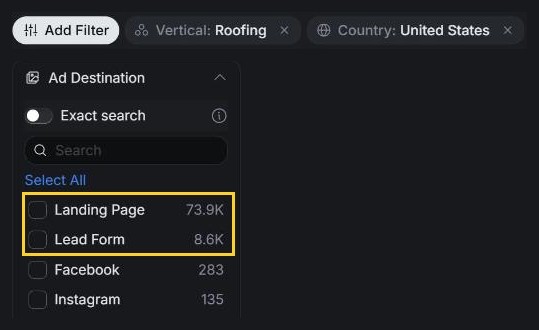
The counts say how many, but not who is behind them, and that is the interesting part. Roofing is the clearest place to look. On October 16, 2026, we sorted US roofing by Top Creative, AdPlexity Social's Creative Score sort, once for each destination, and the two top lists did not look alike. The top instant form ads came from local roofers selling their own jobs. Fortress Roofing Systems, a South Florida roofer, sent its "The Last Roof You'll Ever Need" ad to an instant form with a Get Quote button. Micah Hill Roofing & Restoration used one to book roof inspections around Dallas and Fort Worth.

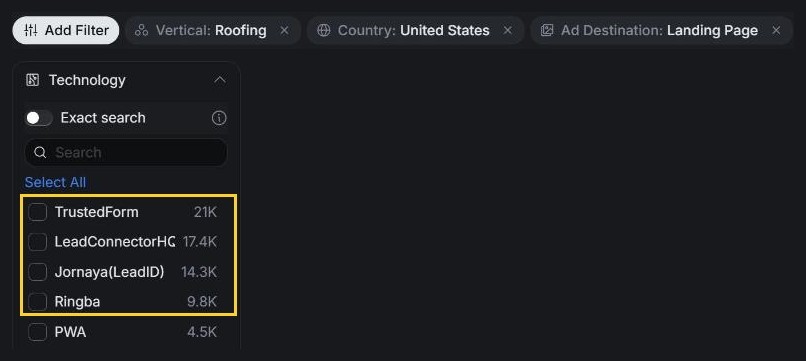
The top landing page ads came from lead generation sites instead, and the pages behind the top ones carried TrustedForm, Jornaya and Ringba call tracking together. The likely reason is mechanical, not taste: a roofer calls the homeowner back directly, while a lead seller has to prove consent to the buyer and route calls, and those scripts need a page to run on.
It is not only the top of the list, either. Of the US roofing landing page ads AdPlexity Social saw in the last 30 days, more than 1 in 4 landed on a page with TrustedForm, one of the consent tools lead sellers rely on. About 1 in 5 landed on a page with Jornaya, and about 1 in 8 on a page with Ringba.
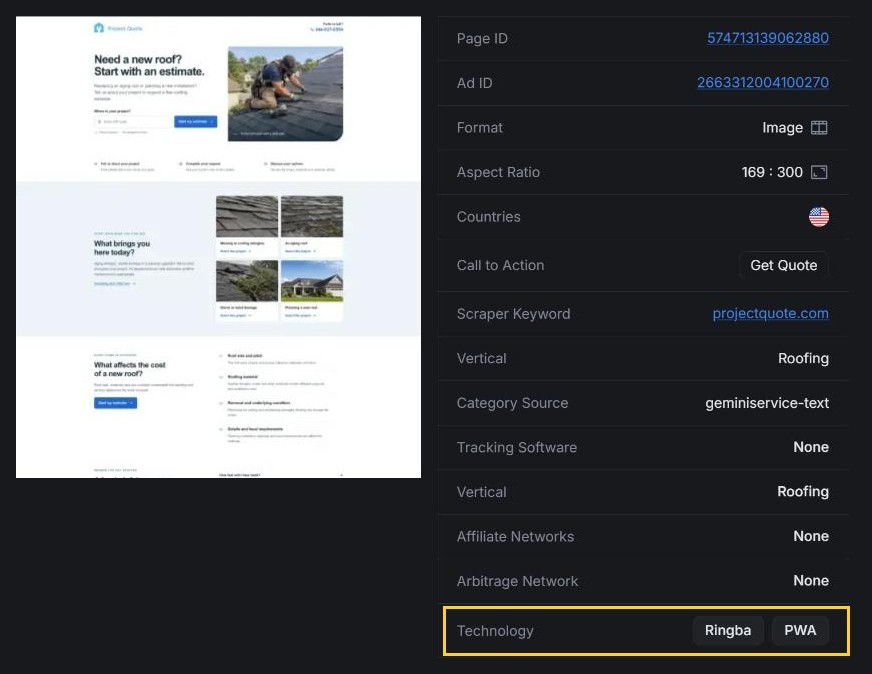
Project Quote shows what the page side looks like up close. Its ad, "Request a Roof Replacement Estimate", sent the click through one redirect on its own domain to a quote page that opened on a ZIP code step, and AdPlexity Social detected Ringba on that page. The page combined a quote form with call tracking, which an instant form cannot hold.
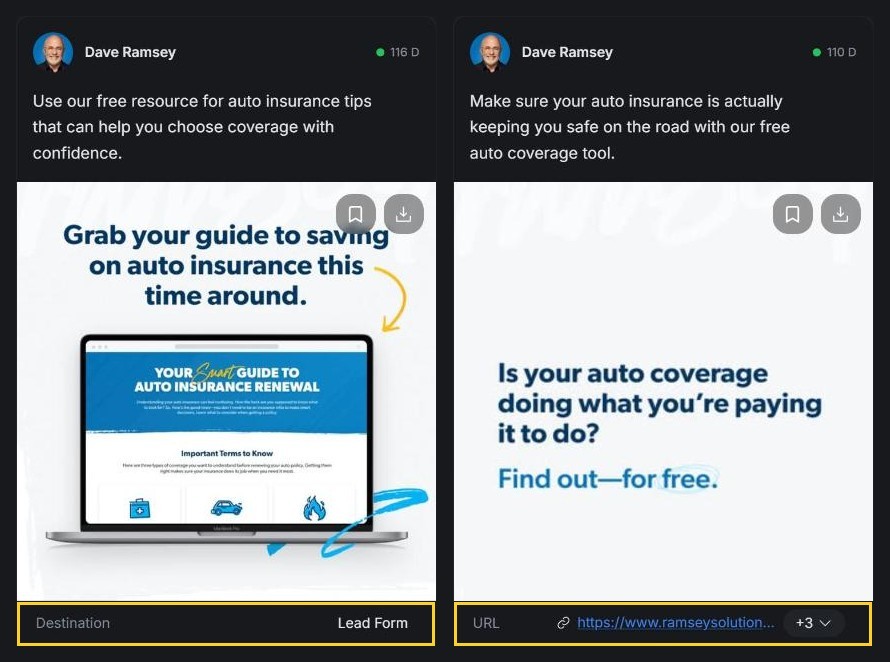
Dave Ramsey ran both formats on the same topic, which makes the contrast easy to see. One auto insurance ad, headlined "Get Your Guide", opened an instant form that hands over a guide. Another, headlined "Review Before You Renew", opened a page on ramseysolutions.com that hosts an auto coverage tool. Both had been running since June 2026.
For the longer breakdown of roofing and remodeling, see how home improvement lead gen runs on Facebook.
Sign up at adplexity.io and run the same split for your own vertical.
Why Are My Facebook Lead Form Leads Not Converting?
Half of the problem is built into the format. What makes an instant form convert (no typing, prefilled fields, two taps) is also what makes its leads thin, because a casual tap costs the person nothing.
Meta's answer is the Higher intent form type, which adds a review screen built to "prevent receiving submissions from those people who are only marginally interested". It comes with a trade: Meta only delivers a Higher intent form in Facebook Feed and Instagram feed on mobile, never on desktop, so choosing it also narrows where the ad runs.
Speed is the other half. Meta recommends an integrated CRM or its Leads Center instead of downloading leads by hand, and running lead ads during business hours. Firms that tried to contact a lead within an hour were nearly seven times as likely to qualify it as firms that tried an hour later, according to a Harvard Business Review study of 1.25 million sales leads at 42 US companies, published in March 2011. The same study found they were more than 60 times as likely as firms that waited 24 hours or longer. Meta keeps a lead available for download for up to 90 days, but that is a storage window, not a follow-up plan.
The rest of the fixes live inside the builder: custom questions with conditional logic, phone verification by one-time password, work email validation for business buyers, an appointment request step, and the qualified leads performance goal. That last one has a new condition: since April 2026, new campaigns can only use the qualified leads goal with a Conversions API integration, and Meta said existing campaigns would be affected from August 2026. Conversions API for CRM sends your CRM's lead stages back to Meta so it can optimize for leads that qualify. Still, none of these settings replaces a fast callback.
When Should You Send Facebook Ads to a Landing Page Instead?
Send the click to a page when what you need cannot live in a form inside Meta. Meta's own guidance points to a website form in three cases: when people need to book an appointment or get a quote through your own system, when you need information Meta's policies bar from an instant form, such as a Social Security number, or when buyers should see the full details of a higher consideration product first.
Consent is another reason: TrustedForm and Jornaya both install as scripts on a web page, so neither can run inside an instant form, which has no page underneath it. ActiveProspect, which makes TrustedForm and since January 2026 also owns Jornaya, documents a TrustedForm route for Facebook lead ads through its LeadConduit integration. We found no Jornaya equivalent (checked October 2026). Whether a certificate made that way counts is the lead buyer's call, written in their spec.
Anything built from steps needs a page too: a quiz, a multi-step quote, a calculator. RoofingCalculator.com's ads sent people to a roofing cost calculator that started with a ZIP code, and an instant form cannot run one. If you want to see how pages like that get built, we looked at which landing page builders show up behind Meta lead gen funnels. Affiliate-style lead gen needs a page for its own reason: a redirect chain through a tracker such as Redtrack or ClickFlare has nowhere to run inside an instant form.
Put as a table, the short version looks like this.
If your situation is | Start with | Why |
|---|---|---|
A local business that calls back within minutes | An instant form, with Higher intent turned on | Two taps, then a fast handoff |
Selling leads to buyers who require TrustedForm or Jornaya | A landing page, or a TrustedForm certificate through LeadConduit if the buyer accepts it | Neither script can run on an instant form |
Quiz steps, quotes, calculators | A landing page | An instant form cannot hold multiple steps of your own |
Sensitive details | A landing page | Meta bars them from instant forms |
Selling by phone | A call ad, or a landing page with a tracked number | The next section covers the difference |
CRM stages sent back to Meta | Either format, on the qualified leads goal with a Conversions API integration | Meta optimizes for leads that qualify |
Not sure yet | Separate ad sets, one per format | Covered in the section on running both |
Is Click-to-Call Better Than a Lead Form?
Not quite the right comparison, because calls are a third destination, not a version of either format above. Meta offers three calling routes. A call ad puts a Call now button on the ad and can run under the Awareness, Traffic, Engagement, Leads or Sales objective, with an optional callback request that lets people message the business to ask for a call. A call add-on sends people to the website with a Call now button over it. And the Website and calls conversion location opens your page "with a Call now button visible at the bottom".
What Meta measures has grown. It now reports calls placed, partly modeled, plus calls that lasted at least 20 and 60 seconds and callback requests. Call Insights lists each call's start time, duration and whether it was answered, though those details are estimated unless call forwarding is on. Call forwarding is US only and also adds the caller's number.
A tracked number on your own page, through a platform such as Ringba, Retreaver or Trackdrive, still ties each call to the ad on your side and to the rules a lead buyer pays on. Phonexa notes that whether a pay per call payout is earned depends on the call's length, time, date, caller location and sometimes its outcome. AdPlexity Social detects all three platforms on landing pages. Project Quote's roofing page, for example, ran a quote form and Ringba together. Our guide to the setup behind most pay per call funnels goes deeper.
Be careful with the claims you will see for calls. Invoca, a vendor selling into this space, says phone leads are often a business's most valuable conversions and that "callers convert faster, spend more, and remain loyal". It cites its own blog rather than independent research, so read it as a pitch.
If you sell by phone, start with a call ad or a landing page with a tracked number, and judge it the way you judge the other two formats: on qualified leads and sales.
Should You Run Lead Forms and Landing Pages Together?
You can, and Meta will even do the mixing for you, but you lose sight of what each format's leads cost. Its Website and instant forms conversion location sends each person to "the place they are most likely to convert", decided person by person, though value rules let you weight one location over the other. Only the Maximize number of leads goal works with it. For the qualified leads goal, Meta says to pick Instant forms or Website on its own.
The instant form add-on is a smaller version of the same idea: it pops an instant form up over your own site inside a Website campaign and is delivered in the Facebook mobile app only.
A combined campaign can lower your blended cost per lead, but it cannot tell you what each format's leads cost, because Meta says "cost per result (or, cost per lead) cannot be separated by conversion location". To isolate that, run the same creative and audience as two separate ad sets, one per destination, and compare them on cost per qualified lead from your own CRM. From the outside, that is what Dave Ramsey's two ads look like: separate ads, one per format.
How Can You See Which Format Your Competitors Use?
To read the split for any vertical in AdPlexity Social, open Explore, stay on the Ads tab and set Last 30 Days. Choose Add Filter, then Vertical, and pick one line such as Roofing or Insurance: Car. Set Country to United States, then add Ad Destination. The counts show the split, and setting Ad Destination to Lead Form or Landing Page filters the grid to that format. Group by Creative and sort by Top Creative to see what is scaling in each. For the longer walkthrough, see how to find the top performing lead gen ads in your vertical.
Then open any ad. Its Creative Details panel shows the Destination (Lead Form) or the landing page URL, along with the tracking software and the technology detected, and the Landing Pages tab shows the page itself and its redirect chain. That is the fastest way to reverse-engineer a competitor's landing page funnel.
Save the ads and domains worth tracking to a Board, one per format, so you keep a short list of the ads behind each side. Recheck the split monthly.
The free option is the Meta Ad Library, which filters by language, advertiser, platform, media type, active status and a date range (checked October 16, 2026). None of that separates an instant form ad from a website ad.
Frequently Asked Questions
What is a good conversion rate for Facebook lead ads?
WordStream's 2026 benchmarks, drawn from 452 US campaigns, put the median conversion rate for Meta leads campaigns at 8.54 percent and the median cost per lead at 27.39 dollars. By category, Home and Home Improvement campaigns ran below that rate, with a median of 5.32 percent, and Real Estate above it, at 9.95 percent. WordStream does not break the sample out by conversion location, so these figures likely blend instant forms and landing pages. Compare them with your own rate to a qualified lead, not just to a submitted one.
Are Facebook lead ads cheaper than landing pages?
Not reliably. In WordStream's 2019 client data, lead ads cost 17.98 dollars per action against 13.26 dollars for landing pages, while AdEspresso's 2016 test found a near tie, at 0.95 against 0.93 dollars per lead. Meta reports 60 percent lower cost per lead for advertisers who ran both instant form and website form campaigns, but that compares running both with website forms alone, not one format with the other.
Do you need a website to run Facebook lead ads?
You do not need a website for the form itself, since an instant form opens inside Facebook or Instagram. Meta recommends linking a privacy policy, and the link must open a web page, not a PDF or an image. Its current requirements page lists that link as optional, while one of its own help pages still calls it required. A minimal web presence is still the safe choice.
How do you stop fake leads from Facebook instant forms?
Use Meta's own tools: phone verification by one-time password, work email validation for business buyers, the Higher intent form type and a custom qualifying question with conditional logic. None of that replaces fast follow-up; a lead left waiting for hours is a bigger quality problem than any form setting.
How long can you download leads from Meta?
You can download a lead from Meta for up to 90 days from submission, after which Meta no longer makes it available. Connecting a CRM, or working leads in Meta's Leads Center, avoids losing leads to that window and speeds up the follow-up that lead quality depends on.
Can you use TrustedForm or Jornaya with Facebook lead ads?
Not as scripts on the form, since an instant form has no page for either script to run on. Consent language can go in the form's custom disclaimer. ActiveProspect documents a TrustedForm route for Facebook lead ads through LeadConduit. It makes TrustedForm and has owned Jornaya since January 2026, but we found no Jornaya equivalent as of October 2026.
How do you track calls from Facebook ads?
Meta reports calls placed, partly modeled, plus calls lasting at least 20 and 60 seconds and callback requests. Its Call Insights lists each call's time, duration and whether it was answered. A tracked number from Ringba, Retreaver or Trackdrive on your landing page ties each call to the ad on your side and to the rules a lead buyer pays on. To research those funnels, see how to find pay per call campaigns.
Are lead ads or landing pages better for qualified leads?
In WordStream's in-house data from more than 40,000 link clicks, landing pages showed a 5.7 percent higher conversion rate to a qualified lead than lead ads, and a 1.4 percent higher rate to a demo request. Meta has since added the Higher intent form type and work email validation to help instant forms filter, so that gap may not hold the same way today. Let your own CRM decide, not conversion rate alone.
Conclusion
The roofing lists say it better than any study: the format followed the business behind the click. The top instant form ads came from local roofers booking their own jobs, and the top landing page ads from lead sellers whose pages carried consent and call tracking scripts. So what happens after the click decides the format.
Put the published tests next to it and they agree: forms fill faster, pages qualify better, and cost per lead swings either way. That is why the only scoreboard worth trusting is cost per qualified lead from your own CRM. Sign up at adplexity.io and see which format your competitors run.
Table of Contents
What Is the Difference Between Facebook Lead Ads and Landing Pages?
Which Converts Better: Facebook Lead Ads or Landing Pages?
What Do Lead Gen Advertisers Actually Run on Meta?
Why Are My Facebook Lead Form Leads Not Converting?
When Should You Send Facebook Ads to a Landing Page Instead?
Is Click-to-Call Better Than a Lead Form?
Should You Run Lead Forms and Landing Pages Together?
How Can You See Which Format Your Competitors Use?
Frequently Asked Questions
Conclusion
Key takeaways. Sort US roofing ads in AdPlexity Social by Creative Score and the two formats split by who is buying the click. The top instant form ads come from local roofers booking their own inspections and quotes, Fortress Roofing Systems among them. The top landing page ads come from lead sellers, whose pages carry TrustedForm, Jornaya and call tracking. Those scripts need a page and cannot run inside an instant form. In the published tests that tracked it, instant forms turned more clicks into leads, and landing pages turned more of those leads into qualified ones. So pick the format that fits what happens after the click, and judge it on cost per qualified lead from your own CRM, not the campaign's cost per lead.
Which converts better, a Facebook lead ad or a landing page? It depends on what you measure, and the usual measures do not agree. Count the clicks that turn into leads and the instant form usually wins. Count the leads that turn out to be qualified and the landing page usually does. The first half is easy to see: lead ads converted more clicks into leads than landing pages in WordStream's 2019 analysis of its own clients' campaigns, while each action cost more.
If you are a local business owner, a lead generator or a media buyer deciding where to send the click, this guide covers what the published tests actually measured, what Meta has changed since, and what roofing, remodeling, insurance and other lead gen brands run right now. The market data comes from AdPlexity Social, which records Meta ads across all placements and the landing pages behind them.
What Is the Difference Between Facebook Lead Ads and Landing Pages?
The short answer is where the form lives. Both formats sit inside Meta's Leads objective, and the setting that separates them is the conversion location, which decides where the click goes. With Instant forms, the form opens inside Facebook or Instagram. With Website, the click opens your own page in the in-app browser. Meta calls the first one an instant form, ads that use one are commonly called lead ads, and AdPlexity Social labels that destination Lead Form.
Where the form lives changes what the visitor has to do. Inside Meta's apps, the contact fields can arrive prefilled: Meta may fill in name, email and phone number "if they have already provided their information" to Meta. Prefill takes the typing away, and with it some of the friction that filters out a casual click. On a landing page, whatever comes before the form is up to you, whether that is a quiz, long copy, a video or a calculator.
It is not a niche format, at least by Meta's own count: Meta reports more than one billion instant forms submitted in 2023, 16.6 percent more than in 2022.
Here is how the two compare on the details that matter once the click lands.
Instant form | Landing page | |
|---|---|---|
Where the form lives | Inside Meta's apps | Your own page, opened in the in-app browser |
Contact fields | May be prefilled by Meta | Typed in, unless the browser autofills them |
What can come before the form | An intro screen, custom questions, conditional logic, gated content, Rich creative | Anything: quiz steps, long copy, video, a calculator |
Quality controls | The Higher intent form type, phone verification, work email validation | Your own validation and steps |
Consent documentation | Meta's custom disclaimer, or a TrustedForm certificate through LeadConduit | TrustedForm or Jornaya scripts on the page |
Where a lead waits | Downloadable from Meta for 90 days, in Leads Center, or in a connected CRM | Your own form backend or CRM |
What a competitor can see | The ad; the form itself is not a public page | The page, its redirect chain and its scripts |
Which Converts Better: Facebook Lead Ads or Landing Pages?
Across the tests that measured it, instant forms usually win at turning a click into a lead. Landing pages usually win at turning that lead into a qualified one, and cost per lead swings either way.
The evidence is thinner than it looks, so here is each source with the limit that comes with it. Start with WordStream's 2019 analysis of its own clients' campaigns, more than 3,000 of them. Lead ads won on conversion rate, averaging 12.54 percent against 10.47 percent for landing pages, and lost on cost, with each action more expensive. Mind the labels: the "Conversions" campaigns WordStream compared are today's Leads objective with the Website conversion location.
The same post then turned to WordStream's in-house CRM data, from more than 40,000 link clicks, and both halves of the pattern showed up. Lead ads had "an 11.7% higher rate" of clicks turning into leads. On quality, landing pages had "a 5.7% higher conversion rate to a “qualified” lead", a smaller edge on demo requests, and a cost per quality lead WordStream calls "significantly lower". Those gaps are most likely percentage points, though WordStream does not define them. Its post writes the difference between the two conversion rates above as 2.07 percent higher, which is a percentage point difference.
AdEspresso's 2016 test is far smaller: a single $2,000 experiment that retargeted AdEspresso's own website visitors with eBook offers. Lead ads landed at $0.95 per lead against $0.93 for landing pages, a near tie, with lead ads winning on mobile and landing pages on desktop. Three details keep it from settling anything. The campaigns ran one after another, not at the same time. In a reply under the post, the author called an extra desktop right column placement on the landing page campaign "a mistake". And neither side tracked lead quality.
Meta publishes figures too, and they are Meta's claims, so read them that way. Meta reports that advertisers who ran both instant form and website form campaigns saw on average 60 percent lower cost per lead and 125 percent more leads than with website form campaigns alone. The basis is a meta-analysis of 22 A/B tests run between January 2023 and April 2024. Look at what was compared, though: running both against website forms alone, not one format against the other. It cannot say which format earned the gain.
Separately, on its performance goals page, Meta says instant forms saw 21 percent lower cost per quality lead than lead ads optimized for the number of leads, when the forms used Conversions API for CRM with the Maximize number of qualified leads goal. Website forms on the qualified leads goal saw 9.5 percent lower. Meta does not say how quality was measured.
The table puts the five sources side by side, along with what each one cannot tell you.
Source (date) | Sample | Instant form result | Landing page result | What it cannot tell you |
|---|---|---|---|---|
WordStream, client data (Feb 2019) | 60 days, 3,000+ campaigns, about $9.5 million spent | 12.54% conversion rate, $17.98 per action | 10.47% conversion rate, $13.26 per action | Whether either lead ever became a sale |
WordStream, in-house CRM (Feb 2019) | 40,000+ link clicks, one company's CRM | 11.7% higher rate of clicks to leads | 5.7% higher to a qualified lead, 1.4% higher to a demo request, lower cost per quality lead | Most likely percentage points, not stated |
AdEspresso (Oct 2016) | One advertiser, $2,000, retargeting its own site visitors | $0.95 per lead, won on mobile | $0.93 per lead, won on desktop | Lead quality; the campaigns ran one after another |
Meta, both campaign types vs. website alone | 22 A/B tests, Jan 2023 to Apr 2024 | Not isolated: part of the combined approach | Website form campaigns alone were the baseline, beaten by 60% lower cost per lead and 125% more leads | Which format earned the gain |
Meta, qualified leads goal | Meta's own reporting, no method shown | 21% lower cost per quality lead, with Conversions API for CRM | 9.5% lower cost per quality lead on the qualified leads goal | What counts as a quality lead |
Cost per lead is the wrong scoreboard, because it rewards whichever format is cheapest to fill, not whichever sends better leads. Judge on cost per qualified lead or cost per sale from your own CRM. Any unsourced cost per lead range is an opinion until it names a sample and a date.
What Do Lead Gen Advertisers Actually Run on Meta?
Mostly landing pages, though the mix moves a lot from one vertical to the next. AdPlexity Social tags each Meta ad it records with where the click lands: Landing Page, Lead Form, Instagram or Facebook. That tag is its Ad Destination filter, so you can pick a vertical, set the country and read the split. This is what it showed for ten verticals in the United States.
Vertical (AdPlexity Social) | Land on a landing page | Open an instant form |
|---|---|---|
Real Estate | about 256,600 | about 16,300 |
Roofing | about 73,900 | about 8,600 |
Bathroom Remodel | about 73,300 | about 9,900 |
Insurance: Car | about 64,700 | about 660 |
Legal Aid: Injury Claims | about 58,200 | about 4,500 |
Windows | about 56,700 | about 4,700 |
HVAC | about 39,300 | about 7,200 |
Debt Relief | about 38,000 | about 1,500 |
Insurance: Home | about 29,000 | about 1,600 |
Solar | about 24,000 | about 2,600 |
US ads AdPlexity Social saw running in the last 30 days, read October 19, 2026 (the two insurance lines on October 15). A few ads open an Instagram profile or a Facebook Page instead and are not counted here.
Landing pages outnumber instant forms in every vertical we checked. Instant forms take their biggest share in HVAC, about 15 percent, and their smallest in car insurance, about 1 percent.
The counts say how many, but not who is behind them, and that is the interesting part. Roofing is the clearest place to look. On October 16, 2026, we sorted US roofing by Top Creative, AdPlexity Social's Creative Score sort, once for each destination, and the two top lists did not look alike. The top instant form ads came from local roofers selling their own jobs. Fortress Roofing Systems, a South Florida roofer, sent its "The Last Roof You'll Ever Need" ad to an instant form with a Get Quote button. Micah Hill Roofing & Restoration used one to book roof inspections around Dallas and Fort Worth.
The top landing page ads came from lead generation sites instead, and the pages behind the top ones carried TrustedForm, Jornaya and Ringba call tracking together. The likely reason is mechanical, not taste: a roofer calls the homeowner back directly, while a lead seller has to prove consent to the buyer and route calls, and those scripts need a page to run on.
It is not only the top of the list, either. Of the US roofing landing page ads AdPlexity Social saw in the last 30 days, more than 1 in 4 landed on a page with TrustedForm, one of the consent tools lead sellers rely on. About 1 in 5 landed on a page with Jornaya, and about 1 in 8 on a page with Ringba.
Project Quote shows what the page side looks like up close. Its ad, "Request a Roof Replacement Estimate", sent the click through one redirect on its own domain to a quote page that opened on a ZIP code step, and AdPlexity Social detected Ringba on that page. The page combined a quote form with call tracking, which an instant form cannot hold.
Dave Ramsey ran both formats on the same topic, which makes the contrast easy to see. One auto insurance ad, headlined "Get Your Guide", opened an instant form that hands over a guide. Another, headlined "Review Before You Renew", opened a page on ramseysolutions.com that hosts an auto coverage tool. Both had been running since June 2026.
For the longer breakdown of roofing and remodeling, see how home improvement lead gen runs on Facebook.
Sign up at adplexity.io and run the same split for your own vertical.
Why Are My Facebook Lead Form Leads Not Converting?
Half of the problem is built into the format. What makes an instant form convert (no typing, prefilled fields, two taps) is also what makes its leads thin, because a casual tap costs the person nothing.
Meta's answer is the Higher intent form type, which adds a review screen built to "prevent receiving submissions from those people who are only marginally interested". It comes with a trade: Meta only delivers a Higher intent form in Facebook Feed and Instagram feed on mobile, never on desktop, so choosing it also narrows where the ad runs.
Speed is the other half. Meta recommends an integrated CRM or its Leads Center instead of downloading leads by hand, and running lead ads during business hours. Firms that tried to contact a lead within an hour were nearly seven times as likely to qualify it as firms that tried an hour later, according to a Harvard Business Review study of 1.25 million sales leads at 42 US companies, published in March 2011. The same study found they were more than 60 times as likely as firms that waited 24 hours or longer. Meta keeps a lead available for download for up to 90 days, but that is a storage window, not a follow-up plan.
The rest of the fixes live inside the builder: custom questions with conditional logic, phone verification by one-time password, work email validation for business buyers, an appointment request step, and the qualified leads performance goal. That last one has a new condition: since April 2026, new campaigns can only use the qualified leads goal with a Conversions API integration, and Meta said existing campaigns would be affected from August 2026. Conversions API for CRM sends your CRM's lead stages back to Meta so it can optimize for leads that qualify. Still, none of these settings replaces a fast callback.
When Should You Send Facebook Ads to a Landing Page Instead?
Send the click to a page when what you need cannot live in a form inside Meta. Meta's own guidance points to a website form in three cases: when people need to book an appointment or get a quote through your own system, when you need information Meta's policies bar from an instant form, such as a Social Security number, or when buyers should see the full details of a higher consideration product first.
Consent is another reason: TrustedForm and Jornaya both install as scripts on a web page, so neither can run inside an instant form, which has no page underneath it. ActiveProspect, which makes TrustedForm and since January 2026 also owns Jornaya, documents a TrustedForm route for Facebook lead ads through its LeadConduit integration. We found no Jornaya equivalent (checked October 2026). Whether a certificate made that way counts is the lead buyer's call, written in their spec.
Anything built from steps needs a page too: a quiz, a multi-step quote, a calculator. RoofingCalculator.com's ads sent people to a roofing cost calculator that started with a ZIP code, and an instant form cannot run one. If you want to see how pages like that get built, we looked at which landing page builders show up behind Meta lead gen funnels. Affiliate-style lead gen needs a page for its own reason: a redirect chain through a tracker such as Redtrack or ClickFlare has nowhere to run inside an instant form.
Put as a table, the short version looks like this.
If your situation is | Start with | Why |
|---|---|---|
A local business that calls back within minutes | An instant form, with Higher intent turned on | Two taps, then a fast handoff |
Selling leads to buyers who require TrustedForm or Jornaya | A landing page, or a TrustedForm certificate through LeadConduit if the buyer accepts it | Neither script can run on an instant form |
Quiz steps, quotes, calculators | A landing page | An instant form cannot hold multiple steps of your own |
Sensitive details | A landing page | Meta bars them from instant forms |
Selling by phone | A call ad, or a landing page with a tracked number | The next section covers the difference |
CRM stages sent back to Meta | Either format, on the qualified leads goal with a Conversions API integration | Meta optimizes for leads that qualify |
Not sure yet | Separate ad sets, one per format | Covered in the section on running both |
Is Click-to-Call Better Than a Lead Form?
Not quite the right comparison, because calls are a third destination, not a version of either format above. Meta offers three calling routes. A call ad puts a Call now button on the ad and can run under the Awareness, Traffic, Engagement, Leads or Sales objective, with an optional callback request that lets people message the business to ask for a call. A call add-on sends people to the website with a Call now button over it. And the Website and calls conversion location opens your page "with a Call now button visible at the bottom".
What Meta measures has grown. It now reports calls placed, partly modeled, plus calls that lasted at least 20 and 60 seconds and callback requests. Call Insights lists each call's start time, duration and whether it was answered, though those details are estimated unless call forwarding is on. Call forwarding is US only and also adds the caller's number.
A tracked number on your own page, through a platform such as Ringba, Retreaver or Trackdrive, still ties each call to the ad on your side and to the rules a lead buyer pays on. Phonexa notes that whether a pay per call payout is earned depends on the call's length, time, date, caller location and sometimes its outcome. AdPlexity Social detects all three platforms on landing pages. Project Quote's roofing page, for example, ran a quote form and Ringba together. Our guide to the setup behind most pay per call funnels goes deeper.
Be careful with the claims you will see for calls. Invoca, a vendor selling into this space, says phone leads are often a business's most valuable conversions and that "callers convert faster, spend more, and remain loyal". It cites its own blog rather than independent research, so read it as a pitch.
If you sell by phone, start with a call ad or a landing page with a tracked number, and judge it the way you judge the other two formats: on qualified leads and sales.
Should You Run Lead Forms and Landing Pages Together?
You can, and Meta will even do the mixing for you, but you lose sight of what each format's leads cost. Its Website and instant forms conversion location sends each person to "the place they are most likely to convert", decided person by person, though value rules let you weight one location over the other. Only the Maximize number of leads goal works with it. For the qualified leads goal, Meta says to pick Instant forms or Website on its own.
The instant form add-on is a smaller version of the same idea: it pops an instant form up over your own site inside a Website campaign and is delivered in the Facebook mobile app only.
A combined campaign can lower your blended cost per lead, but it cannot tell you what each format's leads cost, because Meta says "cost per result (or, cost per lead) cannot be separated by conversion location". To isolate that, run the same creative and audience as two separate ad sets, one per destination, and compare them on cost per qualified lead from your own CRM. From the outside, that is what Dave Ramsey's two ads look like: separate ads, one per format.
How Can You See Which Format Your Competitors Use?
To read the split for any vertical in AdPlexity Social, open Explore, stay on the Ads tab and set Last 30 Days. Choose Add Filter, then Vertical, and pick one line such as Roofing or Insurance: Car. Set Country to United States, then add Ad Destination. The counts show the split, and setting Ad Destination to Lead Form or Landing Page filters the grid to that format. Group by Creative and sort by Top Creative to see what is scaling in each. For the longer walkthrough, see how to find the top performing lead gen ads in your vertical.
Then open any ad. Its Creative Details panel shows the Destination (Lead Form) or the landing page URL, along with the tracking software and the technology detected, and the Landing Pages tab shows the page itself and its redirect chain. That is the fastest way to reverse-engineer a competitor's landing page funnel.
Save the ads and domains worth tracking to a Board, one per format, so you keep a short list of the ads behind each side. Recheck the split monthly.
The free option is the Meta Ad Library, which filters by language, advertiser, platform, media type, active status and a date range (checked October 16, 2026). None of that separates an instant form ad from a website ad.
Frequently Asked Questions
What is a good conversion rate for Facebook lead ads?
WordStream's 2026 benchmarks, drawn from 452 US campaigns, put the median conversion rate for Meta leads campaigns at 8.54 percent and the median cost per lead at 27.39 dollars. By category, Home and Home Improvement campaigns ran below that rate, with a median of 5.32 percent, and Real Estate above it, at 9.95 percent. WordStream does not break the sample out by conversion location, so these figures likely blend instant forms and landing pages. Compare them with your own rate to a qualified lead, not just to a submitted one.
Are Facebook lead ads cheaper than landing pages?
Not reliably. In WordStream's 2019 client data, lead ads cost 17.98 dollars per action against 13.26 dollars for landing pages, while AdEspresso's 2016 test found a near tie, at 0.95 against 0.93 dollars per lead. Meta reports 60 percent lower cost per lead for advertisers who ran both instant form and website form campaigns, but that compares running both with website forms alone, not one format with the other.
Do you need a website to run Facebook lead ads?
You do not need a website for the form itself, since an instant form opens inside Facebook or Instagram. Meta recommends linking a privacy policy, and the link must open a web page, not a PDF or an image. Its current requirements page lists that link as optional, while one of its own help pages still calls it required. A minimal web presence is still the safe choice.
How do you stop fake leads from Facebook instant forms?
Use Meta's own tools: phone verification by one-time password, work email validation for business buyers, the Higher intent form type and a custom qualifying question with conditional logic. None of that replaces fast follow-up; a lead left waiting for hours is a bigger quality problem than any form setting.
How long can you download leads from Meta?
You can download a lead from Meta for up to 90 days from submission, after which Meta no longer makes it available. Connecting a CRM, or working leads in Meta's Leads Center, avoids losing leads to that window and speeds up the follow-up that lead quality depends on.
Can you use TrustedForm or Jornaya with Facebook lead ads?
Not as scripts on the form, since an instant form has no page for either script to run on. Consent language can go in the form's custom disclaimer. ActiveProspect documents a TrustedForm route for Facebook lead ads through LeadConduit. It makes TrustedForm and has owned Jornaya since January 2026, but we found no Jornaya equivalent as of October 2026.
How do you track calls from Facebook ads?
Meta reports calls placed, partly modeled, plus calls lasting at least 20 and 60 seconds and callback requests. Its Call Insights lists each call's time, duration and whether it was answered. A tracked number from Ringba, Retreaver or Trackdrive on your landing page ties each call to the ad on your side and to the rules a lead buyer pays on. To research those funnels, see how to find pay per call campaigns.
Are lead ads or landing pages better for qualified leads?
In WordStream's in-house data from more than 40,000 link clicks, landing pages showed a 5.7 percent higher conversion rate to a qualified lead than lead ads, and a 1.4 percent higher rate to a demo request. Meta has since added the Higher intent form type and work email validation to help instant forms filter, so that gap may not hold the same way today. Let your own CRM decide, not conversion rate alone.
Conclusion
The roofing lists say it better than any study: the format followed the business behind the click. The top instant form ads came from local roofers booking their own jobs, and the top landing page ads from lead sellers whose pages carried consent and call tracking scripts. So what happens after the click decides the format.
Put the published tests next to it and they agree: forms fill faster, pages qualify better, and cost per lead swings either way. That is why the only scoreboard worth trusting is cost per qualified lead from your own CRM. Sign up at adplexity.io and see which format your competitors run.
Table of Contents
Quickly navigate through the key sections of this article.
Discover Winning Meta Ads
Similar Blogs
Check related blogs
Check related blogs
Check related blogs















Ready to See What’s Really Working on Meta?
Adplexity
Social
© Copyright 2026 All Rights Reserved
Ready to See What’s Really Working on Meta?
Adplexity
Social
© Copyright 2026 All Rights Reserved
Ready to See What’s Really Working on Meta?
Adplexity
Social
© Copyright 2026 All Rights Reserved