Omri Gal of Galileo Media does not wait for offers to come to him. He cracks one, then asks the owner for half the profit and the only seat at the table.
Omri Gal of Galileo Media does not wait for offers to come to him. He cracks one, then asks the owner for half the profit and the only seat at the table.
Key takeaways. Omri Gal of Galileo Media says affiliates no longer have moats, because a winning creative can be copied one for one the moment it works. His answer is to get closer to the offer: he cracks an offer, proposes a 50-50 profit share, and asks to be the only affiliate on it. He puts trust ahead of contracts, since in his experience nothing protects you fully, and he says that on Meta right now you win by entertaining before you sell. His team also built an AI agent on the AdPlexity Social API that sends the day's top ads to Slack.
Watch the full episode: https://youtu.be/y8Km-dQKtMQ
Watch the video here:
Who Is Omri Gal, and Why Does He Wear Both Hats?
Omri Gal has a test for every offer he considers: has he cracked it, and can he scale it? If yes, he does not run it as one of fifty affiliates. He goes to the offer owner, proposes a 50-50 profit share, and asks to be the only affiliate on the offer. This is the recap of Behind The Ads episode 9 for anyone who would rather read it than watch 43 minutes.
Omri is the founder of Galileo Media. He got his first glimpse of the industry in 2014, and by 2015 it was his main business. He started with mobile DSPs and pop traffic, moved through app installs, and today his team is mainly on Meta and native. Galileo has its own supplements brand and also runs traffic as an affiliate to various software offers. The surprise is which side pays more.
"I can tell you still that affiliate is actually even the biggest source of revenue than even the own product, which is interesting."
He still likes the product side for how it feels: "full control of the funnel and you kind of look more long-term." Affiliate is where you hear about new things first. It is the same pull we keep hearing from guests, including Vik Vallo, who argued that affiliates need to own what they promote.
Why Is a Great Creative Not a Moat Anymore?
Omri's reason for owning something is blunt.
"The reason why a lot of affiliates are moving to the product side is also because you need to have some moats in your business."
A week before we recorded, he talked to an affiliate friend who is one of the top people on a particular offer and, in Omri's words, a creative genius. People started copying his creatives one for one. His ROI went down, and he could not get them to stop. Omri's takeaway: being really good at creatives does not put you at the front, because a creative is very easy to take from you.
Guido's read from AdPlexity Social users was that the biggest affiliates always find what is next: by the time people start copying their funnels, they already have two or three new ones ready.
What Does "Entertain Before You Sell" Mean on Meta?
Ask Omri what is working right now and he starts with a warning that any answer has a shelf life.
"If you asked me in July this question, okay, I will give you a completely different answer than I will give you right now."
Meta keeps tightening what you can and cannot do, and the platform moves in waves. What works at the moment, in his view, is not making your ads seem like ads. People come to these platforms bored and want to be entertained, not sold to. When his team entertains the user before the sell, CTRs go up, and so does the intent behind the click. His tip is the cheapest research you can do.
"Just go and watch the big brands, the big DTC brands on Ad Library, see what they do, and you will get the hang of it."
AI makes this affordable. Omri says a video of five minutes that used to take a month can be done in about 24 hours. Guido added the cost side: a five to ten minute video used to run into the thousands of dollars and now costs not even a hundred, so you can test dozens of scripts instead of betting on one.
On metrics, he refuses to give you one number: "each vertical has its own metrics and each creative has its own metrics." With high payouts, look at a soft conversion, but only after you know your KPIs.
What Does an Affiliate JV Actually Look Like?
Omri runs several, and there is no single template. A JV is his way of reducing the risk of killing it for a month and then watching everyone jump on your offer.
The first shape is closer to a partnership. For his own product, both sides put in money and share costs under one brand. His team handles media buying, the funnels and everything marketing. The partner handles manufacturing, call centers, customer service, upsells, and bringing in and managing the affiliates.
"Keep doing what you know how to do. Take care of the ads, take care of everything."
That is the pitch to a media buyer who does not want the headache of customer service and processing. You earn from the backend too, and build a brand you can hold long term.
The second shape is the "fund everything" JV. The owner pays for the operation, Omri's team runs the ads, and whatever is left is split 50-50. It carries less risk for him, though a big loss would probably be shared. For another operator who thinks in long-term JVs, see Thomas Owen on episode 5.
How Do You Ask an Offer Owner for Exclusivity?
The third shape is the one Omri calls a proper JV, and it starts with proof. He finds an offer, runs it, and only then walks over to the owner.
"I cracked it and I know that I can scale on it."
His pitch is a 50-50 profit share with one condition: no more affiliates on the offer, and he gets paid on everything his traffic produces. Owners often like it, because many do not want to deal with fifty affiliates and do not trust everyone.
"We want someone we trust, we have good relationship with, there is full transparency and there is stability."
It is not easy, Omri admits, and his connections help. But he thinks affiliates rarely consider it, which makes it underrated. You need volume and credibility, not just an ask out of the blue, and you need to keep showing up at the shows. As Guido noted, it flips the usual dynamic: affiliates get chased at a show, but here the affiliate walks up to the owner.
Sometimes he skips the JV and asks for exclusivity alone, on one traffic source. It does not have to be Meta, because "sometimes Meta is too big to ask for exclusivity." Traffic reps talk, so when a source starts scaling for him, word gets around, more people pile into the same offer, and it becomes a race to the bottom. So he commits to a number.
"If I can commit to X amount of sales a day I want exclusivity."
And he is upfront the other way too: if it goes down for him, he tells the owner to give it to someone else. It echoes Manik Sharma's advice on episode 4 to be the only one working with a local car dealership, only here the offer is online.
Do Contracts Protect You in a Partnership?
Guido asked the uncomfortable one. In a deep partnership the partner holds the customers, so what stops them from running off with them?
"There is no way to kind of protect yourself 100%."
He has been ripped off, not paid, many times, and learned to live with it. What matters most is the partner. In his words, "the connection and the transparency needs to be really on point," and the people he partners with on his own product are people he has known for years. As for contracts, he has friends in disputes who have been in court for a long time, with the process still dragging.
A simple JV where they fund everything and you split profit does not need much trust: if they stop paying, you stop the traffic. A deeper partnership, which Omri does not even call a JV, can go wrong like any other. His filter is simple.
"You just have to have good people. You have to know how to recognize good people, people that will not basically go around and steal from you."
What Did a Search Arbitrage Payment Hold Teach His Team?
Omri's rule on risk is about who pays you, and he learned it in search arbitrage.
"We built like a big operation, we had many media buyers and everyone was kind of putting in different keywords and stuff."
At that scale you cannot control things at the micro level. One media buyer put a line in an ad that the feed partner did not allow, because it lifted his ROI. Then the feed partner said it was holding the team's payments, around 250K, in an industry that was already low margin. Omri chose not to name the partner.
The lesson he gave his team: if an advertiser or partner tells you not to do something, do not do it, because the price is not getting paid, and blaming one of the media buyers changes nothing. Guido boiled it down to a single rule: never play with the one who gets you paid.
How Did Omri's Team Build an AI Agent on the AdPlexity Social API?
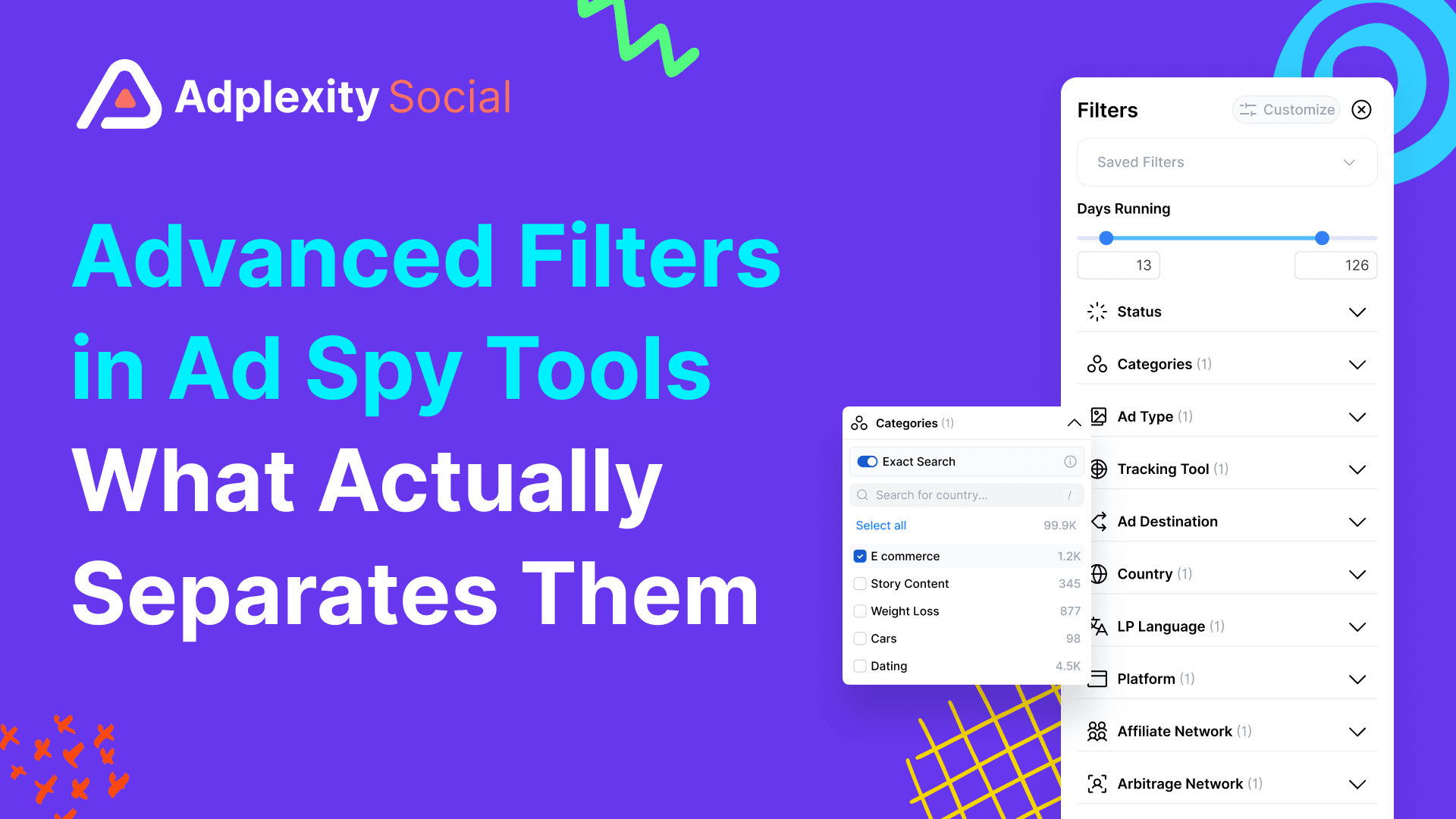
Omri is one of our top users of the AdPlexity Social API. The problem he wanted to solve was time. He has a big team, and he does not want people spending hours in spy tools every day, even though he considers spying one of the most important jobs in this industry.
So his team set up a report that lands in one of their Slack channels every day: the top 10 ads that ran the day before on AdPlexity Social. The build, as he describes it, is small.
"We connected the API to one of our AI agents, simple setup."
The agent is connected to Slack. Omri says he is not a big tech guy, so he told the agent what he wanted, gave it the API, and it figured it out.
"Give me like the link to each one, the headline for each one."
The team gets a snapshot in Slack without opening any other tool, and what they watch for is a pattern.
"Sometimes you see the same type of ads repeating day after day after day after day, which is a good indication. But sometimes you kind of get like new things that kind of pop up."
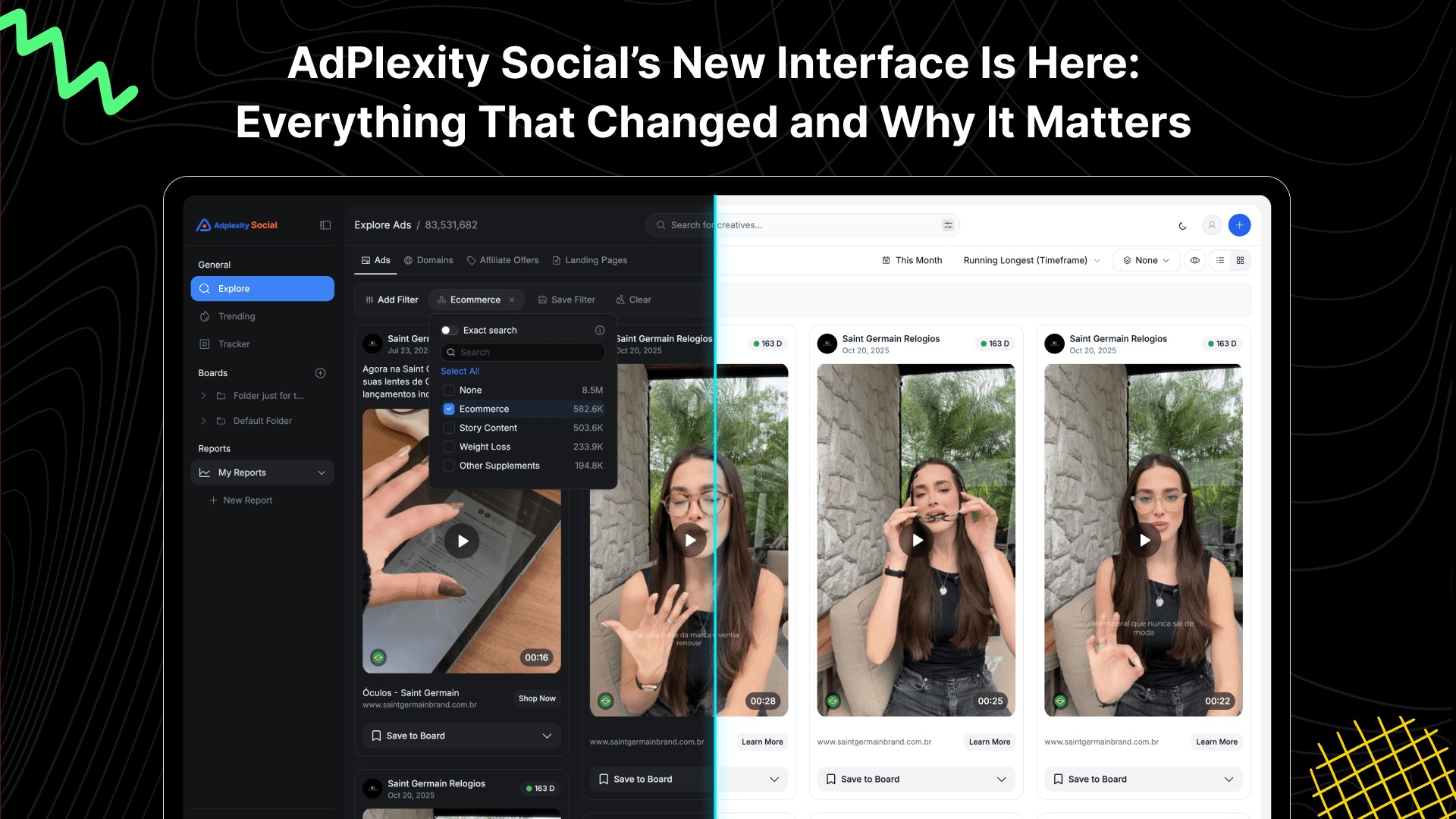
When something new shows up, they open it in AdPlexity Social and save it, which is what Boards are for, so the team knows to come back. Our API and MCP are live for all users and work with AI assistants such as Claude, ChatGPT and Gemini.
Omri was also one of the first people we gave access to Creative Score, and he agrees with the problem it is built around.
"Most used creative is not as big signal as it used to be."
His wish for the future is a way to find pages with a lot of active ads, since big pages are usually the ones that are scaling. We hear that as a request, not a promise. Omri says Telegram is the main place to find him. And if you want the research behind a workflow like his, AdPlexity Social indexes more than one hundred million Meta ads across all placements, with fifteen million new ads added every month, plus the landing pages behind them. Sign up at adplexity.io to see it for yourself.
Frequently Asked Questions
What is a JV in affiliate marketing?
A joint venture, the way Omri uses the term, is a deal where an affiliate and an offer owner or product company each take the part they are best at and share the profit. The affiliate usually runs the traffic and funnels, while the owner handles the product, customer service and processing. Funding and split change from deal to deal, and Omri says there is no single rule for how a JV should look.
How do you ask an offer owner for exclusivity?
Omri asks after an offer is proven. He tells the owner he has cracked it, proposes a 50-50 profit share, and asks to be the only affiliate on it. He backs the ask with a volume commitment and says he will hand the offer back if he cannot keep it up.
Can a contract protect you in an affiliate partnership?
Omri says nothing protects you fully, and he has seen friends stuck in court over disputes for a long time. His filter is trust, meaning transparency and partners who will not steal from you. Treat that as one operator's experience, not legal advice.
What does it mean to entertain before you sell on Meta?
It means giving the viewer something worth watching before the ad asks for anything. Omri says people come to these platforms bored, and when his team works on the entertainment factor, click-through rates and the intent behind the click go up. His tip is to watch what big DTC brands run in the Ad Library.
How can I get the day's top ads into Slack with an AI agent?
Omri's team connected the AdPlexity Social API to an AI agent that is connected to Slack, then told the agent what the daily report should contain, including the link and headline of each ad. He calls it a simple setup. The API and MCP announcement shows what is included.
Do I need a paid tool to research winning ads on Meta?
The free Meta Ad Library is a fair place to start. A paid tool earns its place when research becomes a daily job for a team, as with Omri's Slack report, or when you want the landing pages and redirect chains behind an ad. Our guide to the Meta Ad Library covers what the free version shows and what it leaves out.
Table of Contents
Quickly navigate through the key sections of this article.