How to Tell If a Facebook Ad Is Profitable: 6 Signals (2026)

Share:

You cannot see anyone else's ROAS. You can see how long they keep paying for an ad, how fast they copy it, and what they built behind the click.
You cannot see anyone else's ROAS. You can see how long they keep paying for an ad, how fast they copy it, and what they built behind the click.
Table of Contents
Can you see if someone else's Facebook ad is profitable?
Do likes and comments mean a Facebook ad is working?
Step 1: Check how long the Facebook ad has been running
Step 2: Count how many ads use the same creative
Step 3: Check if new copies are still launching this week
Step 4: See how many countries the ad runs in
Step 5: Follow the click to the landing page, redirect chain and tech stack
Step 6: Combine the signals into a verdict
Frequently Asked Questions
Conclusion
Key takeaways. Your own ad is profitable once its ROAS clears your break-even ROAS, and nobody outside an advertiser's own ad account can see that number for someone else's ad. What you can see instead is behavior: how long a creative keeps running, how many copies are live, whether new ones are still launching, how many countries it reaches, and what the advertiser built behind the click. Likes and comments measure attention, not sales. When a runtime past 30 days agrees with at least one behavior signal and one post-click signal, you are about as close to proof as public data gets. ZenaMakeup's palette video is what that agreement looks like: months of runtime and new copies still going out week after week.
The Facebook ad pulling the most reactions in a niche is often not the one making money. The one a brand quietly keeps paying for usually is. ZenaMakeup, a makeup brand whose hero product is an eye and cheek palette, has kept one palette video running since March, and in the past week alone it launched more than 200 fresh copies of it. A brand does not keep paying for a video for six months unless it pays back.
If you run Facebook ads and want to know whether a competitor's ad is actually making money before you borrow its angle, this guide shows you how in about 10 minutes. All you need is the advertiser's domain, page name or the ad's Library link.
By the end, you will be able to:
Read runtime without being fooled by it: tell a survivor from a proven winner.
Tell a test from a scaled winner: read copy count and run length together.
Spot a past winner before you copy it: so you are not late to it.
Read the funnel behind the click: see what the advertiser built and measures.
To find winning creatives across a whole niche rather than judge one ad you already found, start with find winning ad creatives across a whole niche.
Can you see if someone else's Facebook ad is profitable?
No. Nobody outside an advertiser's own ad account can see what a commercial Facebook ad spends or earns back. What you can see is everything the advertiser does in public: how long they keep paying, how many copies they run, and what they built behind the click.
Your own ad is profitable once its ROAS clears your break-even ROAS, 1 divided by your profit margin. A 40 percent margin needs a break-even ROAS of 2.5 before a single dollar counts as profit. That math belongs in your ad account, not this article.
For someone else's ad, the Ad Library shows a spend range only for social issue, election and political ads, and a reach estimate only for ads delivered in the EU or the UK. Reach proves delivery, not profit.
The pivot this guide runs on: every signal below is a decision the advertiser made while looking at their own ROAS. Paying for an ad, copying it, expanding into new countries and building pages behind it are votes that the numbers already say yes.
Here is what each side can see, and where:
Data point | Your own ad (Ads Manager) | Someone else's ad (Ad Library) | Ad intelligence tool |
|---|---|---|---|
Spend and ROAS | Full detail | No, except social issue, election and political ads | No |
Start date of each ad | Yes | Yes, "Started running on" | Yes, plus a creative-level First Seen |
Copies on other pages | Not applicable | No, stops at the one page you view | Yes, every page |
Copies launched this week | Not applicable | No | Yes |
Countries | Yes | Limited, a reach estimate only for EU and UK ads | Yes, 16 tracked markets |
Landing page, redirects, tech stack | Yes | No | Yes |
Do likes and comments mean a Facebook ad is working?
Campaign objective decides who reacts. An engagement campaign buys cheap reactions from people who like to react. A sales campaign optimizes for buyers, and buyers rarely stop scrolling to hit like.
Reactions pool on the post, not the ad, so an old viral post keeps its likes no matter how the ad is doing now. Comments can be hidden or deleted, so the thread you see is never the full conversation. A controversial hook pulls in people who love arguing, not people who buy.
Comments are still worth reading, just not as a scoreboard. They are free research on objections and how customers talk, useful the next time you are spying on competitor Facebook ads. The signals that matter come from what the advertiser does with its money, not from what an audience does with its thumbs.
Engagement measures attention, not purchases.
Step 1: Check how long the Facebook ad has been running
This is the first filter, not the verdict, and it costs nothing.
Open Meta's Ad Library, find the advertiser's page or search the ad's own text, and open the ad card. Read the "Started running on" date and the Active or inactive status printed on the card.
Only the first row below comes from Meta. The rest are practitioner rules of thumb:
How long it has run | What it usually means | What can fool you |
|---|---|---|
Under 7 days | Inside Meta's learning phase, which needs roughly 50 optimization events in a week to exit | Nothing is proven yet either way |
1 to 4 weeks | Survived the first round of cuts | A small test budget can survive this long too |
30+ days | Probably paying for itself | Evergreen and brand budgets reach 30 days without ever being profitable |
90+ days | Proven, at least once | Brand and evergreen ads live here too, so it is not automatic proof |
Runtime shows survival, not budget. A small evergreen spend can survive for years on its own, and brand campaigns run for months regardless of sales. Active means still delivering, not heavily funded. The start date also belongs to that one ad ID, so a months-old creative relaunched as fresh copies looks brand new, card by card. Step 2 fixes this with a creative-level First Seen date instead.
Here is the trap in action. One of the newest copies of ZenaMakeup's palette video went live in the UK in late September. Open its card in the Ad Library and it says that copy ran for about two hours, then stopped. Nothing on that card says the video behind it has been running since March. Most of ZenaMakeup's ads look exactly like this: about three in four run for three days or less, and only 63 out of more than 10,000 ever pass the one-month mark. The brand keeps swapping the copy and keeps the video. Judged one card at a time, nothing here looks like it lasts. Judged by the video, the winner is obvious.


Quality check: If the ad started less than a week ago, stop here and check it again in 7 days. No other signal overrides a runtime that short.
Runtime proves survival, not spend.
Step 2: Count how many ads use the same creative
Copies matter because that is how you scale a winner: duplicate it into new ad sets, new campaigns, new pages. Every copy is another deliberate bet on the same creative.
Free method: read the page's own ad. "N ads use this creative and text" means identical copies are running as separate ads from that page. That is scaling. "This ad has multiple versions," means Meta is testing variations inside one ad. That is testing.
The catch: the Library only counts copies on the one page you are viewing. Affiliates and lead gen advertisers spread a creative across dozens of pages on purpose. One page badly under-reports it.
The rule: many active ads of different creatives means testing. Many active ads of the same creative means scaling. A burst of copies all first seen within days of each other, gone within a week, means a volume test. Read copy count and run length together; neither means anything alone.
AdPlexity Social replaces the guesswork. It counts a creative's copies across every page running it, not just one. The header lays out how many are live, how fast that number is moving, and how long the creative has survived since it first appeared, the same First Seen date that exposes the per-ad trap from Step 1.
ZenaMakeup is a clean case of what scaling looks like from the inside. Its palette video has been running since March and sits in the Top bracket of the Creative Score. It has more than 2,000 copies, spread across two of the brand's own Pages, which is why checking just one Page, the way the free method does, catches only part of the real count.
Then zoom out to the advertiser
Beyond one creative, check the advertiser's whole domain: active ads, pages running them, and distinct creatives in rotation. There is no universal "serious" number. Duplicate volume is a property of the vertical. Lead gen often runs one creative per county, while many ecommerce brands barely duplicate at all. Compare inside the vertical, never across it.
Set that against the rest of what ZenaMakeup runs. Most of what the brand launches each month is a video it has run before, not something new. In September it launched ads on 88 videos it had already used and only 13 new ones, almost seven to one. That is a brand testing a handful of new ideas a month and paying to keep the ones that already work.
ZenaMakeup's hair removal mousse is the newest test, and the score says it is too early to call. It only started running in late September, with just a handful of copies so far, and its videos sit in the Medium bracket or below. Check again in 7 days.

A pile of copies is not a winner until it has survived. Read the First Seen and Last Seen dates before you read the count.
Quality check: If every copy was first seen in the same few days and none has run longer than a week, treat it as a test and come back in 7 days.
See a creative's copies across every page running it, not just the one in front of you. Sign up at adplexity.io and pull the same view on the next ad you find.
The same creative, copied many times, is a budget decision.
Step 3: Check if new copies are still launching this week
Lifetime volume is history. What matters this week is direction, and a creative can carry a huge lifetime # Ads while being completely finished.
A rising creative has new copies launching and a climbing active count: it is being scaled right now. A steady creative holds its active count with only a few new copies: a sustained earner. A falling creative has a dropping active count and no new copies: it is winding down, and copying it now means you arrive late.
AdPlexity Social's Creative Score ranks creatives by live momentum. It weighs how many duplicates are active right now, how fast the advertiser is launching new ones, and how long the creative has been running, then sorts every creative into one of five brackets: Top, High, Medium, Low and Dormant. Top is rare. Sort by Top Creative and stack it with a vertical or Industry filter so you are comparing inside your own niche.
ZenaMakeup is not riding one lucky clip. The palette offer runs in several different videos at once, and three of them sit in the Top bracket right now. That is the brand betting on the offer itself, not on a single video that happened to take off.
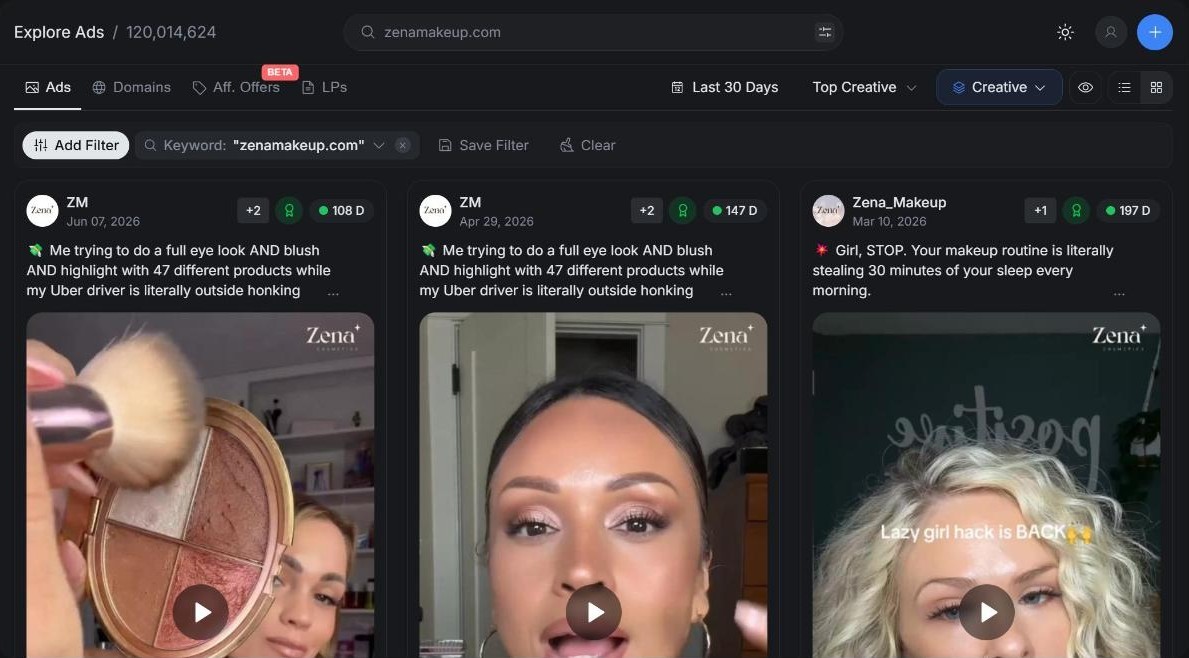
Scroll further down the same list and a second story shows up. ZenaMakeup has been advertising its eyeliner stamp since the same month as the palette's longest runner, back in March, but those videos' Creative Scores are falling fast, some down by more than half in a single week, while the palette videos keep climbing. Same brand, same starting month, two directions: one is being scaled, the other is being wound down.

Lifetime volume is history. This week's copies are the live signal.
Step 4: See how many countries the ad runs in
Expanding into new countries, including a copy translated into another language, is a budget decision, and advertisers only make that call once the first market is already working. That makes it a supporting signal, not proof on its own.
Some advertisers launch in a dozen countries from day one. Apps, iGaming and broad-targeting offers do this routinely, so for them a wide country spread proves nothing extra. Placements prove even less than countries do: automatic placements are Meta's own default, so an ad running on Facebook, Instagram and Messenger together just means nobody turned automatic placements off.
AdPlexity Social lists the countries each copy was seen in, across the 16 markets it tracks. It never shows a global count. An instant translation toggle turns any copy into English, the fastest way to catch the same creative reappearing in another language.
The palette runs in the US, the UK, Canada and Australia. ZenaMakeup did not stop at the ad itself: it set up local versions of the palette product page for Australia, Canada and the UK, and those three local pages alone carry about half of all its ads. Setting up a store for a new market is an investment, the kind a brand makes once that market is paying.

Nobody pays to expand a loser.
Step 5: Follow the click to the landing page, redirect chain and tech stack
Money invested after the click is the strongest public evidence an ad pays. Anyone can write an ad for free. A dedicated page, a tracker or an affiliate network fee are recurring costs that only keep happening if they earn their keep.
The landing page
A real landing page is dedicated to this one offer: a product page, advertorial, quiz or video sales letter, never a plain homepage. Several page variants on one domain are a stronger tell, since split testing only pays off with real traffic.
The palette video's click lands on a dedicated product page for the palette on ZenaMakeup's own Shopify store.
The redirect chain
A hop through a tracker such as Redtrack, Voluum, ClickFlare, Binom or Keitaro means the advertiser sees cost and revenue daily, so a long run behind a tracker is a vote it keeps renewing. A unique ID per ad in the landing URL does the same job with no named tracker in sight. Ignore fbclid, which Meta stamps on every click regardless.
This ad skips that step entirely: no tracker and no affiliate network, and the only hop in the chain stays on the store's own domain. That is normal for a Shopify store measuring its own orders directly, rather than paying for a tracker the way an affiliate has to.
The tech stack
The tech stack names the business model before you read a word of copy: Shopify means a store, VTurb a video sales letter, TrustedForm or Jornaya lead certification in regulated lead gen, and Ringba pay per call. An affiliate network such as ClickBank, BuyGoods, Digistore24 or GiddyUp names the offer and means someone gets paid per sale. Match the business model to the tech stack: an affiliate video sales letter's economics do not transfer to a Shopify brand, and TrustedForm documents consent, which matters most when the leads are sold on to buyers.
Without a tool, clicking the ad only shows the page it routed you to, and drops you into that advertiser's retargeting audience.
AdPlexity Social's Landing Pages tab shows the landing page screenshot, the full redirect chain, outgoing URLs, and every detected technology, tracking tool and affiliate network. That is post-click intelligence: reading what was built and measured after the click, the fastest way to reverse-engineer the full funnel behind a competitor's ad.
An advertiser running behind a real tracker knows exactly what this ad earns. If it is still running, the answer has already been yes.
Quality check: If the ad sends traffic to a homepage with no tracker and no dedicated page, runtime alone is carrying the whole verdict. Weigh it lower.

Step 6: Combine the signals into a verdict
No single signal proves a winner on its own. Two or three of them agreeing is the closest thing to proof public data gives you.
The six signals, plus the metric that only looks like one:
Signal | Strong sign | Weak sign | Check free | Check in AdPlexity Social |
|---|---|---|---|---|
How long it has run | 30+ days | Under 7 days, learning phase | "Started running on" | Days Running, First Seen |
Active copies across pages | Many copies on many pages | A handful, one page | Page's own duplicate count | Active Ads, every page |
New copies this week | Several | None | Not visible on one page | New Ads (7D) |
Countries it runs in | Expanding past the first market | Stuck in one market | Not shown clearly | Countries per copy, 16 markets |
What was built behind the click | Dedicated page, variants | Plain homepage | Click the ad yourself | Landing Pages tab, screenshot |
Whether clicks are measured | Tracker, per-ad ID, network | None of those | Not visible | Redirect chain, tech stack |
Likes, comments, shares | None on its own | High on a reused post or controversy | Visible on the post | Not tracked at all |
Combine those signals and here is the verdict each pattern points to:
Verdict | What it looks like | What to do |
|---|---|---|
Scaling winner | 30+ days, many active copies, new copies this week, measured funnel | Study it now |
Steady earner | Long run, stable active copies, few new ones | Study the funnel, expect less headroom |
Past winner | Big lifetime # Ads, active near zero, no new copies | Learn from it, do not copy now |
Volume test | Many copies first seen within days, short runs | Check again in 7 days |
Evergreen or brand ad | Long run, one or two copies, homepage, nothing measured | Not direct response proof |
ZenaMakeup's own videos sort into these same patterns. The palette video is the scaling winner: running since March and sitting in the Top bracket. The eyeliner stamp videos are winding down instead, their Creative Scores falling fast, some by more than half in a single week. The new hair removal mousse is still too early to call, a handful of copies sitting in Medium or below until another week of data says otherwise.
Run the scorecard on ZenaMakeup's palette video and it clears the bar. Runtime clears the 30-day mark easily: the video has been running since March. The behavior signal holds too: new copies of it are still launching week after week, not winding down. The post-click signal is just as solid: a dedicated product page for the palette, with local versions for Australia, Canada and the UK, and no third-party tracker needed because the store measures its own orders. By this guide's own bar, that is a scaling winner, not a guess.
The bar: a runtime past 30 days, plus at least one behavior signal, active or new copies, plus one post-click signal.
Save any creative worth watching to a Board and check it again in 7 days. Direction over one week is the best tiebreaker there is.
Frequently Asked Questions
How do I know if my own Facebook ad is profitable?
Compare its ROAS to your break-even ROAS, 1 divided by your profit margin, then check that number against real revenue in your store or CRM, not Ads Manager's attribution alone.
Can you see how much a competitor spends on a Facebook ad?
Not for an ordinary commercial ad. The Library only shows a spend range for social issue, election and political ads, plus a reach estimate for ads delivered in the EU or the UK. Any other spend figure is a model. Runtime and copy count are the reliable substitute.
How long does a Facebook ad need to run before it counts as a winner?
There is no set rule, and it depends heavily on the industry: a brand with an evergreen product can run one video for months, while a seasonal offer or a fast-moving vertical may cycle through creatives in a few weeks. Judge runtime against other advertisers in the same industry, and look at whether the advertiser is still adding copies, not at a fixed number of days. The 30 days used in this guide is a rule of thumb for a first read, not a law. The one firm point is the start: nothing is proven in the first week, while the ad is still inside Meta's learning phase.
Do likes and comments mean a Facebook ad is profitable?
No. They measure attention, not purchases. Reactions pool on a reused post no matter how the ad performs, and comments can be hidden or deleted. AdPlexity Social does not track likes, comments or shares; it judges behavior instead.
What does "This ad has multiple versions" mean in the Meta Ad Library?
It means Meta is testing variations, different images or text combined automatically, inside one ad. A line saying a number of ads use the same creative and text means separate, identical ads are running, usually scaling or an audience split.
How many active ads does a serious competitor run on Facebook?
There is no universal number. It depends on the vertical: lead gen often runs one creative per county, while many ecommerce brands barely duplicate. Ask how many active copies one creative has, and how many distinct creatives that advertiser runs.
Can a Facebook ad run for months and still lose money?
Yes. Small evergreen or retargeting budgets, brand goals, or an ad nobody switched off can run for months on their own. That is why runtime needs active copies and a real funnel beside it before it counts as proof.
Do I need a paid tool to tell if a Facebook ad is profitable?
Not for the basics. Runtime and single-page copy counts are free in the Ad Library. Copies across other pages, new copies this week, and the redirect chain and tech stack all need a tool; see what the free Ad Library cannot show for the full gap.
Conclusion
You now have six checks for the next ad that catches your eye:
How long has it run
How many copies are active across pages
Are new copies still launching this week
How many countries does it reach
What was built behind the click
Is any of it actually measured
None of these six proves anything on its own, but two or three agreeing is about as close to proof as public data gets. Run them on ZenaMakeup's palette video and nearly every one points the same way, which is exactly what makes it worth studying instead of scrolling past.
Sign up at adplexity.io and run these six checks on the next ad you are tempted to copy, against a database of 100M+ Meta ads with 15M+ new ones added every month.
Table of Contents
Can you see if someone else's Facebook ad is profitable?
Do likes and comments mean a Facebook ad is working?
Step 1: Check how long the Facebook ad has been running
Step 2: Count how many ads use the same creative
Step 3: Check if new copies are still launching this week
Step 4: See how many countries the ad runs in
Step 5: Follow the click to the landing page, redirect chain and tech stack
Step 6: Combine the signals into a verdict
Frequently Asked Questions
Conclusion
Key takeaways. Your own ad is profitable once its ROAS clears your break-even ROAS, and nobody outside an advertiser's own ad account can see that number for someone else's ad. What you can see instead is behavior: how long a creative keeps running, how many copies are live, whether new ones are still launching, how many countries it reaches, and what the advertiser built behind the click. Likes and comments measure attention, not sales. When a runtime past 30 days agrees with at least one behavior signal and one post-click signal, you are about as close to proof as public data gets. ZenaMakeup's palette video is what that agreement looks like: months of runtime and new copies still going out week after week.
The Facebook ad pulling the most reactions in a niche is often not the one making money. The one a brand quietly keeps paying for usually is. ZenaMakeup, a makeup brand whose hero product is an eye and cheek palette, has kept one palette video running since March, and in the past week alone it launched more than 200 fresh copies of it. A brand does not keep paying for a video for six months unless it pays back.
If you run Facebook ads and want to know whether a competitor's ad is actually making money before you borrow its angle, this guide shows you how in about 10 minutes. All you need is the advertiser's domain, page name or the ad's Library link.
By the end, you will be able to:
Read runtime without being fooled by it: tell a survivor from a proven winner.
Tell a test from a scaled winner: read copy count and run length together.
Spot a past winner before you copy it: so you are not late to it.
Read the funnel behind the click: see what the advertiser built and measures.
To find winning creatives across a whole niche rather than judge one ad you already found, start with find winning ad creatives across a whole niche.
Can you see if someone else's Facebook ad is profitable?
No. Nobody outside an advertiser's own ad account can see what a commercial Facebook ad spends or earns back. What you can see is everything the advertiser does in public: how long they keep paying, how many copies they run, and what they built behind the click.
Your own ad is profitable once its ROAS clears your break-even ROAS, 1 divided by your profit margin. A 40 percent margin needs a break-even ROAS of 2.5 before a single dollar counts as profit. That math belongs in your ad account, not this article.
For someone else's ad, the Ad Library shows a spend range only for social issue, election and political ads, and a reach estimate only for ads delivered in the EU or the UK. Reach proves delivery, not profit.
The pivot this guide runs on: every signal below is a decision the advertiser made while looking at their own ROAS. Paying for an ad, copying it, expanding into new countries and building pages behind it are votes that the numbers already say yes.
Here is what each side can see, and where:
Data point | Your own ad (Ads Manager) | Someone else's ad (Ad Library) | Ad intelligence tool |
|---|---|---|---|
Spend and ROAS | Full detail | No, except social issue, election and political ads | No |
Start date of each ad | Yes | Yes, "Started running on" | Yes, plus a creative-level First Seen |
Copies on other pages | Not applicable | No, stops at the one page you view | Yes, every page |
Copies launched this week | Not applicable | No | Yes |
Countries | Yes | Limited, a reach estimate only for EU and UK ads | Yes, 16 tracked markets |
Landing page, redirects, tech stack | Yes | No | Yes |
Do likes and comments mean a Facebook ad is working?
Campaign objective decides who reacts. An engagement campaign buys cheap reactions from people who like to react. A sales campaign optimizes for buyers, and buyers rarely stop scrolling to hit like.
Reactions pool on the post, not the ad, so an old viral post keeps its likes no matter how the ad is doing now. Comments can be hidden or deleted, so the thread you see is never the full conversation. A controversial hook pulls in people who love arguing, not people who buy.
Comments are still worth reading, just not as a scoreboard. They are free research on objections and how customers talk, useful the next time you are spying on competitor Facebook ads. The signals that matter come from what the advertiser does with its money, not from what an audience does with its thumbs.
Engagement measures attention, not purchases.
Step 1: Check how long the Facebook ad has been running
This is the first filter, not the verdict, and it costs nothing.
Open Meta's Ad Library, find the advertiser's page or search the ad's own text, and open the ad card. Read the "Started running on" date and the Active or inactive status printed on the card.
Only the first row below comes from Meta. The rest are practitioner rules of thumb:
How long it has run | What it usually means | What can fool you |
|---|---|---|
Under 7 days | Inside Meta's learning phase, which needs roughly 50 optimization events in a week to exit | Nothing is proven yet either way |
1 to 4 weeks | Survived the first round of cuts | A small test budget can survive this long too |
30+ days | Probably paying for itself | Evergreen and brand budgets reach 30 days without ever being profitable |
90+ days | Proven, at least once | Brand and evergreen ads live here too, so it is not automatic proof |
Runtime shows survival, not budget. A small evergreen spend can survive for years on its own, and brand campaigns run for months regardless of sales. Active means still delivering, not heavily funded. The start date also belongs to that one ad ID, so a months-old creative relaunched as fresh copies looks brand new, card by card. Step 2 fixes this with a creative-level First Seen date instead.
Here is the trap in action. One of the newest copies of ZenaMakeup's palette video went live in the UK in late September. Open its card in the Ad Library and it says that copy ran for about two hours, then stopped. Nothing on that card says the video behind it has been running since March. Most of ZenaMakeup's ads look exactly like this: about three in four run for three days or less, and only 63 out of more than 10,000 ever pass the one-month mark. The brand keeps swapping the copy and keeps the video. Judged one card at a time, nothing here looks like it lasts. Judged by the video, the winner is obvious.
Quality check: If the ad started less than a week ago, stop here and check it again in 7 days. No other signal overrides a runtime that short.
Runtime proves survival, not spend.
Step 2: Count how many ads use the same creative
Copies matter because that is how you scale a winner: duplicate it into new ad sets, new campaigns, new pages. Every copy is another deliberate bet on the same creative.
Free method: read the page's own ad. "N ads use this creative and text" means identical copies are running as separate ads from that page. That is scaling. "This ad has multiple versions," means Meta is testing variations inside one ad. That is testing.
The catch: the Library only counts copies on the one page you are viewing. Affiliates and lead gen advertisers spread a creative across dozens of pages on purpose. One page badly under-reports it.
The rule: many active ads of different creatives means testing. Many active ads of the same creative means scaling. A burst of copies all first seen within days of each other, gone within a week, means a volume test. Read copy count and run length together; neither means anything alone.
AdPlexity Social replaces the guesswork. It counts a creative's copies across every page running it, not just one. The header lays out how many are live, how fast that number is moving, and how long the creative has survived since it first appeared, the same First Seen date that exposes the per-ad trap from Step 1.
ZenaMakeup is a clean case of what scaling looks like from the inside. Its palette video has been running since March and sits in the Top bracket of the Creative Score. It has more than 2,000 copies, spread across two of the brand's own Pages, which is why checking just one Page, the way the free method does, catches only part of the real count.
Then zoom out to the advertiser
Beyond one creative, check the advertiser's whole domain: active ads, pages running them, and distinct creatives in rotation. There is no universal "serious" number. Duplicate volume is a property of the vertical. Lead gen often runs one creative per county, while many ecommerce brands barely duplicate at all. Compare inside the vertical, never across it.
Set that against the rest of what ZenaMakeup runs. Most of what the brand launches each month is a video it has run before, not something new. In September it launched ads on 88 videos it had already used and only 13 new ones, almost seven to one. That is a brand testing a handful of new ideas a month and paying to keep the ones that already work.
ZenaMakeup's hair removal mousse is the newest test, and the score says it is too early to call. It only started running in late September, with just a handful of copies so far, and its videos sit in the Medium bracket or below. Check again in 7 days.
A pile of copies is not a winner until it has survived. Read the First Seen and Last Seen dates before you read the count.
Quality check: If every copy was first seen in the same few days and none has run longer than a week, treat it as a test and come back in 7 days.
See a creative's copies across every page running it, not just the one in front of you. Sign up at adplexity.io and pull the same view on the next ad you find.
The same creative, copied many times, is a budget decision.
Step 3: Check if new copies are still launching this week
Lifetime volume is history. What matters this week is direction, and a creative can carry a huge lifetime # Ads while being completely finished.
A rising creative has new copies launching and a climbing active count: it is being scaled right now. A steady creative holds its active count with only a few new copies: a sustained earner. A falling creative has a dropping active count and no new copies: it is winding down, and copying it now means you arrive late.
AdPlexity Social's Creative Score ranks creatives by live momentum. It weighs how many duplicates are active right now, how fast the advertiser is launching new ones, and how long the creative has been running, then sorts every creative into one of five brackets: Top, High, Medium, Low and Dormant. Top is rare. Sort by Top Creative and stack it with a vertical or Industry filter so you are comparing inside your own niche.
ZenaMakeup is not riding one lucky clip. The palette offer runs in several different videos at once, and three of them sit in the Top bracket right now. That is the brand betting on the offer itself, not on a single video that happened to take off.
Scroll further down the same list and a second story shows up. ZenaMakeup has been advertising its eyeliner stamp since the same month as the palette's longest runner, back in March, but those videos' Creative Scores are falling fast, some down by more than half in a single week, while the palette videos keep climbing. Same brand, same starting month, two directions: one is being scaled, the other is being wound down.
Lifetime volume is history. This week's copies are the live signal.
Step 4: See how many countries the ad runs in
Expanding into new countries, including a copy translated into another language, is a budget decision, and advertisers only make that call once the first market is already working. That makes it a supporting signal, not proof on its own.
Some advertisers launch in a dozen countries from day one. Apps, iGaming and broad-targeting offers do this routinely, so for them a wide country spread proves nothing extra. Placements prove even less than countries do: automatic placements are Meta's own default, so an ad running on Facebook, Instagram and Messenger together just means nobody turned automatic placements off.
AdPlexity Social lists the countries each copy was seen in, across the 16 markets it tracks. It never shows a global count. An instant translation toggle turns any copy into English, the fastest way to catch the same creative reappearing in another language.
The palette runs in the US, the UK, Canada and Australia. ZenaMakeup did not stop at the ad itself: it set up local versions of the palette product page for Australia, Canada and the UK, and those three local pages alone carry about half of all its ads. Setting up a store for a new market is an investment, the kind a brand makes once that market is paying.
Nobody pays to expand a loser.
Step 5: Follow the click to the landing page, redirect chain and tech stack
Money invested after the click is the strongest public evidence an ad pays. Anyone can write an ad for free. A dedicated page, a tracker or an affiliate network fee are recurring costs that only keep happening if they earn their keep.
The landing page
A real landing page is dedicated to this one offer: a product page, advertorial, quiz or video sales letter, never a plain homepage. Several page variants on one domain are a stronger tell, since split testing only pays off with real traffic.
The palette video's click lands on a dedicated product page for the palette on ZenaMakeup's own Shopify store.
The redirect chain
A hop through a tracker such as Redtrack, Voluum, ClickFlare, Binom or Keitaro means the advertiser sees cost and revenue daily, so a long run behind a tracker is a vote it keeps renewing. A unique ID per ad in the landing URL does the same job with no named tracker in sight. Ignore fbclid, which Meta stamps on every click regardless.
This ad skips that step entirely: no tracker and no affiliate network, and the only hop in the chain stays on the store's own domain. That is normal for a Shopify store measuring its own orders directly, rather than paying for a tracker the way an affiliate has to.
The tech stack
The tech stack names the business model before you read a word of copy: Shopify means a store, VTurb a video sales letter, TrustedForm or Jornaya lead certification in regulated lead gen, and Ringba pay per call. An affiliate network such as ClickBank, BuyGoods, Digistore24 or GiddyUp names the offer and means someone gets paid per sale. Match the business model to the tech stack: an affiliate video sales letter's economics do not transfer to a Shopify brand, and TrustedForm documents consent, which matters most when the leads are sold on to buyers.
Without a tool, clicking the ad only shows the page it routed you to, and drops you into that advertiser's retargeting audience.
AdPlexity Social's Landing Pages tab shows the landing page screenshot, the full redirect chain, outgoing URLs, and every detected technology, tracking tool and affiliate network. That is post-click intelligence: reading what was built and measured after the click, the fastest way to reverse-engineer the full funnel behind a competitor's ad.
An advertiser running behind a real tracker knows exactly what this ad earns. If it is still running, the answer has already been yes.
Quality check: If the ad sends traffic to a homepage with no tracker and no dedicated page, runtime alone is carrying the whole verdict. Weigh it lower.
Step 6: Combine the signals into a verdict
No single signal proves a winner on its own. Two or three of them agreeing is the closest thing to proof public data gives you.
The six signals, plus the metric that only looks like one:
Signal | Strong sign | Weak sign | Check free | Check in AdPlexity Social |
|---|---|---|---|---|
How long it has run | 30+ days | Under 7 days, learning phase | "Started running on" | Days Running, First Seen |
Active copies across pages | Many copies on many pages | A handful, one page | Page's own duplicate count | Active Ads, every page |
New copies this week | Several | None | Not visible on one page | New Ads (7D) |
Countries it runs in | Expanding past the first market | Stuck in one market | Not shown clearly | Countries per copy, 16 markets |
What was built behind the click | Dedicated page, variants | Plain homepage | Click the ad yourself | Landing Pages tab, screenshot |
Whether clicks are measured | Tracker, per-ad ID, network | None of those | Not visible | Redirect chain, tech stack |
Likes, comments, shares | None on its own | High on a reused post or controversy | Visible on the post | Not tracked at all |
Combine those signals and here is the verdict each pattern points to:
Verdict | What it looks like | What to do |
|---|---|---|
Scaling winner | 30+ days, many active copies, new copies this week, measured funnel | Study it now |
Steady earner | Long run, stable active copies, few new ones | Study the funnel, expect less headroom |
Past winner | Big lifetime # Ads, active near zero, no new copies | Learn from it, do not copy now |
Volume test | Many copies first seen within days, short runs | Check again in 7 days |
Evergreen or brand ad | Long run, one or two copies, homepage, nothing measured | Not direct response proof |
ZenaMakeup's own videos sort into these same patterns. The palette video is the scaling winner: running since March and sitting in the Top bracket. The eyeliner stamp videos are winding down instead, their Creative Scores falling fast, some by more than half in a single week. The new hair removal mousse is still too early to call, a handful of copies sitting in Medium or below until another week of data says otherwise.
Run the scorecard on ZenaMakeup's palette video and it clears the bar. Runtime clears the 30-day mark easily: the video has been running since March. The behavior signal holds too: new copies of it are still launching week after week, not winding down. The post-click signal is just as solid: a dedicated product page for the palette, with local versions for Australia, Canada and the UK, and no third-party tracker needed because the store measures its own orders. By this guide's own bar, that is a scaling winner, not a guess.
The bar: a runtime past 30 days, plus at least one behavior signal, active or new copies, plus one post-click signal.
Save any creative worth watching to a Board and check it again in 7 days. Direction over one week is the best tiebreaker there is.
Frequently Asked Questions
How do I know if my own Facebook ad is profitable?
Compare its ROAS to your break-even ROAS, 1 divided by your profit margin, then check that number against real revenue in your store or CRM, not Ads Manager's attribution alone.
Can you see how much a competitor spends on a Facebook ad?
Not for an ordinary commercial ad. The Library only shows a spend range for social issue, election and political ads, plus a reach estimate for ads delivered in the EU or the UK. Any other spend figure is a model. Runtime and copy count are the reliable substitute.
How long does a Facebook ad need to run before it counts as a winner?
There is no set rule, and it depends heavily on the industry: a brand with an evergreen product can run one video for months, while a seasonal offer or a fast-moving vertical may cycle through creatives in a few weeks. Judge runtime against other advertisers in the same industry, and look at whether the advertiser is still adding copies, not at a fixed number of days. The 30 days used in this guide is a rule of thumb for a first read, not a law. The one firm point is the start: nothing is proven in the first week, while the ad is still inside Meta's learning phase.
Do likes and comments mean a Facebook ad is profitable?
No. They measure attention, not purchases. Reactions pool on a reused post no matter how the ad performs, and comments can be hidden or deleted. AdPlexity Social does not track likes, comments or shares; it judges behavior instead.
What does "This ad has multiple versions" mean in the Meta Ad Library?
It means Meta is testing variations, different images or text combined automatically, inside one ad. A line saying a number of ads use the same creative and text means separate, identical ads are running, usually scaling or an audience split.
How many active ads does a serious competitor run on Facebook?
There is no universal number. It depends on the vertical: lead gen often runs one creative per county, while many ecommerce brands barely duplicate. Ask how many active copies one creative has, and how many distinct creatives that advertiser runs.
Can a Facebook ad run for months and still lose money?
Yes. Small evergreen or retargeting budgets, brand goals, or an ad nobody switched off can run for months on their own. That is why runtime needs active copies and a real funnel beside it before it counts as proof.
Do I need a paid tool to tell if a Facebook ad is profitable?
Not for the basics. Runtime and single-page copy counts are free in the Ad Library. Copies across other pages, new copies this week, and the redirect chain and tech stack all need a tool; see what the free Ad Library cannot show for the full gap.
Conclusion
You now have six checks for the next ad that catches your eye:
How long has it run
How many copies are active across pages
Are new copies still launching this week
How many countries does it reach
What was built behind the click
Is any of it actually measured
None of these six proves anything on its own, but two or three agreeing is about as close to proof as public data gets. Run them on ZenaMakeup's palette video and nearly every one points the same way, which is exactly what makes it worth studying instead of scrolling past.
Sign up at adplexity.io and run these six checks on the next ad you are tempted to copy, against a database of 100M+ Meta ads with 15M+ new ones added every month.
Table of Contents
Quickly navigate through the key sections of this article.
Discover Winning Meta Ads
Similar Blogs
Check related blogs
Check related blogs
Check related blogs








Ready to See What’s Really Working on Meta?
Adplexity
Social
© Copyright 2026 All Rights Reserved
Ready to See What’s Really Working on Meta?
Adplexity
Social
© Copyright 2026 All Rights Reserved
Ready to See What’s Really Working on Meta?
Adplexity
Social
© Copyright 2026 All Rights Reserved