Insurance Leads From Facebook Ads: Top Funnels and Meta's 2026 Rules

Share:

The top-scoring insurance ad on Facebook right now is a State Farm template that nearly 1,300 local agents run under their own Pages. Here is what the biggest insurance advertisers run, where their clicks go, and the rules every ad and lead form has to pass.
The top-scoring insurance ad on Facebook right now is a State Farm template that nearly 1,300 local agents run under their own Pages. Here is what the biggest insurance advertisers run, where their clicks go, and the rules every ad and lead form has to pass.
Table of Contents
How Many Insurance Ads Run on Facebook Right Now?
What Does the Top-Scoring Insurance Ad on Facebook Look Like?
How Do the Top Advertisers Get Insurance Leads From Facebook Ads?
Do Insurance Ads on Facebook Need a Special Ad Category?
Why Do Insurance Ads Get Rejected on Facebook?
What Do the TCPA and State Laws Require on an Insurance Lead Form?
How Do You Find the Insurance Advertisers Winning in Your Line?
Frequently Asked Questions
Conclusion
Key takeaways. Right now, the top-scoring insurance ad in US car and home insurance does not come from a lead generator or a big brand campaign. It is one State Farm template, "Call, Click or Stop By", that AdPlexity Social recorded on nearly 1,300 local agents' own Facebook Pages, each sending the click to the agent's own site. It runs under new rules: since January 21, 2025, no US insurance campaign can choose its audience by age, gender or ZIP code, so the Page, the local face and the funnel behind the click do the work targeting used to do. Lead generators work the same market through comparison pages that record consent with TrustedForm or Jornaya. Before you scale, choose the Special Ad Category, keep instant form questions inside Meta's list, and get the consent language right.
Several of the top-ranking guides to insurance Facebook ads still tell agents to target by age, household income, ZIP code and lookalike audiences. Meta switched those options off or limited them for any insurance campaign reaching the United States on January 21, 2025. The insurance ads still running at scale adapted, in the ad itself and in the funnel behind the click.
This guide is for insurance agents, lead generators and media buyers who want to know what works now that the old targeting is gone. It covers what the top insurance ads run, where the click goes, and the rules each ad and form has to pass. The numbers come from AdPlexity Social, which records Meta ads across all placements and the landing pages behind them.
How Many Insurance Ads Run on Facebook Right Now?
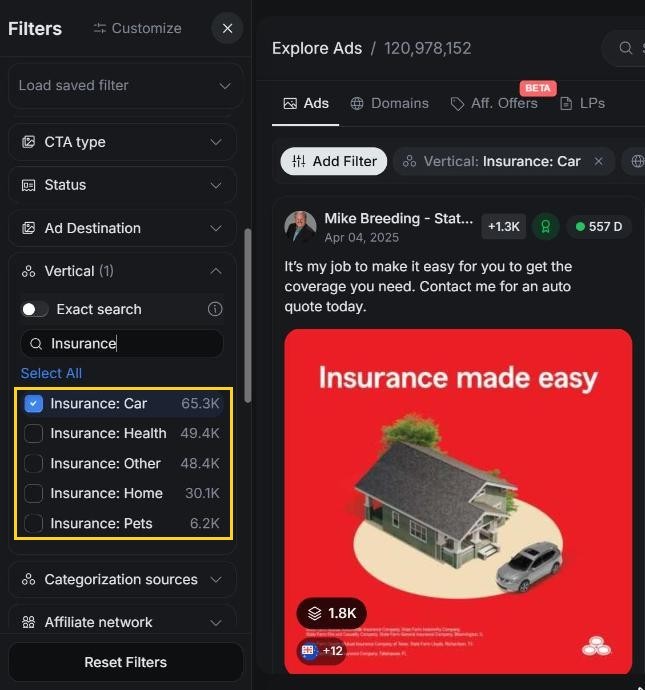
AdPlexity Social splits insurance into five lines (Car, Health, Home, Other and Pets) and has no parent "Insurance" option. Final expense, Medicare and life insurance have no line of their own, so they fall under those five. The counts below are ads it saw running in the last 30 days, not new ads and not companies. Read the counts as scale, not as an audit: one ad can carry more than one tag, so the lines never add up to one total, and a few ads in every line are not insurance offers at all.
Line | US ads, last 30 days | Land on a landing page | Open an instant form |
|---|---|---|---|
Insurance: Car | about 65,300 | about 64,700 | about 660 |
Insurance: Health | about 49,400 | about 44,400 | about 4,900 |
Insurance: Other | about 48,400 | about 37,500 | about 10,600 |
Insurance: Home | about 30,100 | about 29,000 | about 1,600 |
Insurance: Pets | about 6,200 | about 6,200 | 3 |
Read in AdPlexity Social on October 15, 2026, Country United States, Last 30 Days. A few ads open an Instagram profile or a Facebook Page instead, so the two destination columns do not add up to the total.
Car is the biggest line, and almost every car insurance click goes to a landing page, with about 1 in 100 opening an instant form. Instant forms pile up in Other instead, at about 1 in 5, and the ones at the top of that line sell life insurance and final expense coverage.
What Does the Top-Scoring Insurance Ad on Facebook Look Like?
Filter AdPlexity Social to US car insurance, group the results by creative and sort by Top Creative, its Creative Score sort. You would expect a lead generator at the top, or a big carrier's brand campaign. What you get is a State Farm template called "Call, Click or Stop By", and the same creative also sits at the top of the Home line.
The copy could hardly be plainer: "It's my job to make it easy for you to get the coverage you need. Contact me for an auto quote today." Many copies close with the agent's own name and insurance license number, so each one still sounds like a single local person talking.
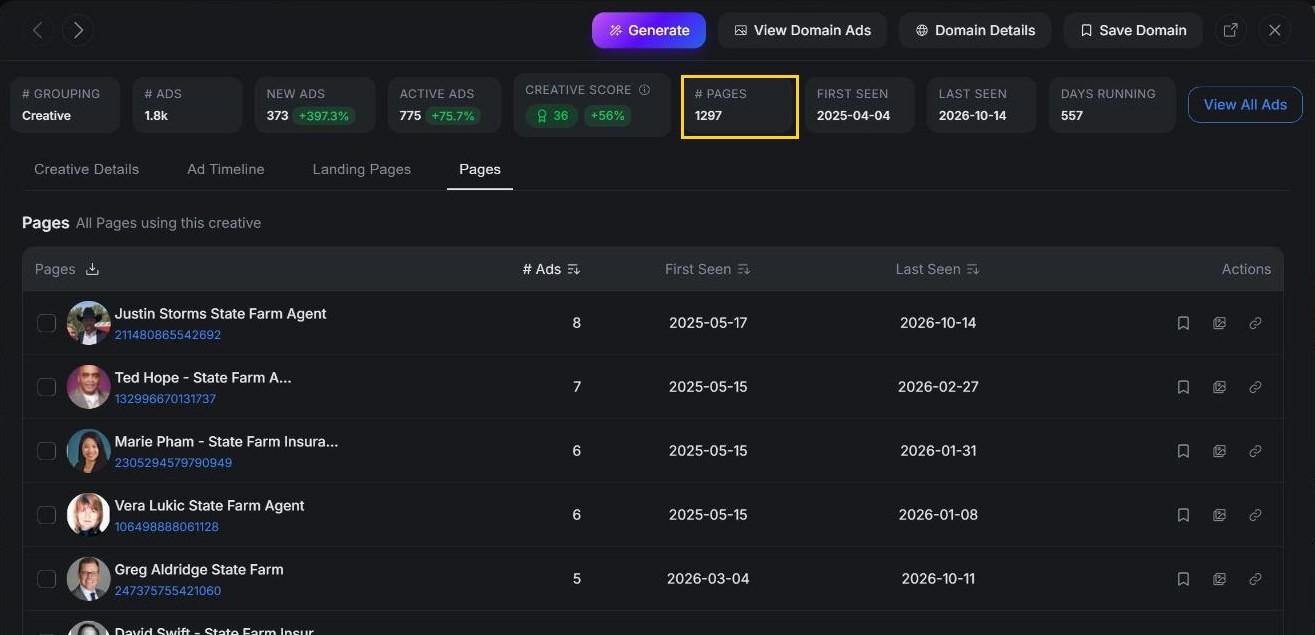
What makes it unusual is who runs it. The creative's header in AdPlexity Social shows it running from 1,297 Pages belonging to State Farm agents, and the copies link to the agents' own websites. AdPlexity Social first saw the template in April 2025 and still records hundreds of live copies. The same play shows up in life insurance, where AdPlexity Social recorded a "State Farm Life Insurance" template running from nearly 2,000 Pages in the Health line.
The lesson for an agent is how plain the winner is: a local person, three ways to reach them, no price. For anyone researching the market, the lesson is different: a ranking by domain would never show you this ad, because every agent links to a different site. Only grouping by creative pulls all those Pages into one view.
How Do the Top Advertisers Get Insurance Leads From Facebook Ads?
Once someone clicks, the click goes to one of three places: a landing page, an instant form that never leaves Meta, or a phone call. The top players mix them, depending on what they can handle after the click.
Landing Page, Instant Form or Phone Call: Where Does the Click Go?
Most US insurance clicks go to a landing page, as the table earlier shows, but the other two routes are worth one example each.
Trucker's Life Insurance Shop is a life insurance Page whose ads open an instant form. Its headline reads "You Insure Your Truck. What About Yourself?" and speaks to truck drivers by trade, so the people who stop are the ones it was written for. AdPlexity Social has seen that creative group running since early August 2026. An instant form keeps the lead inside Meta, which is exactly why Meta limits what the form can ask (the rejection section below has that list).

Then there is the phone route. Goratehive.com, a home insurance comparison brand, sends its ads through a Voluum tracking link to a comparison page, and AdPlexity Social detects Retreaver on that page. Retreaver is a call tracking tool, so finding it there means a phone call is part of the plan. To look for more of these, see how to find pay per call campaigns and the verticals they run in.
Inside a Car Insurance Comparison Funnel
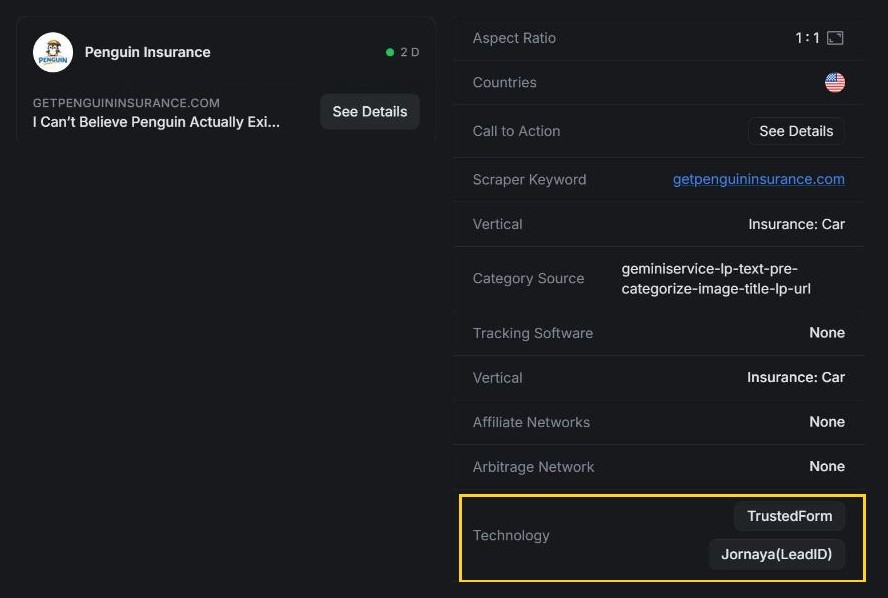
Penguin Insurance is a car insurance quote brand with a penguin for a mascot, and one of its ads carries the headline "I Can't Believe Penguin Actually Exists." Click it and the browser passes through two hops, both on Penguin's own domains: getpenguininsurance.com first, then f.getpenguininsurance.com. It then lands on a quote page that asks for a ZIP code. AdPlexity Social detects no outside tracker or affiliate network anywhere in that chain.
The part to remember is on the quote page itself: for a brand fronted by a penguin, AdPlexity Social detects both consent certification tools there, TrustedForm and Jornaya, side by side. Reading the redirect chain and the detected technology this way is the fastest way to reverse-engineer a competitor's landing page funnel.
Which Domains Lead Car, Home and Health Insurance?
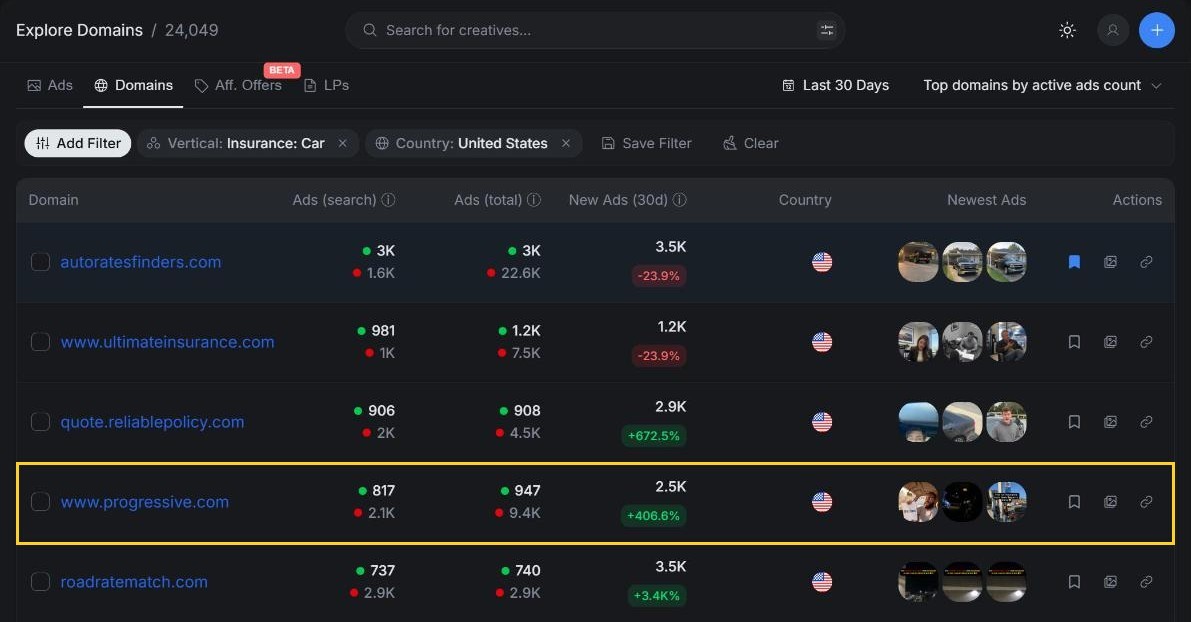
The Domains view ranks the domains behind a line by how many of their ads are running right now, as AdPlexity Social recorded them. In the Car line, Progressive (www.progressive.com) sits fourth, and it is the only big national carrier in the top six. The rest are quote and comparison sites and smaller insurance brands.
The Home line is the surprise, because the top two are not insurers at all: search.yahoo.com is a search results page that carries search arbitrage traffic, and facebook.com keeps the click on Facebook itself. Farmers (www.farmers.com) is the carrier in the top five.
In the Health line, search arbitrage leads again. The row that jumps out is Devoted Health (hello.devoted.com), a Medicare Advantage plan: AdPlexity Social saw it launch more than twenty times as many new ads in the last 30 days as in the 30 days before. That lands right ahead of Medicare's Open Enrollment, which runs from October 15 to December 7.
One name is missing from all three lists: State Farm, because its agents link to hundreds of different sites. The same method works in other verticals, and here it is applied to pay per call and lead gen campaigns, domain by domain.
Consent Certification Runs on Thousands of Insurance Pages
About 3 in 10 of the US car insurance ads AdPlexity Social recorded in the last 30 days landed on a page with Jornaya detected, and about 1 in 4 landed on a page with TrustedForm. Neither tool is an ad platform: both record that a specific visitor agreed to be contacted at a specific moment, which is the record a seller needs if a call or text is ever challenged. The rules section below covers what that consent has to say, and TrustedForm vs Jornaya covers how the two tools compare.
Insurance ads in AdPlexity Social come with their landing page, redirect chain and detected technology. Sign up at adplexity.io to pull it for your own line.
Do Insurance Ads on Facebook Need a Special Ad Category?
This is Meta's own policy as it reads in October 2026. Nothing here is legal advice, and policy pages change, so check the linked pages before you rely on any of it.
Yes. Since January 21, 2025, an advertiser based in the United States, or reaching audiences in the United States, must use the Special Ad Category for financial products and services on campaigns of that kind, and insurance is one of them. The category replaced the old Credit category in October 2024.
In the US, Meta counts ads for insurance products and brand ads for financial products and services, whatever the offer, as ads in this category. Choosing the category does not slow down review, and it does not limit delivery to people interested in finance.
A separate Meta advertising policy, for financial and insurance products and services, says insurance ads must target people 18 or older, must carry any disclosures the law requires, and in some countries need proof of a license or authorization.
Each row pairs one of the category's limits with what still works:
What the category limits | What still works |
|---|---|
Targeting by ZIP code or postal code, and any location exclusions | Location by country, region, state, province or city |
Age, which is generally fixed at 18 to 65 or older | A passing reference to an age group in the ad copy |
Gender, which must include everyone | Reaching all genders |
Some demographic, behavior and interest options, all exclusions, and Advantage+ lookalike audiences | Broad delivery within the allowed geography |
Custom audiences, which may only be available in Meta Ads Manager | Custom audiences built in Ads Manager |
In the US and Canada, a city, address or dropped pin expands to a 15-mile radius. That same audience page still words the age rule for housing, employment and credit ads. Credit is the category that financial products and services replaced, so expect the old wording on that page.
Meta also announced a restriction on customer lists alongside the October 2024 change, but it never rolled out.
To set the category, open Ads Manager, create or open the campaign, select Special Ad Categories, choose the category, then choose the countries.
Outside the US, the answer changes: the category covers credit offers in the US, Canada and parts of Europe, but insurance only in the US. A US-based insurer needs the category even when it targets other countries. But for an advertiser outside the US reaching audiences outside the US, insurance sits outside this category, though other rules apply.
In the United Kingdom, any ad for a financial product or service aimed at UK audiences needs authorization from the Financial Conduct Authority (FCA). Meta's advertiser verification requirement in the United States covers securities and investments, annuities included, but insurance is not on that list.
The same category covers consumer credit, which is why debt relief funnels on Meta sit under it too.
Why Do Insurance Ads Get Rejected on Facebook?
Check your ad against Meta's own rules before Meta does. The table below holds Meta's rules and examples only, nothing from a real company's ads.
Reason | What Meta's rule says | Where it is written |
|---|---|---|
No Special Ad Category chosen | Ads may be rejected if the right category is not chosen, for an advertiser based in or reaching the US | Meta Business Help Center, Special Ad Categories |
Audience set under 18 | Insurance ads must target people 18 and older | Meta's financial and insurance products and services policy |
Copy that asserts or implies a personal attribute | Copy may not assert or imply age, health or vulnerable financial status. Meta's examples: "Meet seniors" is allowed, "Meet other seniors" is not, and neither is "Are you 18 years old?" or "Do you have diabetes?"; a passing reference to an age group is allowed | Meta's Personal Attributes policy |
A deceptive insurance or government-money offer | Offers of false, heavily discounted insurance with a request for an up-front fee such as an administration fee or deposit, promises of significant savings compared to conventional insurance providers, and false offers of money from government grants or programs | Meta's Prohibited Commercial Practices Community Standard |
A banned instant form question | No instant form may ask for insurance company names, plan details or policy numbers, health conditions, income, credit score, bankruptcy or debt status, or a government ID; if a form breaks the rule, the lead ad will not run | Meta Business Help Center, questions prohibited on instant forms |
Missing authorization | Ads for financial products or services aimed at UK audiences need FCA authorization; some countries require proof of a license | Meta's financial services authorization pages |
Start with the copy. The personal attributes rule bars copy that asserts or implies the viewer's age, health or vulnerable financial status, though a passing reference to an age group is allowed.
Then check the offer itself. The table above lists the three kinds of promise the deceptive offers rule covers. If your pitch sounds like any of them, fix the offer, not the wording.
The banned questions list applies to every instant form, insurance included. It catches the questions you would naturally ask to qualify a lead, such as the current carrier, plan details, income or credit score. If a form asks one, the lead ad will not run.
What a form can ask instead is in Meta's own suggested questions for an insurance quote. They prefill full name, email, phone number, ZIP code and marital status, then ask custom questions such as whether the person already has that type of insurance, when they plan to switch, and their car's annual mileage. ZIP code and marital status arrive as prefill fields from the profile, not as questions the form asks outright.
If a rejection looks wrong, request another review in Meta Business Support Home. Most ads are reviewed within 24 hours, and editing the targeting, creative, optimization or billing event sends an ad back into review.
Watch the account, not only the ad: enough rejections can restrict the whole ad account.
What Do the TCPA and State Laws Require on an Insurance Lead Form?
What follows is general information, not legal advice. Talk to a TCPA attorney about your own forms and call flows before you rely on any of it.
The FCC's rules under the Telephone Consumer Protection Act (TCPA) require prior express written consent before a telemarketing call to a cell phone made with an autodialer or an artificial or prerecorded voice. On a home landline, the written consent rule covers artificial or prerecorded voice calls. That consent is a signed agreement (e-signatures count) that names the number, says the person authorizes those calls, and says signing is not a condition of buying anything.
The form's consent is only one of the things a call has to clear, because the same rules set two more limits. No telephone solicitation is allowed before 8 a.m. or after 9 p.m. in the recipient's local time. And calling a number on the national Do Not Call registry takes a signed written agreement, unless there is an established business relationship or a personal relationship.
The FCC adopted the one-to-one consent rule in December 2023 to close what it called the lead generator loophole, where one consent covered calls from many unrelated sellers.
That rule never took effect. The Insurance Marketing Coalition challenged it. According to the court's opinion, the Coalition describes itself as a consortium of more than twenty insurance industry members, lead generators among them. The Eleventh Circuit vacated that part of the order on January 24, 2025 in Insurance Marketing Coalition v. FCC, and the court's mandate voided the rule as of April 30, 2025. The FCC then put the earlier text back into the regulation, effective August 29, 2025. So for your form, the regulation does not limit one consent to one seller at a time.
A newer ruling adds a wrinkle. On February 25, 2026, in Bradford v. Sovereign Pest Control of TX, the Fifth Circuit ruled that the statute allows prior express consent to be given orally as well as in writing. It binds the federal courts in Texas, Louisiana and Mississippi, and the FCC's rule text still says written. Treat the ruling as a question for your attorney, not a reason to drop the written consent on your form.
The rules on revoking consent keep changing. Since April 11, 2025, a person can revoke consent by any reasonable means. Opt-outs must be honored within 10 business days, so your system needs a way to catch an opt-out however it arrives. An FCC order adopted on September 30, 2026 will change two parts of that once it takes effect, 30 days after the order is published in the Federal Register. Callers may then name one exclusive opt-out method, and an opt-out from informational calls can be limited to that kind of call. An opt-out from telemarketing still stops all of that caller's telemarketing. The order had not been published by October 15, 2026, so check the effective date before you rely on any of it.
Florida adds its own layer. Under Florida's statute, a telephonic sales call needs prior express written consent if it uses an automated system for both selecting and dialing numbers, or plays a recorded message. A checked box can count as the signature. Before suing over text messages, the person must reply STOP, and can sue only if the texts continue 15 days later.
Oklahoma's Telephone Solicitation Act also asks for prior express written consent for sales calls that use an automated system for selecting or dialing numbers or play a recorded message. It bars commercial solicitation calls before 8 a.m. or after 8 p.m. local time, an evening cutoff an hour earlier than the FCC's. No more than three calls are allowed in 24 hours on the same subject.
Medicare Advantage has a separate rule. Third-party marketing organizations that sell plans for more than one Medicare Advantage organization must use the standard disclaimer from CMS, the Centers for Medicare & Medicaid Services, on their websites, in emails and other electronic communication, in marketing materials, and out loud on sales calls before discussing any benefits. Formally, the plan has to make sure the disclaimer is used, but if you are that kind of organization, the work of using it lands on you.
All of this is why TrustedForm and Jornaya, from earlier in this guide, exist: they record that a specific person consented at a specific moment.
How Do You Find the Insurance Advertisers Winning in Your Line?
These six steps repeat the research above for your own line.
Start by picking your line. In Explore, on the Ads tab, choose Add Filter, then Vertical, and pick Insurance: Car, Health, Home, Other or Pets. Set Country to United States and the date range to Last 30 Days.
Surface what is scaling. Group the results by Creative and sort by Top Creative. Open a creative to read its header (# Ads, # Pages, First Seen, Active Ads, New Ads and its Creative Score) and its Pages tab, which lists every Page running it. Grouped by Creative, the State Farm template shows up as one creative instead of copies scattered across 1,297 Pages. For a closer read of the results, see how to spot top performing lead gen ads and vertical trends.
Follow the click. Open any ad. Its Creative Details panel lists the destination, the tracking software and the technology detected on the landing page (TrustedForm, Jornaya, Ringba or Retreaver, for example), and the Landing Pages tab shows the page itself and its redirect chain.
Check the instant form side separately. Add the Ad Destination filter set to Lead Form next to your Vertical filter. The tag also catches some non-insurance ads, so skim the results before you count them.
Switch to the Domains tab to see who leads the line. Sort it by active ads count, and compare each domain's new ads in the last 30 days with the 30 before. Remember that the tab cannot show template programs like State Farm's, which are spread across hundreds of agent sites.
Save what is worth watching. Put it on a Board named for the line, then run the same search next month to see who is still scaling and whether a funnel that looks new is an old creative on a fresh page.
Frequently Asked Questions
Do insurance ads on Facebook need a Special Ad Category?
Yes: since January 21, 2025, any insurance advertiser based in the United States or reaching US audiences needs the financial products and services category, which replaced Credit. Meta may reject an ad without it, and choosing it does not change how long review takes. Outside the US, insurance is not in this category for non-US advertisers, though other rules apply, including FCA authorization for financial ads aimed at UK audiences.
Can you target by age for final expense or Medicare ads on Facebook?
No, not on a campaign reaching the United States: age is generally fixed at 18 to 65 or older. Copy may mention an age group in passing ("Meet seniors" is Meta's own allowed example) but may not imply the viewer's age ("Meet other seniors" is not allowed). AdPlexity Social has no separate line for final expense or Medicare, so those ads fall under its five insurance lines and you pull them by line or by keyword.
Why was my insurance ad rejected on Facebook?
Meta's rules point to a handful of causes: no Special Ad Category on a US campaign, an audience under 18, copy that asserts or implies a personal attribute such as age or health, a deceptive insurance or government-money offer, or an instant form question Meta bars. If the rejection looks wrong, request another review in Meta Business Support Home instead of resubmitting the same ad.
What questions can an insurance instant form ask on Facebook?
For an insurance quote, Meta suggests prefilling full name, email, phone number, ZIP code and marital status, then asking custom questions such as whether the person already has that type of insurance, when they plan to switch, and their car's annual mileage. A form cannot ask for insurance company names, plan details or policy numbers, health conditions, income, credit score, bankruptcy or debt status, or a government ID, and if it does, the lead ad will not run.
Do you need a website to run Facebook ads for insurance leads?
No, an instant form collects the lead inside Meta, though Meta asks for a link to your privacy policy on the form. Most insurance ads still go to a landing page, because that is where the quote form, the consent language and the call routing live. In AdPlexity Social's US car insurance data, only about 1 in 100 ads opens an instant form.
Do Facebook insurance leads need TCPA consent?
Yes, if the lead will get an autodialed or prerecorded telemarketing call. The FCC's rules under the Telephone Consumer Protection Act (TCPA) require prior express written consent, which is a signed agreement that names the number and says signing is not a condition of purchase. A 2026 Fifth Circuit ruling allows oral consent, but it binds only the federal courts in Texas, Louisiana and Mississippi. Florida and Oklahoma add their own rules. On an instant form, the consent language goes in the form's custom disclaimer. This is general information, not legal advice.
Are Facebook insurance leads worth it in 2026?
Nobody outside an advertiser's own account can say whether insurance leads are worth it. Only that account shows cost per lead and close rate, and no ad intelligence tool measures them, so treat any number claiming otherwise as a guess. What the data does show is persistence: AdPlexity Social first saw a State Farm template in April 2025, has recorded it on more than a thousand agent Pages, and still sees hundreds of copies live. It also shows consent tooling in use, with Jornaya detected on about 3 in 10 of the US car insurance ads it recorded in the last 30 days. To read those signals on any single ad, see how to tell if a Facebook ad is profitable.
How can I see which insurance ads competitors run on Facebook?
The Meta Ad Library shows a Page's ads and keyword results, but not which insurance line an ad belongs to or what happens after the click. AdPlexity Social filters ads by insurance line and records the landing page, redirect chain and detected technology behind each one. For the full method, see how to spy on competitor Facebook ads.
Conclusion
The top-scoring US car and home insurance ad in AdPlexity Social this month is a plain local template with a person, three ways to reach them and no price. In the Creative Score sort it outranks the cleverer funnels around it. Since January 21, 2025, no US insurance campaign can pick its audience by age, gender or ZIP code, so the Page, the local face and the funnel behind the click carry the weight.
What still works is a clean funnel, the right Special Ad Category, an instant form that stays inside Meta's rules, and consent you can prove. Sign up at adplexity.io and filter your own line before you build the next one.
Table of Contents
How Many Insurance Ads Run on Facebook Right Now?
What Does the Top-Scoring Insurance Ad on Facebook Look Like?
How Do the Top Advertisers Get Insurance Leads From Facebook Ads?
Do Insurance Ads on Facebook Need a Special Ad Category?
Why Do Insurance Ads Get Rejected on Facebook?
What Do the TCPA and State Laws Require on an Insurance Lead Form?
How Do You Find the Insurance Advertisers Winning in Your Line?
Frequently Asked Questions
Conclusion
Key takeaways. Right now, the top-scoring insurance ad in US car and home insurance does not come from a lead generator or a big brand campaign. It is one State Farm template, "Call, Click or Stop By", that AdPlexity Social recorded on nearly 1,300 local agents' own Facebook Pages, each sending the click to the agent's own site. It runs under new rules: since January 21, 2025, no US insurance campaign can choose its audience by age, gender or ZIP code, so the Page, the local face and the funnel behind the click do the work targeting used to do. Lead generators work the same market through comparison pages that record consent with TrustedForm or Jornaya. Before you scale, choose the Special Ad Category, keep instant form questions inside Meta's list, and get the consent language right.
Several of the top-ranking guides to insurance Facebook ads still tell agents to target by age, household income, ZIP code and lookalike audiences. Meta switched those options off or limited them for any insurance campaign reaching the United States on January 21, 2025. The insurance ads still running at scale adapted, in the ad itself and in the funnel behind the click.
This guide is for insurance agents, lead generators and media buyers who want to know what works now that the old targeting is gone. It covers what the top insurance ads run, where the click goes, and the rules each ad and form has to pass. The numbers come from AdPlexity Social, which records Meta ads across all placements and the landing pages behind them.
How Many Insurance Ads Run on Facebook Right Now?
AdPlexity Social splits insurance into five lines (Car, Health, Home, Other and Pets) and has no parent "Insurance" option. Final expense, Medicare and life insurance have no line of their own, so they fall under those five. The counts below are ads it saw running in the last 30 days, not new ads and not companies. Read the counts as scale, not as an audit: one ad can carry more than one tag, so the lines never add up to one total, and a few ads in every line are not insurance offers at all.
Line | US ads, last 30 days | Land on a landing page | Open an instant form |
|---|---|---|---|
Insurance: Car | about 65,300 | about 64,700 | about 660 |
Insurance: Health | about 49,400 | about 44,400 | about 4,900 |
Insurance: Other | about 48,400 | about 37,500 | about 10,600 |
Insurance: Home | about 30,100 | about 29,000 | about 1,600 |
Insurance: Pets | about 6,200 | about 6,200 | 3 |
Read in AdPlexity Social on October 15, 2026, Country United States, Last 30 Days. A few ads open an Instagram profile or a Facebook Page instead, so the two destination columns do not add up to the total.
Car is the biggest line, and almost every car insurance click goes to a landing page, with about 1 in 100 opening an instant form. Instant forms pile up in Other instead, at about 1 in 5, and the ones at the top of that line sell life insurance and final expense coverage.
What Does the Top-Scoring Insurance Ad on Facebook Look Like?
Filter AdPlexity Social to US car insurance, group the results by creative and sort by Top Creative, its Creative Score sort. You would expect a lead generator at the top, or a big carrier's brand campaign. What you get is a State Farm template called "Call, Click or Stop By", and the same creative also sits at the top of the Home line.
The copy could hardly be plainer: "It's my job to make it easy for you to get the coverage you need. Contact me for an auto quote today." Many copies close with the agent's own name and insurance license number, so each one still sounds like a single local person talking.
What makes it unusual is who runs it. The creative's header in AdPlexity Social shows it running from 1,297 Pages belonging to State Farm agents, and the copies link to the agents' own websites. AdPlexity Social first saw the template in April 2025 and still records hundreds of live copies. The same play shows up in life insurance, where AdPlexity Social recorded a "State Farm Life Insurance" template running from nearly 2,000 Pages in the Health line.
The lesson for an agent is how plain the winner is: a local person, three ways to reach them, no price. For anyone researching the market, the lesson is different: a ranking by domain would never show you this ad, because every agent links to a different site. Only grouping by creative pulls all those Pages into one view.
How Do the Top Advertisers Get Insurance Leads From Facebook Ads?
Once someone clicks, the click goes to one of three places: a landing page, an instant form that never leaves Meta, or a phone call. The top players mix them, depending on what they can handle after the click.
Landing Page, Instant Form or Phone Call: Where Does the Click Go?
Most US insurance clicks go to a landing page, as the table earlier shows, but the other two routes are worth one example each.
Trucker's Life Insurance Shop is a life insurance Page whose ads open an instant form. Its headline reads "You Insure Your Truck. What About Yourself?" and speaks to truck drivers by trade, so the people who stop are the ones it was written for. AdPlexity Social has seen that creative group running since early August 2026. An instant form keeps the lead inside Meta, which is exactly why Meta limits what the form can ask (the rejection section below has that list).
Then there is the phone route. Goratehive.com, a home insurance comparison brand, sends its ads through a Voluum tracking link to a comparison page, and AdPlexity Social detects Retreaver on that page. Retreaver is a call tracking tool, so finding it there means a phone call is part of the plan. To look for more of these, see how to find pay per call campaigns and the verticals they run in.
Inside a Car Insurance Comparison Funnel
Penguin Insurance is a car insurance quote brand with a penguin for a mascot, and one of its ads carries the headline "I Can't Believe Penguin Actually Exists." Click it and the browser passes through two hops, both on Penguin's own domains: getpenguininsurance.com first, then f.getpenguininsurance.com. It then lands on a quote page that asks for a ZIP code. AdPlexity Social detects no outside tracker or affiliate network anywhere in that chain.
The part to remember is on the quote page itself: for a brand fronted by a penguin, AdPlexity Social detects both consent certification tools there, TrustedForm and Jornaya, side by side. Reading the redirect chain and the detected technology this way is the fastest way to reverse-engineer a competitor's landing page funnel.
Which Domains Lead Car, Home and Health Insurance?
The Domains view ranks the domains behind a line by how many of their ads are running right now, as AdPlexity Social recorded them. In the Car line, Progressive (www.progressive.com) sits fourth, and it is the only big national carrier in the top six. The rest are quote and comparison sites and smaller insurance brands.
The Home line is the surprise, because the top two are not insurers at all: search.yahoo.com is a search results page that carries search arbitrage traffic, and facebook.com keeps the click on Facebook itself. Farmers (www.farmers.com) is the carrier in the top five.
In the Health line, search arbitrage leads again. The row that jumps out is Devoted Health (hello.devoted.com), a Medicare Advantage plan: AdPlexity Social saw it launch more than twenty times as many new ads in the last 30 days as in the 30 days before. That lands right ahead of Medicare's Open Enrollment, which runs from October 15 to December 7.
One name is missing from all three lists: State Farm, because its agents link to hundreds of different sites. The same method works in other verticals, and here it is applied to pay per call and lead gen campaigns, domain by domain.
Consent Certification Runs on Thousands of Insurance Pages
About 3 in 10 of the US car insurance ads AdPlexity Social recorded in the last 30 days landed on a page with Jornaya detected, and about 1 in 4 landed on a page with TrustedForm. Neither tool is an ad platform: both record that a specific visitor agreed to be contacted at a specific moment, which is the record a seller needs if a call or text is ever challenged. The rules section below covers what that consent has to say, and TrustedForm vs Jornaya covers how the two tools compare.
Insurance ads in AdPlexity Social come with their landing page, redirect chain and detected technology. Sign up at adplexity.io to pull it for your own line.
Do Insurance Ads on Facebook Need a Special Ad Category?
This is Meta's own policy as it reads in October 2026. Nothing here is legal advice, and policy pages change, so check the linked pages before you rely on any of it.
Yes. Since January 21, 2025, an advertiser based in the United States, or reaching audiences in the United States, must use the Special Ad Category for financial products and services on campaigns of that kind, and insurance is one of them. The category replaced the old Credit category in October 2024.
In the US, Meta counts ads for insurance products and brand ads for financial products and services, whatever the offer, as ads in this category. Choosing the category does not slow down review, and it does not limit delivery to people interested in finance.
A separate Meta advertising policy, for financial and insurance products and services, says insurance ads must target people 18 or older, must carry any disclosures the law requires, and in some countries need proof of a license or authorization.
Each row pairs one of the category's limits with what still works:
What the category limits | What still works |
|---|---|
Targeting by ZIP code or postal code, and any location exclusions | Location by country, region, state, province or city |
Age, which is generally fixed at 18 to 65 or older | A passing reference to an age group in the ad copy |
Gender, which must include everyone | Reaching all genders |
Some demographic, behavior and interest options, all exclusions, and Advantage+ lookalike audiences | Broad delivery within the allowed geography |
Custom audiences, which may only be available in Meta Ads Manager | Custom audiences built in Ads Manager |
In the US and Canada, a city, address or dropped pin expands to a 15-mile radius. That same audience page still words the age rule for housing, employment and credit ads. Credit is the category that financial products and services replaced, so expect the old wording on that page.
Meta also announced a restriction on customer lists alongside the October 2024 change, but it never rolled out.
To set the category, open Ads Manager, create or open the campaign, select Special Ad Categories, choose the category, then choose the countries.
Outside the US, the answer changes: the category covers credit offers in the US, Canada and parts of Europe, but insurance only in the US. A US-based insurer needs the category even when it targets other countries. But for an advertiser outside the US reaching audiences outside the US, insurance sits outside this category, though other rules apply.
In the United Kingdom, any ad for a financial product or service aimed at UK audiences needs authorization from the Financial Conduct Authority (FCA). Meta's advertiser verification requirement in the United States covers securities and investments, annuities included, but insurance is not on that list.
The same category covers consumer credit, which is why debt relief funnels on Meta sit under it too.
Why Do Insurance Ads Get Rejected on Facebook?
Check your ad against Meta's own rules before Meta does. The table below holds Meta's rules and examples only, nothing from a real company's ads.
Reason | What Meta's rule says | Where it is written |
|---|---|---|
No Special Ad Category chosen | Ads may be rejected if the right category is not chosen, for an advertiser based in or reaching the US | Meta Business Help Center, Special Ad Categories |
Audience set under 18 | Insurance ads must target people 18 and older | Meta's financial and insurance products and services policy |
Copy that asserts or implies a personal attribute | Copy may not assert or imply age, health or vulnerable financial status. Meta's examples: "Meet seniors" is allowed, "Meet other seniors" is not, and neither is "Are you 18 years old?" or "Do you have diabetes?"; a passing reference to an age group is allowed | Meta's Personal Attributes policy |
A deceptive insurance or government-money offer | Offers of false, heavily discounted insurance with a request for an up-front fee such as an administration fee or deposit, promises of significant savings compared to conventional insurance providers, and false offers of money from government grants or programs | Meta's Prohibited Commercial Practices Community Standard |
A banned instant form question | No instant form may ask for insurance company names, plan details or policy numbers, health conditions, income, credit score, bankruptcy or debt status, or a government ID; if a form breaks the rule, the lead ad will not run | Meta Business Help Center, questions prohibited on instant forms |
Missing authorization | Ads for financial products or services aimed at UK audiences need FCA authorization; some countries require proof of a license | Meta's financial services authorization pages |
Start with the copy. The personal attributes rule bars copy that asserts or implies the viewer's age, health or vulnerable financial status, though a passing reference to an age group is allowed.
Then check the offer itself. The table above lists the three kinds of promise the deceptive offers rule covers. If your pitch sounds like any of them, fix the offer, not the wording.
The banned questions list applies to every instant form, insurance included. It catches the questions you would naturally ask to qualify a lead, such as the current carrier, plan details, income or credit score. If a form asks one, the lead ad will not run.
What a form can ask instead is in Meta's own suggested questions for an insurance quote. They prefill full name, email, phone number, ZIP code and marital status, then ask custom questions such as whether the person already has that type of insurance, when they plan to switch, and their car's annual mileage. ZIP code and marital status arrive as prefill fields from the profile, not as questions the form asks outright.
If a rejection looks wrong, request another review in Meta Business Support Home. Most ads are reviewed within 24 hours, and editing the targeting, creative, optimization or billing event sends an ad back into review.
Watch the account, not only the ad: enough rejections can restrict the whole ad account.
What Do the TCPA and State Laws Require on an Insurance Lead Form?
What follows is general information, not legal advice. Talk to a TCPA attorney about your own forms and call flows before you rely on any of it.
The FCC's rules under the Telephone Consumer Protection Act (TCPA) require prior express written consent before a telemarketing call to a cell phone made with an autodialer or an artificial or prerecorded voice. On a home landline, the written consent rule covers artificial or prerecorded voice calls. That consent is a signed agreement (e-signatures count) that names the number, says the person authorizes those calls, and says signing is not a condition of buying anything.
The form's consent is only one of the things a call has to clear, because the same rules set two more limits. No telephone solicitation is allowed before 8 a.m. or after 9 p.m. in the recipient's local time. And calling a number on the national Do Not Call registry takes a signed written agreement, unless there is an established business relationship or a personal relationship.
The FCC adopted the one-to-one consent rule in December 2023 to close what it called the lead generator loophole, where one consent covered calls from many unrelated sellers.
That rule never took effect. The Insurance Marketing Coalition challenged it. According to the court's opinion, the Coalition describes itself as a consortium of more than twenty insurance industry members, lead generators among them. The Eleventh Circuit vacated that part of the order on January 24, 2025 in Insurance Marketing Coalition v. FCC, and the court's mandate voided the rule as of April 30, 2025. The FCC then put the earlier text back into the regulation, effective August 29, 2025. So for your form, the regulation does not limit one consent to one seller at a time.
A newer ruling adds a wrinkle. On February 25, 2026, in Bradford v. Sovereign Pest Control of TX, the Fifth Circuit ruled that the statute allows prior express consent to be given orally as well as in writing. It binds the federal courts in Texas, Louisiana and Mississippi, and the FCC's rule text still says written. Treat the ruling as a question for your attorney, not a reason to drop the written consent on your form.
The rules on revoking consent keep changing. Since April 11, 2025, a person can revoke consent by any reasonable means. Opt-outs must be honored within 10 business days, so your system needs a way to catch an opt-out however it arrives. An FCC order adopted on September 30, 2026 will change two parts of that once it takes effect, 30 days after the order is published in the Federal Register. Callers may then name one exclusive opt-out method, and an opt-out from informational calls can be limited to that kind of call. An opt-out from telemarketing still stops all of that caller's telemarketing. The order had not been published by October 15, 2026, so check the effective date before you rely on any of it.
Florida adds its own layer. Under Florida's statute, a telephonic sales call needs prior express written consent if it uses an automated system for both selecting and dialing numbers, or plays a recorded message. A checked box can count as the signature. Before suing over text messages, the person must reply STOP, and can sue only if the texts continue 15 days later.
Oklahoma's Telephone Solicitation Act also asks for prior express written consent for sales calls that use an automated system for selecting or dialing numbers or play a recorded message. It bars commercial solicitation calls before 8 a.m. or after 8 p.m. local time, an evening cutoff an hour earlier than the FCC's. No more than three calls are allowed in 24 hours on the same subject.
Medicare Advantage has a separate rule. Third-party marketing organizations that sell plans for more than one Medicare Advantage organization must use the standard disclaimer from CMS, the Centers for Medicare & Medicaid Services, on their websites, in emails and other electronic communication, in marketing materials, and out loud on sales calls before discussing any benefits. Formally, the plan has to make sure the disclaimer is used, but if you are that kind of organization, the work of using it lands on you.
All of this is why TrustedForm and Jornaya, from earlier in this guide, exist: they record that a specific person consented at a specific moment.
How Do You Find the Insurance Advertisers Winning in Your Line?
These six steps repeat the research above for your own line.
Start by picking your line. In Explore, on the Ads tab, choose Add Filter, then Vertical, and pick Insurance: Car, Health, Home, Other or Pets. Set Country to United States and the date range to Last 30 Days.
Surface what is scaling. Group the results by Creative and sort by Top Creative. Open a creative to read its header (# Ads, # Pages, First Seen, Active Ads, New Ads and its Creative Score) and its Pages tab, which lists every Page running it. Grouped by Creative, the State Farm template shows up as one creative instead of copies scattered across 1,297 Pages. For a closer read of the results, see how to spot top performing lead gen ads and vertical trends.
Follow the click. Open any ad. Its Creative Details panel lists the destination, the tracking software and the technology detected on the landing page (TrustedForm, Jornaya, Ringba or Retreaver, for example), and the Landing Pages tab shows the page itself and its redirect chain.
Check the instant form side separately. Add the Ad Destination filter set to Lead Form next to your Vertical filter. The tag also catches some non-insurance ads, so skim the results before you count them.
Switch to the Domains tab to see who leads the line. Sort it by active ads count, and compare each domain's new ads in the last 30 days with the 30 before. Remember that the tab cannot show template programs like State Farm's, which are spread across hundreds of agent sites.
Save what is worth watching. Put it on a Board named for the line, then run the same search next month to see who is still scaling and whether a funnel that looks new is an old creative on a fresh page.
Frequently Asked Questions
Do insurance ads on Facebook need a Special Ad Category?
Yes: since January 21, 2025, any insurance advertiser based in the United States or reaching US audiences needs the financial products and services category, which replaced Credit. Meta may reject an ad without it, and choosing it does not change how long review takes. Outside the US, insurance is not in this category for non-US advertisers, though other rules apply, including FCA authorization for financial ads aimed at UK audiences.
Can you target by age for final expense or Medicare ads on Facebook?
No, not on a campaign reaching the United States: age is generally fixed at 18 to 65 or older. Copy may mention an age group in passing ("Meet seniors" is Meta's own allowed example) but may not imply the viewer's age ("Meet other seniors" is not allowed). AdPlexity Social has no separate line for final expense or Medicare, so those ads fall under its five insurance lines and you pull them by line or by keyword.
Why was my insurance ad rejected on Facebook?
Meta's rules point to a handful of causes: no Special Ad Category on a US campaign, an audience under 18, copy that asserts or implies a personal attribute such as age or health, a deceptive insurance or government-money offer, or an instant form question Meta bars. If the rejection looks wrong, request another review in Meta Business Support Home instead of resubmitting the same ad.
What questions can an insurance instant form ask on Facebook?
For an insurance quote, Meta suggests prefilling full name, email, phone number, ZIP code and marital status, then asking custom questions such as whether the person already has that type of insurance, when they plan to switch, and their car's annual mileage. A form cannot ask for insurance company names, plan details or policy numbers, health conditions, income, credit score, bankruptcy or debt status, or a government ID, and if it does, the lead ad will not run.
Do you need a website to run Facebook ads for insurance leads?
No, an instant form collects the lead inside Meta, though Meta asks for a link to your privacy policy on the form. Most insurance ads still go to a landing page, because that is where the quote form, the consent language and the call routing live. In AdPlexity Social's US car insurance data, only about 1 in 100 ads opens an instant form.
Do Facebook insurance leads need TCPA consent?
Yes, if the lead will get an autodialed or prerecorded telemarketing call. The FCC's rules under the Telephone Consumer Protection Act (TCPA) require prior express written consent, which is a signed agreement that names the number and says signing is not a condition of purchase. A 2026 Fifth Circuit ruling allows oral consent, but it binds only the federal courts in Texas, Louisiana and Mississippi. Florida and Oklahoma add their own rules. On an instant form, the consent language goes in the form's custom disclaimer. This is general information, not legal advice.
Are Facebook insurance leads worth it in 2026?
Nobody outside an advertiser's own account can say whether insurance leads are worth it. Only that account shows cost per lead and close rate, and no ad intelligence tool measures them, so treat any number claiming otherwise as a guess. What the data does show is persistence: AdPlexity Social first saw a State Farm template in April 2025, has recorded it on more than a thousand agent Pages, and still sees hundreds of copies live. It also shows consent tooling in use, with Jornaya detected on about 3 in 10 of the US car insurance ads it recorded in the last 30 days. To read those signals on any single ad, see how to tell if a Facebook ad is profitable.
How can I see which insurance ads competitors run on Facebook?
The Meta Ad Library shows a Page's ads and keyword results, but not which insurance line an ad belongs to or what happens after the click. AdPlexity Social filters ads by insurance line and records the landing page, redirect chain and detected technology behind each one. For the full method, see how to spy on competitor Facebook ads.
Conclusion
The top-scoring US car and home insurance ad in AdPlexity Social this month is a plain local template with a person, three ways to reach them and no price. In the Creative Score sort it outranks the cleverer funnels around it. Since January 21, 2025, no US insurance campaign can pick its audience by age, gender or ZIP code, so the Page, the local face and the funnel behind the click carry the weight.
What still works is a clean funnel, the right Special Ad Category, an instant form that stays inside Meta's rules, and consent you can prove. Sign up at adplexity.io and filter your own line before you build the next one.
Table of Contents
Quickly navigate through the key sections of this article.
Discover Winning Meta Ads
Similar Blogs
Check related blogs
Check related blogs
Check related blogs














Ready to See What’s Really Working on Meta?
Adplexity
Social
© Copyright 2026 All Rights Reserved
Ready to See What’s Really Working on Meta?
Adplexity
Social
© Copyright 2026 All Rights Reserved
Ready to See What’s Really Working on Meta?
Adplexity
Social
© Copyright 2026 All Rights Reserved