Redtrack vs Voluum vs ClickFlare: Which Tracker Fits Your Meta Ads

Share:
The tracker found on the most Meta ads is not in the usual matchup. Here is which one lead gen, search arbitrage, affiliate and store funnels run, and how to pick yours.
The tracker found on the most Meta ads is not in the usual matchup. Here is which one lead gen, search arbitrage, affiliate and store funnels run, and how to pick yours.
Search "Redtrack vs Voluum" and you get a two-way fight. On Meta, though, the tracker found on the most ads is neither one: it is ClickFlare, with Redtrack close behind and Voluum far back.
That does not make ClickFlare the right pick for everyone. The right tracker depends on the funnel you run, and the data shows it clearly. Lead gen comes down to a near-even split between Redtrack and ClickFlare, search arbitrage runs almost entirely on ClickFlare, and affiliate offers on the big three networks, ClickBank, BuyGoods and Digistore24, run on Redtrack by a wide margin.
This guide covers which trackers Meta funnels actually run, what each one does with Meta's Conversions API, three real funnels built on Redtrack and ClickFlare, and how to check any competitor's tracker yourself.
Key takeaways. The tracker found on the most Meta ads right now is ClickFlare, with Redtrack close behind, Binom a smaller third and Voluum a distant fourth. The funnel decides which to start with: lead gen splits almost evenly between Redtrack and ClickFlare, search arbitrage runs almost entirely on ClickFlare, and affiliate offers on ClickBank, BuyGoods and Digistore24 run on Redtrack by a wide margin, with Shopify stores leaning the same way. Popularity on Meta is a starting point, but the tracker still has to handle the data your funnel produces: call quality, feed revenue or network postbacks.
Table of Contents
Which Tracker Should You Pick for Meta Ads?
Which Trackers Do Meta Advertisers Actually Use?
Redtrack vs Voluum: Which Is Better for Facebook Ads?
Redtrack vs ClickFlare: Which One Fits Your Funnel?
Why Do Search Arbitrage Buyers Use ClickFlare?
Does Voluum Support the Facebook Conversions API?
ClickFlare vs Voluum: Which Affiliate Tracker Is Better?
Binom vs ClickFlare: Self-Hosted or Cloud?
How Do You Set Up a Tracker With the Meta Pixel and Conversions API?
How Can You See Which Tracker a Competitor Uses?
Frequently Asked Questions
Conclusion
Which Tracker Should You Pick for Meta Ads?
Start with the funnel, not the brand name. Lead gen funnels mostly run on Redtrack or ClickFlare, and search arbitrage belongs on ClickFlare. Affiliate offers on the big three networks, and a branded store of your own, both point to Redtrack. Voluum and Binom fit narrower cases: several traffic sources on one agency account, or heavy click volume on a server you run yourself.
If you run | Start with | Why |
|---|---|---|
Lead gen (forms, quotes, calls) | Redtrack or ClickFlare | These two run far ahead of everything else in lead gen |
Search arbitrage | ClickFlare | It is almost the only tracker found on arbitrage funnels |
Affiliate offers on ClickBank, BuyGoods or Digistore24 | Redtrack | Their Meta funnels already run on Redtrack by a wide margin |
Your own store or brand | Redtrack | Shopify funnels on Meta lean toward it, and it connects to Shopify for store revenue |
Many traffic sources on an agency budget | Voluum, once on a plan with its Conversions API | Its automation is built for coordinating several traffic sources at once |
Heavy click volume and your own server | Binom (or Keitaro) | Binom's flat license costs the same at any click volume, on a server you run |
Popularity on Meta is a starting point, not proof. The tracker you pick still has to handle whatever data your funnel actually produces, whether that is call and lead quality, feed revenue, network postbacks or store orders.
Which Trackers Do Meta Advertisers Actually Use?
Over the last 30 days, ClickFlare is the tracker found on the most Meta ads, with Redtrack close behind, Binom third and Voluum a distant fourth.
Tracker | All Meta ads | Lead gen funnels | Search arbitrage funnels | ClickBank, BuyGoods or Digistore24 offers | Shopify funnels |
|---|---|---|---|---|---|
ClickFlare | about 453,300 | about 9,800 | about 169,900 | about 1,200 | about 1,100 |
Redtrack | about 400,000 | about 10,800 | none found | about 184,900 | about 8,800 |
Binom | about 180,600 | about 480 | about 1,000 | under 100 | about 480 |
Voluum | about 59,900 | about 40 | none found | about 6,600 | about 6,500 |

Lead gen funnels are pages with TrustedForm, Jornaya or LeadConnector detected, search arbitrage funnels are ads tagged with any arbitrage network such as System1, Tonic or Visymo, the offers column covers ads linked to ClickBank, BuyGoods or Digistore24, and Shopify funnels have Shopify detected on the landing page.
A funnel can carry two trackers, and an ad can land in two of these columns, so none of this adds up to a total. The counts show which tool a funnel runs, not which one performs better.
Lead gen is a two-tracker race: Redtrack and ClickFlare are level, and nothing else comes close. For the ads behind these funnels, see how to find top-performing lead gen ads.
Search arbitrage belongs to ClickFlare. It is almost alone there, with a little Binom, and Redtrack and Voluum do not show up at all.
Affiliate offers on ClickBank, BuyGoods and Digistore24 run on Redtrack, by a wide margin. For more on what those funnels look like, see ClickBank, BuyGoods and Digistore24 campaigns.
Shopify funnels lean Redtrack as well.
Binom lands third overall but stays small in all four funnel types above, so most of its volume sits in other kinds of funnels.
Redtrack vs Voluum: Which Is Better for Facebook Ads?
For most advertisers running their own Meta campaigns, Redtrack is the easier pick over Voluum. The Conversions API sits on every Redtrack plan, including the cheapest one, while Voluum sells that same access as an add-on on its Agency plan and includes it only on Enterprise.
The bigger difference is the setup both vendors recommend for Meta. Their Meta guides call for tracking straight from the landing page, with no redirect in front of it, passing fbclid and Meta's ad, ad set and campaign ids on the page.
Voluum's own guide to that setup says plainly what it costs: tracking this way means "you cannot use rule-based paths, weights and Traffic Distribution AI," so on Meta, Voluum's routing automation is off the table. The data shows where buyers have landed: Redtrack turns up on almost seven times as many Meta ads as Voluum.
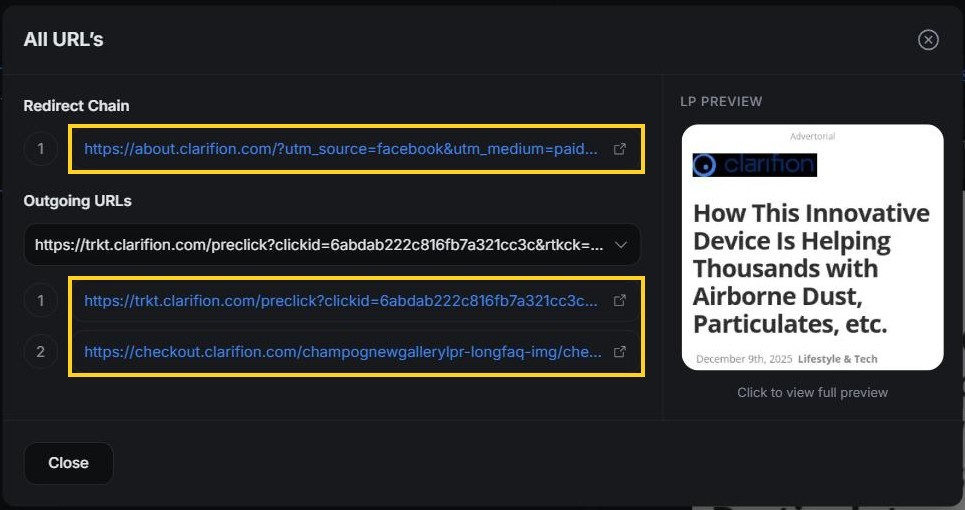
Clarifion shows what a clean direct setup looks like in practice. The brand sells plug-in air ionizers under its own name, and its ads lead straight to a pre-sell article on its own domain, with nothing in front of the page.
Redtrack shows up only on the way out: the checkout button carries the visitor through a tracking link on a Clarifion subdomain before the order page. That is the direct setup the vendors' Meta guides describe, run by a real brand rather than an affiliate. The sign that it pays: the same offer has been running since early 2025, and the brand keeps adding fresh copies instead of moving on.
Voluum still earns its place with a specific buyer: one running Meta next to several other traffic sources, who wants all of it reporting into one dashboard, on a plan that includes the Conversions API.
If Meta is your only or main traffic source, start with Redtrack.
Redtrack vs ClickFlare: Which One Fits Your Funnel?
Redtrack and ClickFlare start from the same place: both are cloud trackers billed by tracked events, and ClickFlare, like Redtrack, includes the Conversions API on every plan. The real choice between them comes down to what your funnel needs.
Lead gen is where the two meet head on, level in the data. ClickFlare's lead generation page lists what it does for these funnels: it tracks every form submission, phone call and custom event server-side, connects call tracking tools such as Ringba and Retreaver, ties each call back to the click and ad behind it, and can send only qualified leads back to Meta.
Redtrack is not a step behind here either. Redtrack's own site leads with "Affiliates & lead gen" as a headline use case, next to ecommerce and DTC brands, and lists a Shopify integration.
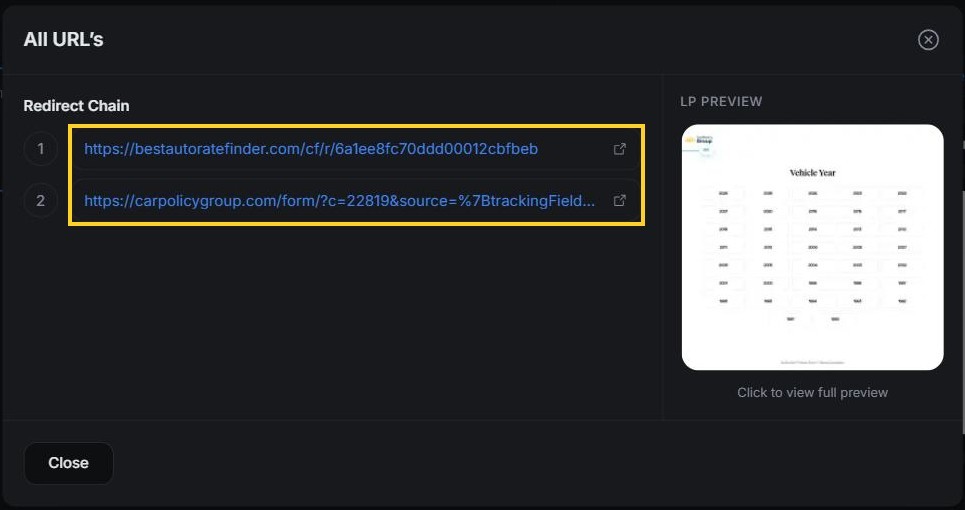
AutoPulse HQ shows what that lead gen funnel looks like in practice. It is a video pitching a lower car insurance rate, and the domain shown in the ad is not where the funnel actually lives: that address is the tracking domain, and the click runs through a ClickFlare redirect on it before landing on a quote form on a separate site, with TrustedForm and Jornaya both detected on the form. It sits in the Top bracket of AdPlexity Social's Creative Score, the rare tier for creatives scaling hardest right now, with more than a hundred new ad copies behind it in just the past week.
For lead gen, either one works, so choose on how each handles your calls and lead quality; for affiliate offers and stores, pick Redtrack; for search arbitrage, ClickFlare.
Why Do Search Arbitrage Buyers Use ClickFlare?
Search arbitrage is the one funnel where the choice is not close: on Meta, it is ClickFlare's almost by itself.
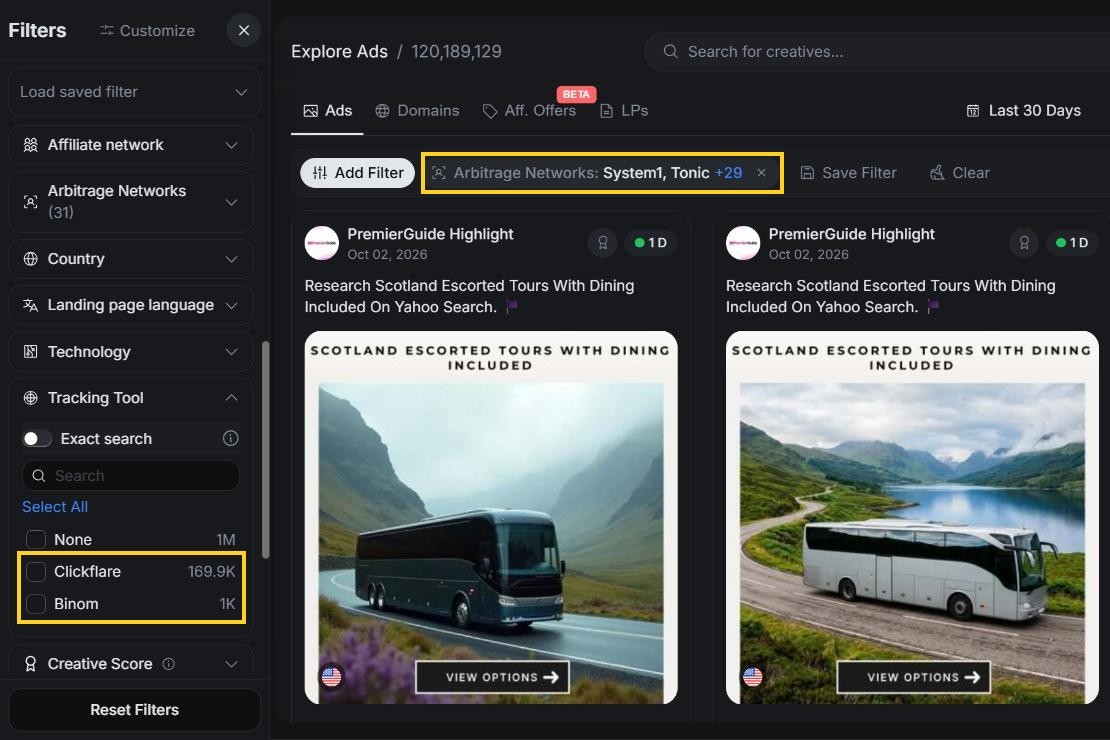
The likely reason is what ClickFlare built for this funnel. Its search arbitrage page says it pulls revenue straight from Tonic, System1, Sedo, AdSense and more, syncs cost every five minutes and shows earnings per click by keyword. Once the feed confirms the revenue, ClickFlare sends it back to Meta through the Conversions API.
For a search arbitrage buyer, that loop is the business. The money in this model comes from a visitor clicking a sponsored search result further down the funnel, not the Meta ad itself, so a tracker that cannot pull that revenue back and match it to the ad that paid for the click misses the part of the funnel that actually pays.
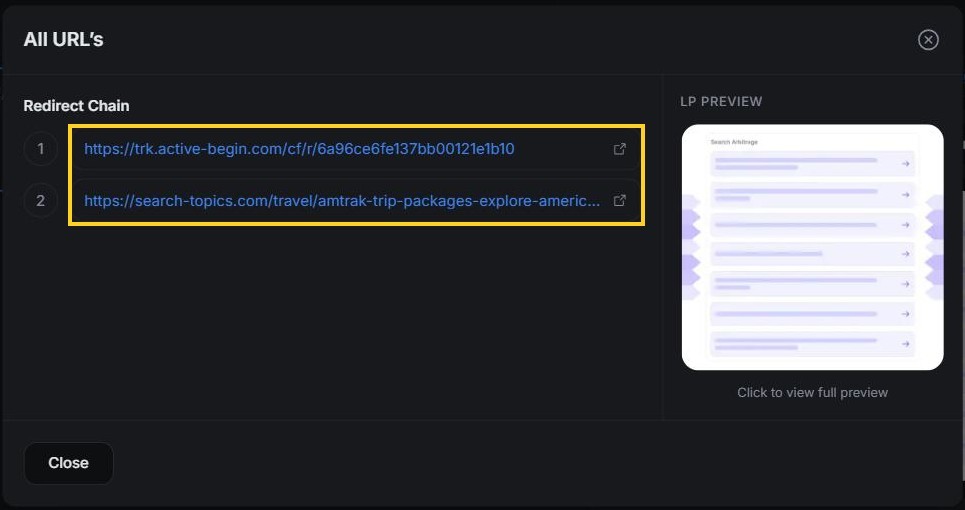
Nustar Trenz runs that loop end to end. Its ad is an Amtrak trips video, and the click passes through a ClickFlare redirect on the buyer's own tracking domain before landing on a System1 search article about Amtrak packages. The page address carries ClickFlare's own tracking fields next to the keywords the buyer is asking System1 to show, phrases such as "all-inclusive senior tours," so every paid search click can still be matched back to the Meta ad that bought the original visit. The same video has kept running since early August, spread across three separate Pages.
For how these funnels work, see what search arbitrage is, where this advertiser also appears, and the tracking patterns behind profitable RSOC ads.
Does Voluum Support the Facebook Conversions API?
Yes, Voluum supports the Facebook Conversions API, just not for everyone. Voluum's pricing page lists "Conversion API postback for major traffic platforms" as an add-on on Agency, and only Enterprise folds it into the plan by default. Profit, Scale and Start-up, the three tiers below Agency, do not get it at all.
The setup is not complicated once you are on the right plan. Per Voluum's conversion integration guide, you verify a domain, grab a pixel ID and an access token, and connect all three inside Automizer. One step matters more than the rest: turn off the Pixel Redirect URL option first, because, in Voluum's words, the goal is "to avoid sending conversions twice."
Do not confuse this with the "Advanced Facebook Integration" sitting on the same pricing page. That feature handles ad and ad set management plus cost sync, and it has nothing to do with sending conversion events to Meta.
Redtrack and ClickFlare skip this question entirely. Both include the Conversions API on their entry plan, no add-on, no upgrade.
ClickFlare vs Voluum: Which Affiliate Tracker Is Better?
The plan question alone tilts this one. ClickFlare's pricing page lists its Conversions API for Facebook, Google, TikTok, Snapchat and Reddit as "Included in every plan," and calls the policy "No plan-gating." Voluum asks you to reach Agency or Enterprise first, for the reasons above.
On Meta, the gap shows up in the data too. ClickFlare is found on far more Meta ads than Voluum, and the difference is starkest in lead gen and search arbitrage: ClickFlare is level with Redtrack in one and almost alone in the other, while Voluum barely registers in either.
Voluum's strength is the buyer running Meta alongside several other traffic sources on an Agency or Enterprise budget, with rule-based paths and Traffic Distribution AI doing the routing, although on Meta's direct tracking that automation is off, as covered above. ClickFlare fits the advertiser who just wants Meta conversions working, no tier to plan around.
For a Meta-only affiliate budget, ClickFlare is the easier call; Voluum earns its keep once several traffic sources share the account.
Binom vs ClickFlare: Self-Hosted or Cloud?
Binom is the tracker you host yourself. Binom's own site describes a product that runs on a server you rent and manage, built on PHP, MySQL and the ionCube loader, under one license that costs the same at any click volume, with no per-click fee on top. Binom Cloud sits in between, the same product hosted for you, for anyone who does not want to run a server.
Binom's Meta side is cost sync rather than a full Conversions API build. Per its Facebook integration documentation, cost pulls in every 30 minutes, matched against Meta's own ad id, and the access token needs replacing roughly every two months. The vendor keeps building on it: Binom's changelog shows a v2 Facebook integration in closed beta since May 2026, and a new release at the end of August 2026.
ClickFlare is the cloud answer to Binom's self-hosted one: no server to patch, the Conversions API included on every plan, billed by tracked events instead of a license. Binom ranks third on Meta overall, ahead of Voluum, yet it is small in every funnel type covered above.
Keitaro is the other self-hosted name worth knowing. Per its install guide, it also runs from your own VPS or VDS, sized to the clicks you expect each day, and it shows up on Meta far less than Binom in this data.
Self-hosting fits heavy click volume and someone willing to own the server, its updates and its uptime. Everyone else is better off with a cloud tracker, where the Meta setup works out of the box.
Choose Binom or Keitaro only if you are ready to run the server yourself; otherwise a cloud tracker such as ClickFlare is the simpler Meta setup.
How Do You Set Up a Tracker With the Meta Pixel and Conversions API?
These trackers all set up on Meta the same basic way, just under different names, in five moves.
Point a tracking domain at the tracker and verify it inside Meta Business Manager. Redtrack asks for a CNAME record to its own domain; Voluum needs that domain verified before its Conversions API goes live.
Skip the redirect. Put the tracker's own script directly on the landing page instead: Redtrack's Universal Script, Voluum's direct method, Binom's LP Pixel, or ClickFlare's direct tracking script, passing fbclid plus Meta's ad, ad set and campaign ids as URL parameters. Redtrack's own Meta guide is blunt about why: "fbclid parameter is required for sending the conversion data back to Meta."
Bring in the cost. Meta does not pass ad spend through a URL parameter, so trackers pull it through an API connection to the ad account instead. Redtrack's connection needs reconnecting roughly every two to three months.
Map conversions to Meta's standard events with a pixel ID and access token from Meta's Events Manager, documented in similar terms by Redtrack, Voluum and ClickFlare.
Deduplicate. Meta matches the pixel's eventID with the server event's event_id and event name inside a 48-hour window, so the same action does not turn into two conversions. ClickFlare pairs its event ID with a click and transaction identifier, Redtrack uses its own click id, and Voluum's guide says to turn off Pixel Redirect URL.
Redtrack flags two caveats: conversion data can take up to 24 hours to show up inside Meta, and Meta sometimes removes conversion events in regulated niches.
Once those five pieces are in place, a campaign reports cost and conversions in one dashboard, with nothing slowing the click down.
How Can You See Which Tracker a Competitor Uses?
Doing this by hand works, but it takes longer: click through from the ad to its landing page, open developer tools to the Network panel, and reload, watching for a script call to a domain that has nothing to do with the brand in the ad, usually the tracker loading in the background. Hovering the button before you click it often shows the same thing.
The examples earlier in this guide offer a shortcut: ClickFlare's redirect showed up as a /cf/r/ path on the advertiser's own domain in both ClickFlare funnels, and Redtrack's click link carried an rtkck parameter. Treat that as a clue to check, not a rule to expect everywhere. A fuller walkthrough on reverse-engineering a competitor's landing page funnel picks up from here, and the same mismatch, a brand name on the ad and a different domain underneath it, is the pattern behind the technical fingerprint method for finding hidden affiliate ads.
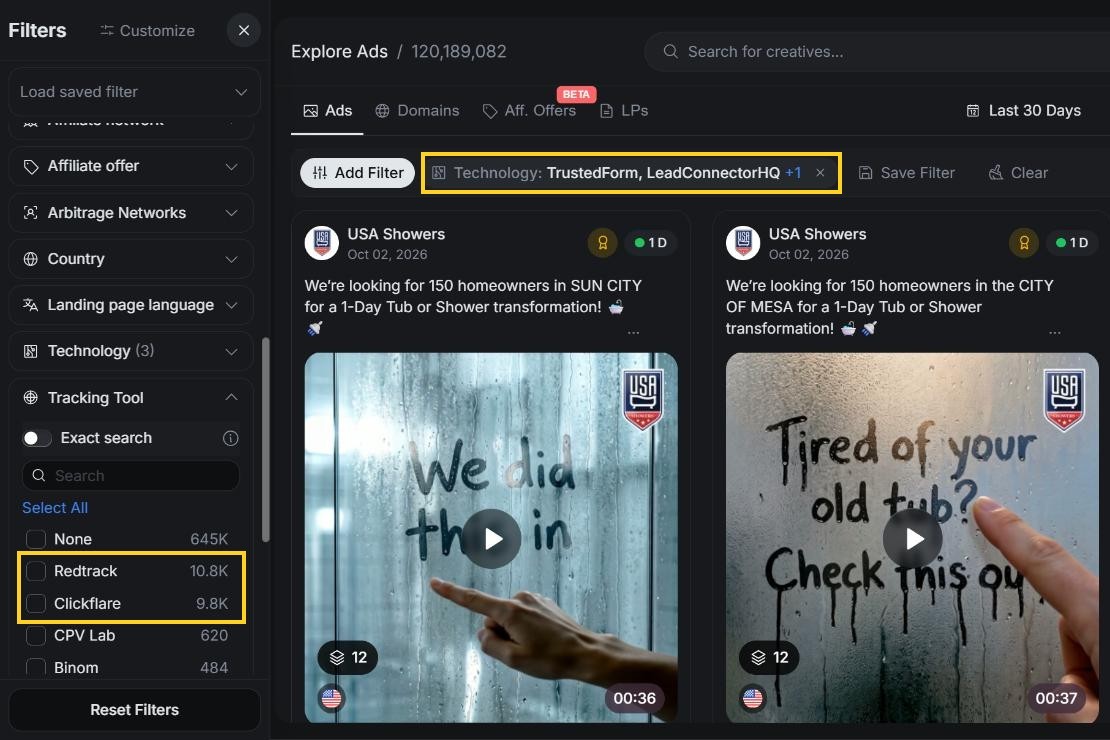
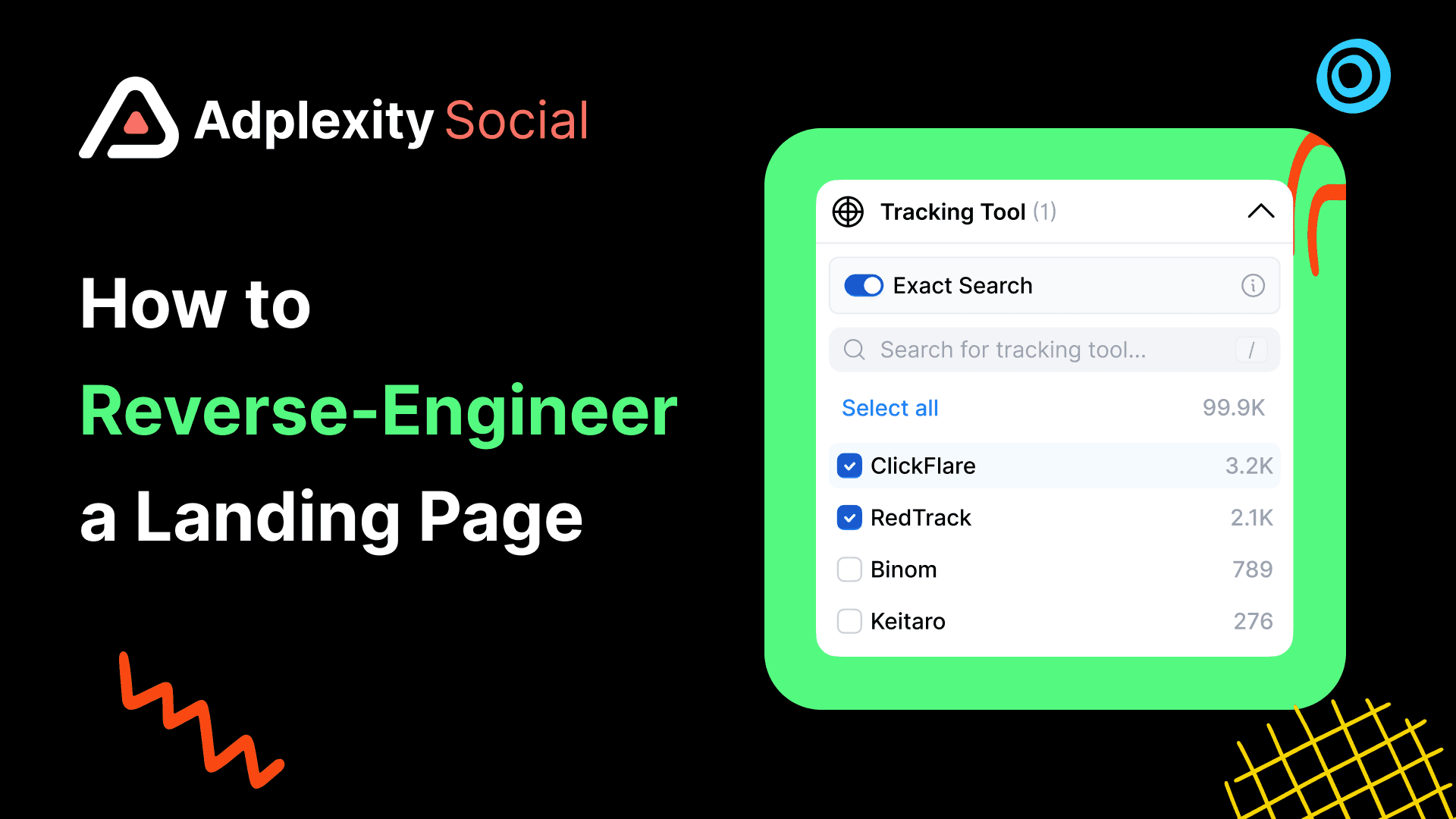
AdPlexity Social runs this same check across every ad it records, all at once. Open Explore, the Ads tab, and Add Filter on Tracking Tool, where the app's own labels read Clickflare, Redtrack, Binom, Voluum and Keitaro. Stack a second filter, Technology, Arbitrage Networks or Affiliate network, to narrow it to your own kind of funnel; how advanced filters differ between spy tools covers what else is worth stacking. Then open any ad: its details name the tracking software, and its Landing Pages tab lays out the redirect chain, the way the three funnels above show.
Save a funnel worth watching to a Board, one per tracker or per offer, so a monthly recheck shows whether the setup underneath it changed.
Frequently Asked Questions
Do you need a tracker to run affiliate offers on Facebook?
Not always. ClickBank's own server-to-server integration sends Initiate Checkout and Purchase events straight to Meta through the Conversions API, working off the fbclid on the tracking link alone. A dedicated tracker earns its cost once you run more than one offer at a time, or want spend and revenue in one report instead of scattered across accounts.
What is the best tracker for lead gen on Facebook?
Redtrack or ClickFlare. The two are close to level on Meta lead gen funnels, and nothing else comes near. Pick on how each handles what your funnel lives on: ClickFlare ties phone calls from tools such as Ringba back to the click and can send only qualified leads back to Meta, and Redtrack lists affiliates and lead gen as a headline use case.
Which tracker do search arbitrage buyers use on Meta?
ClickFlare, close to alone: Binom shows up in small amounts, and Redtrack and Voluum do not appear at all. It pulls revenue straight from feed providers such as Tonic, System1, Sedo and AdSense, shows earnings per click by keyword and sends confirmed revenue back to Meta. That matters because in search arbitrage the money comes from the search ads a visitor clicks after the Meta ad, and the tracker has to match that revenue to the ad's cost.
What is the best tracker for ClickBank offers on Facebook?
Redtrack, by a wide margin. Across ClickBank, BuyGoods and Digistore24 funnels on Meta, it runs well ahead of ClickFlare, Binom and Voluum. Its Conversions API sits on every plan, same as ClickFlare's, so the real decision is which plan tier fits your volume, not whether the integration exists at all.
Is Redtrack cheaper than Voluum?
There is no dollar figure worth printing here, since both vendors change their plans too often for a number to stay accurate. What stays steadier is the structure: Redtrack includes the Conversions API on its entry-level plan, while Voluum ties that same feature to an Agency add-on or its Enterprise tier. Check both vendors' pricing pages before deciding.
Can you use redirect tracking links in Facebook ads?
Yes, and plenty of advertisers do: the lead gen and search arbitrage funnels in this guide both click through a ClickFlare redirect on the advertiser's own domain. The vendors' Meta guides lead with direct tracking instead, a script on the landing page, which skips the extra hop and keeps fbclid on the page. On Voluum, direct tracking also switches off rule-based paths, weights and Traffic Distribution AI, so weigh what you give up either way.
Why does Meta count my conversions twice?
Usually because the browser pixel and the server-side Conversions API both reported the same action without a shared event ID. Meta matches the pixel's eventID with the server event's event_id and event name inside a 48-hour window; outside that match, both get counted separately. Each tracker has its own fix: ClickFlare's click and transaction identifier, Redtrack's own click id, or Voluum's Pixel Redirect URL setting.
Can AdPlexity Social show which tracker a competitor uses?
Yes. The Tracking Tool filter runs across every Meta ad the platform records, checking the landing page and the full redirect chain behind it. Stack it with Affiliate network, Arbitrage Networks or Technology to narrow to your own kind of funnel, then open any ad to see the tracking software it runs and, in its Landing Pages tab, the full redirect chain.
Conclusion
No single tracker wins every Meta funnel, but the split by type is clear enough to act on. Lead gen comes down to Redtrack or ClickFlare, search arbitrage runs on ClickFlare almost alone, and affiliate offers on ClickBank, BuyGoods or Digistore24 lean toward Redtrack by a wide margin, as Shopify stores do. Binom and Keitaro fit heavy click volume on your own server, and Voluum fits an agency budget running Meta alongside several other traffic sources. Sign up at adplexity.io and filter Meta ads by Tracking Tool for your own kind of funnel. AdPlexity Social indexes 100M+ Meta ads and adds 15M+ new ones every month.
Search "Redtrack vs Voluum" and you get a two-way fight. On Meta, though, the tracker found on the most ads is neither one: it is ClickFlare, with Redtrack close behind and Voluum far back.
That does not make ClickFlare the right pick for everyone. The right tracker depends on the funnel you run, and the data shows it clearly. Lead gen comes down to a near-even split between Redtrack and ClickFlare, search arbitrage runs almost entirely on ClickFlare, and affiliate offers on the big three networks, ClickBank, BuyGoods and Digistore24, run on Redtrack by a wide margin.
This guide covers which trackers Meta funnels actually run, what each one does with Meta's Conversions API, three real funnels built on Redtrack and ClickFlare, and how to check any competitor's tracker yourself.
Key takeaways. The tracker found on the most Meta ads right now is ClickFlare, with Redtrack close behind, Binom a smaller third and Voluum a distant fourth. The funnel decides which to start with: lead gen splits almost evenly between Redtrack and ClickFlare, search arbitrage runs almost entirely on ClickFlare, and affiliate offers on ClickBank, BuyGoods and Digistore24 run on Redtrack by a wide margin, with Shopify stores leaning the same way. Popularity on Meta is a starting point, but the tracker still has to handle the data your funnel produces: call quality, feed revenue or network postbacks.
Table of Contents
Which Tracker Should You Pick for Meta Ads?
Which Trackers Do Meta Advertisers Actually Use?
Redtrack vs Voluum: Which Is Better for Facebook Ads?
Redtrack vs ClickFlare: Which One Fits Your Funnel?
Why Do Search Arbitrage Buyers Use ClickFlare?
Does Voluum Support the Facebook Conversions API?
ClickFlare vs Voluum: Which Affiliate Tracker Is Better?
Binom vs ClickFlare: Self-Hosted or Cloud?
How Do You Set Up a Tracker With the Meta Pixel and Conversions API?
How Can You See Which Tracker a Competitor Uses?
Frequently Asked Questions
Conclusion
Which Tracker Should You Pick for Meta Ads?
Start with the funnel, not the brand name. Lead gen funnels mostly run on Redtrack or ClickFlare, and search arbitrage belongs on ClickFlare. Affiliate offers on the big three networks, and a branded store of your own, both point to Redtrack. Voluum and Binom fit narrower cases: several traffic sources on one agency account, or heavy click volume on a server you run yourself.
If you run | Start with | Why |
|---|---|---|
Lead gen (forms, quotes, calls) | Redtrack or ClickFlare | These two run far ahead of everything else in lead gen |
Search arbitrage | ClickFlare | It is almost the only tracker found on arbitrage funnels |
Affiliate offers on ClickBank, BuyGoods or Digistore24 | Redtrack | Their Meta funnels already run on Redtrack by a wide margin |
Your own store or brand | Redtrack | Shopify funnels on Meta lean toward it, and it connects to Shopify for store revenue |
Many traffic sources on an agency budget | Voluum, once on a plan with its Conversions API | Its automation is built for coordinating several traffic sources at once |
Heavy click volume and your own server | Binom (or Keitaro) | Binom's flat license costs the same at any click volume, on a server you run |
Popularity on Meta is a starting point, not proof. The tracker you pick still has to handle whatever data your funnel actually produces, whether that is call and lead quality, feed revenue, network postbacks or store orders.
Which Trackers Do Meta Advertisers Actually Use?
Over the last 30 days, ClickFlare is the tracker found on the most Meta ads, with Redtrack close behind, Binom third and Voluum a distant fourth.
Tracker | All Meta ads | Lead gen funnels | Search arbitrage funnels | ClickBank, BuyGoods or Digistore24 offers | Shopify funnels |
|---|---|---|---|---|---|
ClickFlare | about 453,300 | about 9,800 | about 169,900 | about 1,200 | about 1,100 |
Redtrack | about 400,000 | about 10,800 | none found | about 184,900 | about 8,800 |
Binom | about 180,600 | about 480 | about 1,000 | under 100 | about 480 |
Voluum | about 59,900 | about 40 | none found | about 6,600 | about 6,500 |
Lead gen funnels are pages with TrustedForm, Jornaya or LeadConnector detected, search arbitrage funnels are ads tagged with any arbitrage network such as System1, Tonic or Visymo, the offers column covers ads linked to ClickBank, BuyGoods or Digistore24, and Shopify funnels have Shopify detected on the landing page.
A funnel can carry two trackers, and an ad can land in two of these columns, so none of this adds up to a total. The counts show which tool a funnel runs, not which one performs better.
Lead gen is a two-tracker race: Redtrack and ClickFlare are level, and nothing else comes close. For the ads behind these funnels, see how to find top-performing lead gen ads.
Search arbitrage belongs to ClickFlare. It is almost alone there, with a little Binom, and Redtrack and Voluum do not show up at all.
Affiliate offers on ClickBank, BuyGoods and Digistore24 run on Redtrack, by a wide margin. For more on what those funnels look like, see ClickBank, BuyGoods and Digistore24 campaigns.
Shopify funnels lean Redtrack as well.
Binom lands third overall but stays small in all four funnel types above, so most of its volume sits in other kinds of funnels.
Redtrack vs Voluum: Which Is Better for Facebook Ads?
For most advertisers running their own Meta campaigns, Redtrack is the easier pick over Voluum. The Conversions API sits on every Redtrack plan, including the cheapest one, while Voluum sells that same access as an add-on on its Agency plan and includes it only on Enterprise.
The bigger difference is the setup both vendors recommend for Meta. Their Meta guides call for tracking straight from the landing page, with no redirect in front of it, passing fbclid and Meta's ad, ad set and campaign ids on the page.
Voluum's own guide to that setup says plainly what it costs: tracking this way means "you cannot use rule-based paths, weights and Traffic Distribution AI," so on Meta, Voluum's routing automation is off the table. The data shows where buyers have landed: Redtrack turns up on almost seven times as many Meta ads as Voluum.
Clarifion shows what a clean direct setup looks like in practice. The brand sells plug-in air ionizers under its own name, and its ads lead straight to a pre-sell article on its own domain, with nothing in front of the page.
Redtrack shows up only on the way out: the checkout button carries the visitor through a tracking link on a Clarifion subdomain before the order page. That is the direct setup the vendors' Meta guides describe, run by a real brand rather than an affiliate. The sign that it pays: the same offer has been running since early 2025, and the brand keeps adding fresh copies instead of moving on.
Voluum still earns its place with a specific buyer: one running Meta next to several other traffic sources, who wants all of it reporting into one dashboard, on a plan that includes the Conversions API.
If Meta is your only or main traffic source, start with Redtrack.
Redtrack vs ClickFlare: Which One Fits Your Funnel?
Redtrack and ClickFlare start from the same place: both are cloud trackers billed by tracked events, and ClickFlare, like Redtrack, includes the Conversions API on every plan. The real choice between them comes down to what your funnel needs.
Lead gen is where the two meet head on, level in the data. ClickFlare's lead generation page lists what it does for these funnels: it tracks every form submission, phone call and custom event server-side, connects call tracking tools such as Ringba and Retreaver, ties each call back to the click and ad behind it, and can send only qualified leads back to Meta.
Redtrack is not a step behind here either. Redtrack's own site leads with "Affiliates & lead gen" as a headline use case, next to ecommerce and DTC brands, and lists a Shopify integration.
AutoPulse HQ shows what that lead gen funnel looks like in practice. It is a video pitching a lower car insurance rate, and the domain shown in the ad is not where the funnel actually lives: that address is the tracking domain, and the click runs through a ClickFlare redirect on it before landing on a quote form on a separate site, with TrustedForm and Jornaya both detected on the form. It sits in the Top bracket of AdPlexity Social's Creative Score, the rare tier for creatives scaling hardest right now, with more than a hundred new ad copies behind it in just the past week.
For lead gen, either one works, so choose on how each handles your calls and lead quality; for affiliate offers and stores, pick Redtrack; for search arbitrage, ClickFlare.
Why Do Search Arbitrage Buyers Use ClickFlare?
Search arbitrage is the one funnel where the choice is not close: on Meta, it is ClickFlare's almost by itself.
The likely reason is what ClickFlare built for this funnel. Its search arbitrage page says it pulls revenue straight from Tonic, System1, Sedo, AdSense and more, syncs cost every five minutes and shows earnings per click by keyword. Once the feed confirms the revenue, ClickFlare sends it back to Meta through the Conversions API.
For a search arbitrage buyer, that loop is the business. The money in this model comes from a visitor clicking a sponsored search result further down the funnel, not the Meta ad itself, so a tracker that cannot pull that revenue back and match it to the ad that paid for the click misses the part of the funnel that actually pays.
Nustar Trenz runs that loop end to end. Its ad is an Amtrak trips video, and the click passes through a ClickFlare redirect on the buyer's own tracking domain before landing on a System1 search article about Amtrak packages. The page address carries ClickFlare's own tracking fields next to the keywords the buyer is asking System1 to show, phrases such as "all-inclusive senior tours," so every paid search click can still be matched back to the Meta ad that bought the original visit. The same video has kept running since early August, spread across three separate Pages.
For how these funnels work, see what search arbitrage is, where this advertiser also appears, and the tracking patterns behind profitable RSOC ads.
Does Voluum Support the Facebook Conversions API?
Yes, Voluum supports the Facebook Conversions API, just not for everyone. Voluum's pricing page lists "Conversion API postback for major traffic platforms" as an add-on on Agency, and only Enterprise folds it into the plan by default. Profit, Scale and Start-up, the three tiers below Agency, do not get it at all.
The setup is not complicated once you are on the right plan. Per Voluum's conversion integration guide, you verify a domain, grab a pixel ID and an access token, and connect all three inside Automizer. One step matters more than the rest: turn off the Pixel Redirect URL option first, because, in Voluum's words, the goal is "to avoid sending conversions twice."
Do not confuse this with the "Advanced Facebook Integration" sitting on the same pricing page. That feature handles ad and ad set management plus cost sync, and it has nothing to do with sending conversion events to Meta.
Redtrack and ClickFlare skip this question entirely. Both include the Conversions API on their entry plan, no add-on, no upgrade.
ClickFlare vs Voluum: Which Affiliate Tracker Is Better?
The plan question alone tilts this one. ClickFlare's pricing page lists its Conversions API for Facebook, Google, TikTok, Snapchat and Reddit as "Included in every plan," and calls the policy "No plan-gating." Voluum asks you to reach Agency or Enterprise first, for the reasons above.
On Meta, the gap shows up in the data too. ClickFlare is found on far more Meta ads than Voluum, and the difference is starkest in lead gen and search arbitrage: ClickFlare is level with Redtrack in one and almost alone in the other, while Voluum barely registers in either.
Voluum's strength is the buyer running Meta alongside several other traffic sources on an Agency or Enterprise budget, with rule-based paths and Traffic Distribution AI doing the routing, although on Meta's direct tracking that automation is off, as covered above. ClickFlare fits the advertiser who just wants Meta conversions working, no tier to plan around.
For a Meta-only affiliate budget, ClickFlare is the easier call; Voluum earns its keep once several traffic sources share the account.
Binom vs ClickFlare: Self-Hosted or Cloud?
Binom is the tracker you host yourself. Binom's own site describes a product that runs on a server you rent and manage, built on PHP, MySQL and the ionCube loader, under one license that costs the same at any click volume, with no per-click fee on top. Binom Cloud sits in between, the same product hosted for you, for anyone who does not want to run a server.
Binom's Meta side is cost sync rather than a full Conversions API build. Per its Facebook integration documentation, cost pulls in every 30 minutes, matched against Meta's own ad id, and the access token needs replacing roughly every two months. The vendor keeps building on it: Binom's changelog shows a v2 Facebook integration in closed beta since May 2026, and a new release at the end of August 2026.
ClickFlare is the cloud answer to Binom's self-hosted one: no server to patch, the Conversions API included on every plan, billed by tracked events instead of a license. Binom ranks third on Meta overall, ahead of Voluum, yet it is small in every funnel type covered above.
Keitaro is the other self-hosted name worth knowing. Per its install guide, it also runs from your own VPS or VDS, sized to the clicks you expect each day, and it shows up on Meta far less than Binom in this data.
Self-hosting fits heavy click volume and someone willing to own the server, its updates and its uptime. Everyone else is better off with a cloud tracker, where the Meta setup works out of the box.
Choose Binom or Keitaro only if you are ready to run the server yourself; otherwise a cloud tracker such as ClickFlare is the simpler Meta setup.
How Do You Set Up a Tracker With the Meta Pixel and Conversions API?
These trackers all set up on Meta the same basic way, just under different names, in five moves.
Point a tracking domain at the tracker and verify it inside Meta Business Manager. Redtrack asks for a CNAME record to its own domain; Voluum needs that domain verified before its Conversions API goes live.
Skip the redirect. Put the tracker's own script directly on the landing page instead: Redtrack's Universal Script, Voluum's direct method, Binom's LP Pixel, or ClickFlare's direct tracking script, passing fbclid plus Meta's ad, ad set and campaign ids as URL parameters. Redtrack's own Meta guide is blunt about why: "fbclid parameter is required for sending the conversion data back to Meta."
Bring in the cost. Meta does not pass ad spend through a URL parameter, so trackers pull it through an API connection to the ad account instead. Redtrack's connection needs reconnecting roughly every two to three months.
Map conversions to Meta's standard events with a pixel ID and access token from Meta's Events Manager, documented in similar terms by Redtrack, Voluum and ClickFlare.
Deduplicate. Meta matches the pixel's eventID with the server event's event_id and event name inside a 48-hour window, so the same action does not turn into two conversions. ClickFlare pairs its event ID with a click and transaction identifier, Redtrack uses its own click id, and Voluum's guide says to turn off Pixel Redirect URL.
Redtrack flags two caveats: conversion data can take up to 24 hours to show up inside Meta, and Meta sometimes removes conversion events in regulated niches.
Once those five pieces are in place, a campaign reports cost and conversions in one dashboard, with nothing slowing the click down.
How Can You See Which Tracker a Competitor Uses?
Doing this by hand works, but it takes longer: click through from the ad to its landing page, open developer tools to the Network panel, and reload, watching for a script call to a domain that has nothing to do with the brand in the ad, usually the tracker loading in the background. Hovering the button before you click it often shows the same thing.
The examples earlier in this guide offer a shortcut: ClickFlare's redirect showed up as a /cf/r/ path on the advertiser's own domain in both ClickFlare funnels, and Redtrack's click link carried an rtkck parameter. Treat that as a clue to check, not a rule to expect everywhere. A fuller walkthrough on reverse-engineering a competitor's landing page funnel picks up from here, and the same mismatch, a brand name on the ad and a different domain underneath it, is the pattern behind the technical fingerprint method for finding hidden affiliate ads.
AdPlexity Social runs this same check across every ad it records, all at once. Open Explore, the Ads tab, and Add Filter on Tracking Tool, where the app's own labels read Clickflare, Redtrack, Binom, Voluum and Keitaro. Stack a second filter, Technology, Arbitrage Networks or Affiliate network, to narrow it to your own kind of funnel; how advanced filters differ between spy tools covers what else is worth stacking. Then open any ad: its details name the tracking software, and its Landing Pages tab lays out the redirect chain, the way the three funnels above show.
Save a funnel worth watching to a Board, one per tracker or per offer, so a monthly recheck shows whether the setup underneath it changed.
Frequently Asked Questions
Do you need a tracker to run affiliate offers on Facebook?
Not always. ClickBank's own server-to-server integration sends Initiate Checkout and Purchase events straight to Meta through the Conversions API, working off the fbclid on the tracking link alone. A dedicated tracker earns its cost once you run more than one offer at a time, or want spend and revenue in one report instead of scattered across accounts.
What is the best tracker for lead gen on Facebook?
Redtrack or ClickFlare. The two are close to level on Meta lead gen funnels, and nothing else comes near. Pick on how each handles what your funnel lives on: ClickFlare ties phone calls from tools such as Ringba back to the click and can send only qualified leads back to Meta, and Redtrack lists affiliates and lead gen as a headline use case.
Which tracker do search arbitrage buyers use on Meta?
ClickFlare, close to alone: Binom shows up in small amounts, and Redtrack and Voluum do not appear at all. It pulls revenue straight from feed providers such as Tonic, System1, Sedo and AdSense, shows earnings per click by keyword and sends confirmed revenue back to Meta. That matters because in search arbitrage the money comes from the search ads a visitor clicks after the Meta ad, and the tracker has to match that revenue to the ad's cost.
What is the best tracker for ClickBank offers on Facebook?
Redtrack, by a wide margin. Across ClickBank, BuyGoods and Digistore24 funnels on Meta, it runs well ahead of ClickFlare, Binom and Voluum. Its Conversions API sits on every plan, same as ClickFlare's, so the real decision is which plan tier fits your volume, not whether the integration exists at all.
Is Redtrack cheaper than Voluum?
There is no dollar figure worth printing here, since both vendors change their plans too often for a number to stay accurate. What stays steadier is the structure: Redtrack includes the Conversions API on its entry-level plan, while Voluum ties that same feature to an Agency add-on or its Enterprise tier. Check both vendors' pricing pages before deciding.
Can you use redirect tracking links in Facebook ads?
Yes, and plenty of advertisers do: the lead gen and search arbitrage funnels in this guide both click through a ClickFlare redirect on the advertiser's own domain. The vendors' Meta guides lead with direct tracking instead, a script on the landing page, which skips the extra hop and keeps fbclid on the page. On Voluum, direct tracking also switches off rule-based paths, weights and Traffic Distribution AI, so weigh what you give up either way.
Why does Meta count my conversions twice?
Usually because the browser pixel and the server-side Conversions API both reported the same action without a shared event ID. Meta matches the pixel's eventID with the server event's event_id and event name inside a 48-hour window; outside that match, both get counted separately. Each tracker has its own fix: ClickFlare's click and transaction identifier, Redtrack's own click id, or Voluum's Pixel Redirect URL setting.
Can AdPlexity Social show which tracker a competitor uses?
Yes. The Tracking Tool filter runs across every Meta ad the platform records, checking the landing page and the full redirect chain behind it. Stack it with Affiliate network, Arbitrage Networks or Technology to narrow to your own kind of funnel, then open any ad to see the tracking software it runs and, in its Landing Pages tab, the full redirect chain.
Conclusion
No single tracker wins every Meta funnel, but the split by type is clear enough to act on. Lead gen comes down to Redtrack or ClickFlare, search arbitrage runs on ClickFlare almost alone, and affiliate offers on ClickBank, BuyGoods or Digistore24 lean toward Redtrack by a wide margin, as Shopify stores do. Binom and Keitaro fit heavy click volume on your own server, and Voluum fits an agency budget running Meta alongside several other traffic sources. Sign up at adplexity.io and filter Meta ads by Tracking Tool for your own kind of funnel. AdPlexity Social indexes 100M+ Meta ads and adds 15M+ new ones every month.
Table of Contents
Quickly navigate through the key sections of this article.
Discover Winning Meta Ads
Similar Blogs
Check related blogs
Check related blogs
Check related blogs


































Ready to See What’s Really Working on Meta?
Adplexity
Social
© Copyright 2026 All Rights Reserved
Ready to See What’s Really Working on Meta?
Adplexity
Social
© Copyright 2026 All Rights Reserved
Ready to See What’s Really Working on Meta?
Adplexity
Social
© Copyright 2026 All Rights Reserved