Can You Use Affiliate Links in Facebook Ads? The 2026 Rules

Share:

Meta's ad rules never mention affiliate links. They judge the ad, the page it opens and the offer behind it, and the FTC adds a disclosure rule of its own.
Meta's ad rules never mention affiliate links. They judge the ad, the page it opens and the offer behind it, and the FTC adds a disclosure rule of its own.
Table of Contents
Can You Use Affiliate Links in Facebook Ads?
What Do Meta's Advertising Standards Say About Affiliate Offers?
What Does an Affiliate Funnel Look Like Behind a Facebook Ad?
How Are Affiliate Funnels Structured, and What Does Each Format Need?
Do You Have to Disclose Affiliate Links in Facebook Ads?
Why Do Affiliate Ad Accounts Get Restricted, and How Do You Request a Review?
How Can You See How Other Affiliates Structure Their Funnels?
Frequently Asked Questions
Conclusion
Key takeaways. Walter's Shed Plans, a Digistore24 offer, has run on Meta since May 2025, and the landing address carrying more of its ads than any other sends the click straight to the vendor's own sales page, affiliate parameter included. Meta's rules never mention affiliate links: they judge the ad, the page it opens and the offer. "Never direct link" is network advice, not a Meta rule. In the US, the FTC wants the commission disclosed where people see the recommendation. Restrictions follow rule breaks and persistent negative feedback, and the way back is a fixed ad or a review request.
You will hear that Meta bans affiliate links, or at least direct links to an offer. Open Meta's Advertising Standards, the page Meta calls "Introduction to the Advertising Standards", and the word affiliate never appears. The only near hits are "religious affiliation" and "political affiliation". What Meta checks is the ad, the page it opens and the practices behind the offer, not the business model paying you. Look at what is running: for one long-running affiliate offer on Meta, the landing address that carries the most ads sends the click straight to the vendor's own page, as AdPlexity Social records it.
If you are an affiliate or a media buyer promoting network offers with Meta ads, this guide starts with what Meta's rules actually say, then looks at three real funnels running on Meta in October 2026 and what each funnel format has to get right. After that it covers the disclosure rule from the US Federal Trade Commission (FTC), why accounts get restricted and how to ask for a review. The funnels come from AdPlexity Social, which records Meta ads across all placements, along with the landing pages, redirect chains and affiliate networks behind them. This guide summarizes Meta's and the FTC's published rules as of October 2026. It is not legal advice, so talk to an advertising lawyer about your own funnel.
Can You Use Affiliate Links in Facebook Ads?
Yes, with conditions. Meta's Advertising Standards do not ban the affiliate model. They govern the ad, the landing page it opens and the practices behind what it promotes. Networks and vendors add their own traffic rules on top, and in the United States the FTC requires the commission to be disclosed. That makes three separate rulebooks, each written and enforced by someone different, and an affiliate ad has to answer to all of them to run and keep running.
Table A: The three rulebooks an affiliate ad answers to
Rulebook | What it covers | Where to read it | What happens when it is broken |
|---|---|---|---|
Meta | The ad, the landing page it opens and the account behind both | transparency.meta.com | Ad rejection, reduced distribution, a restricted or disabled account |
Network and vendor terms | Traffic sources, direct linking, allowed claims, disclosure | The offer's own affiliate terms | Set and enforced by each network or vendor, not Meta |
The FTC | Disclosure, honest endorsements, honest reviews and testimonials | The Endorsement Guides and the consumer reviews rule | FTC enforcement, separate from Meta's |
Affiliate offers are not a niche on Meta: in the last 30 days, AdPlexity Social tagged thousands of US Meta ads to an affiliate network, and the rows below overlap, so they are not a total.
Affiliate network | US Meta ads AdPlexity Social tagged, last 30 days |
|---|---|
BuyGoods | about 169,700 |
ClickBank | about 17,200 |
Digistore24 | about 8,700 |
GiddyUp | about 5,300 |
Read October 19, 2026, Country United States. One ad can carry more than one network tag.

With that many ads in play, you will hear one piece of advice again and again: never direct link. Where does it come from, if not from Meta? Mostly from network advice. ClickBank's own blog tells affiliates to use a bridge page, "a page between your Facebook ad and the offer page that warms up your audience and helps with Facebook Ads compliance". Its bridge page guide lists one reason for building one: to "avoid getting shut down by Google or Facebook Ads for including an affiliate marketing link or HopLink right in your ad". Both are advice, and the contracts are looser: as of October 19, 2026, the affiliate terms of ClickBank, Digistore24 and BuyGoods do not ban direct linking from Facebook ads, but each lets vendors add their own promotion rules.
The practical reason the advice keeps getting repeated is review. With a direct link, the vendor's page becomes the page Meta reviews against your ad, since review can reach an ad's associated landing page and the ad has to stay relevant to it. You do not control that page, so you cannot keep it matching your ad or put your own disclosure on it. That is a cost of direct linking, not a ban on it, and it is easier to weigh once you have read what Meta's rules say.
What Do Meta's Advertising Standards Say About Affiliate Offers?
The Advertising Standards never use the word affiliate, so there is no affiliate clause to find. Five rules decide whether an affiliate-funded ad runs: landing page review, the Relevance rule, the Prohibited commercial practices standard, the Spam standard, and whether the account counts as legitimate. Table B gives each one a row and quotes Meta where the exact words matter.
Table B: The Meta rules an affiliate funnel touches
Rule | Where Meta publishes it | What it says | Where it bites |
|---|---|---|---|
Landing page review | Advertising Standards introduction | Review "may include" an ad's images, video, text and targeting information, "as well as an ad's associated landing page or other destinations," and ads remain subject to review again after they go live | Any page in the funnel Meta can reach from the ad |
Relevance | Advertising Standards introduction | The ad must clearly represent what is advertised, every part of the ad must be relevant to the product, and the products in the ad "must match those promoted on the landing page" | A mismatch between the ad and whatever the click opens |
Prohibited commercial practices | Advertising Standards, applying the Community Standard of the same name | Bans deceptive tactics such as celebrity-bait and brand-bait scams, get-rich-quick offers and false government programs, and acts on persistent negative feedback about practices like misleading pricing, non-delivery, unauthorized charges, ignored refund policies and deceptive subscriptions | The offer itself, its claims and its checkout |
Spam | Community Standards, last revised June 2024 | Bans misleading links, deceptive redirects, trapping visitors with irrelevant pop-ups as they try to leave, pages that impersonate a known brand, and cloaking | Links, redirects, pop-ups and look-alike pages |
Account legitimacy | Advertising Standards introduction | Ad accounts must be associated with a legitimate business or individual, verification may be required, and a restricted asset cannot be used to advertise | The account and Page running the ad |
The Spam row gets specific about redirects and cloaking. In Meta's description, a deceptive redirect is a page that demands an action such as "click here" before showing the promised content and then changes domain, or that sends visitors automatically to a substantially different domain. Cloaking is "intentionally presenting different off-platform content, such as URLs or applications, to our integrity systems versus what is shown to users".
Creators get their own rule. When a creator's or publisher's content features a business partner "for an exchange of value" and runs as an ad, it must tag the partner with the branded content tool, whether or not the deal is an affiliate one.
If you have read older guides, you may remember the Unacceptable Business Practices page. It now redirects to Meta's Prohibited Commercial Practices page, the rule that covers non-delivery, ignored refund policies and deceptive subscription terms. An affiliate's buyer ends up in the vendor's checkout, so read the offer's refund and subscription terms before you promote it. That is practical advice, not a Meta requirement.
Quality sits outside the named rules, so an ad can break none of them and still perform worse. Meta says "Lower quality ads which do not necessarily violate our policies may experience impacted performance." The mechanism is the auction: Meta's ad quality guidance explains that ads with a lower quality ranking tend to cost more, which may reduce their distribution.
All of this comes from Meta's own pages, read on October 19, 2026. What it looks like in a live funnel is another matter.
What Does an Affiliate Funnel Look Like Behind a Facebook Ad?
Three funnels running on Meta in October 2026 give three different answers to one question: where does the affiliate link go? Start with the one that has no page in the middle at all.
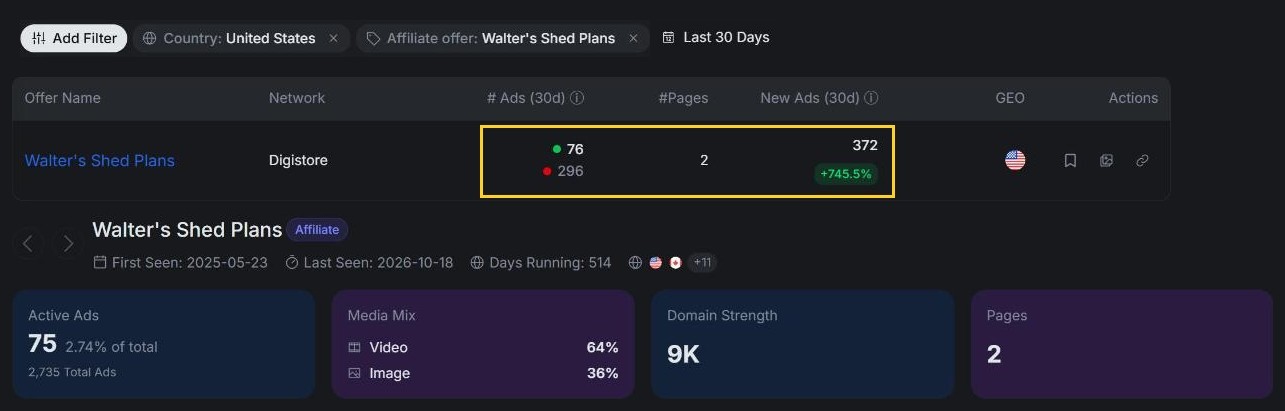
Walter's Shed Plans is a Digistore24 offer for shed building plans. AdPlexity Social first saw it on Meta on May 23, 2025, and by October 19 it had been running for 514 days. In the 30 days to October 19, AdPlexity Social recorded 372 new US ads for it, more than eight times the month before. Most of those ads run on one Page, Walter M. Smith, and the top creatives by Creative Score are video ads about building your own shed.
AdPlexity Social lists the landing addresses behind the offer, and the one carrying the most ads, 886 of them over 140 days, is the vendor's own sales page on waltershedplans.com, with an affiliate parameter in the address. That parameter carries the affiliate's ID. No page of the affiliate's sits in between, and the vendor's page runs VTurb, a video player built for sales letters. AdPlexity Social cannot tell you who runs the Page, but it does show you where the click goes.

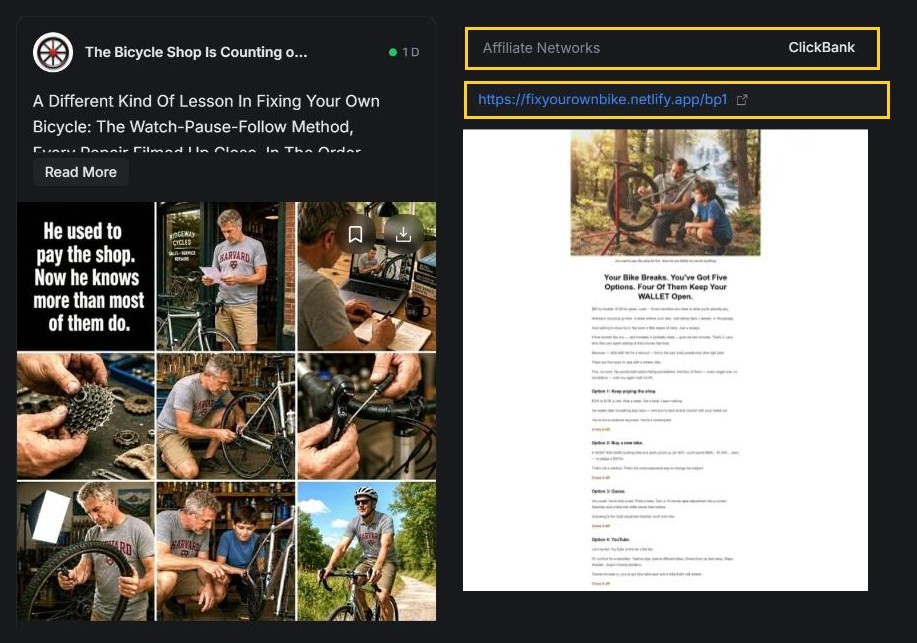
The second funnel puts a page in the middle. It is a bicycle repair video course sold through ClickBank, and its ads run on a new Page called "The Bicycle Shop Is Counting on You Not Knowing This. Time to Change That." AdPlexity Social first saw the creative on October 15, 2026, and by October 19 it had recorded 32 ads, all of them live.
The click opens fixyourownbike.netlify.app/bp1, a page on a free Netlify subdomain. It runs close to 800 words and argues its way through the options for a broken bike (keep paying the shop, buy a new bike, guess, YouTube, or be shown properly once) before it introduces the course. Its two buttons go to a ClickBank hoplink, the network's tracked affiliate link. The page closes with a line calling itself an "Independent affiliate page" that "may earn a commission if you buy through links on this page". The ad never shows the affiliate link, but a page the affiliate controls does.
The third funnel moves to physical products. GiddyUp is a network for them, and its top creative in the US by Creative Score comes from a Page called Lifed, which has 16 of the top 25 creatives on that list. The top ad reads like a magazine pitch, "Every month our editors dig through hundreds of new home products", and AdPlexity Social shows 52 ads on that creative, nearly all of them new in the last seven days.
The click lands on gadgetpicks.co, an editor-style list of 23-plus gadgets that starts with a photo backup stick. All but one of its 80 "Read more" links run through the same tracking domain, and AdPlexity Social detects Everflow, an affiliate tracking platform, behind it. The site's footer says: "This site is an affiliate of the above merchants and earns from qualifying purchases."
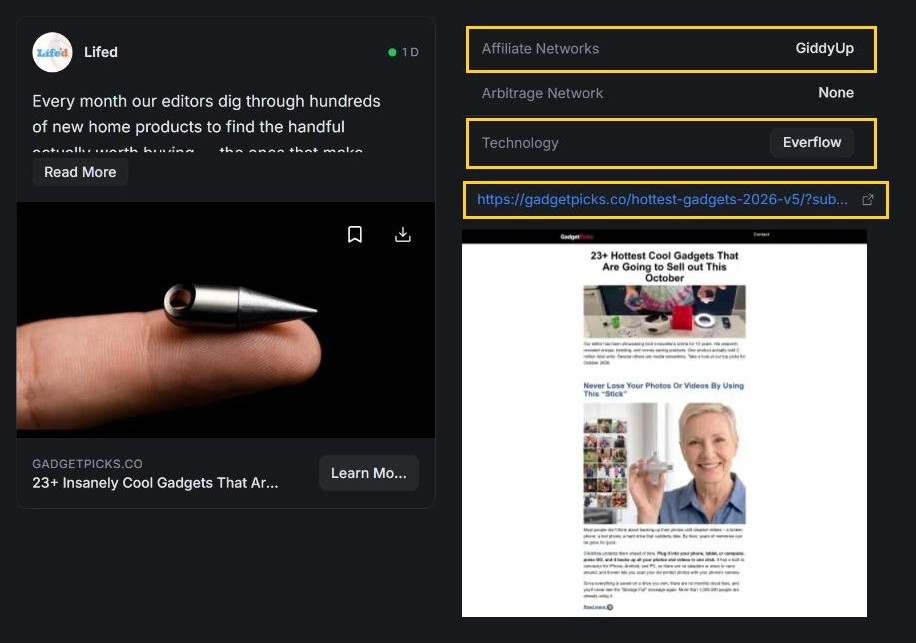
Table C: Where the affiliate link sits in three funnels
Funnel | Network | Where the click lands | Where the affiliate link sits |
|---|---|---|---|
Walter's Shed Plans | Digistore24 | The vendor's own sales page, with a VTurb video | In the landing address, as an affiliate parameter |
Bicycle repair course | ClickBank | A bridge page on a free Netlify subdomain | On the page's buttons, as a ClickBank hoplink |
Lifed's gadget list | GiddyUp | An editor-style list page | Behind the "Read more" links, almost all through one tracking domain |
Read in AdPlexity Social on October 19, 2026. Three funnels are a sample, not a survey of how every affiliate builds.
To reverse-engineer a competitor's landing page funnel for an ad you found yourself, open the ad's Landing Pages tab, where the page and its redirect chain show up.
How Are Affiliate Funnels Structured, and What Does Each Format Need?
Four funnel structures are worth telling apart, and none is automatically fine or automatically a problem. Each can meet Meta's rules and the FTC's, or miss them, depending on how it is built, and the table below shows what each one demands from you.
Table D: Four funnel structures and what each must get right
Structure | What the visitor sees | Who controls the page Meta reviews | Where the disclosure goes | Rules to check first |
|---|---|---|---|---|
Straight to the vendor's page | The vendor's own sales page or VSL | The vendor | In the ad itself, the only part you control | Relevance, landing page review, the vendor's promotion rules |
Bridge page | A page the affiliate built that gives real content before linking out | The affiliate | Near the first link to the offer | Relevance, Spam, ad quality |
Advertorial or list page | An article-style page, built by the affiliate or supplied by the vendor | Whoever built it | At the headline, labeled as an ad, and near the links | Native advertising labels, honest testimonials |
VSL | A video sales letter, usually on the vendor's own domain | Usually the vendor | Inside the video itself | Honest endorsements, checkout terms |
Straight to the Vendor's Page
This is the shortest funnel there is, the shape Walter's Shed Plans uses, where the only trace of the affiliate is the parameter in the address. Meta does not ban it. The catch is that Meta checks your ad against the vendor's page for Relevance, and you cannot change a word on that page, any disclosure included, so your ad is the only place left for yours.
The network is the other gate, and its rules are narrower than the folklore. ClickBank bars skipping the seller's pitch page. For traffic sources that restrict redirected links it now offers Direct Tracking Links, which send traffic straight to a seller's landing page instead of through the standard HopLink, though each seller can switch them off. Digistore24's US affiliate terms bar direct linking from search ads, not social ads, and require the company's express written approval before an affiliate publishes their own ad copy. Vendors can add their own rules on top, so read the offer's affiliate page before you build around a direct link.
Bridge Page
ClickBank calls it a bridge page, or presell page: a page you control between the ad and the offer, which ClickBank says "warms up your audience". The bar worth holding it to is higher: give the visitor something real before sending them on, and match what the ad promised, which is the Relevance rule in one sentence.
It has to stand on its own, so a visitor who never clicks through still leaves with something. Forcing a click before showing the promised content and then changing domain is the deceptive redirect the Spam standard describes. Skip exit pop-ups that throw something unrelated at a visitor who is leaving: the same standard calls that trapping, and Digistore24's US affiliate terms bar deceptive pop-ups and exit pop-ups too.
Thin pages can cost you even where no rule names them. Meta's ad quality guidance lists landing pages that "Lack substantive or original content", carry a "Disproportionate volume of ads relative to content", or throw pop-up or interstitial ads as signs of a low-quality landing page experience. And because you built the page, the disclosure goes near the first link to the offer, in your own words.
Advertorial or List Page
An article-style page, whether a long advertorial or a magazine-style list, still has to announce itself as an ad when it reads like editorial content. The FTC's native advertising guide names "Ad," "Advertisement," "Paid Advertisement" and "Sponsored Advertising Content" as terms people understand, and it wants the label right at the headline, above it or in front of it, not buried at the bottom. The same guide notes that the FTC has taken action against "operators of affiliate advertising networks" for helping create deceptive advertising content.
Testimonials and stories have to be real, too. The FTC's consumer reviews and testimonials rule, in force since October 21, 2024, bans writing, creating or selling a review or testimonial that misrepresents whether the person exists, whether they used the product or what they experienced. It also bars a business from spreading testimonials about its own products that it knew or should have known were fake. The rule carries civil penalties, and the FTC sent warning letters under it to ten companies in December 2025.
Meta's Prohibited commercial practices standard separately bans celebrity-bait, brand-bait and false government program claims, and Meta's review can reach the page your ad opens whether you wrote it yourself or the vendor handed it to you.
VSL
A video sales letter usually lives on the vendor's own domain, often on a player such as VTurb, the one AdPlexity Social detected behind Walter's Shed Plans. The pitch happens inside the video, so that is where the disclosure goes: the FTC's guidance for influencers says a disclosure for an endorsement made in a video "should be in the video and not just in the description". When the pitch comes in both picture and sound, the Endorsement Guides say the disclosure should appear in both. If the video belongs to the vendor, you are back to the first structure, where the ad is the only part you control.
Because a VSL usually ends at a checkout, the Prohibited commercial practices items come into play too, misleading pricing and deceptive subscriptions included. To see how these funnels look in your own niche, find winning VSL funnels on Facebook.
Do You Have to Disclose Affiliate Links in Facebook Ads?
Yes, in the United States, whenever your ad or the page behind it recommends something you earn a commission on. The FTC's Endorsement Guides treat a commission as a material connection (their own example is a blogger paid through affiliate links), and a connection a significant part of your audience would not expect has to be disclosed clearly and conspicuously. The harder part is the wording, and the FTC has been specific about it.
Table E: Disclosure wording and what the FTC says
Wording | FTC's view | Source |
|---|---|---|
"I get commissions for purchases made through links in this post" | The FTC's own suggested wording | Endorsement Guides: What People Are Asking |
"Paid link" right next to the link | Should be adequate | Endorsement Guides: What People Are Asking |
"Affiliate link" on its own | Consumers might not understand it | Endorsement Guides: What People Are Asking |
"Commissionable link" | Probably not a clear disclosure | Endorsement Guides: What People Are Asking |
A bare "Buy now" button | Would not be adequate | Endorsement Guides: What People Are Asking |
"Ad," "Advertisement" or "Sponsored" | Clear, when placed where it is hard to miss | Disclosures 101 for Social Media Influencers |
"Sp," "Spon" or "Collab" | Not clear | Disclosures 101 for Social Media Influencers |
Ordinary words fare better than trade shorthand, and placement matters as much as wording. The Guides say a disclosure on social media or the internet should be unavoidable. Their test is this: if people can see the recommendation without clicking "more" but cannot see the disclosure without it, the disclosure fails. So put it beside the recommendation or the link, not in a bio. A bridge page or an advertorial needs its own disclosure, because plenty of people land there without reading the ad that sent them.
Meta's own label covers less than it seems. Ads already carry one: "Sponsored", or "Ad" on Instagram since Meta switched the label there in March 2026. That label says one thing, that the post is an ad, not that whoever wrote it earns a commission on what it recommends. The FTC judges an ad the way a reasonable consumer reads it: if it is clear something is a paid advertisement, no extra disclosure is needed. But copy written as a personal recommendation reads as an endorsement, and the commission behind it is the connection the Guides want disclosed.
Platform tools do not settle it either. Asked whether a platform's built-in disclosure tool is enough, the FTC's answer is "Not necessarily", and it says it is always best to add your own. Meta's branded content tool only covers creator or publisher content run as an ad.
Why Do Affiliate Ad Accounts Get Restricted, and How Do You Request a Review?
Restrictions follow rule breaks, and Meta's wording leans on persistence. Meta may restrict or disable the accounts responsible, under its Prohibited commercial practices standard, when negative feedback about practices such as non-delivery or ignored refund policies persists despite warnings. The Account Integrity standard extends that to accounts, Pages or business assets that "Persistently violate our Advertising Standards" or were "Created or repurposed to evade a previous account or entity removal". The Advertising Standards also say ad accounts must be associated with a legitimate business or individual, Meta may require verification, and a restricted asset cannot be used to advertise.
Meta puts it plainly: "Helping anyone evade or circumvent our enforcement of our policies or terms of service is also prohibited." The only way back this article covers is the one Meta publishes. A rejected ad can be edited and resubmitted, and Meta reviews it as a new ad. If you believe a decision was wrong, request a review of the ad, ad account, user account, Page or Business Account in Meta Business Support Home, which Meta used to call Account Quality. You need to be an admin on the account, and Meta may ask you to confirm your identity or complete verification first.
How Can You See How Other Affiliates Structure Their Funnels?
The Meta Ad Library shows the creative and how long an ad has run, and then it stops at the click: which page opens, whether it redirects anywhere, and where the page's links go.
AdPlexity Social picks up from there. In Explore, open Ads, choose Add Filter, then Affiliate network, and you get the ads it tagged to ClickBank, BuyGoods, Digistore24, GiddyUp and others.
The Aff. Offers tab (Beta) works one level up: it lists offers with their ads over the last 30 days, their Pages and their new ads. Open an offer and you see its first seen date and its days running, plus the ads, Pages, landing pages, creatives, hooks and ad copy AdPlexity Social recorded for it.
Try it on Walter's Shed Plans: open the offer there and its Landing Pages tab shows the affiliate parameter on the address that carries the most ads.
The technical fingerprint behind a page often tells you the business model before you read a word: the tracker AdPlexity Social detects (such as Redtrack and ClickFlare), the VSL player (VTurb among them), an affiliate platform such as Everflow, and the network itself. An ad's Landing Pages tab shows the page its click opened and the redirect chain in front of it.
Reading a funnel's structure is research, but copying a claim, a testimonial or a creative wholesale is something else, and every rule above still applies to whatever you build.
To jump straight to offers already running at scale, spot top-performing affiliate campaigns on ClickBank, BuyGoods and Digistore24. Sign up at adplexity.io and open any affiliate ad to see the page behind it.
Frequently Asked Questions
Can you direct link a ClickBank product in a Facebook ad?
Meta does not ban it, and as of October 19, 2026 neither do ClickBank's affiliate terms. What they bar is skipping the seller's pitch page, and ClickBank even offers Direct Tracking Links that send traffic straight to a seller's landing page. ClickBank's own blog still recommends a bridge page and warns that a HopLink placed right in an ad risks getting shut down. With a direct link, the vendor's page is what Meta checks against your ad, and the ad is the only place left for your disclosure. Vendors can add their own promotion rules, so read the offer's affiliate page first.
Does Meta still have an Unacceptable Business Practices policy?
Not under that name. The old page now redirects to Meta's Prohibited Commercial Practices page. It covers misleading pricing, non-delivery, ignored refund policies and deceptive subscription terms, among others, and bans tactics such as celebrity-bait and get-rich-quick offers.
Do I need an affiliate disclosure if Meta already labels my ad as an ad?
Usually yes. Meta's ad label ("Sponsored", or "Ad" on Instagram) says the post is an ad, not that whoever wrote it earns a commission on what it recommends. The FTC judges by how a reasonable consumer reads your ad, and copy written as a personal recommendation reads as an endorsement, which needs its own disclosure. A bridge page or advertorial needs the disclosure again, on the page itself.
Can you do affiliate marketing on Facebook without a website?
Yes, in a limited way. An ad can point straight at the vendor's page, as the Walter's Shed Plans funnel does, and organic posts can carry a disclosed affiliate link. The trade-off is that you get no control over the page Meta checks against your ad, and the vendor's own promotion rules may restrict direct linking.
Is "affiliate link" enough as a disclosure?
Probably not. FTC guidance says consumers might not understand "affiliate link" on its own and that a bare "buy now" button would not be adequate. "Paid link" right next to the link should be adequate, and the FTC's own suggested wording is "I get commissions for purchases made through links in this post."
How do you appeal a restricted Facebook ad account?
You appeal in Meta Business Support Home, formerly Account Quality. If you believe the decision was wrong, request a review of the ad, ad account, user account, Page or Business Account. You need to be an admin, and Meta may ask you to confirm your identity or complete verification. A rejected ad can also be edited and resubmitted, and Meta reviews the edited version as a new ad.
Is it legal to run affiliate offers with Facebook ads?
Yes, affiliate marketing itself is legal. In the United States, the FTC requires a clear commission disclosure and honest endorsements, reviews and testimonials, while Meta requires that the ad, the funnel and the account behind it follow its own standards. This is a summary of published rules, not legal advice, so check anything specific to your offer with an advertising lawyer.
Does Meta's branded content tool replace an FTC disclosure?
No. The branded content tool covers creator or publisher content run as an ad, and Meta's own branded content policies still require creators to provide the disclosures the law requires. The FTC says a platform's built-in disclosure tool is not necessarily enough and that it is always best to add your own, so both may be needed at once.
Conclusion
Walter's Shed Plans sent the click straight to the vendor's page, the bicycle course sent it through a bridge page, and Lifed's gadget list sent it through a list page. AdPlexity Social saw all three running on Meta in October 2026. Whichever of them you build, the rules come down to the same three things: an ad that matches the page it opens, an offer that does not deceive anyone at any step, and a commission disclosed where people see it before they click.
Sign up at adplexity.io and open any affiliate ad you find to see the landing page behind it, the redirect chain and the network it routes to.
Table of Contents
Can You Use Affiliate Links in Facebook Ads?
What Do Meta's Advertising Standards Say About Affiliate Offers?
What Does an Affiliate Funnel Look Like Behind a Facebook Ad?
How Are Affiliate Funnels Structured, and What Does Each Format Need?
Do You Have to Disclose Affiliate Links in Facebook Ads?
Why Do Affiliate Ad Accounts Get Restricted, and How Do You Request a Review?
How Can You See How Other Affiliates Structure Their Funnels?
Frequently Asked Questions
Conclusion
Key takeaways. Walter's Shed Plans, a Digistore24 offer, has run on Meta since May 2025, and the landing address carrying more of its ads than any other sends the click straight to the vendor's own sales page, affiliate parameter included. Meta's rules never mention affiliate links: they judge the ad, the page it opens and the offer. "Never direct link" is network advice, not a Meta rule. In the US, the FTC wants the commission disclosed where people see the recommendation. Restrictions follow rule breaks and persistent negative feedback, and the way back is a fixed ad or a review request.
You will hear that Meta bans affiliate links, or at least direct links to an offer. Open Meta's Advertising Standards, the page Meta calls "Introduction to the Advertising Standards", and the word affiliate never appears. The only near hits are "religious affiliation" and "political affiliation". What Meta checks is the ad, the page it opens and the practices behind the offer, not the business model paying you. Look at what is running: for one long-running affiliate offer on Meta, the landing address that carries the most ads sends the click straight to the vendor's own page, as AdPlexity Social records it.
If you are an affiliate or a media buyer promoting network offers with Meta ads, this guide starts with what Meta's rules actually say, then looks at three real funnels running on Meta in October 2026 and what each funnel format has to get right. After that it covers the disclosure rule from the US Federal Trade Commission (FTC), why accounts get restricted and how to ask for a review. The funnels come from AdPlexity Social, which records Meta ads across all placements, along with the landing pages, redirect chains and affiliate networks behind them. This guide summarizes Meta's and the FTC's published rules as of October 2026. It is not legal advice, so talk to an advertising lawyer about your own funnel.
Can You Use Affiliate Links in Facebook Ads?
Yes, with conditions. Meta's Advertising Standards do not ban the affiliate model. They govern the ad, the landing page it opens and the practices behind what it promotes. Networks and vendors add their own traffic rules on top, and in the United States the FTC requires the commission to be disclosed. That makes three separate rulebooks, each written and enforced by someone different, and an affiliate ad has to answer to all of them to run and keep running.
Table A: The three rulebooks an affiliate ad answers to
Rulebook | What it covers | Where to read it | What happens when it is broken |
|---|---|---|---|
Meta | The ad, the landing page it opens and the account behind both | transparency.meta.com | Ad rejection, reduced distribution, a restricted or disabled account |
Network and vendor terms | Traffic sources, direct linking, allowed claims, disclosure | The offer's own affiliate terms | Set and enforced by each network or vendor, not Meta |
The FTC | Disclosure, honest endorsements, honest reviews and testimonials | The Endorsement Guides and the consumer reviews rule | FTC enforcement, separate from Meta's |
Affiliate offers are not a niche on Meta: in the last 30 days, AdPlexity Social tagged thousands of US Meta ads to an affiliate network, and the rows below overlap, so they are not a total.
Affiliate network | US Meta ads AdPlexity Social tagged, last 30 days |
|---|---|
BuyGoods | about 169,700 |
ClickBank | about 17,200 |
Digistore24 | about 8,700 |
GiddyUp | about 5,300 |
Read October 19, 2026, Country United States. One ad can carry more than one network tag.
With that many ads in play, you will hear one piece of advice again and again: never direct link. Where does it come from, if not from Meta? Mostly from network advice. ClickBank's own blog tells affiliates to use a bridge page, "a page between your Facebook ad and the offer page that warms up your audience and helps with Facebook Ads compliance". Its bridge page guide lists one reason for building one: to "avoid getting shut down by Google or Facebook Ads for including an affiliate marketing link or HopLink right in your ad". Both are advice, and the contracts are looser: as of October 19, 2026, the affiliate terms of ClickBank, Digistore24 and BuyGoods do not ban direct linking from Facebook ads, but each lets vendors add their own promotion rules.
The practical reason the advice keeps getting repeated is review. With a direct link, the vendor's page becomes the page Meta reviews against your ad, since review can reach an ad's associated landing page and the ad has to stay relevant to it. You do not control that page, so you cannot keep it matching your ad or put your own disclosure on it. That is a cost of direct linking, not a ban on it, and it is easier to weigh once you have read what Meta's rules say.
What Do Meta's Advertising Standards Say About Affiliate Offers?
The Advertising Standards never use the word affiliate, so there is no affiliate clause to find. Five rules decide whether an affiliate-funded ad runs: landing page review, the Relevance rule, the Prohibited commercial practices standard, the Spam standard, and whether the account counts as legitimate. Table B gives each one a row and quotes Meta where the exact words matter.
Table B: The Meta rules an affiliate funnel touches
Rule | Where Meta publishes it | What it says | Where it bites |
|---|---|---|---|
Landing page review | Advertising Standards introduction | Review "may include" an ad's images, video, text and targeting information, "as well as an ad's associated landing page or other destinations," and ads remain subject to review again after they go live | Any page in the funnel Meta can reach from the ad |
Relevance | Advertising Standards introduction | The ad must clearly represent what is advertised, every part of the ad must be relevant to the product, and the products in the ad "must match those promoted on the landing page" | A mismatch between the ad and whatever the click opens |
Prohibited commercial practices | Advertising Standards, applying the Community Standard of the same name | Bans deceptive tactics such as celebrity-bait and brand-bait scams, get-rich-quick offers and false government programs, and acts on persistent negative feedback about practices like misleading pricing, non-delivery, unauthorized charges, ignored refund policies and deceptive subscriptions | The offer itself, its claims and its checkout |
Spam | Community Standards, last revised June 2024 | Bans misleading links, deceptive redirects, trapping visitors with irrelevant pop-ups as they try to leave, pages that impersonate a known brand, and cloaking | Links, redirects, pop-ups and look-alike pages |
Account legitimacy | Advertising Standards introduction | Ad accounts must be associated with a legitimate business or individual, verification may be required, and a restricted asset cannot be used to advertise | The account and Page running the ad |
The Spam row gets specific about redirects and cloaking. In Meta's description, a deceptive redirect is a page that demands an action such as "click here" before showing the promised content and then changes domain, or that sends visitors automatically to a substantially different domain. Cloaking is "intentionally presenting different off-platform content, such as URLs or applications, to our integrity systems versus what is shown to users".
Creators get their own rule. When a creator's or publisher's content features a business partner "for an exchange of value" and runs as an ad, it must tag the partner with the branded content tool, whether or not the deal is an affiliate one.
If you have read older guides, you may remember the Unacceptable Business Practices page. It now redirects to Meta's Prohibited Commercial Practices page, the rule that covers non-delivery, ignored refund policies and deceptive subscription terms. An affiliate's buyer ends up in the vendor's checkout, so read the offer's refund and subscription terms before you promote it. That is practical advice, not a Meta requirement.
Quality sits outside the named rules, so an ad can break none of them and still perform worse. Meta says "Lower quality ads which do not necessarily violate our policies may experience impacted performance." The mechanism is the auction: Meta's ad quality guidance explains that ads with a lower quality ranking tend to cost more, which may reduce their distribution.
All of this comes from Meta's own pages, read on October 19, 2026. What it looks like in a live funnel is another matter.
What Does an Affiliate Funnel Look Like Behind a Facebook Ad?
Three funnels running on Meta in October 2026 give three different answers to one question: where does the affiliate link go? Start with the one that has no page in the middle at all.
Walter's Shed Plans is a Digistore24 offer for shed building plans. AdPlexity Social first saw it on Meta on May 23, 2025, and by October 19 it had been running for 514 days. In the 30 days to October 19, AdPlexity Social recorded 372 new US ads for it, more than eight times the month before. Most of those ads run on one Page, Walter M. Smith, and the top creatives by Creative Score are video ads about building your own shed.
AdPlexity Social lists the landing addresses behind the offer, and the one carrying the most ads, 886 of them over 140 days, is the vendor's own sales page on waltershedplans.com, with an affiliate parameter in the address. That parameter carries the affiliate's ID. No page of the affiliate's sits in between, and the vendor's page runs VTurb, a video player built for sales letters. AdPlexity Social cannot tell you who runs the Page, but it does show you where the click goes.
The second funnel puts a page in the middle. It is a bicycle repair video course sold through ClickBank, and its ads run on a new Page called "The Bicycle Shop Is Counting on You Not Knowing This. Time to Change That." AdPlexity Social first saw the creative on October 15, 2026, and by October 19 it had recorded 32 ads, all of them live.
The click opens fixyourownbike.netlify.app/bp1, a page on a free Netlify subdomain. It runs close to 800 words and argues its way through the options for a broken bike (keep paying the shop, buy a new bike, guess, YouTube, or be shown properly once) before it introduces the course. Its two buttons go to a ClickBank hoplink, the network's tracked affiliate link. The page closes with a line calling itself an "Independent affiliate page" that "may earn a commission if you buy through links on this page". The ad never shows the affiliate link, but a page the affiliate controls does.
The third funnel moves to physical products. GiddyUp is a network for them, and its top creative in the US by Creative Score comes from a Page called Lifed, which has 16 of the top 25 creatives on that list. The top ad reads like a magazine pitch, "Every month our editors dig through hundreds of new home products", and AdPlexity Social shows 52 ads on that creative, nearly all of them new in the last seven days.
The click lands on gadgetpicks.co, an editor-style list of 23-plus gadgets that starts with a photo backup stick. All but one of its 80 "Read more" links run through the same tracking domain, and AdPlexity Social detects Everflow, an affiliate tracking platform, behind it. The site's footer says: "This site is an affiliate of the above merchants and earns from qualifying purchases."
Table C: Where the affiliate link sits in three funnels
Funnel | Network | Where the click lands | Where the affiliate link sits |
|---|---|---|---|
Walter's Shed Plans | Digistore24 | The vendor's own sales page, with a VTurb video | In the landing address, as an affiliate parameter |
Bicycle repair course | ClickBank | A bridge page on a free Netlify subdomain | On the page's buttons, as a ClickBank hoplink |
Lifed's gadget list | GiddyUp | An editor-style list page | Behind the "Read more" links, almost all through one tracking domain |
Read in AdPlexity Social on October 19, 2026. Three funnels are a sample, not a survey of how every affiliate builds.
To reverse-engineer a competitor's landing page funnel for an ad you found yourself, open the ad's Landing Pages tab, where the page and its redirect chain show up.
How Are Affiliate Funnels Structured, and What Does Each Format Need?
Four funnel structures are worth telling apart, and none is automatically fine or automatically a problem. Each can meet Meta's rules and the FTC's, or miss them, depending on how it is built, and the table below shows what each one demands from you.
Table D: Four funnel structures and what each must get right
Structure | What the visitor sees | Who controls the page Meta reviews | Where the disclosure goes | Rules to check first |
|---|---|---|---|---|
Straight to the vendor's page | The vendor's own sales page or VSL | The vendor | In the ad itself, the only part you control | Relevance, landing page review, the vendor's promotion rules |
Bridge page | A page the affiliate built that gives real content before linking out | The affiliate | Near the first link to the offer | Relevance, Spam, ad quality |
Advertorial or list page | An article-style page, built by the affiliate or supplied by the vendor | Whoever built it | At the headline, labeled as an ad, and near the links | Native advertising labels, honest testimonials |
VSL | A video sales letter, usually on the vendor's own domain | Usually the vendor | Inside the video itself | Honest endorsements, checkout terms |
Straight to the Vendor's Page
This is the shortest funnel there is, the shape Walter's Shed Plans uses, where the only trace of the affiliate is the parameter in the address. Meta does not ban it. The catch is that Meta checks your ad against the vendor's page for Relevance, and you cannot change a word on that page, any disclosure included, so your ad is the only place left for yours.
The network is the other gate, and its rules are narrower than the folklore. ClickBank bars skipping the seller's pitch page. For traffic sources that restrict redirected links it now offers Direct Tracking Links, which send traffic straight to a seller's landing page instead of through the standard HopLink, though each seller can switch them off. Digistore24's US affiliate terms bar direct linking from search ads, not social ads, and require the company's express written approval before an affiliate publishes their own ad copy. Vendors can add their own rules on top, so read the offer's affiliate page before you build around a direct link.
Bridge Page
ClickBank calls it a bridge page, or presell page: a page you control between the ad and the offer, which ClickBank says "warms up your audience". The bar worth holding it to is higher: give the visitor something real before sending them on, and match what the ad promised, which is the Relevance rule in one sentence.
It has to stand on its own, so a visitor who never clicks through still leaves with something. Forcing a click before showing the promised content and then changing domain is the deceptive redirect the Spam standard describes. Skip exit pop-ups that throw something unrelated at a visitor who is leaving: the same standard calls that trapping, and Digistore24's US affiliate terms bar deceptive pop-ups and exit pop-ups too.
Thin pages can cost you even where no rule names them. Meta's ad quality guidance lists landing pages that "Lack substantive or original content", carry a "Disproportionate volume of ads relative to content", or throw pop-up or interstitial ads as signs of a low-quality landing page experience. And because you built the page, the disclosure goes near the first link to the offer, in your own words.
Advertorial or List Page
An article-style page, whether a long advertorial or a magazine-style list, still has to announce itself as an ad when it reads like editorial content. The FTC's native advertising guide names "Ad," "Advertisement," "Paid Advertisement" and "Sponsored Advertising Content" as terms people understand, and it wants the label right at the headline, above it or in front of it, not buried at the bottom. The same guide notes that the FTC has taken action against "operators of affiliate advertising networks" for helping create deceptive advertising content.
Testimonials and stories have to be real, too. The FTC's consumer reviews and testimonials rule, in force since October 21, 2024, bans writing, creating or selling a review or testimonial that misrepresents whether the person exists, whether they used the product or what they experienced. It also bars a business from spreading testimonials about its own products that it knew or should have known were fake. The rule carries civil penalties, and the FTC sent warning letters under it to ten companies in December 2025.
Meta's Prohibited commercial practices standard separately bans celebrity-bait, brand-bait and false government program claims, and Meta's review can reach the page your ad opens whether you wrote it yourself or the vendor handed it to you.
VSL
A video sales letter usually lives on the vendor's own domain, often on a player such as VTurb, the one AdPlexity Social detected behind Walter's Shed Plans. The pitch happens inside the video, so that is where the disclosure goes: the FTC's guidance for influencers says a disclosure for an endorsement made in a video "should be in the video and not just in the description". When the pitch comes in both picture and sound, the Endorsement Guides say the disclosure should appear in both. If the video belongs to the vendor, you are back to the first structure, where the ad is the only part you control.
Because a VSL usually ends at a checkout, the Prohibited commercial practices items come into play too, misleading pricing and deceptive subscriptions included. To see how these funnels look in your own niche, find winning VSL funnels on Facebook.
Do You Have to Disclose Affiliate Links in Facebook Ads?
Yes, in the United States, whenever your ad or the page behind it recommends something you earn a commission on. The FTC's Endorsement Guides treat a commission as a material connection (their own example is a blogger paid through affiliate links), and a connection a significant part of your audience would not expect has to be disclosed clearly and conspicuously. The harder part is the wording, and the FTC has been specific about it.
Table E: Disclosure wording and what the FTC says
Wording | FTC's view | Source |
|---|---|---|
"I get commissions for purchases made through links in this post" | The FTC's own suggested wording | Endorsement Guides: What People Are Asking |
"Paid link" right next to the link | Should be adequate | Endorsement Guides: What People Are Asking |
"Affiliate link" on its own | Consumers might not understand it | Endorsement Guides: What People Are Asking |
"Commissionable link" | Probably not a clear disclosure | Endorsement Guides: What People Are Asking |
A bare "Buy now" button | Would not be adequate | Endorsement Guides: What People Are Asking |
"Ad," "Advertisement" or "Sponsored" | Clear, when placed where it is hard to miss | Disclosures 101 for Social Media Influencers |
"Sp," "Spon" or "Collab" | Not clear | Disclosures 101 for Social Media Influencers |
Ordinary words fare better than trade shorthand, and placement matters as much as wording. The Guides say a disclosure on social media or the internet should be unavoidable. Their test is this: if people can see the recommendation without clicking "more" but cannot see the disclosure without it, the disclosure fails. So put it beside the recommendation or the link, not in a bio. A bridge page or an advertorial needs its own disclosure, because plenty of people land there without reading the ad that sent them.
Meta's own label covers less than it seems. Ads already carry one: "Sponsored", or "Ad" on Instagram since Meta switched the label there in March 2026. That label says one thing, that the post is an ad, not that whoever wrote it earns a commission on what it recommends. The FTC judges an ad the way a reasonable consumer reads it: if it is clear something is a paid advertisement, no extra disclosure is needed. But copy written as a personal recommendation reads as an endorsement, and the commission behind it is the connection the Guides want disclosed.
Platform tools do not settle it either. Asked whether a platform's built-in disclosure tool is enough, the FTC's answer is "Not necessarily", and it says it is always best to add your own. Meta's branded content tool only covers creator or publisher content run as an ad.
Why Do Affiliate Ad Accounts Get Restricted, and How Do You Request a Review?
Restrictions follow rule breaks, and Meta's wording leans on persistence. Meta may restrict or disable the accounts responsible, under its Prohibited commercial practices standard, when negative feedback about practices such as non-delivery or ignored refund policies persists despite warnings. The Account Integrity standard extends that to accounts, Pages or business assets that "Persistently violate our Advertising Standards" or were "Created or repurposed to evade a previous account or entity removal". The Advertising Standards also say ad accounts must be associated with a legitimate business or individual, Meta may require verification, and a restricted asset cannot be used to advertise.
Meta puts it plainly: "Helping anyone evade or circumvent our enforcement of our policies or terms of service is also prohibited." The only way back this article covers is the one Meta publishes. A rejected ad can be edited and resubmitted, and Meta reviews it as a new ad. If you believe a decision was wrong, request a review of the ad, ad account, user account, Page or Business Account in Meta Business Support Home, which Meta used to call Account Quality. You need to be an admin on the account, and Meta may ask you to confirm your identity or complete verification first.
How Can You See How Other Affiliates Structure Their Funnels?
The Meta Ad Library shows the creative and how long an ad has run, and then it stops at the click: which page opens, whether it redirects anywhere, and where the page's links go.
AdPlexity Social picks up from there. In Explore, open Ads, choose Add Filter, then Affiliate network, and you get the ads it tagged to ClickBank, BuyGoods, Digistore24, GiddyUp and others.
The Aff. Offers tab (Beta) works one level up: it lists offers with their ads over the last 30 days, their Pages and their new ads. Open an offer and you see its first seen date and its days running, plus the ads, Pages, landing pages, creatives, hooks and ad copy AdPlexity Social recorded for it.
Try it on Walter's Shed Plans: open the offer there and its Landing Pages tab shows the affiliate parameter on the address that carries the most ads.
The technical fingerprint behind a page often tells you the business model before you read a word: the tracker AdPlexity Social detects (such as Redtrack and ClickFlare), the VSL player (VTurb among them), an affiliate platform such as Everflow, and the network itself. An ad's Landing Pages tab shows the page its click opened and the redirect chain in front of it.
Reading a funnel's structure is research, but copying a claim, a testimonial or a creative wholesale is something else, and every rule above still applies to whatever you build.
To jump straight to offers already running at scale, spot top-performing affiliate campaigns on ClickBank, BuyGoods and Digistore24. Sign up at adplexity.io and open any affiliate ad to see the page behind it.
Frequently Asked Questions
Can you direct link a ClickBank product in a Facebook ad?
Meta does not ban it, and as of October 19, 2026 neither do ClickBank's affiliate terms. What they bar is skipping the seller's pitch page, and ClickBank even offers Direct Tracking Links that send traffic straight to a seller's landing page. ClickBank's own blog still recommends a bridge page and warns that a HopLink placed right in an ad risks getting shut down. With a direct link, the vendor's page is what Meta checks against your ad, and the ad is the only place left for your disclosure. Vendors can add their own promotion rules, so read the offer's affiliate page first.
Does Meta still have an Unacceptable Business Practices policy?
Not under that name. The old page now redirects to Meta's Prohibited Commercial Practices page. It covers misleading pricing, non-delivery, ignored refund policies and deceptive subscription terms, among others, and bans tactics such as celebrity-bait and get-rich-quick offers.
Do I need an affiliate disclosure if Meta already labels my ad as an ad?
Usually yes. Meta's ad label ("Sponsored", or "Ad" on Instagram) says the post is an ad, not that whoever wrote it earns a commission on what it recommends. The FTC judges by how a reasonable consumer reads your ad, and copy written as a personal recommendation reads as an endorsement, which needs its own disclosure. A bridge page or advertorial needs the disclosure again, on the page itself.
Can you do affiliate marketing on Facebook without a website?
Yes, in a limited way. An ad can point straight at the vendor's page, as the Walter's Shed Plans funnel does, and organic posts can carry a disclosed affiliate link. The trade-off is that you get no control over the page Meta checks against your ad, and the vendor's own promotion rules may restrict direct linking.
Is "affiliate link" enough as a disclosure?
Probably not. FTC guidance says consumers might not understand "affiliate link" on its own and that a bare "buy now" button would not be adequate. "Paid link" right next to the link should be adequate, and the FTC's own suggested wording is "I get commissions for purchases made through links in this post."
How do you appeal a restricted Facebook ad account?
You appeal in Meta Business Support Home, formerly Account Quality. If you believe the decision was wrong, request a review of the ad, ad account, user account, Page or Business Account. You need to be an admin, and Meta may ask you to confirm your identity or complete verification. A rejected ad can also be edited and resubmitted, and Meta reviews the edited version as a new ad.
Is it legal to run affiliate offers with Facebook ads?
Yes, affiliate marketing itself is legal. In the United States, the FTC requires a clear commission disclosure and honest endorsements, reviews and testimonials, while Meta requires that the ad, the funnel and the account behind it follow its own standards. This is a summary of published rules, not legal advice, so check anything specific to your offer with an advertising lawyer.
Does Meta's branded content tool replace an FTC disclosure?
No. The branded content tool covers creator or publisher content run as an ad, and Meta's own branded content policies still require creators to provide the disclosures the law requires. The FTC says a platform's built-in disclosure tool is not necessarily enough and that it is always best to add your own, so both may be needed at once.
Conclusion
Walter's Shed Plans sent the click straight to the vendor's page, the bicycle course sent it through a bridge page, and Lifed's gadget list sent it through a list page. AdPlexity Social saw all three running on Meta in October 2026. Whichever of them you build, the rules come down to the same three things: an ad that matches the page it opens, an offer that does not deceive anyone at any step, and a commission disclosed where people see it before they click.
Sign up at adplexity.io and open any affiliate ad you find to see the landing page behind it, the redirect chain and the network it routes to.
Table of Contents
Quickly navigate through the key sections of this article.
Discover Winning Meta Ads
Similar Blogs
Check related blogs
Check related blogs
Check related blogs












Ready to See What’s Really Working on Meta?
Adplexity
Social
© Copyright 2026 All Rights Reserved
Ready to See What’s Really Working on Meta?
Adplexity
Social
© Copyright 2026 All Rights Reserved
Ready to See What’s Really Working on Meta?
Adplexity
Social
© Copyright 2026 All Rights Reserved